Inspectors rarely come alone
Ontario Compliance Enforcement: The Cross-Domain View
A hospitality operator can clear one inspection and still get hit by three more, because the regulators don't share calendars. Fire, liquor, workplace safety, food, and employment enforcement all run on separate schedules, separate risk models, and separate political mandates. The operational hit comes when two or three of them land in the same month at the same location, each expecting a different manager's time for a different set of records on a different deadline.
The enforcement figures in this piece are Duty Room analysis of Ontario Newsroom conviction releases, AGCO annual reports, municipal fire service records, Toronto DineSafe open data, and ESA prosecution statistics. Coverage varies by domain: the fire conviction series reaches back to 2009, and the workplace safety series runs to May 2026.
Overlap is the default, not the exception
Ontario has five enforcement programs that can put an inspector in a restaurant, bar, or hotel. Each program runs its own inspection cycle. None of the agencies running them checks whether another regulator visited last week.
For a single-unit pub, that might mean one uncomfortable month every few years. For a multi-site operator running ten or fifteen locations across the GTA, some location is almost always mid-inspection or mid-follow-up with somebody. The aggregate management load lands as one continuous drain on the same small pool of people who also need to run service.
The combinations that hit hospitality hardest are predictable. Fire and food inspections both target the physical premises and both run on municipal schedules. AGCO inspections target licensing compliance during operating hours. When a fire order lands on the same week as a conditional DineSafe pass and an AGCO visit, one area manager is suddenly trying to source suppression system certificates, fix a handwashing station, and answer questions about a serving-area layout change. None of the three regulators knows about the other two.
The manager-hours problem
Fines get all the attention. The real cost is hours.
A fire inspector issues an order requiring documentation of suppression system testing within 14 days. That means calling the maintenance contractor, confirming the last service date, getting the certificate sent over, filing it, and scheduling the reinspection around service hours. Budget two to four hours of a manager's week, sometimes more if the contractor is slow.
The same week, an AGCO officer flags a capacity issue in the patio area. Now the same manager is pulling the original licence conditions, measuring the layout, possibly calling the AGCO registrar to confirm what's permitted, and documenting the changes. Another two to four hours.
Monday morning, an ESA investigator calls about an overtime complaint from a former employee. The manager needs to pull six months of time-and-attendance records, match them against pay stubs, and produce the employment contract. If the records aren't tidy, this alone can consume a full day.
Each of those tasks is manageable in isolation. Stacked into the same ten-day window, they pull the person responsible for floor operations into a compliance sprint. Tables still need to be served. Staff still need to be scheduled. The regulators don't coordinate, but the manager's calendar is the same calendar.
Fire plus food plus AGCO: the common trio
The combination that lands most often for hospitality is fire, food, and liquor. All three are premises-based. A 60-seat restaurant in Toronto can expect two or three food inspections a year under the public-health risk ratings, fire inspections on a municipal schedule that varies by building type and local policy, and AGCO inspections that have more than doubled in volume since 2020 (from 11,929 across the province to 27,756 in 2024-25)1. The 2024-25 total is not a like-for-like hospitality comparison: the AGCO says it conducted more than 8,800 inspections of newly licensed convenience and grocery stores that year.
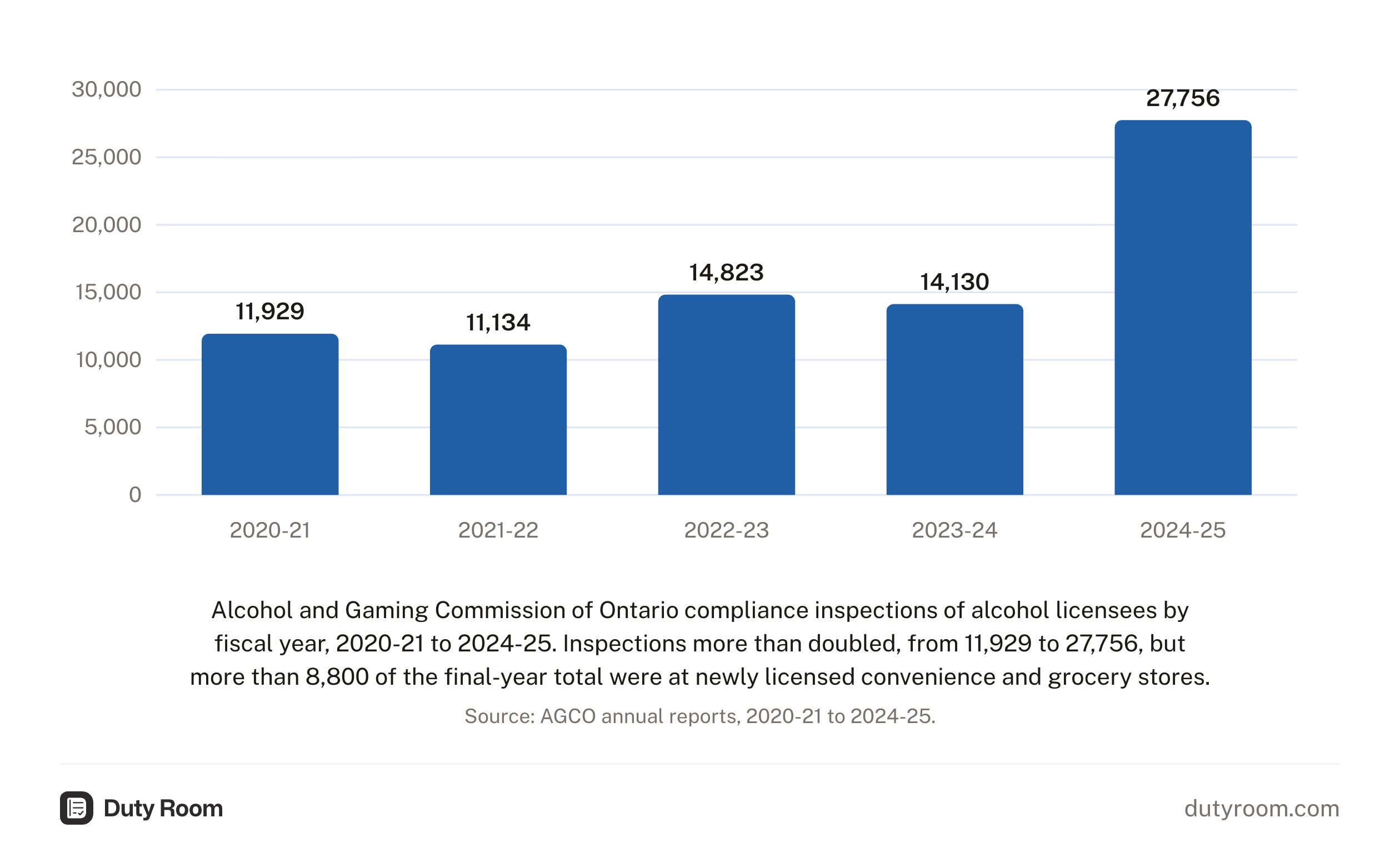
| Fiscal year | Inspections |
|---|---|
| 2020-21 | 11,929 |
| 2021-22 | 11,134 |
| 2022-23 | 14,823 |
| 2023-24 | 14,130 |
| 2024-25 | 27,756 |
The violation rates suggest how often these visits leave work behind. In 2022-23, about one in five AGCO alcohol inspections found a violation. Toronto's conditional food-inspection pass rate has climbed from 0.3% to 1.0% in three years2. Toronto Fire Services alone charged 915 property owners or occupants across 9,268 property inspections in 2024, up from 576 two years earlier. The volume of enforcement activity generating follow-up obligations is growing in most verticals at once.
And the follow-ups don't resolve on the same timeline. A DineSafe conditional pass requires a reinspection within days. A fire order typically allows 14 to 30 days. An AGCO Notice of Proposal can take months to reach a tribunal hearing. The manager tracking all three is working to three different clocks.
January 2026: new penalty powers, narrower than they sound
Two regulations took effect on the same day in January 2026: O. Reg. 260/25 gave the fire system administrative monetary penalties, and O. Reg. 365/25 did the same for OHSA. For operators, the change isn't the maximum fine. It's the shorter clock between inspection and bill. But neither new power is as broad as the matching start dates suggest.
The fire penalties are fixed and modest: $200 for a first order, $400 for a second, and $600 for a third within three years, and they only operate in municipalities that have set up the screening and hearing officers the regulation requires. An unresolved fire order used to sit in the system for months before it became expensive. A kitchen with a lapsed suppression system test can now draw a fixed penalty order in a municipality that has adopted the fire AMP system. The OHSA penalty power is narrower so far: it covers a single procurement-related contravention, and the framework lets the government add more by regulation. Paying that penalty closes off prosecution for the same contravention. A missing guard on a piece of equipment still goes through inspection orders and the courts.
The OHSA conviction data gives a sense of what the court route already costs when it gets there: the typical (median) fine has held around $80,000 across 335 convictions announced since June 2018, and 2025 was the busiest year on record, with $7.4 million in announced fines3. Fire code convictions are smaller, typically about $11,250 across 75 cases4, but they escalate steeply on repeat. One Welland property owner went from a $6,000 fine in 2022 to $287,500 in 2026 for the same building after ignoring orders. The municipal releases behind those figures do not record appeal status, and we have not verified whether the 2026 conviction is under appeal. On the fire side, AMPs won't replace prosecutions. They'll add a faster penalty layer underneath, which means more financial consequences arriving sooner, creating more follow-up obligations that compete for the same manager's time.
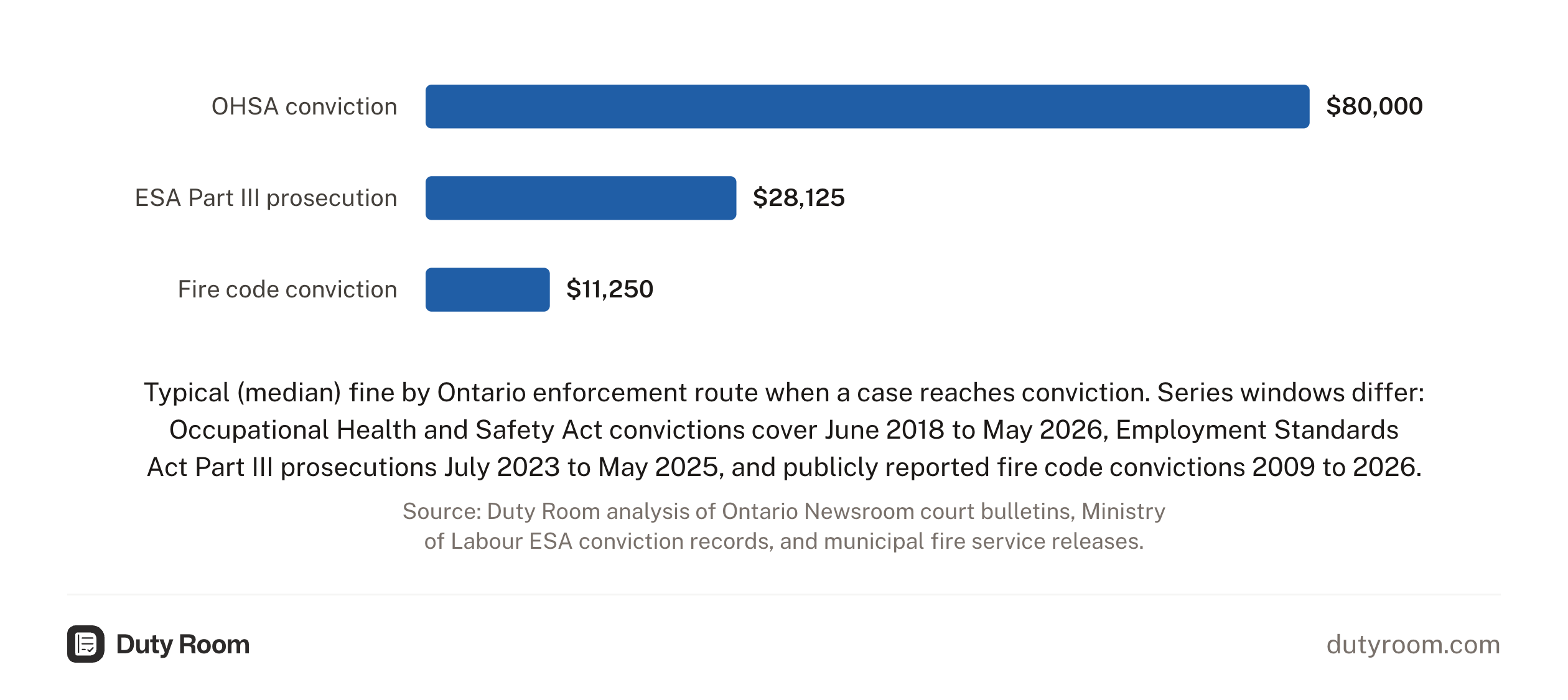
| Enforcement route | Cases with a fine | Median fine | Series window |
|---|---|---|---|
| OHSA conviction | 335 | $80,000 | June 2018 to May 2026 |
| ESA Part III prosecution | 28 | $28,125 per case | July 2023 to May 2025 |
| Fire code conviction | 75 | About $11,250 | 2009 to 2026, published amounts |
Employment standards: the complaint that arrives sideways
The other regulators show up on a schedule. The ESA investigator usually shows up because someone filed a complaint. There's no inspection cycle to anticipate. A former server files an overtime claim, and the Ministry contacts the employer.
ESA prosecutions have grown nearly fivefold since 2020, from 23 to 111 in 2024-255. Most are small-ticket record-keeping violations at $355 each. But the 28 serious prosecutions between July 2023 and May 2025 typically ended in five-figure fines per case, with the worst reaching six figures, and directors were personally fined in 46% of those cases6. For an owner-operator who is also the sole corporate director of a numbered Ontario corporation, that's personal liability, not a business expense.
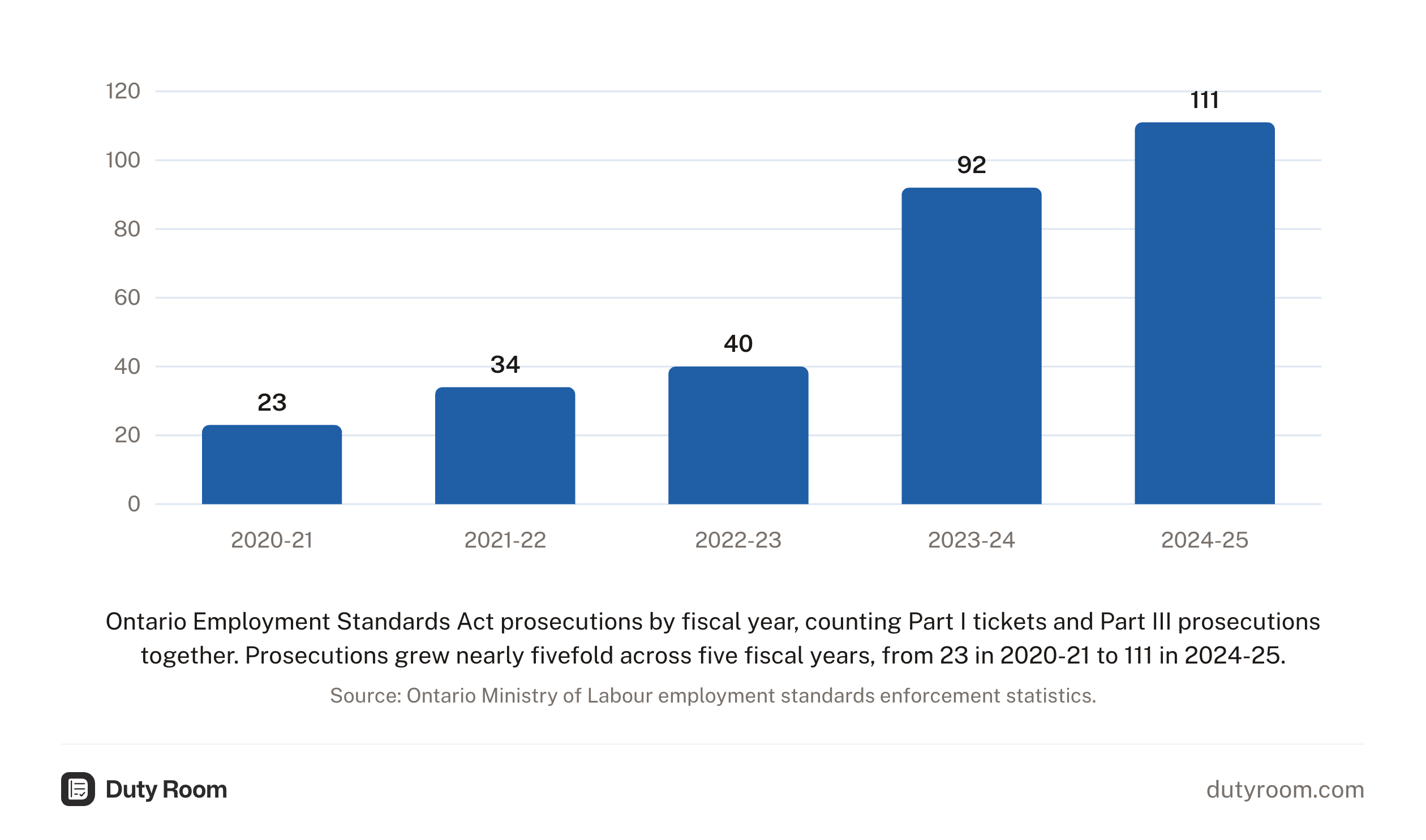
| Fiscal year | Part I tickets | Part III prosecutions | Total |
|---|---|---|---|
| 2020-21 | 21 | 2 | 23 |
| 2021-22 | 22 | 12 | 34 |
| 2022-23 | 33 | 7 | 40 |
| 2023-24 | 87 | 5 | 92 |
| 2024-25 | 99 | 12 | 111 |
What makes ESA complaints compound the overlap problem is their timing. They don't arrive during a quiet period. They arrive whenever a disgruntled employee decides to file. If that happens to coincide with a fire reinspection and an AGCO review, the same manager is now pulling time-and-attendance records while also sourcing fire suppression certificates and answering questions about patio capacity.
Counting the hours, not the fines
A $295 fire ticket doesn't close a restaurant. A $355 ESA record-keeping fine doesn't change anyone's quarter. An AGCO warning without a Notice of Proposal is just a note in a file.
Picture a Friday afternoon with a fire reinspection open, an AGCO follow-up call pending, and an ESA records request on the desk. The cost is the manager you no longer have on the floor.
For a multi-site operator, multiply that across locations. If three of your twelve restaurants are mid-follow-up with different regulators in the same month, you've effectively lost a full-time manager to compliance administration. That manager isn't running service, isn't training staff, isn't catching the next problem before an inspector does.
The regulators didn't plan it this way. They each run their own program on their own cycle. But the operator's week doesn't come in vertical slices. It comes in hours, and those hours get consumed whether the enforcement action produces a fine or just a stack of paperwork and a reinspection date.
-
Duty Room analysis of AGCO annual-report inspection volumes, 2020-21 to 2024-25: provincial inspections rose from 11,929 in 2020-21 to 27,756 in 2024-25, a 2.3x increase (+133%). More than 8,800 of the final-year inspections were of newly licensed convenience and grocery stores.
-
Duty Room analysis of Toronto DineSafe open data (96,342 inspections, June 2022 to November 2025): the conditional-pass share runs 0.3% in 2022 (partial, from June), 0.4%, 0.7%, then 1.0% in 2025 (partial, to November), a 3.3x rise across the two partial endpoint years.
-
Duty Room analysis of the Ontario Newsroom Ministry of Labour court bulletins (335 OHSA convictions carrying a fine, announced June 2018 to May 2026): the all-time median announced fine is $80,000; 2025 set records for volume (56 single-defendant convictions) and total announced fines ($7,404,000).
-
Duty Room analysis of the Ontario fire-code conviction table (75 of 80 cases carrying an explicit dollar amount, spanning 2009 to 2026): the median fine is about $11,250 and the mean about $30,800, with a minimum of $295.
-
Duty Room analysis of the Ontario Ministry of Labour ESA prosecution series, 2020-21 to 2024-25: annual prosecutions rose from 23 in 2020-21 to 111 in 2024-25 (99 Part I tickets plus 12 Part III prosecutions), a nearly fivefold increase.
-
Duty Room analysis of ESA Part III convictions (69 counts across 28 unique cases, July 2023 to May 2025): the per-case mean fine is $68,604 and the per-case median $28,125, with 15 of 28 cases in five figures and 4 reaching six figures (top case $562,500); directors were personally fined in 13 of the 28 (46%).
This report is based on published enforcement data, sources available at publication, and original analysis. It is for general information only and doesn't constitute legal advice.
Convictions become Ministry press releases.
Duty Room helps operators and their safety adviser stay aligned on policies, training, JHSC minutes, incidents, and hazard records between visits.