Fatality fines just changed
$2M Maximum and $500K Mandatory Minimums: What Ontario's New OHSA Penalties Mean
Ontario has stacked three penalty changes onto a workplace-safety system that was already expensive. The typical (median) OHSA fine was $80,000 across 269 convictions the Ministry announced between June 2018 and January 2025.1 Hospitality shows up in that record three times in seven years, and one of those three was the largest fine in it: $700,000 for a North York bakery after two worker deaths.
What changed, and when
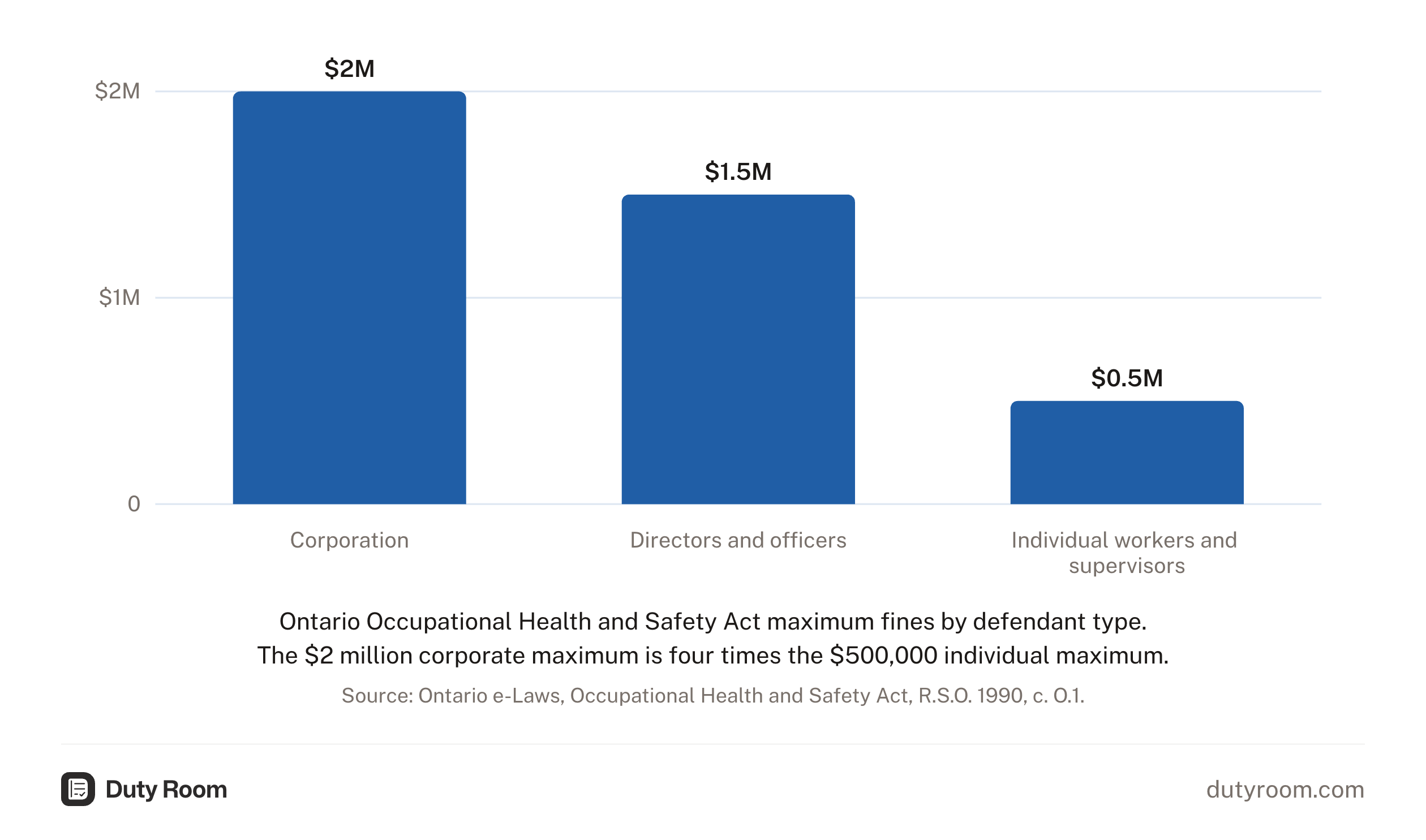
Bill 79 (Working for Workers Act, 2023) raised the maximum corporate fine from $1.5 million to $2 million per offence on October 26, 2023, keeping Ontario's maximum corporate fine the highest in Canada.
Directors and officers face up to $1.5 million and/or 12 months' imprisonment. Individual workers and supervisors face up to $500,000. Fines at this level carry a 25% victim fine surcharge on top.
| Defendant type | Maximum penalty |
|---|---|
| Corporation | $2,000,000 |
| Directors and officers | $1,500,000 |
| Individual workers and supervisors | $500,000 |
Bill 229 (Working for Workers Six Act, 2024) added a floor. A corporation convicted of a second or subsequent offence causing a death or serious injury within a two-year window now faces a mandatory minimum of $500,000. Courts previously had full sentencing discretion from zero upward. That discretion is gone for repeat serious offences.
O. Reg. 365/25 launched the administrative monetary penalties scheme on January 1, 2026. The enabling legislation (Bill 30, s. 69.1) lets inspectors issue penalties without laying a charge, with amounts set by regulation. As of July 2026, the regulation prescribes a single penalty, for one narrow procurement contravention under O. Reg. 364/25: the lesser of $100,000 or 10% of the contract value. The statutory authority exists for the government to expand the scheme to additional contraventions by regulation. The Minister may publish the names of penalized employers.
The trend was already moving before any of this passed
Fines were rising on their own. The typical conviction fine went from $80,000 in 2019 to $100,000 in 2023. Total fines announced in a year went from $4.4 million to $7.0 million over the same period.2 Courts were already treating OHSA violations more seriously before the legislature changed what courts were allowed to do.
The conviction record shows how wide sentencing discretion ran under the old rules. Goldentrust Development was fined $50,000 in 2022 after a worker's fatal fall; Resolute FP Canada was fined $500,000 in 2023 after a fatal lockout failure.3 Courts keep that discretion for a first offence. For the scenario the legislature most worried about, the floor is now $500,000 and there's nothing to negotiate.
Exposure across multi-site operations
Each location in a multi-site operation is a separate site where an inspector can arrive and find a contravention. The AMP scheme currently covers only one narrow regulation, but the statutory power exists for the government to expand it to general OHSA contraventions by regulation, and a penalty that can reach $100,000 positions it as a fast enforcement tool for ongoing non-compliance that hasn't yet caused a death.
The mandatory minimum creates a different kind of exposure. Under Bill 229, a corporation convicted of a second or subsequent offence resulting in death or serious injury within two years faces a floor of $500,000. A conviction over a serious incident at any location within the same corporate entity can trigger that mandatory minimum where a prior conviction sits inside the window.
The exposure points in bar and kitchen operations are predictable: burns and lacerations, falls from height in stockrooms and mezzanines, unguarded equipment.
The combined effect
The AMP scheme, even in its current narrow form, adds a direct monetary tool alongside inspectors' compliance orders, stop-work orders, and prosecution. The $2 million maximum raises the ceiling on what a catastrophic failure can cost. The mandatory minimum puts a floor under sentencing for repeat serious offences.
The pre-2023 enforcement picture had three soft edges for operators: most workplace deaths never produced a conviction, most fines landed well below the maximum, and courts had full discretion over the amount. Bill 79, Bill 229, and O. Reg. 365/25 have reshaped those edges. The AMP power exists and can be expanded by regulation. Repeat serious offences have a floor.
The numbers in the conviction record are largely the old regime's. The new one is stricter.
-
Duty Room analysis of 372 Ontario Ministry of Labour conviction announcements on news.ontario.ca, extracted March 2026: 269 OHSA convictions with fine amounts, announced June 2018 to January 2025. Median fine $80,000; the median is unchanged when the 15 announcements that report one combined fine for several defendants are excluded. All conviction-derived statistics in this briefing are from this analysis.
-
Year-of-announcement medians across single-defendant convictions: 44 convictions in 2019, median $80,000; 53 in 2023, median $100,000. Annual totals count every announced fine, including combined multi-defendant penalties: $4.4 million in 2019, $7.0 million in 2023.
-
Ontario Ministry of Labour court bulletins for Goldentrust Development and Resolute FP Canada.
This briefing is based on sources available at publication and is for general information only. It doesn't constitute legal advice. For advice on your specific situation, consult a qualified professional.
Convictions become Ministry press releases.
Duty Room helps operators and their safety adviser stay aligned on policies, training, JHSC minutes, incidents, and hazard records between visits.