Cases from Ontario premises
Ontario Fire Code Prosecutions and Penalties
One Welland owner went from a $6,000 fire-code conviction in 2022 to $287,500 in January 2026. Same building: fines in 2022 and 2023 didn't fix it, and the file ended with a damaged fire alarm system and compromised fire separations. That's the pattern to watch in Ontario fire-code enforcement: ignore an order, get prosecuted again, and the next fine jumps.
That case sits near the top of 80 convictions compiled from municipal press releases and news reports across Ontario between 2009 and 2026. Seventy-five include explicit fine amounts. Six documented cases ended in jail sentences1.
Most fines stay low until the facts get worse
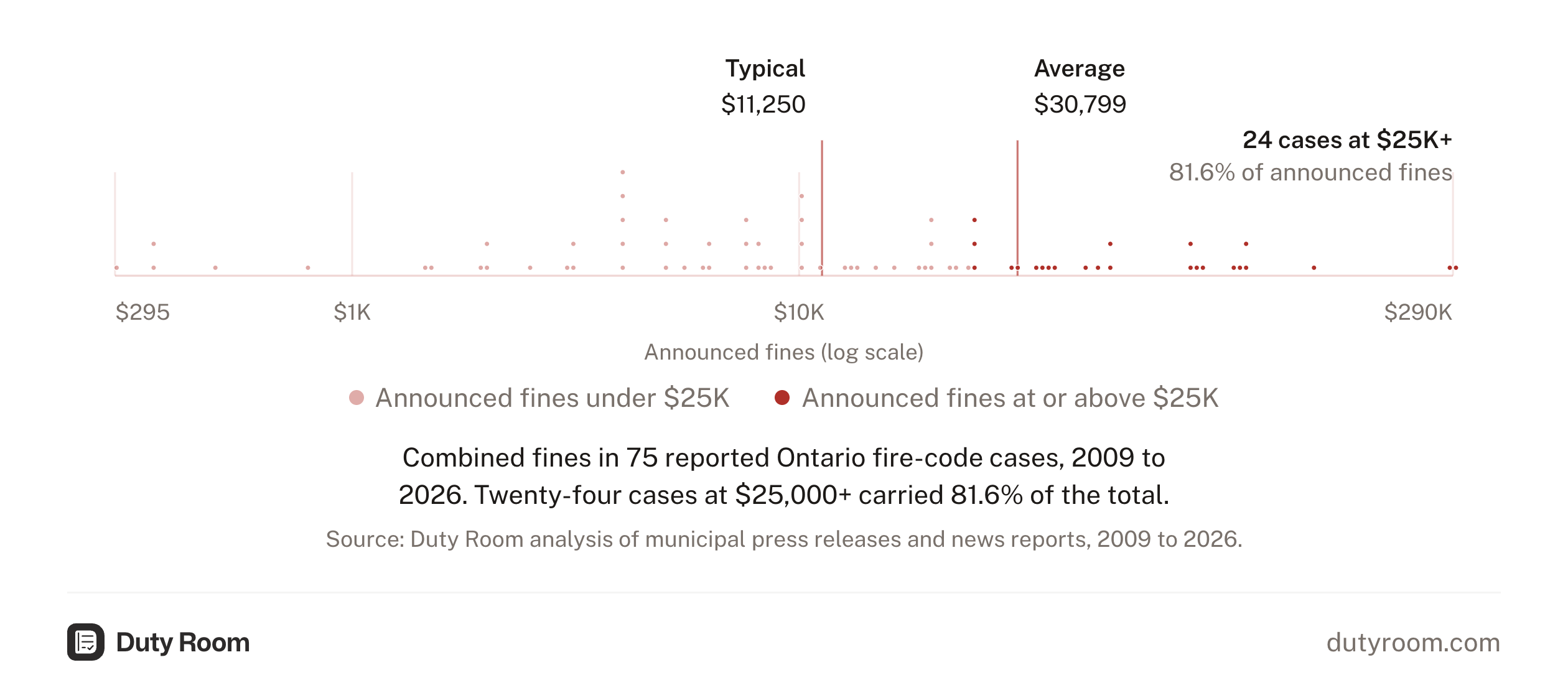
| Measure | Value | |
|---|---|---|
| Cases with explicit fines | 75 | |
| Minimum combined fine | $295 | |
| Maximum combined fine | $290,000 | |
| Median combined fine | $11,250 | |
| Average combined fine | $30,799 | |
| Cases at $25 | 000 or more | 24 of 75 (32.0%) |
| Share of announced fines in those 24 cases | 81.6% |
Duty Room analysis of 80 Ontario fire code convictions compiled from municipal press releases and news reports, 2009 to 2026.
The $11,250 median is pulled down by a long run of smoke-alarm and CO-alarm cases in the $500 to $20,000 range. Once a fatal fire or repeat offence enters the file, the numbers jump. Fatal fires, repeat offenders, and multi-unit properties regularly produce fines of $25,000 to $100,000 or more.
The $290,000 maximum came from an illegal rooming house at 244 Gladstone Ave in Toronto, where a fire critically injured two people. With $70,000 in court costs on top, the owner paid $360,000 in total.
The escalation pattern
Welland's record is not one case climbing a penalty ladder. It spans multiple properties and operators. The pattern is in the type of file: alarm and inspection-order cases stayed below $50,000, while one cumulative case reached $287,500 after earlier fines at the same building failed to change worsening conditions. Repeated enforcement, not the calendar, is what made that case expensive.
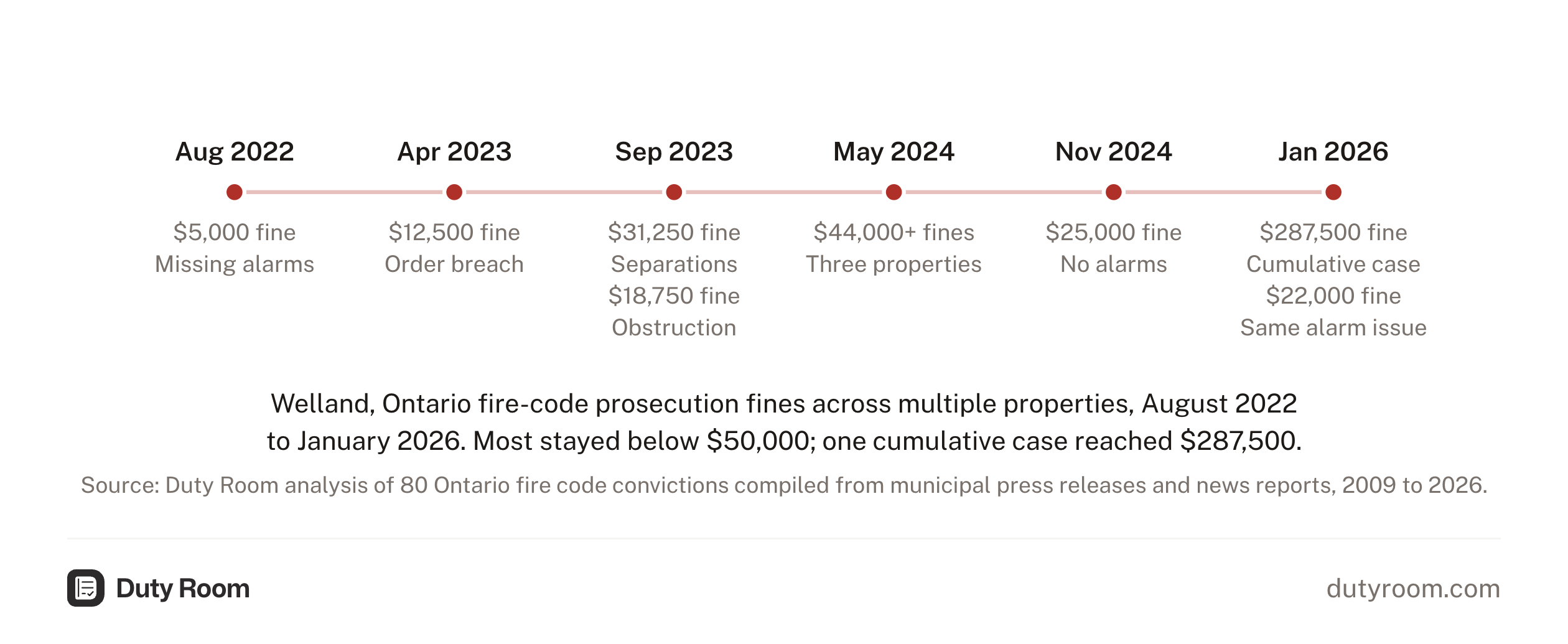
| Date | Fine | Basis |
|---|---|---|
| Aug 2022 | $5,000 | Missing smoke and CO alarms |
| Apr 2023 | $12,500 | Same property, failing to comply with an inspection order |
| Sep 2023 | $31,250 | Different property, fire separations and inoperable alarms |
| Sep 2023 | $18,750 | Obstructing fire marshal assistant |
| May 2024 | $44,000+ | Across three properties |
| Nov 2024 | $25,000 | No smoke or CO alarms after a fire |
| Jan 2026 | $287,500 | The cumulative case |
| Jan 2026 | $22,000 | Different property, same fire alarm issues |
Port Colborne shows the same severity jump on a smaller scale: its routine fines sit in the low thousands, but a fatal fire that killed four people at 53 Nickel St produced a $100,000 fine.
Six people went to jail
Six documented Ontario cases ended in jail sentences, four of them inside this dataset2:
| Defendant | Location | Sentence | Context |
|---|---|---|---|
| R v. Singh | Ontario | 3 years | Criminal Code prosecution arising from fire code failures at a rental property (2015 ONCA 855) |
| Stephen Birch | Hamilton | 135 days | 4th conviction for fire code violations at lodging houses |
| Unnamed owner | Sault Ste. Marie | 90 days | 9 offences: fire separations, safety plan, wiring, HVAC, drills, CO alarms |
| Hung Viet Le | Guelph | 50 days | Fatal fire killed 2 women; no smoke detectors |
| Luciano Brancalion | Hamilton | 14 days | Fatal house fire; no smoke alarms in hallways |
| Sean Paul Cowling | Peterborough | 7 days | Repeat offender; rooming house lacking required exits |
The 3-year sentence is the outlier. Most jail terms cluster around two triggers: repeat breaches and fatal fires.
Public convictions capture a fraction of enforcement
The 80 cases in this data are the ones that made it into news coverage or municipal press releases. The actual enforcement volume is far larger.
Toronto alone charged 915 property owners or occupants and inspected 9,268 properties in 2024. Mississauga logged more than 17,000 inspections the same year. Most of that activity never becomes a public conviction.
Most fire-code enforcement stops earlier than prosecution, at orders and follow-up visits. The convictions emerge when those earlier steps fail.
Where the cases concentrate
Rooming houses and multi-unit rental properties dominate the conviction data. The pattern is consistent: an owner converts a single-family home into multiple rental units, skips the fire code upgrades required for the new occupancy type, and gets caught when a complaint, a fire, or a routine inspection reveals the gaps.
Toronto, Hamilton, Welland, Port Colborne, Sault Ste. Marie, and the Niagara Region produce the most cases3. These are municipalities with active fire prevention divisions and enough enforcement resources to follow through from inspection to prosecution. The absence of cases from other municipalities likely reflects enforcement capacity, not compliance.
Restaurants and bars appear in the data too. A Hamilton restaurant (Rannush Grill) was fined $10,000 for failing to inspect and test its suppression system and emergency lighting. An Italian restaurant and bar (Ora Italian Grill) in Hamilton received $4,000 for overcrowding, obstructed exits, and combustible materials near a fire escape. A Brantford gentlemen's club paid $4,000 for uninspected fire extinguishers, alarm systems, and kitchen ventilation.
The cost beyond the fine
Fines over $1,000 attract a mandatory 25% victim fine surcharge. A $50,000 fine becomes $62,500. Smaller fines carry fixed surcharges under the same regulation. Court costs typically add $1,000 to $5,000. In one Toronto case (96 Rivalda Dr), the owner paid $93,000 in fines plus $137,000 in cost recovery for chemical removal.
Civil liability adds another layer. A $1.3 million civil judgment was awarded against a Toronto rooming house owner after a tenant died in a fire. Insurance implications, business interruption from closure orders, and probation conditions that can prohibit managing rental properties all compound the financial exposure.
Fire protection service companies face prosecution too. Advanced Detection Technologies Corp, York Fire Protection, and the man who operated both were fined $77,500 in total for not properly inspecting and testing fire protection systems. The prosecution reached beyond the building owner to the company hired to maintain compliance.
New enforcement tool: AMPs from January 2026
From January 2026, municipalities that adopt AMPs under Ontario Regulation 260/25 can fine routine fire-code failures without waiting for prosecution. The fire-code AMP briefing covers the order and review process. Not all municipalities have adopted them yet, but the tool is available province-wide.
The AMP amounts are modest and fixed: $200 for a first order, $400 for a second, and $600 for a third within three years. The heavy penalties still come through prosecution: corporate fines reach $1.5 million for a repeat offence, and ignoring an inspection order costs up to $20,000 for every day it goes unaddressed. Set fines for smoke alarm and CO alarm tickets run $195 to $295. Our Ontario fire safety resources cover the recurring inspection records that keep files from reaching this stage.
-
Duty Room analysis of the 80 Ontario fire code convictions compiled from municipal press releases and news reports, March 2009 to February 2026: 75 of the 80 cases carry an explicit fine amount, and 6 ended in a jail sentence. The compilation counts convictions reported in public sources, so it is a floor on actual enforcement.
-
Duty Room analysis of the Ontario fire code convictions: of the 6 documented jail sentences, 4 sit inside the 80-case compilation; the other 2 (the R v. Singh and Stephen Birch sentences) come from outside it.
-
Duty Room analysis of the Ontario fire code convictions, tallied by municipality: Welland (12), Hamilton (about 12), Toronto (about 12), the St. Catharines and Niagara Falls part of the Niagara Region (about 8), Port Colborne (7), and Sault Ste. Marie (3) lead the distribution.
This report is based on published enforcement data, sources available at publication, and original analysis. It is for general information only and doesn't constitute legal advice.
Your consultant sets the actions. Your team keeps the evidence.
Keep Ontario fire safety checks, service reports, and plan reviews in one place. Your team and fire safety consultant see the same record.