The Totals Keep Climbing
Ontario Workplace Safety Fines: 356 Cases, $41 Million
Ontario's 2025 workplace-safety court bulletins announced $7.4 million in fines, the highest annual total in our June 2018–September 2026 sample. The typical fine among single-defendant announcements moved far less: $82,500 across the full year, close to the $80,000 it has centred on since 2018. The tables below cover 356 fine-bearing case announcements under the Occupational Health and Safety Act (OHSA), totalling $41.0 million1. One case here is one bulletin, which may combine fines for several defendants; it is not a count of individual convictions or deaths.
Fatality cases carry larger fines
The median fine in fatality announcements is nearly twice that in the critical-injury group.
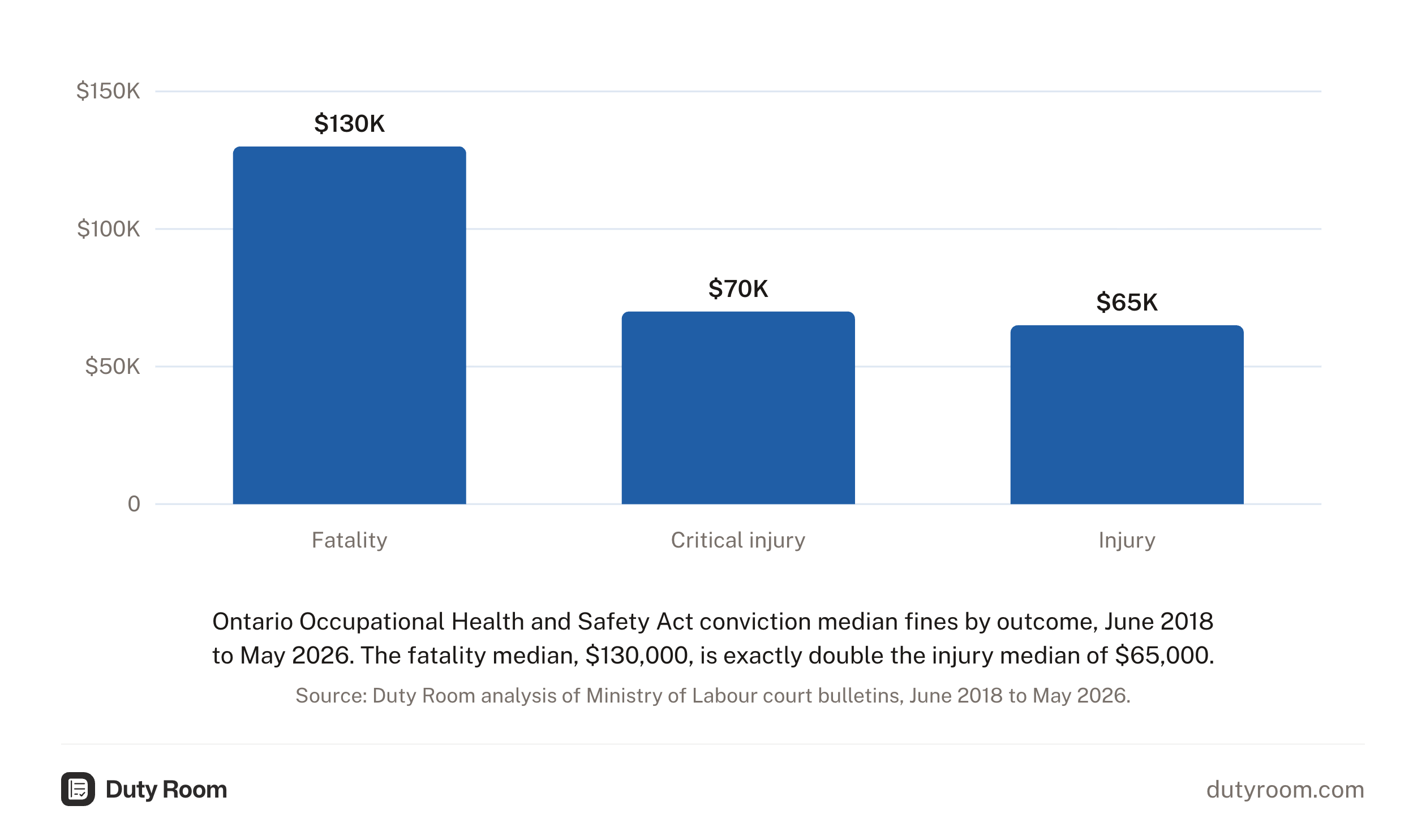
| Outcome group | Announcements | Typical fine (median) | Average fine (mean) |
|---|---|---|---|
| Fatality | 115 | $135,000 | $174,283 |
| Critical-injury tag | 142 | $70,000 | $91,046 |
| Other reported injury | 96 | $70,000 | $81,115 |
| Outcome unstated | 3 | $80,000 | $66,667 |
Of the 356 announcements, 115 involved a worker's death, roughly a third of the sample. The $135,000 typical (median) fine in that group is nearly double the $70,000 in the critical-injury group2. The timeline after a death is covered in our workplace fatality briefing.
These groups follow the bulletin descriptions and the dataset's keyword tags, not a fresh medical or legal assessment of each injury. "Other reported injury" does not establish that the injury was legally non-critical. Not every conviction gets a court bulletin, and this sample cannot show how often an injury or death leads to prosecution.
The Ontario Auditor General's 2019 workplace safety audit cited a 2017 Ministry pilot in which 48% of sampled critical-injury claims (33 of 69) were not reported to the Ministry as required3. That finding concerns a particular sample, but it shows why a prosecution record cannot stand in for an injury record.
Construction and manufacturing account for two-thirds of fines
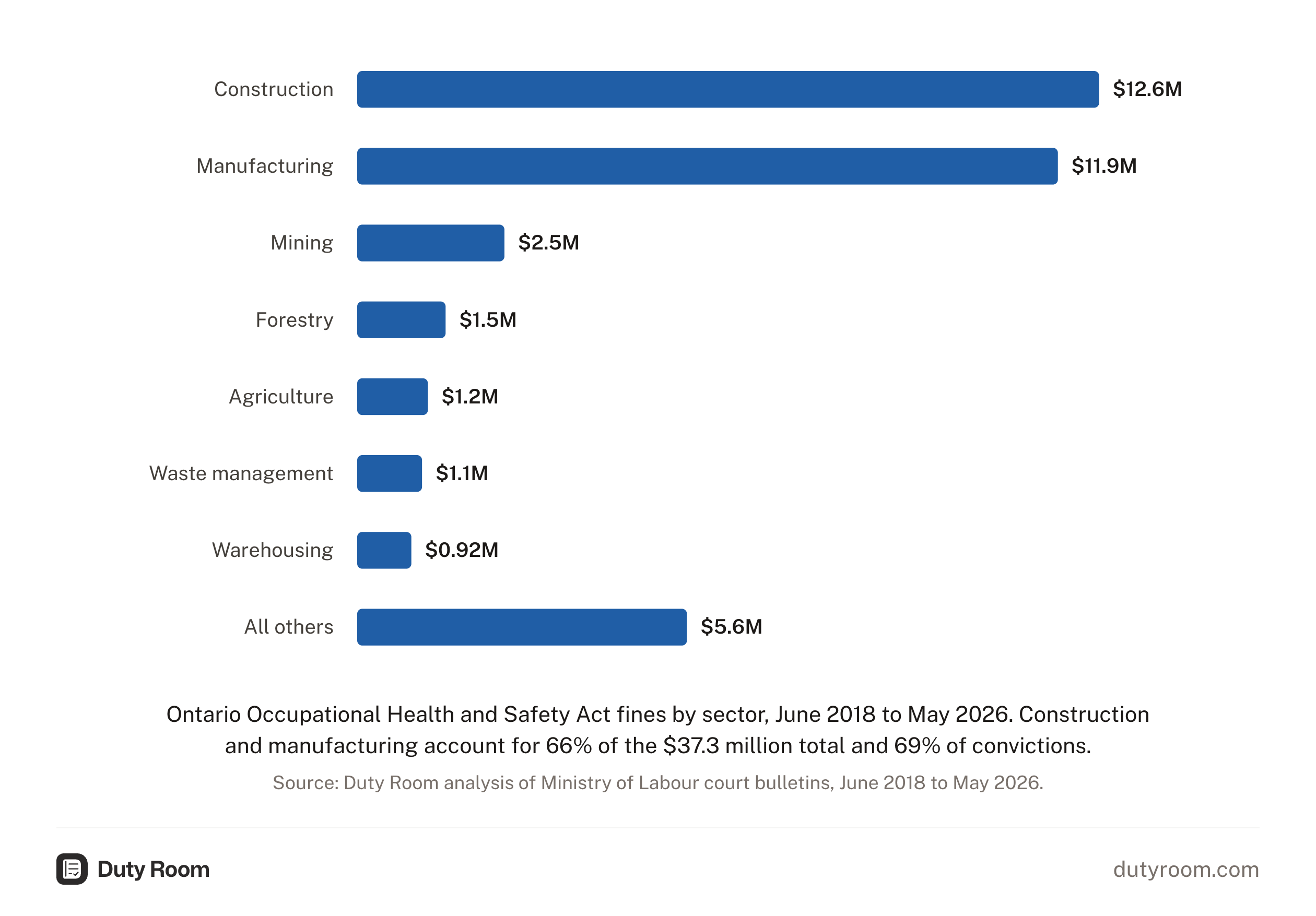
| Sector keyword group | Announcements | Median fine | Total fines |
|---|---|---|---|
| Construction | 116 | $90,000 | $13.5M |
| Manufacturing | 128 | $75,000 | $13.4M |
| Mining | 17 | $120,000 | $2.5M |
| Agriculture | 14 | $107,500 | $1.9M |
| Forestry | 11 | $80,000 | $1.5M |
| Waste management | 11 | $85,000 | $1.1M |
| Warehousing | 8 | $102,500 | $920K |
| All others | 51 | n/a | $6.0M |
The construction and manufacturing groups together account for 69% of announcements and 66% of total fines. Mining has the highest median among the named rows at $120,000, but with only 17 cases4.
These are keyword classifications, not an official industry census. A case involving machinery can be tagged manufacturing even when the employer operates in another industry. The three "hospitality" tags, for example, include a food processor and a wholesale bakery; they cannot establish how rarely restaurants or hotels are prosecuted. For an operator, the hazards and duties described in a case are a better starting point than the sector label alone.
Totals are climbing faster than the typical fine
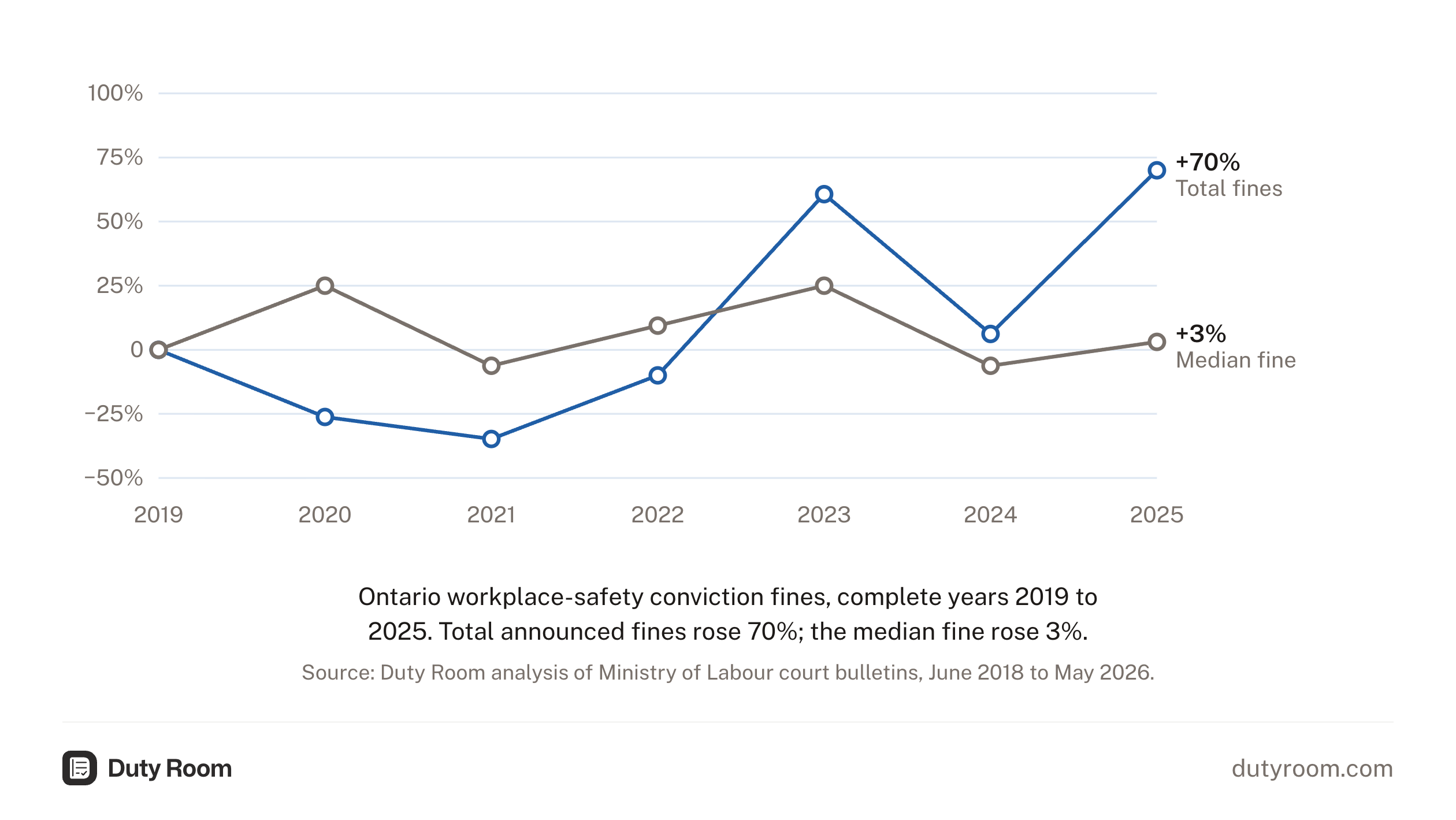
| Announcement year | Single-defendant announcements | Median fine, single defendant | Total fines, all announcements |
|---|---|---|---|
| 2018 (from June) | 23 | $75,000 | $2.0M |
| 2019 | 44 | $80,000 | $4.3M |
| 2020 | 28 | $100,000 | $3.2M |
| 2021 | 24 | $75,000 | $2.8M |
| 2022 | 31 | $90,000 | $3.9M |
| 2023 | 55 | $90,000 | $7.1M |
| 2024 | 41 | $75,000 | $5.4M |
| 2025 | 56 | $82,500 | $7.4M |
| 2026 (to September) | 28 | $80,000 | $4.6M |
Counts and medians in this table use single-defendant announcements; totals include bulletins that report combined fines for several defendants. Years refer to publication, which can follow the conviction by months. The partial 2018 and 2026 periods are not comparable with full years.
Across complete years, total announced fines rose 70% from 2019 to a sample high of $7.4 million in 2025, while the median fine rose just 3%5. The rising aggregate does not mean a comparable rise in the typical penalty. Single-defendant medians ranged from $75,000 to $100,000 across those complete years.
Inspection coverage is a separate question
The Auditor General's 2019 audit found that 61% of inspectors issued no fines in 2018/19, while ten inspectors issued 35% of them. It also estimated, using 2018 business data, that the Ministry's information system contained only 28% of Ontario businesses3.
Those are historical findings about inspection coverage and enforcement practice. They do not tell a business its current chance of inspection, or explain why one sector appears more often in these court bulletins.
Where the announcements are tagged
Toronto is the most common city tag, with 35 announcements, followed by Mississauga with 15, Brampton with 13, Hamilton with 12, and Concord and London with 11 each. Hamilton's median fine is $175,000, more than twice the sample-wide $80,0006. The parser can take a city from the defendant's address or the workplace, and 92 announcements have no city tag. These figures therefore describe the extracted records, not a ranking of where incidents happen or courts impose the toughest sentences.
What a conviction costs after court
An OHSA fine doesn't stay at the number in the judgment. Ontario's provincial-offences surcharge rules add 25% to fines over $1,000: an $80,000 fine leaves the courtroom as $100,0007. The amounts in this report exclude that surcharge and do not establish what was ultimately paid.
The historical median is not a ceiling on a future case. Ontario raised the corporate maximum to $2 million in October 2023, and in December 2024 added a $500,000 corporate minimum for a second or subsequent offence resulting in a worker's death or serious injury within a two-year period8.
The AMP regime introduced in January 2026 is a separate channel. As checked on 7 October 2026, its prescribed penalty covers one rule about equivalent accredited safety-management systems in government and public-sector construction procurement, at the lesser of $100,000 and 10% of the contract value. Paying the penalty in accordance with the notice bars an OHSA charge against that person for the same contravention8.
Use the cases to test the work
The useful question is whether a failure described in a bulletin could happen at your site. In one 2024 case, a damaged bar was removed from a floor grate at a powder-coating facility, leaving access to a moving auger. A temporary worker stepped through the gap and was injured. The facility was fined $55,000 for the guarding failure; the staffing agency was fined $75,000 for failing to provide adequate information, instruction and supervision9.
That is a concrete check for an operator using equipment or temporary staff: how is an unsafe machine kept out of use while a guard awaits repair, and who makes sure a newly assigned worker knows the safe method? Keep the inspection, repair, training and supervision records that show what happened; a written procedure alone does not show it was followed. Our Ontario health and safety resources cover the evidence behind that work.
-
Duty Room analysis of Ministry of Labour court bulletins on the Ontario Newsroom, covering announcements from June 2018 to September 2026. The reconciled sample contains 356 fine-bearing OHSA announcements totalling CAD 40,958,000, median CAD 80,000, mean CAD 115,051. The corrected June 2018–May 2026 window contains 339 announcements/CAD 38,278,000; 17 later announcements add CAD 2,680,000. Historical corrections remove a duplicate, recover five older fined cases and add CAD 25,000 in omitted co-defendant fines. A recovered suspended-sentence case contributes no fine. The successor CSV, correction ledger, raw API responses and reproducible analysis are archived in the research vault. Historical records whose original pages are no longer available rely on the preserved extraction; they were not newly body-verified. This is a published-bulletin sample, not a complete convictions register. Amounts are nominal CAD and exclude surcharges, costs and other orders; one bulletin can combine defendants or offences.
-
Outcome groups: fatality 115, median CAD 135,000, mean CAD 174,283; critical-injury tag 142, median CAD 70,000, mean CAD 91,046; other reported injury 96, median CAD 70,000, mean CAD 81,115; outcome unstated 3, median CAD 80,000, mean CAD 66,667. Fatality takes precedence where a bulletin includes deaths and injuries. Historical keyword enrichment is retained, including critical/serious/amputation wording; it is not a consistent legal classification under the critical-injury definition. The fatality share is 32.3% and its median is 1.93 times the critical-injury group's. These are fine amounts per announcement, including combined-defendant announcements, not estimated sentencing effects of a death.
-
Auditor General of Ontario, 2019 Annual Report, section 3.07, Health and Safety in the Workplace, sections 4.3.1, 4.3.4 and 4.3.6. The critical-injury finding concerns a Ministry pilot sampling WSIB claims from three regions in January–August 2017. The inspection-inventory estimate uses 2018 Statistics Canada business data; the inspector-fines comparison is for 2018/19. These findings do not measure current provincial coverage.
-
Retained keyword sector tags: construction 116 announcements, CAD 13,549,500; manufacturing 128, CAD 13,429,500; together 244/356 (68.5%) and CAD 26,979,000/CAD 40,958,000 (65.9%). Mining: 17, median CAD 120,000, total CAD 2,530,000. Remaining named totals: agriculture CAD 1,850,000; forestry CAD 1,515,000; waste management CAD 1,145,000; warehousing CAD 920,000. All others: 51 announcements, CAD 6,019,000. Tags are not verified industry categories and do not supply a risk denominator.
-
By announcement year, single-defendant counts/medians and all-announcement totals are separate populations. Exact full-year totals, 2019–2025: CAD 4,345,000; CAD 3,212,000; CAD 2,840,000; CAD 3,935,000; CAD 7,113,000; CAD 5,437,000; CAD 7,404,000. Total growth is 70.4%, versus 3.1% for the single-defendant median (CAD 80,000 to CAD 82,500). The 59 all-defendant announcements in 2025 tie 2023; its 56 single-defendant announcements are the largest such annual count in this sample.
-
City tags appear on 264 of 356 fine-bearing announcements. Toronto 35; Mississauga 15; Brampton 13; Hamilton 12; Concord and London 11 each. Hamilton median CAD 175,000. Tags may refer to defendant or workplace location and are not verified incident or sentencing-court locations.
-
O. Reg. 161/00, table, under section 60.1 of the Provincial Offences Act: surcharge of 25% of the actual fine for fines over CAD 1,000. Example arithmetic: CAD 80,000 × 1.25 = CAD 100,000.
-
OHSA, sections 66(2) and 69.1(11); O. Reg. 365/25, section 1; O. Reg. 364/25, sections 2–3. Current official e-Laws Word versions retrieved 7 October 2026 and archived in full. The procurement regulation applies to specified government/public-sector construction procurement initiated or entered into from 1 January 2026; its equivalency rule concerns Chief Prevention Officer-accredited systems required as an eligibility or contract condition. The prescribed penalty is the lesser amount, not an automatic CAD 100,000 fine for any workplace breach.
-
Ontario court bulletin, 5 April 2024: West End Mfg. Inc. and Liiman Employment Inc.. Incident 25 May 2023; convictions 26 March 2024. The combined CAD 130,000 fine is one announcement in this dataset; surcharges are additional.
This report is based on published enforcement data, sources available at publication, and original analysis. It is for general information only and doesn't constitute legal advice.
Convictions become Ministry press releases.
Duty Room helps operators and their safety adviser stay aligned on policies, training, JHSC minutes, incidents, and hazard records between visits.