Three rule changes in 27 months
Ontario OHSA Fines in 2025: Record Totals, Same Typical Fine
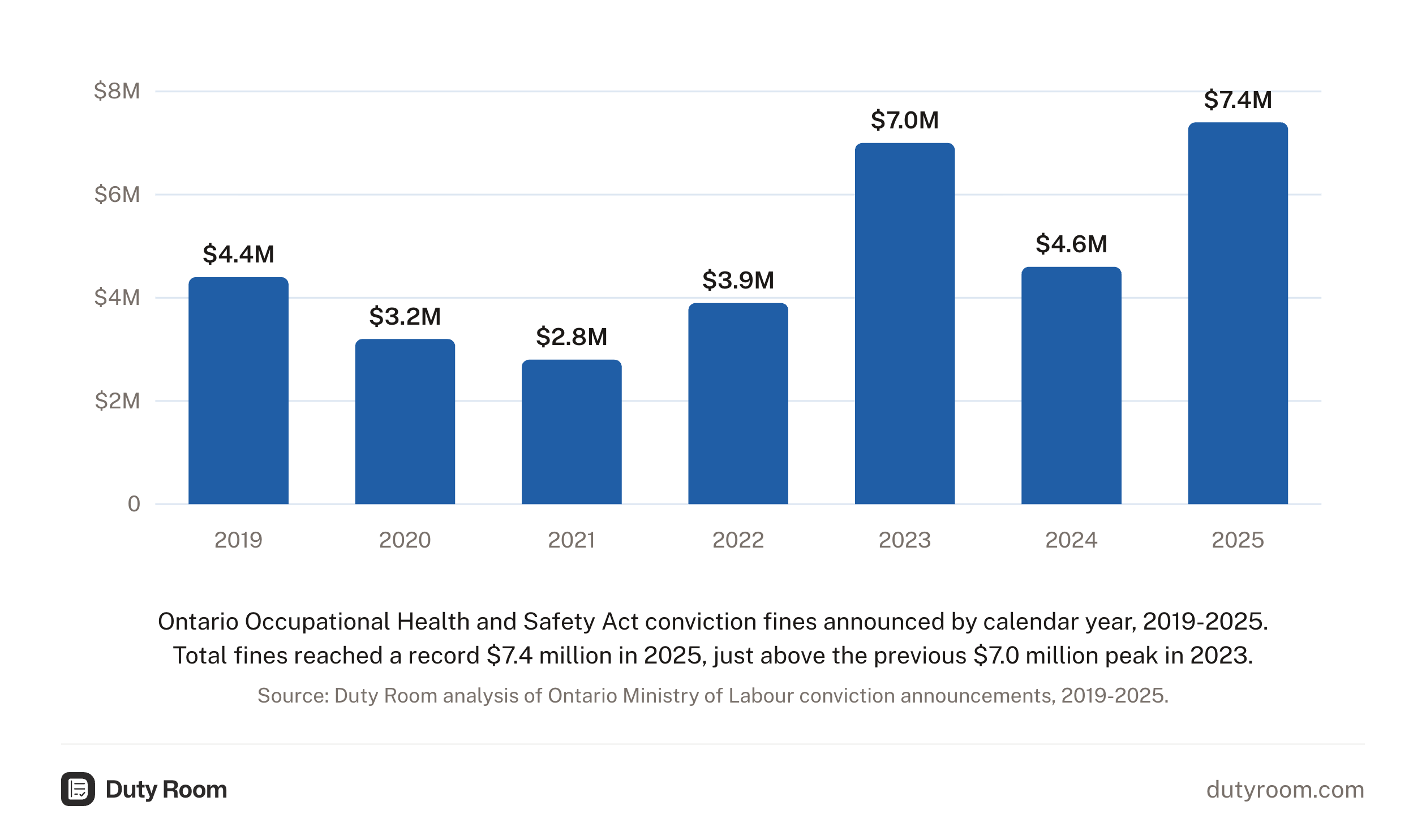
Early 2025 looked like a step change. Ontario's eleven January conviction announcements carried a typical fine of $175,000, more than double the long-run figure. The full year told a calmer story. The typical 2025 fine came in at $82,500, back inside the band it has held since 2018.1 What 2025 actually set was volume records: more convictions announced than in any other year in the record, and $7.4 million in total fines, past the previous peak of $7.0 million in 2023.
Ontario also rewrote the penalty rules three times in 27 months, and each change pushed exposure in one direction. The fuller Ontario workplace safety fines report carries the extended conviction table.
Year-over-year fines
| Year | Convictions | Median fine | Total fines |
|---|---|---|---|
| 2,019 | 44 | $80,000 | $4.4M |
| 2,020 | 28 | $100,000 | $3.2M |
| 2,021 | 24 | $75,000 | $2.8M |
| 2,022 | 32 | $87,500 | $3.9M |
| 2,023 | 53 | $100,000 | $7.0M |
| 2,024 | 41 | $75,000 | $4.6M |
| 2,025 | 56 | $82,500 | $7.4M |
The trend reads upward, but the path is uneven. The typical fine went from $80,000 in 2019 to a $100,000 peak in 2020 and 2023, fell back to $75,000 in 2024, and landed at $82,500 in 2025. No single year is a good budgeting anchor. The totals are the steadier line: $4.4 million in 2019, $7.0 million in 2023, $7.4 million in 2025.
Budget around the structure, not the typical fine
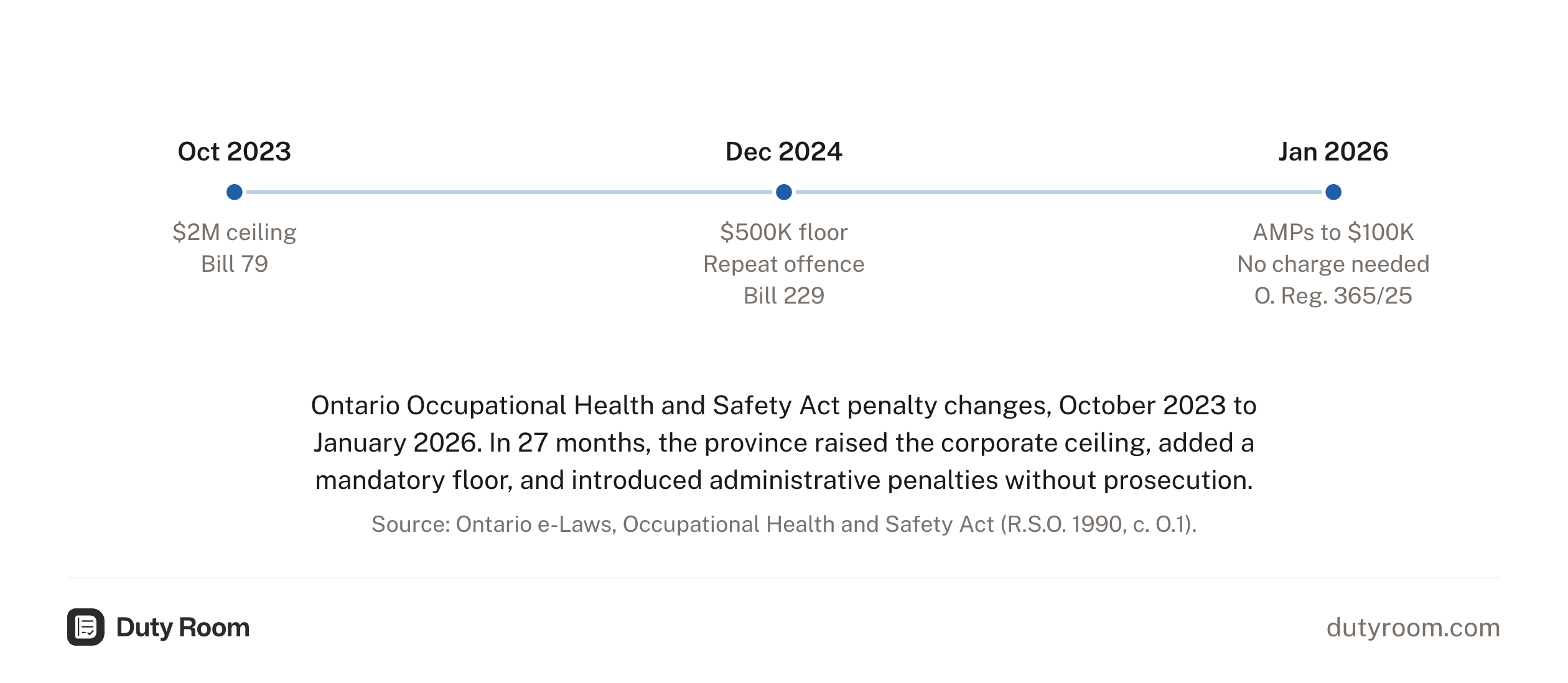
Three changes to Ontario's penalty rules between October 2023 and January 2026 move the exposure numbers more than any single year's figures do.
| Date | Change |
|---|---|
| October 2023 | Bill 79 raises the corporate maximum from $1.5M to $2M per charge |
| December 2024 | Bill 229 sets a $500,000 mandatory minimum for a second serious-injury or fatality conviction within two years |
| January 2026 | O. Reg. 365/25 permits AMPs up to $100,000 without a charge, currently one procurement contravention |
$2M ceiling (October 2023). Bill 79 raised the corporate maximum per charge from $1.5 million to $2 million. Courts had been sentencing well below the old cap (the largest fine in the eight-year record is $700,000), so fines didn't jump overnight. But a judge hearing a serious case now has more room.
$500K floor for repeat offenders (December 2024). Bill 229 set a mandatory minimum of $500,000 for a second serious-injury or fatality conviction within two years. That is six times the historical norm. It applies to a narrow group of employers, but those it catches face exposure with no judicial discount available.
AMPs (January 2026). O. Reg. 365/25 lets an inspector issue an administrative monetary penalty of up to $100,000 without laying a charge. So far the scheme prescribes a penalty for exactly one narrow procurement contravention, so an ordinary safety violation can't draw an AMP today. The statutory power behind it is broader, and the Ministry can extend the scheme to more contraventions by regulation, without going back to the legislature.
These stack. A first offence faces a higher ceiling, a second serious offence within two years a $500,000 floor, and the legal machinery now exists for penalties that skip the prosecution path that produced every conviction in the annual series above.
Conviction odds
Convictions are uncommon. Ontario recorded roughly 370 workplace deaths from 2018 to 2024, and the bulletins announce 92 fatality convictions through January 2025, roughly one in four. Most investigations close without charges. The record is firmer on the wait once a charge lands: a fatality case typically takes just under two years from incident to conviction, and four in ten take longer.2 Our workplace fatality briefing covers the first-week response after a death.
What a conviction costs
For a multi-site operator, the exposure adds up site by site, and a prior conviction anywhere in the company starts the two-year repeat-offence clock.
Court risk. The typical fine across the record is $80,000, and every fine carries a 25% victim surcharge, so an $80,000 fine leaves the courtroom as $100,000. A typical fatality conviction runs around $125,000, or $156,250 with the surcharge, and the worst case in the record is $700,000.3
Repeat-offence risk. For employers with a conviction already on the books, a second conviction within two years for an offence that kills or seriously injures a worker starts at $500,000, and exposure models built before December 2024 do not include that floor.
The typical 2025 fine settled back into the historical band once the full year reported. The penalty structure did not settle back. The working number for a board conversation is a typical court outcome plus surcharge for each site at risk, plus the repeat-offence floor if the company has a conviction in the last two years.
-
Duty Room analysis of Ontario Ministry of Labour conviction announcements on news.ontario.ca, extracted March 2026 and extended June 2026: 335 OHSA convictions with fine amounts, announced June 2018 to May 2026. Medians and conviction counts cover single-defendant announcements (316 of 335); totals include the 19 bulletins that report one combined fine for several defendants. 2025 full year: 56 single-defendant convictions, median $82,500, mean $112,268, with $7,404,000 announced across all 59 bulletins. January 2025 alone: 11 announcements, median $175,000, inflated by two combined fines. The Ministry published no court bulletins between late January and early April 2025, around the provincial election, so the 2025 count is a floor.
-
Workplace deaths: roughly 370 from 2018 to 2024, Ontario open data. Offence-to-conviction lag from the March 2026 extraction: 48 fatality convictions report a single unambiguous offence date and conviction date, median 23.1 months, with 42% at 24 months or more.
-
Single-defendant fatality convictions in the same analysis: 104 records, median $125,000, mean $154,327, maximum $700,000 (a North York bakery, two worker deaths, June 2021).
This briefing is based on sources available at publication and is for general information only. It doesn't constitute legal advice. For advice on your specific situation, consult a qualified professional.
Convictions become Ministry press releases.
Duty Room helps operators and their safety adviser stay aligned on policies, training, JHSC minutes, incidents, and hazard records between visits.