The Ticket Arrives Faster
Ontario Fire Code AMPs: What O. Reg. 260/25 Changes
A lapsed fire alarm test certificate can now generate a penalty order on a 30-day clock, without a court date, in municipalities that have the AMP review machinery in place. Ontario Regulation 260/25 took effect January 1, 2026 and gives municipalities the option. For operators inside municipalities that have stood the regime up locally, the enforcement calendar changed on that date.
The no-court penalty
A fire inspector finds a lapse during a routine inspection or reinspection. Before AMPs, the small-ticket route was a Part I set fine, usually $195 or $295. The heavier route was prosecution, with a court date months out. AMPs add a third route: a penalty order the inspector issues directly, without a court file, alongside (not in place of) the older tools. The order lands on the building owner, tenant, or corporation responsible for the failure.
The inspector doesn't need a new kind of violation to use an AMP. The lapses are the same ones fire services have always enforced: smoke alarms missing or disconnected, CO alarms absent, fire alarm systems not tested on schedule, exit doors blocked or chained, fire safety plans out of date, inspection records incomplete or missing.
Who signs the order
The regulation names two people who can impose a penalty order: the Fire Marshal and an assistant to the Fire Marshal. In practice the assistant is a local fire department official appointed under FPPA section 11. Most often it's the inspector who walks the building. That power only switches on in municipalities that already have a screening officer and a hearing officer to review those orders if the recipient contests. Existing AMP officers under the Municipal Act or the City of Toronto Act count for that purpose, which means a municipality already running AMPs for parking has the review machinery in place; it just has to extend coverage to fire code. Programs for property standards or licensing only count once the municipality appoints their officers to review fire penalty orders.
In municipalities without that machinery, the old enforcement tools still apply. Part I set fines under Schedule 17.4 cover a defined set of fire code offences at $195 or $295 each. Prosecution remains the route for heavier or repeat files, or for any contravention not on the set-fine schedule. The Ontario fire-code conviction report shows where those repeat files land. Local fire prevention offices can confirm where their municipality is on AMP adoption.
The practical split for operators: a restaurant outside the regime faces the same enforcement ladder it faced in 2024. A restaurant inside the regime faces a 30-day-clock financial response to the same documentation gaps, instead of a court date months away.
Speed is the real change
Under the old system, a blocked emergency exit discovered during inspection had two likely outcomes. The inspector could issue an order requiring the owner to fix it. If the owner didn't comply, the case went to prosecution. Prosecution takes months. Some cases in the Ontario conviction record took years from inspection to fine.
AMPs compress the timeline. The penalty order follows the inspection, not the court calendar. The clocks are statutory: 30 days for the operator to pay or request a screening review, 30 more days to escalate to a hearing review if the screening result still stands. Officer decisions are "as soon as practical" rather than fixed-date, so a contested file can take longer than 30 days to resolve. The point is that the dollar figure attaches to the inspection itself, instead of waiting for a court date.
An inspector who finds a missing annual fire alarm test certificate today doesn't wait for a prosecution date to put a dollar figure on it. That's the mechanical change the regulation introduced.
AMPs don't replace prosecution. A municipality can issue an AMP and still prosecute for the same pattern of lapses if the problems continue or if the failure is serious enough. AMPs handle the routine maintenance gaps. Prosecution still handles the repeat offenders and the cases where someone was hurt.
The provisions inside Schedule 1 cluster around maintenance failures rather than design defects: stale test records, plans that no longer match the premises, blocked exits, and missing inspection records for fire-protection systems. Whether the regime "feels" expensive depends on how many distinct provisions an inspector finds lapsed in one walkthrough. The cost section below explains why.
Failures that generate AMPs
The regulation targets the maintenance side of the Ontario Fire Code. What an inspector typically finds on a routine walkthrough:
- An annual fire alarm test certificate that's lapsed
- A smoke or CO alarm that's disconnected, missing, or no longer working
- An exit door chained or blocked by storage
- A fire safety plan that no longer matches the building since the last renovation
- A fire door wedged open or a closure that no longer operates freely
- Posted operating instructions for kitchen fire-protection equipment missing or out of date
What an AMP costs
The regulation prescribes a flat schedule. The amount does not vary by violation type, by venue size, or by municipality.
| Order against the same provision (within 3 years) | Amount |
|---|---|
| First | $200 |
| Second | $400 |
| Third or any subsequent | $600 |
Two features of that schedule matter more than the per-order dollar figure.
The first is that the schedule is per-provision. Each Fire Code provision has its own counter. An inspector who finds a lapsed fire alarm test certificate, an out-of-date fire safety plan, and a wedged-open fire door in one walkthrough writes three first-offence orders, not one. Cumulative exposure on a single inspection is the number of distinct provisions found lapsed, multiplied by $200.
The second is that the escalation window is three years, also per-provision. A venue that lapses the same fire alarm test certificate twice in 36 months sees the second order at $400, not $200. The same venue that lapses a different provision in the same period gets a fresh $200 order; the counters don't pool.
The list of Fire Code provisions inside the regime is enumerated in Schedule 1 of O. Reg. 260/25 and runs to 269 specific items: 257 from Division B of the Fire Code (the operational substance: fire safety plans, alarm and detection records, exit obligations, suppression maintenance, and so on) and 12 from Division C (administrative provisions on persons performing tests and inspections).
The $10,000-individual / $100,000-corporation figures that appear in industry coverage are the general ceilings the FPPA gives the AMP power under section 30.2 of the statute. They cap any AMP regulation made under the Act. They are not third-offence amounts in their own right. O. Reg. 260/25 stays far below them: $600 even at the third-or-subsequent step. The practical exposure for a hospitality operator is the per-provision $200/$400/$600 ladder, not the statutory ceiling.
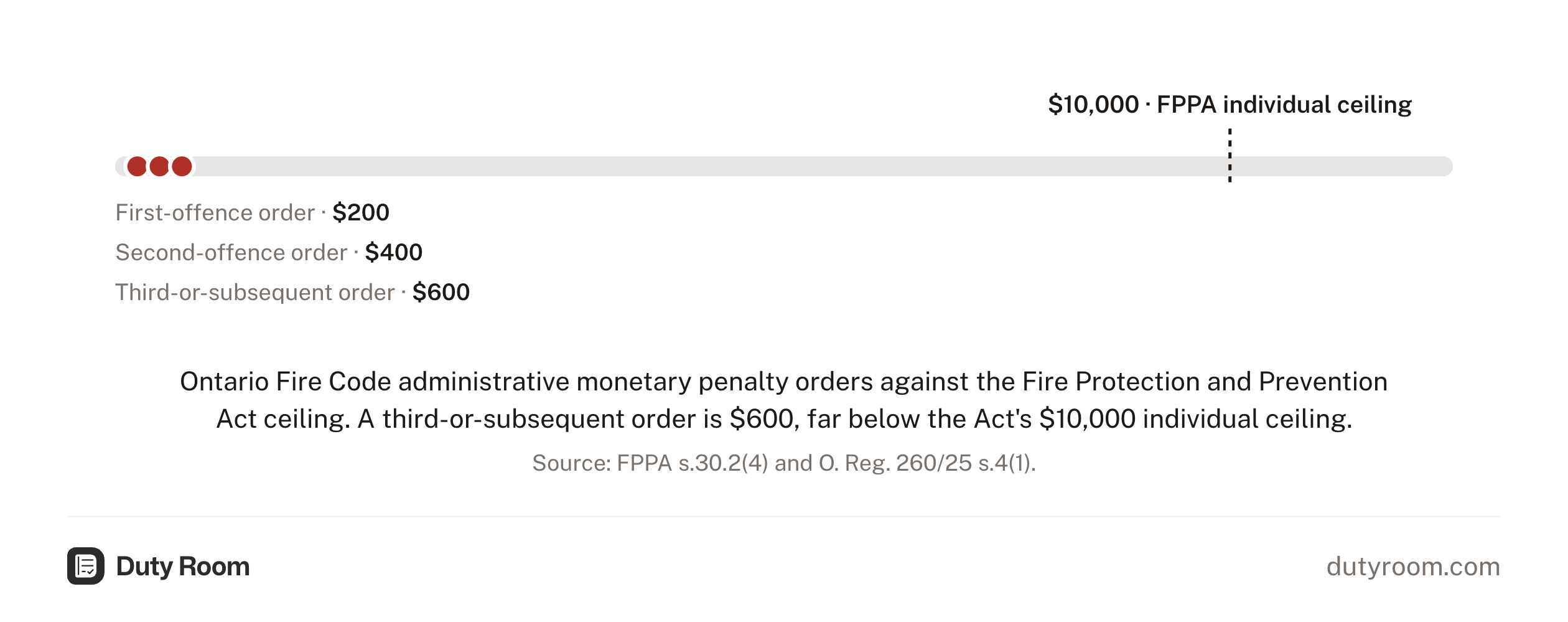
| Figure | Amount | What it is |
|---|---|---|
| First-offence order | $200 | Actual AMP amount, per O. Reg. 260/25 s.4(1) |
| Second-offence order | $400 | Actual AMP amount, per O. Reg. 260/25 s.4(1) |
| Third-or-subsequent order | $600 | Actual AMP amount, per O. Reg. 260/25 s.4(1) |
| FPPA individual ceiling | $10,000 | Statutory cap on the Act's AMP power, not a per-order amount |
| FPPA corporation ceiling | $100,000 | Statutory cap for corporations, not shown on this scale |
Same checklist, faster consequence
The items fire inspectors document haven't changed. The fire code maintenance requirements that applied in 2023 and 2024 apply in 2026. What changed on January 1, 2026 is the enforcement speed for those same requirements in municipalities running the AMP regime.
Before an inspection, four boring records do most of the work of avoiding an order:
- The annual fire alarm test certificate, current within the last 12 months
- The fire safety plan, reflecting the current layout and occupancy
- Exit routes clear, with no storage within the path
- Suppression system maintenance records on file: sprinkler service certificates, plus the hood cleaning logs inspectors ask for alongside them
None of those are new requirements. They're the standard checklist items fire services have reviewed for years. The difference is that finding them absent now triggers a 30-day clock instead of a prosecution queue. Our Ontario fire safety resources cover the recurring records behind that checklist.
The 30-day clocks
The sequence is plain:
- An inspector finds a lapse.
- The inspector (acting as the Fire Marshal's assistant) issues a penalty order.
- The operator has 30 days to pay or request a screening review.
The review itself is a two-stage system. Stage one is a screening officer, who assesses whether the order was reasonable to impose. Stage two, available if the screening result still stands, is a hearing officer, who assesses whether the screening officer's decision was reasonable. The operator has 30 days between stages.
The screening officer or hearing officer decides whether to run their stage orally, electronically, or in writing. They can consider photos, drawings, certified statements, documents, and any other material they regard as credible. The regulation explicitly bars calling witnesses. A municipality can't charge a fee to start a review or to extend the review window.
Payment or final review outcome closes the matter. For repeat findings (the same exit door blocked on a reinspection), the AMP doesn't prevent the municipality from also pursuing prosecution.
This briefing is based on sources available at publication and is for general information only. It doesn't constitute legal advice. For advice on your specific situation, consult a qualified professional.
Advice from your consultant, action from your sites.
Ontario municipalities can now issue fire-code penalty orders from $200 on a 30-day clock, no court date. Duty Room keeps the records inspectors check current.