The worst day keeps going
After a Workplace Fatality in Ontario: What Happens and What It Costs
A Ministry of Labour inspector typically arrives at the site within hours of a workplace death. The law requires you to notify the Ministry immediately, and police and the coroner's office report deaths through their own channels, so the investigation is often underway before the family has been told.
First week
The inspector can stop work in the affected area, sometimes across the entire site, and the scene itself is frozen by law: nothing connected with the death can be disturbed without an inspector's permission, except to save a life, relieve suffering, or prevent further damage. That could be a day, could be longer if the scene is complex or the equipment needs forensic examination.
Investigators want documents fast. The written health and safety policy. Training records for the deceased and their supervisor. Equipment maintenance logs. Inspection records for the area where the death happened. Pre-start health and safety reviews if applicable. They'll interview witnesses on site, usually the same day.
Defence lawyers who work these cases say the first interview decides the file, and they want to be retained before anyone gives a substantive statement, not once charges look likely. The paperwork clock runs alongside: a written report to the Ministry within 48 hours, and a report to WSIB within three business days.
First months
The Ministry investigation continues without a fixed timeline. Inspectors return for follow-up documents and interviews. They consult with engineers, review equipment certifications, and build the file that goes to the Ministry's legal branch.
You won't know for months whether charges are coming. The decision sits with Ministry counsel, and they don't publish a charging test. What the conviction record shows is a pattern: missing fall protection and unguarded machinery, over and over. The cases that reach court tend to involve a safety measure that existed on paper but wasn't followed, or one that never existed.
WSIB processes the fatality claim separately, on its own track. Survivor benefits flow to the family, and the claim lands on your experience rating, which can move your premium rate up through risk bands and keep it there for years, whatever happens with the prosecution.
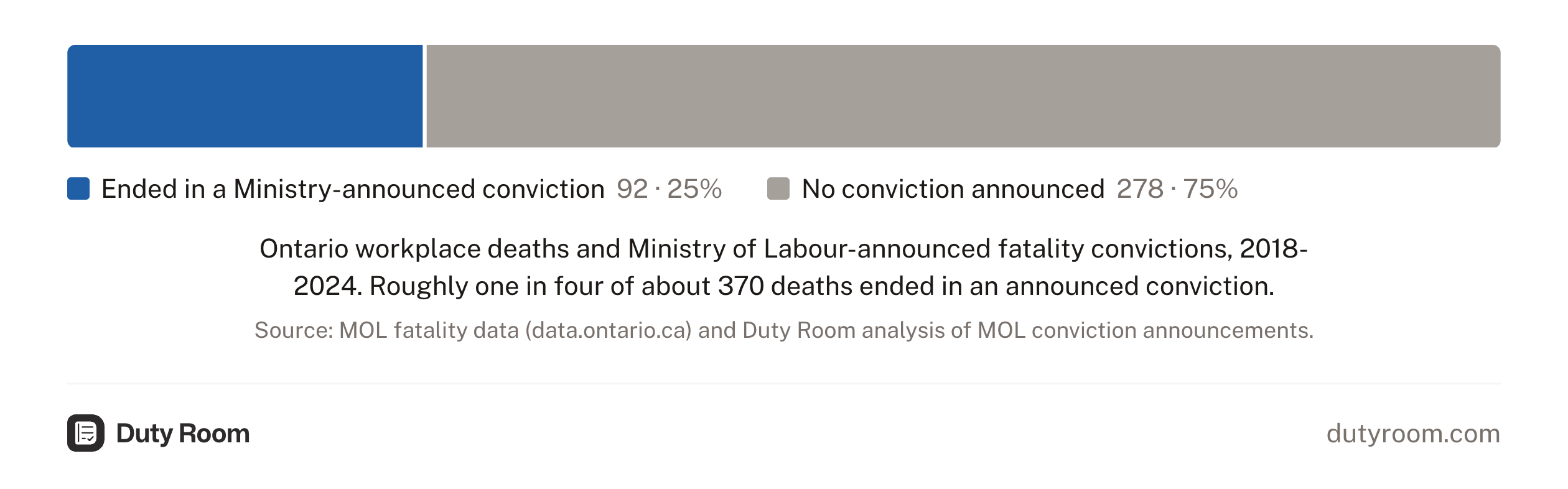
Roughly one in four deaths leads to a conviction
Ontario recorded roughly 370 workplace deaths between 2018 and 2024. Across a similar window, 92 produced a conviction the Ministry announced.1 Convictions lag deaths by a year or more, and not every conviction gets a press release, so the real rate may sit a little higher. Even allowing for that, most workplace deaths in Ontario never end in a conviction.
| Outcome | Deaths |
|---|---|
| Ended in a Ministry-announced conviction | 92 |
| No conviction announced | 278 |
| Total workplace deaths (approx.) | 370 |
The rest were investigated and closed without charges, or resolved without a prosecution. The Ministry's sightlines are narrower than you'd expect: in 40% of the fatality cases the Auditor General's 2019 audit reviewed, the Ministry had no prior record of the business in its system.
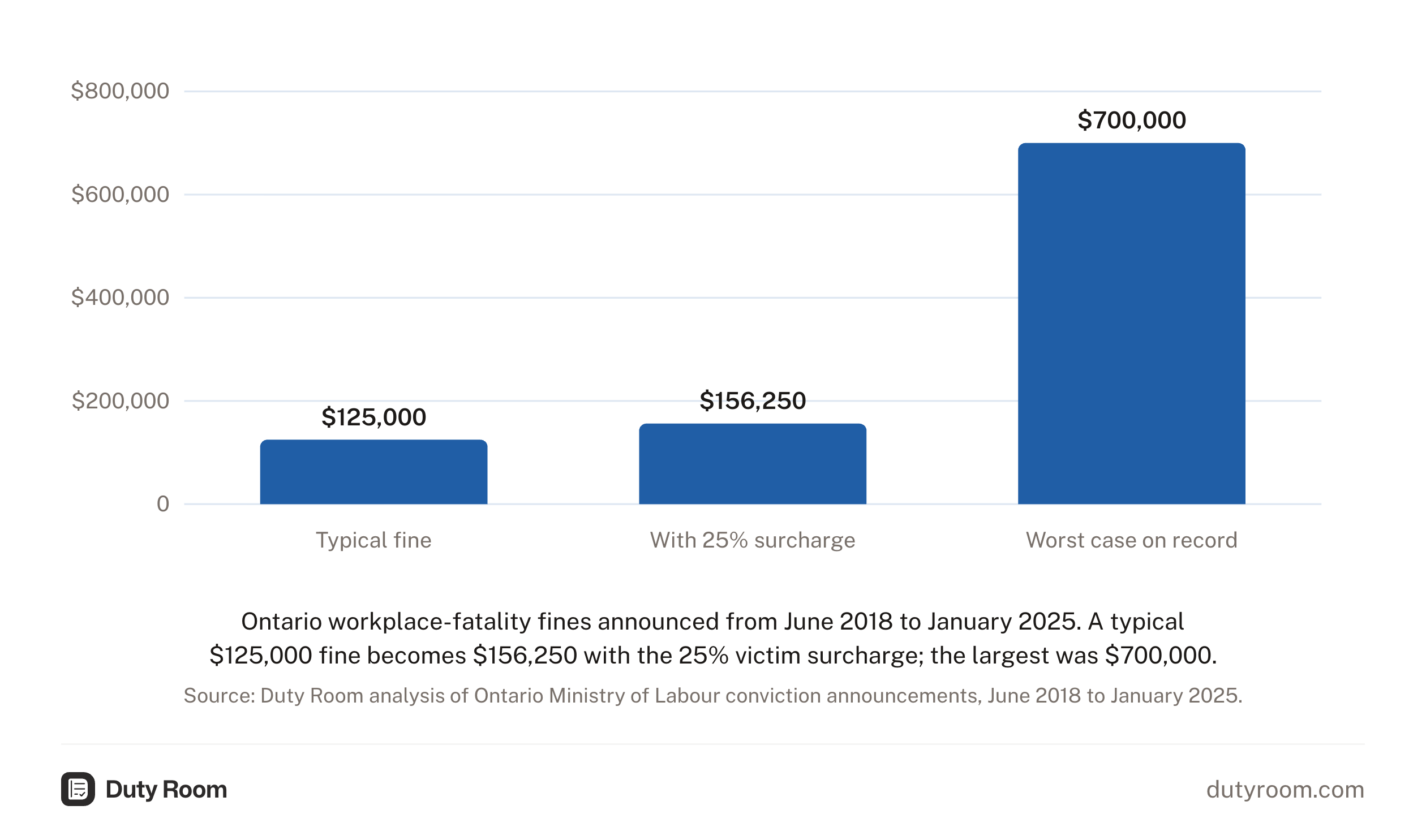
A low conviction rate is not reassurance. It means the Ministry is selective about which cases it takes to court. The fine in a fatality case typically lands around $125,000, and the worst case in the record reached $700,000.1 Add the automatic 25% victim fine surcharge and $125,000 becomes $156,250 before you leave the courtroom.
| Scenario | Amount |
|---|---|
| Typical fine | $125,000 |
| With 25% victim surcharge | $156,250 |
| Worst case on record | $700,000 |
Years one and two
OHSA prosecutions move slowly. A charge laid six months after the death may not reach sentencing for another year. During that period, your operations continue under heightened scrutiny. Follow-up inspections are more likely. Your compliance history is now a factor in every interaction with the Ministry.
The conviction record bears out the slow timeline: in the fatality cases where the Ministry's announcement records both dates, the gap between the incident and the conviction typically ran just under two years, and about four in ten took longer than that.2
Coroner's inquest
Not every workplace death produces an inquest. Mining deaths require one by law; for everything else, including construction since a 2024 law change, it's the coroner's call. Ontario's published inquest records list 78 workplace inquests, covering 107 deaths, between 2018 and 2024. There's no fine at the end of an inquest. It leaves a public record that names the employer, describes what happened, and stays searchable indefinitely.
Hospitality's low count
Construction (111 convictions) and manufacturing (119) dominate the conviction record. Hospitality appears three times across 335 OHSA convictions. Part of that is risk profile. Part of it is attention: the same audit found the Ministry's system tracks only 28% of Ontario businesses, and about 1% get a proactive inspection in a given year. A restaurant answers to the same Act as a construction firm. What differs is how often anyone checks.
After a death, the first thing the investigator asks for is paperwork, and the file the Ministry builds starts with whatever you can produce that morning. Our Ontario health and safety resources cover the records that should exist before that morning.
-
Duty Room analysis of 533 Ontario Ministry of Labour conviction announcements on news.ontario.ca, June 2018 to May 2026, extracted March 2026 and extended June 2026: 335 OHSA convictions with fine amounts, 111 of them following a workplace death. Seven of the 111 report one combined fine for several defendants; fatality fine statistics are computed from the other 104 (median $125,000, mean $154,327, maximum $700,000). The one-in-four comparison uses the 92 fatality convictions announced by January 2025, window-matched to the deaths data, which ends in 2024. All conviction statistics in this briefing are from this analysis.
-
Of the 111 fatality convictions, 66 announcements record a single offence date and a single conviction date: median 23 months from offence to conviction, with 39% taking 24 months or more.
This briefing is based on sources available at publication and is for general information only. It doesn't constitute legal advice. For advice on your specific situation, consult a qualified professional.
Convictions become Ministry press releases.
Duty Room helps operators and their safety adviser stay aligned on policies, training, JHSC minutes, incidents, and hazard records between visits.