Bills Follow The Visit
What a Failed Food Inspection Actually Costs in Ontario
The ticket isn't the part customers see. The yellow conditional pass in the window is. Set fines run $55 to $465 per violation, and a bad visit can produce several, one per violation. The financial hit is usually a few hundred dollars. The public record stays for two years.
Inspection results are published, in some cases the same day. Toronto publishes through DineSafe. Other health units maintain their own systems. A conditional pass or closure stays on the record for two years. Delivery platforms, review sites, and local news scan these listings.
Ticket size
Ontario food premises inspections are conducted by Public Health Inspectors under the Health Protection and Promotion Act and O. Reg. 493/17. Enforcement follows a tiered model.
Part I tickets (set fines under the Provincial Offences Act) are how most fines arrive. The set fine schedule runs from $55 to $465, plus $5 court costs and the victim fine surcharge. Total payable per ticket: roughly $75 to $580.
Peel Region's public conviction registry, the clearest public list of food safety ticket amounts from a single Ontario health unit, shows the pattern clearly across 56 charges:
- $465 (the maximum): 45% of all tickets. Pest violations and sanitary operation failures.
- $120 (mid-range): 32% of all tickets. Equipment maintenance and record-keeping.
- $55 (the minimum): 13% of all tickets. Minor handwashing station issues.
Multiple tickets per visit is standard practice. An inspector who finds pest evidence, a temperature violation, and missing records will write three separate tickets. One visit, three fines, total cost approaching $1,500 before you start fixing anything.
The conditional pass picture
Toronto's current DineSafe extract shows a larger middle tier than the old snapshot suggested. In the rolling file downloaded 13 June 2026, Duty Room counted 73,935 inspection events from 10 November 2023 to 12 June 2026. Of those, 4,057 were conditional passes and 72 were closed. The conditional-pass share was 5.0% in 2024, 5.6% in 2025, and 6.3% in 2026 to date.
Whatever is driving it, more premises are ending up on a public conditional pass. A conditional pass means the inspector found problems serious enough to change your public status but not severe enough to close you. It sits in the middle of the enforcement range, visible to everyone. The reinspection response is where the public status either starts to clear or hardens into a repeat problem.
Beyond tickets: prosecution
Repeated or serious violations can escalate to Part III prosecution in the Ontario Court of Justice. The statutory maximum is $5,000 per charge for an individual and $25,000 for a corporation, per day the offence continues. A Scarborough restaurant (Chandra's Takeout) was fined $20,000 in 2009 for four charges: no certified food handler, hiding a closure sign, pest infestation, and food contamination. That works out to $5,000 per charge, before the victim surcharge took the total payable to $25,000.
Part III prosecutions are rare but expensive. The typical court-imposed fine runs $2,500 to $5,000 per charge, with total prosecution costs of $10,000 to $25,000 for multi-charge cases. Add legal representation and you are well past the cost of whatever compliance problem triggered the inspection in the first place.
Closure orders
Inspectors can close a premises immediately for severe hazards: active pest infestation, sewage backup, no running water, or food held at dangerous temperatures. DineSafe recorded 72 closed inspection events in the current rolling file. Closures are still rare, but if one lands, revenue stops until a reinspection clears you.
The two-year shadow
Conviction information stays on the public record for two years in Peel's system, and other health units run similar published lists. Peel Region's PDF lists establishment name, address, offence, fine, and conviction date. It is published on their website and updated regularly. Toronto's DineSafe results are searchable by anyone.
A $465 ticket is payable quickly. The public listing can sit there for two years.
What inspectors keep finding
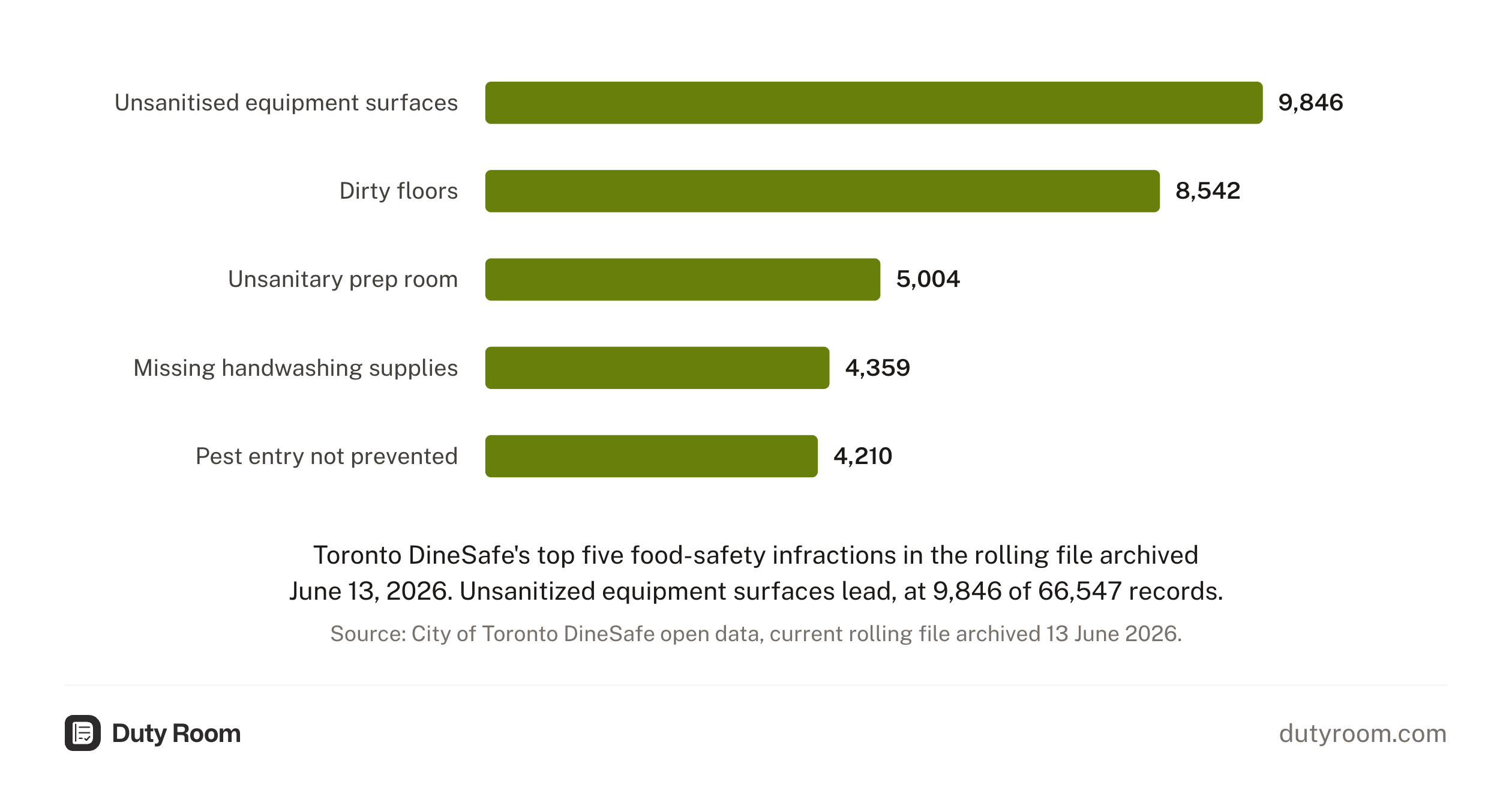
DineSafe's top infraction categories across 66,547 infraction records in the current rolling file:
| Infraction | Records |
|---|---|
| Unsanitised surfaces | 9,846 |
| Dirty floors in food handling rooms | 8,542 |
| Food handling room not in sanitary condition | 5,004 |
| Handwashing stations without soap or towels | 4,359 |
| Pest entry not prevented | 4,210 |
The DineSafe top five cluster together in the record because they share the same root cause: lapses in daily walk-through checks on surface sanitation, floor cleaning, handwashing supplies, and pest prevention.
A common bad visit
A common bad visit looks like this: three tickets worth about $900, a conditional pass posted publicly, and a reinspection within days. The bigger cost is the scramble to fix everything while service is still running.
If the problems recur and prosecution follows, costs jump to $10,000 or more. If closure is ordered, revenue stops entirely.
The DineSafe pattern points to routine daily monitoring as the common factor behind most bad visits.
This briefing is based on sources available at publication and is for general information only. It doesn't constitute legal advice. For advice on your specific situation, consult a qualified professional.
One ticket per violation. Your records answer.
Duty Room helps Ontario operators keep temperature logs, Food Handler certificates, cleaning records, and corrective actions current and shared across sites.