Trouble Rarely Arrives Alone
The $186,000 Year: What Five Regulators Could Cost One Restaurant
What happens when multiple regulators pay attention to the same business in the same year? This report models that scenario for a fictional BC restaurant using published penalty ranges, enforcement statistics, and statutory schedules. The restaurant doesn't exist. The penalties are what regulators actually impose, drawn from published enforcement data. The indirect costs (replacement labour, remediation, lost revenue, legal fees) are modelled from published rates and ranges.
The sequence is a model, not a case study. Not every kitchen injury triggers a fire inspection or an ESB audit. But none of the individual events is unusual on its own, and the costs are drawn from published enforcement data. The point is to show how they compound when they overlap.
The Restaurant
Fifty employees. $2 million in annual revenue. Food primary liquor licence. Metro Vancouver. Annual payroll around $1.5 million. WorkSafeBC premiums of $8,700 a year at the standard restaurant rate of $0.58 per $100 of assessable payroll, per the WorkSafeBC 2026 Classification & Rate List. A typical operation that fills 80 covers on a Friday night and runs a brunch service on weekends.
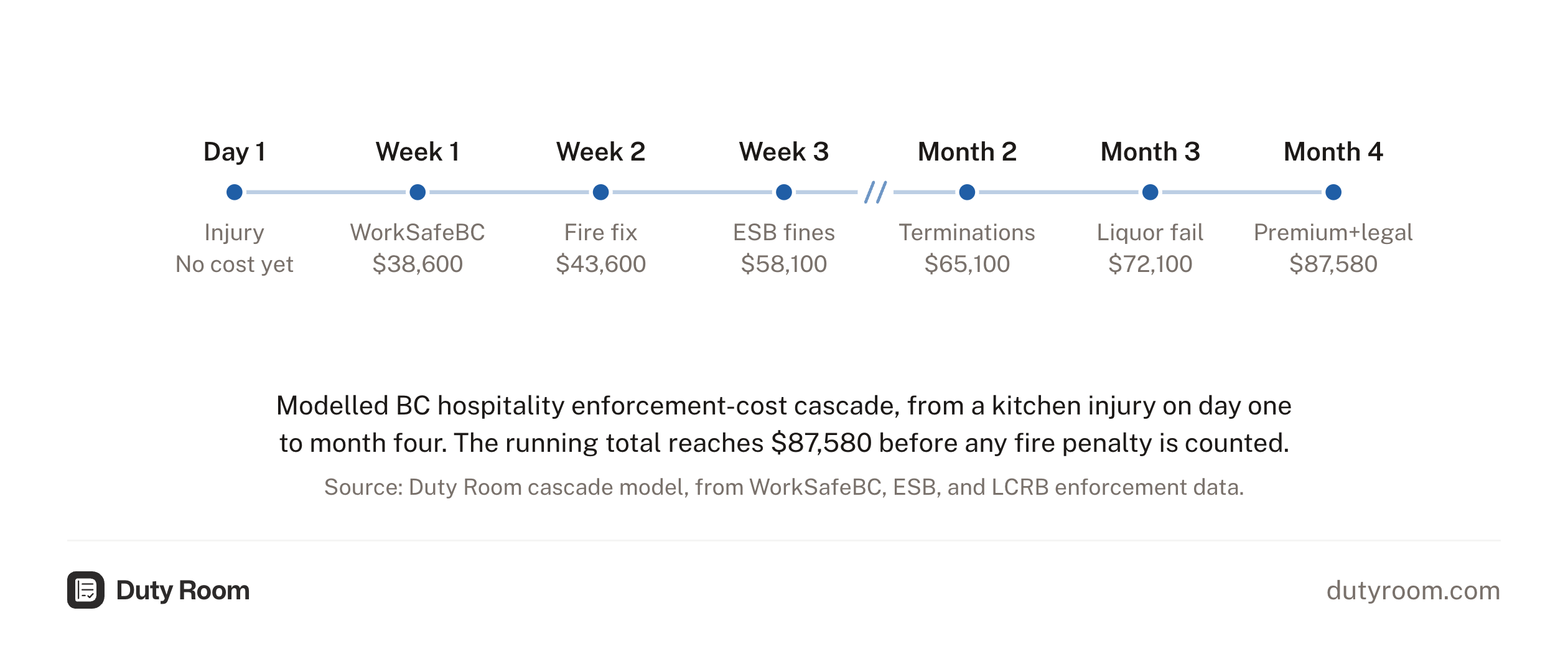
| Point | Event | Running total |
|---|---|---|
| Day 1 | Kitchen injury | $0 |
| Week 1 | WorkSafeBC penalty and replacement labour | $38,600 |
| Week 2 | Fire remediation | $43,600 |
| Week 3 | ESB initial violations | $58,100 |
| Month 2 | Two terminations | $65,100 |
| Month 3 | Liquor licence failure | $72,100 |
| Month 4 | Premium increase and legal costs | $87,580 |
Day 1: The Slip
A line cook loses his footing on a grease-slicked floor near the fryer station. He catches himself on the prep counter but his wrist takes the impact. Fractured scaphoid. Done for six weeks.
Slips like this are routine in the data: falls cause 24.5% of all hospitality injuries in BC, according to the BCIRPU Injury Data Online Tool. In 2023, the sector recorded 1,240 fall-related time-loss claims alone. Fractures have increased 32% over the past 23 years, even as total hospitality injuries declined.
One worker in this industry files a time-loss claim every 104 minutes, around the clock, all year. The total over 23 years: 118,705 accepted claims.
The cook goes to the hospital. The manager files a WorkSafeBC injury report. The night continues.
Week 1: WorkSafeBC Shows Up
The injury report triggers what happens next. WorkSafeBC is both insurer and enforcer in BC. When a claim lands, an inspection often follows. In 2023, WorkSafeBC wrote 54,551 inspection reports across all sectors and issued 40,888 health and safety orders. Orders to tourism and hospitality businesses rose 55% between 2021 and 2024, from 1,689 to 2,614, according to WorkSafeBC's industry health and safety data, and the share of inspections that produce orders has climbed from 22% to 28%.
The inspector walks in during prep. She finds four problems before she finishes the kitchen:
- Grease trap overdue for maintenance (slip hazard and fire hazard)
- No wet floor signage protocol documented
- Incomplete orientation records for two workers hired last month
- First aid kit missing supplies
Health and safety orders are issued. The restaurant has a fixed window to comply.
If those orders aren't followed, an administrative monetary penalty lands. The average WorkSafeBC AMP in 2025 was $33,415, according to WorkSafeBC's Admin Penalties Backgrounder. That's nearly 60% higher than the 2024 average of $21,053. The agency issued $13.7 million in penalties in 2025 on just 410 cases: an 80% increase in total dollars on a 14% increase in volume. Penalties are getting bigger, fast.
For this restaurant, the AMP comes in at $33,000. The statutory maximum in 2026 is $816,148.69. In December 2025, EllisDon Corporation received a single penalty of $514,831 for crane-related safety failures. Our restaurant's $33,000 is on the moderate end.
The injured cook's claim averages 35 lost days for a restaurant worker. At average hospitality wages, that's roughly $5,600 in replacement labour to cover his shifts. And the experience rating adjustment hasn't hit yet.
Running total: $38,600.
Week 2: The Fire Department Connects the Dots
The grease trap finding doesn't stay in WorkSafeBC's file. A grease-clogged exhaust hood is a fire hazard, and fire departments pay attention.
Vancouver Fire Rescue Services conducted 20,481 life safety inspections in 2024. Surrey did another 8,034. Across Vancouver, 12.3% of inspections found violations. Surrey's initial compliance rate dropped from 79% to 74% over five years, according to both departments' 2024 annual reports.
The fire inspector finds three problems: hood suppression system overdue for certified service, a fire exit blocked by delivery boxes, and occupancy capacity signage missing from the dining room.
Since August 1, 2024, BC has had a new Fire Safety Act, replacing the old Fire Services Act. It introduced administrative monetary penalties for the first time: up to $25,000 for individuals, up to $50,000 for corporations. This regime is brand new. No published penalties exist yet, which means no operator knows where the enforcement line falls.
Under the new regime, AMPs attach to non-compliance with an inspector's order, an evacuation order, or a record request, not to the inspection findings themselves. The exposure of up to $50,000 for a corporation lands if the problems aren't fixed. No published penalties exist yet under this Act, so the actual enforcement level is unknown. Remediation costs (hood service, exit clearing, signage) run roughly $5,0001. In 2024, BC recorded 12,072 fires with $663 million in total losses provincially, per the Office of the Fire Commissioner's 2024 Annual Statistical Report.
Running total: $43,600 (excluding the fire AMP, which has no published precedent to benchmark).
Week 3: The Employee Reads His Pay Stubs
The cook is at home with a cast on his wrist and time on his hands. He's collecting WorkSafeBC disability payments, going through his records, and noticing things.
Overtime shifts over the past six months were paid at straight time. The Christmas Day shift wasn't paid at the statutory holiday premium rate. His last vacation payout was short by about $400.
He files a complaint with the Employment Standards Branch. The ESB published 4,472 violation records between March 2022 and January 2026, totalling $2,387,500 in penalties. Hospitality accounted for 665 of those violations (14.9% of the total) across 172 unique employers, based on the ESB Published Violations Register. The share is growing: hospitality went from 12% of violations in 2023 to 18% in 2025. The ESB violations report breaks down the full register.
The ESB investigator doesn't just look at the cook's file. She audits the payroll. Five contraventions: overtime not paid at 1.5x, statutory holiday premium not paid, vacation pay calculation error, incomplete payroll records, and pay statement deficiencies.
Statutory holiday violations make up about a third more of hospitality's violation profile than the all-sector average, based on the ESB sector analysis. Overtime and holiday pay are disproportionately common findings in food and beverage businesses.
The penalties: $500 per contravened section, with repeats of the same section within three years escalating to $2,500, then $10,000. Five contraventions produce $2,500 in administrative penalties. But the back-pay determination covers the cook and every similarly affected employee. The order comes in at $12,000. Only 35% of ESB complaints resolve within 180 days, per the Ministry Service Plan. This will drag on.
Running total: $58,100.
Month 2: The Terminations
The owner is looking at $58,000 in costs and counting. Cash flow is tight. Insurance premiums are going up. The fire remediation bill just cleared.
Under pressure, the manager terminates two underperforming servers. No written notice. No termination pay. Just a Friday conversation and a final cheque that doesn't include what's owed.
This is the single most common employment standards violation in BC. Termination pay under s.18 accounts for 20.5% of all ESB violations. Both servers file complaints. Two more contraventions, two more penalties ($1,000 total), and two more back-pay orders totalling $6,000 in termination pay.
The average ESB investigation produces 3.0 separate contraventions. The top hospitality offender in the published register accumulated $12,000 across 24 violations. ESB violation records jumped 61% from 2023 to 2025, from 1,108 to 1,785 per year.
Running total: $65,100.
Month 3: A Teenager Walks Into a Bar
The LCRB runs its Minors as Agents Program. A 16-year-old, trained and supervised by LCRB enforcement, walks into the restaurant and orders a beer.
The server is new. She was hired two months ago to cover the shifts left open after the kitchen injury shuffled the schedule. She has her Serving It Right certification. Every liquor-serving employee in BC needs it. But SIR certification is an online course: up to four hours, valid for five years. It covers the law. It doesn't cover the 9 p.m. Friday rush when a teenager who looks 22 orders a Pilsner.
The server doesn't ask for ID. The agent is served.
Selling liquor to a minor accounts for 62% of accepted enforcement waivers, per the LCRB Waiver Summary Report 2025. Of 208 waivers accepted in 2025, 128 were for this exact scenario.
The statutory range for a first contravention is $7,000 to $11,000, or a 7- to 11-day licence suspension. The LCRB's standard waiver offer is $7,000 or 7 days, the minimum. Our restaurant faces a choice: pay the $7,000 monetary penalty or accept the 7-day licence suspension. Daily revenue at $2 million annually: $5,479. Seven days: $38,356 in lost revenue. The suspension costs 5.5 times more than the fine. Yet in minor-service cases, 68% of licensees choose the suspension anyway. Many can't produce $7,000 in cash on short notice.
Our restaurant pays the $7,000. Contesting it would cost $5,000 to $15,000 in legal fees, and the due diligence defence requires a level of documentation this restaurant never built. (For the specific systems that succeed and fail at hearing, see the due diligence playbook.) The 85 to 90% waiver acceptance rate suggests most operators don't contest.
Running total: $72,100.
Month 4: The Bill That Keeps Coming
WorkSafeBC's experience rating system operates on a lag. Claims take time to process, and premium adjustments apply to the next assessment period. But they do apply.
The cook's fracture claim drives a surcharge. The restaurant's premiums increase by 30 to 50%. On a base premium of $8,700, that's an additional $2,600 to $4,350 per year. This is not a one-time cost but an annual increase that persists until the claims history improves.
Hotels face even steeper exposure. Their base rate is $1.32 per $100 of payroll versus $0.58 for restaurants, per go2HR's Accommodations profile. A 40% surcharge on the same $1.5 million payroll adds $7,920 per year.
And there's one more landmine, though it has since narrowed. Through 2024, WorkSafeBC reassessed restaurants that excluded tips from the payroll calculations used for premiums; one restaurant was hit with a $20,000 retroactive assessment plus a $5,000 penalty in the BCRFA vs. WorkSafeBC dispute of 2023 to 2024. Updated guidance effective January 1, 2026 means cash tips no longer count toward assessable payroll unless they already appear on a T4.
Running total: $87,580 (including $3,480 annual premium increase and $12,000 in legal costs across proceedings)2.
The Cascade vs. the Worst Case
That's the modelled bad year. Four months, four regulators, $81,580 to $92,580 depending on back-pay outcomes, before any fire AMP. The fifth regulator, the health authority, arrives only in the worst case below.
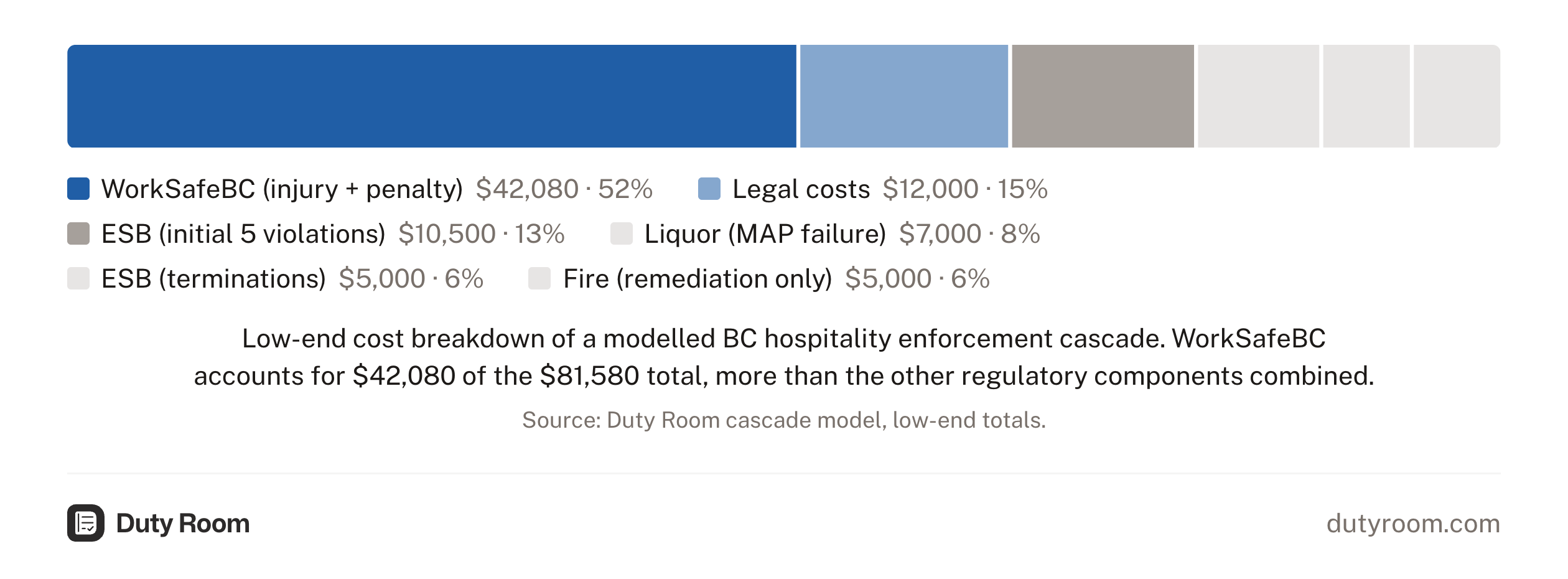
| Component | Direct penalties | Back-pay / orders | Other indirect | Subtotal |
|---|---|---|---|---|
| WorkSafeBC (injury + AMP) | $33,000 | -- | $5,600 replacement + $3,480/yr premium | $42,080 |
| Fire (remediation only)3 | -- | -- | $5,000 remediation | $5,000 |
| ESB (initial 5 violations) | $2,500 | $8,000-$15,000 | -- | $10,500-$17,500 |
| ESB (terminations) | $1,000 | $4,000-$8,000 | -- | $5,000-$9,000 |
| Liquor (MAP failure) | $7,000 | -- | -- | $7,000 |
| Legal costs | $12,000 | -- | -- | $12,000 |
| Cascade total | $55,500 | $12,000-$23,000 | $14,080 | $81,580-$92,580 |
The worst-case year goes further. Take the second liquor contravention as a suspension instead of a penalty, add a fire AMP under the new Act (modelled modestly, since no published precedents exist) and a three-day food safety closure, and the model reaches $186,0004. That is the ceiling of this model, not a likely outcome. Most of the increase comes from indirect costs: lost revenue during suspensions and closures, premium increases, and back-pay orders, which in this model run roughly double the direct penalties.
Most operators won't hit the full $186,000. But the cascade scenario, where routine enforcement actions from different regulators land on the same business in a compressed window, is not exotic. None of the individual events is rare. A kitchen slip is statistically expected: with 5,053 time-loss claims in hospitality in 2023, that's about 14 injuries per day across BC, and falls account for a quarter of them. The MAP program produced at least 128 liquor-minor waiver cases in 2025 alone. Published ESB violation records rose from 1,108 in 2023 to 1,785 in 2025, and hospitality's share is growing, not shrinking. Vancouver alone conducted 20,481 fire inspections in 2024.
The kitchen slip didn't cause the ESB violations or the liquor offence. Those compliance gaps were already in place. The injury report is what brought the first inspector through the door.
The $21,000 Alternative
What does it cost to not be this restaurant?
| Investment | Annual cost |
|---|---|
| Staff training (SIR, FoodSafe, WHMIS, orientation) | $3,000-$5,000 |
| Compliance software (checklists, records, logging) | $2,400-$6,000 |
| go2HR COR program (WorkSafeBC premium rebate up to 10%) | $1,000/yr maintenance |
| Quarterly self-audits (internal staff time) | $1,500-$3,000 |
| External compliance consultant (annual review) | $2,000-$5,000 |
| Policy documentation (one-time, amortized) | $1,000-$2,000 |
| Total | $10,900-$21,000 |
That covers all five domains: training current, records clean, policies written and followed, and self-audits catching problems before inspectors do. A COR certification earns back up to $870 per year in premium rebates. Most of the cascade also leaves a public record: ESB violations are published by employer name, LCRB waivers appear in the annual waiver summaries, contested hearings are published on CanLII, and WorkSafeBC maintains a searchable penalty database. Visibility varies by regulator (inspection orders and fire deficiencies generally are not published), but the penalty trail is findable by anyone who looks.
The annual cost of the compliance program ($10,900 to $21,000) sits in the same range as a single moderately bad enforcement year: one liquor waiver, one ESB investigation, one food safety ticket ($11,730 to $16,730)5. The cascade modelled above is several times more expensive, and it starts with events that happen routinely: a kitchen slip, a missed termination cheque, a server who doesn't ask for ID.
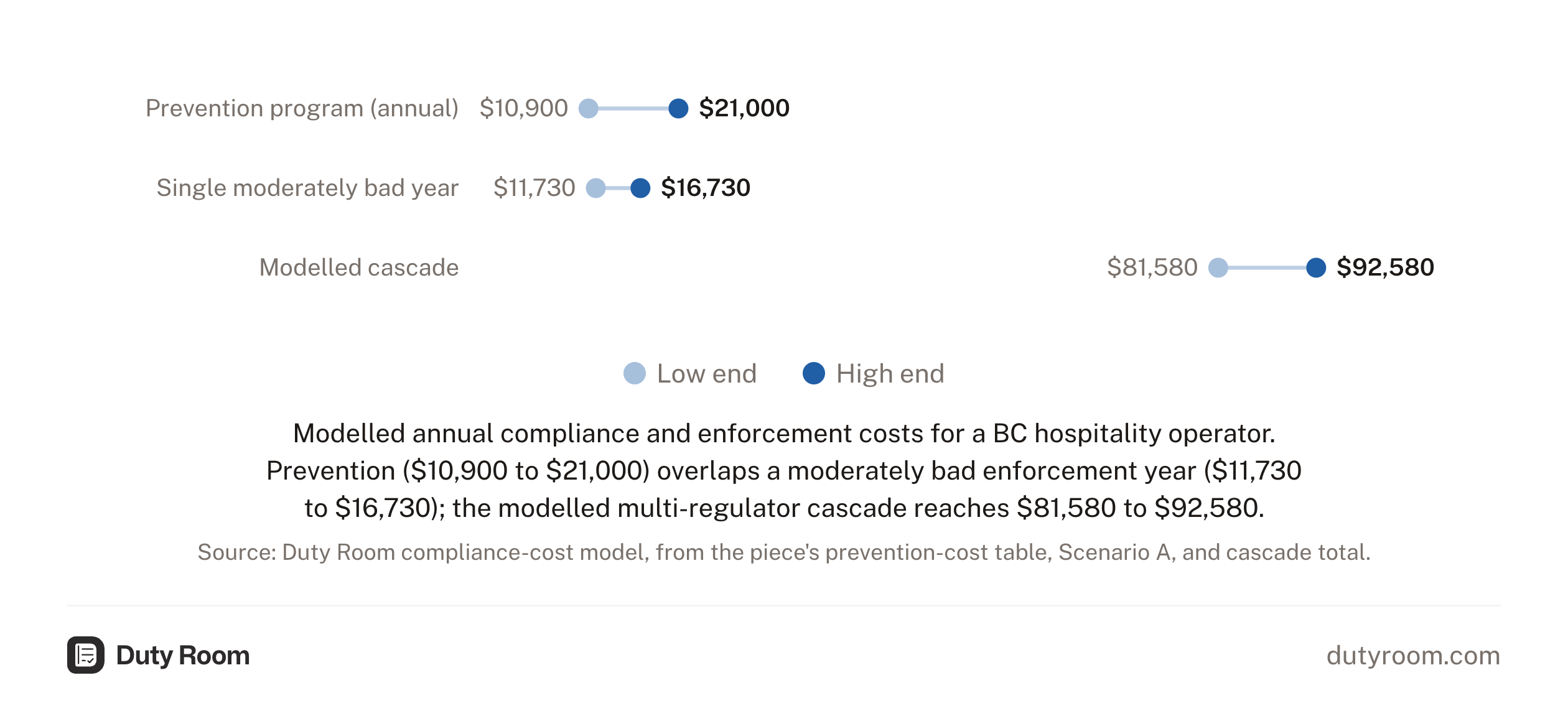
| Tier | Low end | High end |
|---|---|---|
| Prevention program (annual) | $10,900 | $21,000 |
| Single moderately bad year | $11,730 | $16,730 |
| Modelled cascade | $81,580 | $92,580 |
For multi-location operators (73 hold five or more liquor licences in BC), the exposure scales with each site. Enforcement records are public across most of these domains, and a compliance gap at one location is likely present at others.
-
Remediation estimate based on typical commercial kitchen hood service ($2,000-$3,000), fire exit clearing, and signage replacement. Actual costs vary by premises and contractor.
-
Running total components: $33,000 WorkSafeBC AMP, $5,600 replacement labour, $5,000 fire remediation, $2,500 ESB penalties (5 contraventions), $12,000 ESB back-pay, $1,000 ESB termination penalties, $6,000 termination back-pay, $7,000 LCRB penalty, $3,480 premium increase, and $12,000 legal costs, totalling $87,580. Back-pay estimates use ranges; $87,580 uses mid-range figures.
-
Fire AMP excluded from the cascade total. The Fire Safety Act (in force August 1, 2024) authorises AMPs up to $50,000 for corporations, but no penalties had been published under this regime as of March 2026, so there is no real-world figure to include.
-
The $186,000 worst case: a second minors offence taken as a 14-day suspension ($76,712 in lost revenue at $5,479/day; Schedule 2 offers a penalty or a suspension, not both), a $33,000 WorkSafeBC AMP with the premium increase and replacement labour, five ESB violations with $15,000-$25,000 in back-pay, a three-day food safety closure ($1,035 in tickets, $16,438 in lost revenue, $5,000 remediation), a $10,000 fire AMP plus $5,000 remediation, and $12,000 in legal costs: $185,765-$195,765. These are worst-case assumptions stacked together, not observed co-occurrences.
-
The model's typical bad year: one LCRB MAP waiver at $7,000, an ESB investigation finding three contraventions ($1,500 in penalties plus an estimated $3,000-$8,000 back-pay order), and one $230 food safety violation ticket: $11,730-$16,730.
This report is based on published enforcement data, sources available at publication, and original analysis. It is for general information only and doesn't constitute legal advice.
Track compliance across all five domains
Duty Room organises checks, evidence, and training records across fire safety, food safety, workplace safety, liquor, and employment. All by site.