Different records, different denominators
BC Minor-Related Waivers and Annual ID Checks
Minor-related liquor offences account for 70 of 133 liquor-class contravention rows in the LCRB waiver workbook retrieved on 2 October 2026: 52.6%. The file contains 139 rows in total, including six cannabis rows, attached to 123 case numbers.
A row records an accepted waiver for a contravention. It is not necessarily a separate case or a confirmed Minors as Agents test purchase. The title identifies the offence; the workbook does not identify the investigative route for every row.
The rolling window changed
| Snapshot retrieved | All rows | All cases | Liquor rows | Liquor minor-related rows | Signing-date coverage |
|---|---|---|---|---|---|
| 2026-03 | 254 | 216 | 244 | 157 | 2025-01-01 to 2025-12-31 |
| 2026-07-10 | 242 | 210 | 230 | 132 | 2025-06-12 to 2026-06-10 |
| 2026-10-02 | 139 | 123 | 133 | 70 | 2026-01-06 to 2026-06-30 |
The current file's 133 liquor rows belong to 117 cases; its six cannabis rows belong to six cases. The liquor minor-related share is 70/133 (52.6%). Against all classes it is 70/139 (50.4%); counting both liquor and cannabis minor-related titles gives 76/139 (54.7%). Those are three different denominators.
The file has fewer rows than July because its signing window is shorter. Of July's 242 rows, 127 have signing dates in January-June 2026. All 127 also occur in the current file, which has 12 additional rows and extends through 30 June. The March and July files overlap by 115 contravention identities. They must not be added together as independent annual totals.
Even within a shared signing interval, these are published accepted-waiver records, not all enforcement actions. Signing dates can lag offence dates; the current offences span November 2023-June 2026. Revisions and removals are tracked separately in the archive. The smaller current file does not show falling inspections or less enforcement.
The annual government-store series
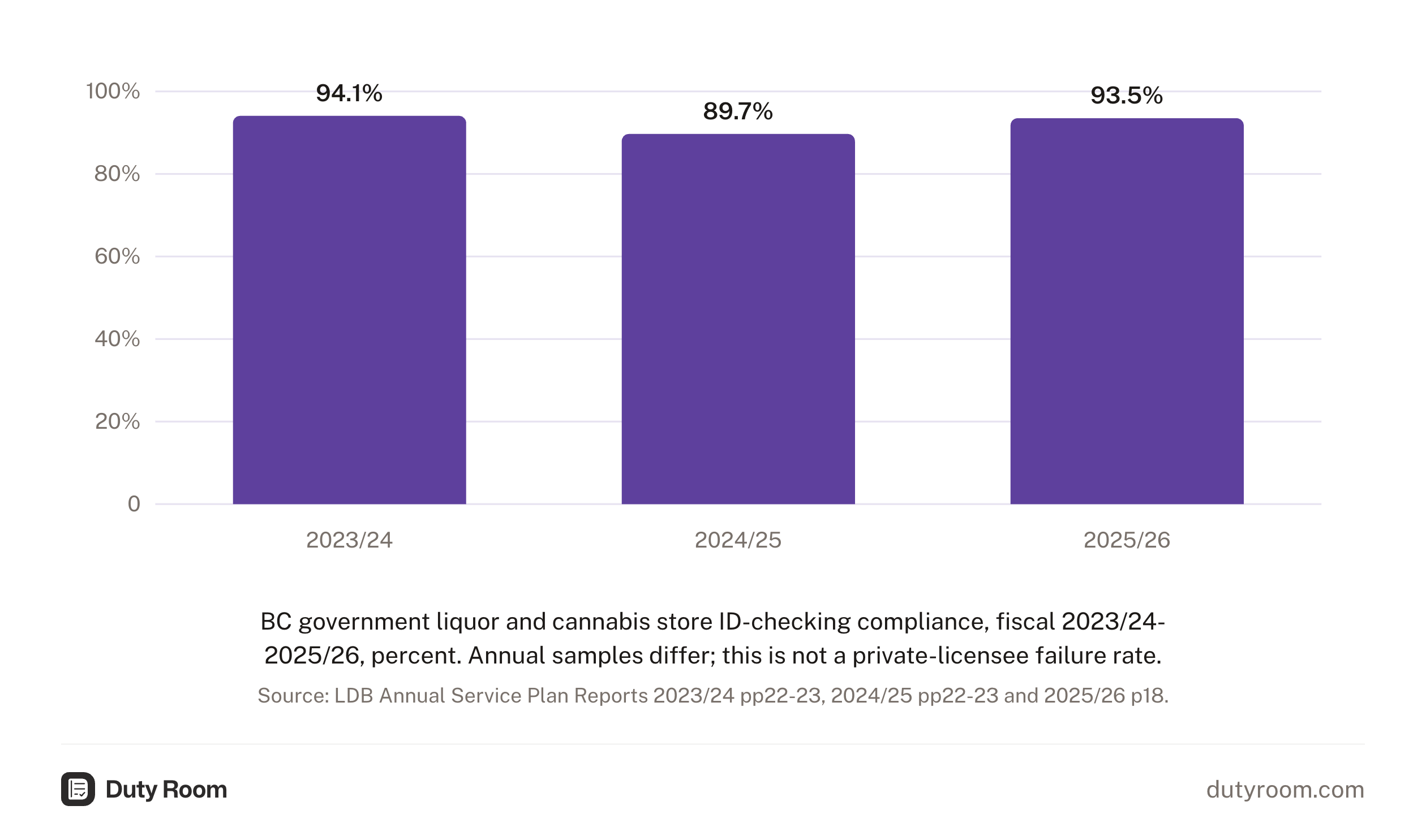
| Fiscal year | Combined compliance % | Liquor sample | Cannabis sample |
|---|---|---|---|
| 2023/24 | 94.1 | 64 BCL checks | 21 BCCS checks |
| 2024/25 | 89.7 | 25 BCL checks | 4 BCCS checks |
| 2025/26 | 93.5 | 26 BCL locations inspected | 5 BCCS locations inspected |
These annual LDB actuals combine BCLIQUOR (BCL) and BC Cannabis Stores (BCCS). The 2025/26 report separately gives 92.3% for BCL and 100% for BCCS. Earlier reports describe numbers of checks; the newest describes locations inspected. We retain that wording rather than assume checks and locations are interchangeable.
The combined rate moves from 94.1% to 89.7% to 93.5%, with different small annual samples. It is not a rate for all BC retailers. The waiver workbook supplies neither the number of private-sector tests nor all their outcomes, so it cannot yield a comparable private-sector pass rate.
What the program tests
The Minors as Agents Program tests age-verification practices using minors. A minor-related offence in an accepted waiver is consistent with the program's subject, but the offence title alone does not prove that the record resulted from a program test. The operational point is to verify age and refuse a sale when the required identification is not produced.
Penalties and the choice of outcome
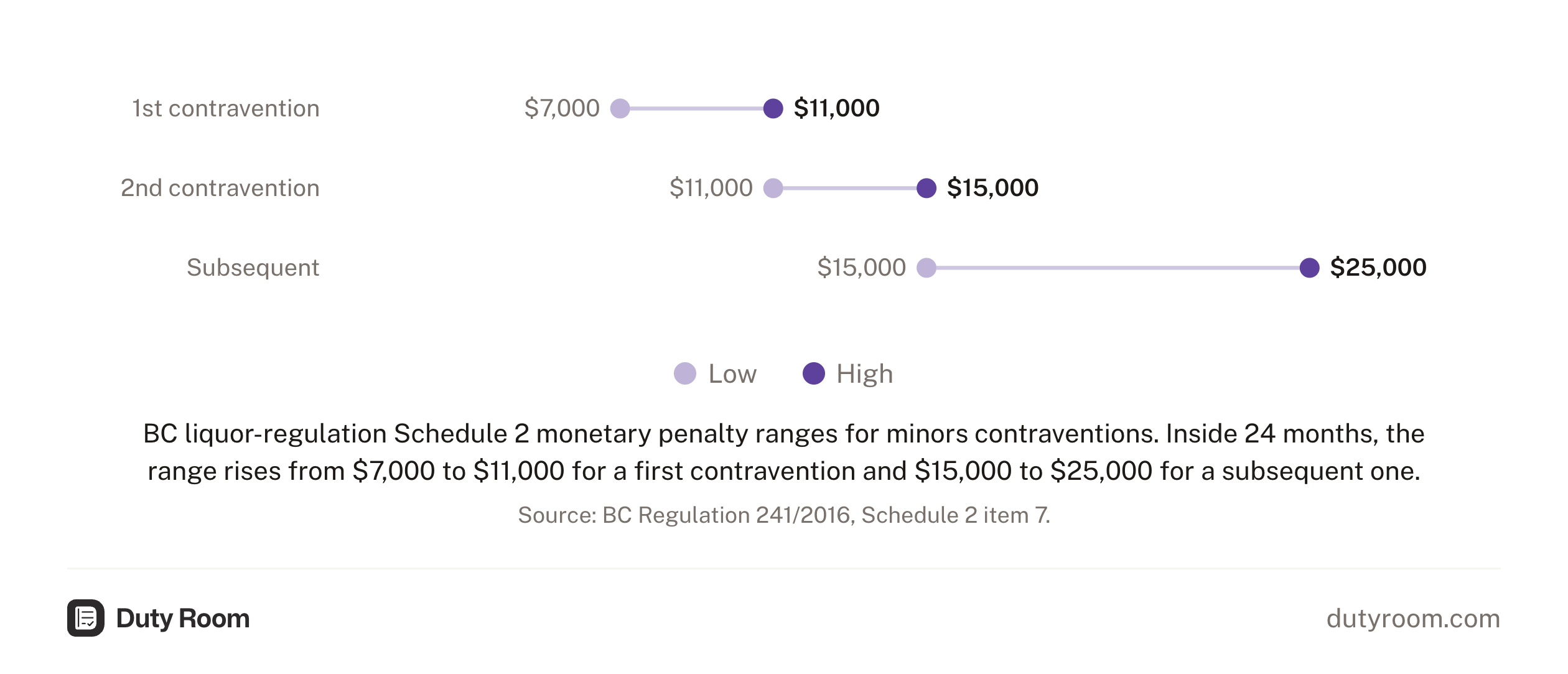
Schedule 2 provides escalating administrative penalties for supplying liquor to a minor:
| Contravention | Monetary penalty | Licence suspension |
|---|---|---|
| 1st contravention | $7,000 to $11,000 | 7 to 11 days |
| 2nd contravention | $11,000 to $15,000 | 11 to 21 days |
| Subsequent | $15,000 to $25,000 | 21 to 41 days |
For a licence, Schedule 2 item 7 (supplying liquor to a minor) applies the same-item, 24-month escalation rules. First contraventions carry $7,000-$11,000 or a 7-11 day suspension; second contraventions $11,000-$15,000 or 11-21 days; subsequent contraventions $15,000-$25,000 or 21-41 days. These are statutory bands, not annual enforcement observations. The source records monetary penalties and suspension days separately; adding them into a single monetary total would be wrong.
For a restaurant assuming $2 million in annual revenue spread evenly over 365 days, seven days is approximately $38,356 in gross revenue. That is an illustrative scenario, not measured lost profit or evidence of why a licensee accepted a particular outcome.
Documentation matters at the premises
The due-diligence playbook discusses a defined historical decision sample. It is not a forecast of the odds of winning a new case. Operators can keep dated briefing records, certification checks and refusals logs, and review whether their policies are applied at each location. Those records document the system in use; they do not guarantee a defence.
The March waivers-by-city report retains its pinned historical numerator and denominator. Neither that report nor these rolling files identify when or where the next test purchase will occur.
Sources and method
Duty Room archived the rolling waiver workbook on 2 October, alongside its March and July predecessors. Row identity uses case number, regulatory class, contravention title and offence date; a separate comparison retains changes to signing date, penalty and packed identity. Minor-related means the title contains “minor,” with liquor and cannabis classes reported separately.
Annual actuals come from the 2023/24 LDB report, the 2024/25 report, and the 2025/26 report. The statutory penalty schedule remains a separate source from both datasets.
This report is based on published enforcement data, sources available at publication, and original analysis. It is for general information only and doesn't constitute legal advice.
Keep each site's ID and training records in one place
Make folders for each site and upload refusal logs, briefing records and Serving It Right certificates. Every file shows who uploaded it and when.