This is Duty Room for Canada. We have a version for your country.

Duty Room
Data: 2019-2026

One violation opens another file

Multi-Domain Offenders: When One Violation Leads to Another

A craft brewhouse in White Rock had an employee drinking on shift and served liquor after hours in October 2024. Fourteen months later, the Employment Standards Branch hit the same operator with eight separate violations: minimum wage, overtime, paydays, termination pay, statutory holidays, payroll records, deductions, and employment termination. Two regulators, ten violations, $6,000 in penalties. Nobody connected the dots between the two files.

We cross-referenced three separate BC regulator data sources to find operators who appear in more than one. The LCRB's waiver records (254 contraventions, February 2023 to November 2025), the ESB's published violations register (4,472 records, 2022-2026), and Fraser Health's violation tickets (112 records, 2019-2026), matched against the LCRB's licence register of 10,572 active licences. The result is the first public cross-domain enforcement analysis for BC hospitality.

One operator appears in both LCRB and ESB enforcement records. Multi-site operators with five or more liquor licences are 3.5 times more likely to face LCRB enforcement than licensees overall. And 38% of restaurants ticketed by Fraser Health for food safety violations also hold liquor licences, meaning they answer to multiple regulators simultaneously. The regulators themselves don't appear to share notes.

One Business, Two Regulators, One Pattern

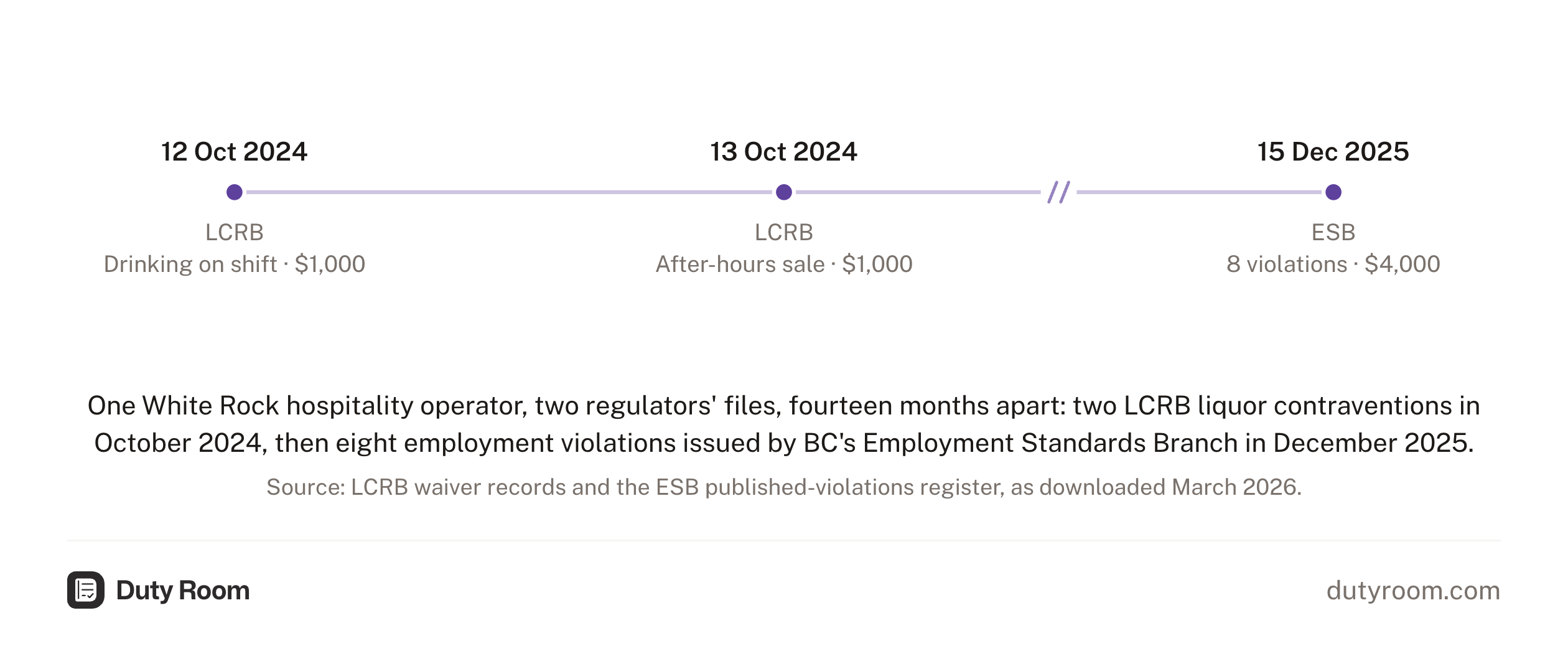
The White Rock craft brewhouse from the top of this report is the single confirmed match between LCRB and ESB enforcement records. The LCRB issued two contraventions on consecutive days in October 2024: an employee consuming liquor while working ($1,000) and selling liquor outside permitted hours ($1,000). Then in December 2025, the ESB issued eight violations against the same entity: minimum wage, overtime, paydays, termination pay, statutory holidays, payroll records, deductions, and employment termination, each carrying a $500 penalty.

Timeline of three dates. October 12 2024: LCRB contravention for an employee consuming liquor while working, $1,000. October 13 2024: LCRB contravention for selling liquor outside permitted hours, $1,000. Fourteen months later, December 15 2025: the Employment Standards Branch issues eight violations at $500 each against the same operator.
One White Rock hospitality operator, two regulators' files, fourteen months apart: two LCRB liquor contraventions in October 2024, then eight employment violations issued by BC's Employment Standards Branch in December 2025.Source: LCRB waiver records and the ESB published-violations register, as downloaded March 2026.
Regulator Date What Penalty
LCRB 2024-10-12 Employee consuming liquor on shift $1,000
LCRB 2024-10-13 Selling liquor outside permitted hours $1,000
ESB 2025-12-15 Minimum wage violation $500
ESB 2025-12-15 Overtime wage violation $500
ESB 2025-12-15 Payday violation $500
ESB 2025-12-15 Termination pay violation $500
ESB 2025-12-15 Statutory holiday violation $500
ESB 2025-12-15 Payroll records violation $500
ESB 2025-12-15 Deductions violation $500
ESB 2025-12-15 Employment termination violation $500

Total: $6,000 across ten violations in two regulatory domains. The two files even sit at different premises of the same operator: the LCRB contraventions at its licensed premises, the ESB violations at a second White Rock address. The employee who was drinking on shift and the staff who were underpaid may not even be the same people. That makes the finding sharper, not weaker: the failures span the operator, not one bad shift at one location. The LCRB and ESB each saw their piece. Neither saw the whole operator.

The business is identified from public regulator data but is not named here. The analytical point is the pattern (two regulators, same operator, between late 2024 and late 2025), not the identity of any individual operator.

Multi-Site Operators: 3.5 Times the Enforcement Rate

Seventy-three operators hold five or more LCRB licences in BC, controlling 652 licences between them, 6.2% of all licences on the register. Six of those 73 (8.2%) appeared in the LCRB waiver data1. Across all 8,622 unique licensees, the background rate is 2.3%.

That's a 3.5x over-representation.

Two horizontal bars. Multi-site operators with five or more licences: 8.2%, 6 of 73. All licensees: 2.3%, about 202 of 8,622.
Licensees appearing in LCRB waiver records, February 2023 to November 2025
GroupIn waiver recordsGroup sizeShare
Multi-site operators (5+ licences)6738.2%
All licensees~2028,6222.3%
Share of BC liquor licensees appearing in the LCRB's waiver records, February 2023 to November 2025: operators holding five or more licences show up at 3.5 times the all-licensee rate.Source: Duty Room analysis of the LCRB waiver report and licence register, downloaded March 2026.

The explanation is partly mechanical: more locations means more chances to be tested. But that is exactly the point. A compliance gap that exists in one location probably exists in five. And in early 2025, the LCRB appears to have run a province-wide test-purchase sweep that caught several of BC's largest chains.

Operator Licences Contravention Date Penalty
Northland Properties Corporation 38 Selling liquor to a minor (x2 locations) Jan-Feb 2025 $14,000
Huber Developments Ltd. 20 Selling liquor to a minor Jan 2025 7-day suspension
White Spot Limited 18 Selling liquor to a minor Feb 2025 $7,000
GolfBC Holdings Inc. 8 Selling to minor + untrained server Mar 2025 $8,000
Moxie's Restaurants Management Inc. 5 Selling liquor to a minor Jan 2025 $7,000
Kitanoya Marketing Corp. 5 Selling liquor to a minor May 2025 $7,000

Licence counts are from the LCRB licence register as downloaded in March 2026. The register moves as licences are issued, transferred, and expire, so current counts will differ.

Selling liquor to a minor appears in every row. GolfBC's $8,000 also folds in a single untrained-server penalty, the group's one contravention of any other kind. The concentration strongly suggests a coordinated MAP test-purchase operation in Q1-Q2 2025. The chains didn't fail on different things. They failed on the same thing, across different cities, in the same window. Selling liquor to minors accounts for 62% of accepted waivers2, and the enforcement heat map shows how MAP deployment patterns vary by geography.

The Huber Developments Cross-Domain Case

Huber is the closest thing the data has to a multi-site operator appearing in both LCRB and ESB enforcement records, and the connection runs through a franchise brand. On January 29, 2025, one of Huber's locations received a 7-day licence suspension for selling liquor to a minor. Eight days later, on February 6, a numbered company operating a Ricky's All Day Grill (0851969 B.C. Ltd.) was penalised by the ESB for prohibited-practices and recruitment-fee violations under the Temporary Foreign Worker Protection Act. Huber operates Ricky's All Day Grill franchises; whether this particular company is Huber-owned or an independent franchisee of the same brand, the public record doesn't say.

Selling to a minor at one location on January 29. Recruitment-fee violations at another on February 6. Eight days apart, two different regulators, and a connection that runs through a brand rather than a single corporate name.

38% of Food Safety Violators Also Hold Liquor Licences

Of Fraser Health's 74 unique ticketed facilities, 28 (38%) also hold active liquor licences3.

These are dual-regulated businesses. A restaurant ticketed for unsafe food temperatures or unsanitary premises is simultaneously subject to LCRB rules about service practices, capacity limits, and staff training. Nothing in the public record suggests a food safety violation triggers a liquor review, or that the LCRB checks whether an establishment has outstanding health authority tickets. Each regulator maintains its own file on the same premises.

The 38% figure comes from Fraser Health's jurisdiction, which covers Surrey, Burnaby, and surrounding municipalities. Fraser Health is one of five BC health authorities. The proportion may differ in Vancouver Coastal Health or Interior Health regions, but the underlying pattern holds: a large share of food service businesses also serve alcohol, and compliance in one domain says nothing about compliance in the other.

None of the 28 dual-regulated facilities with food safety tickets appeared in the LCRB waiver data. There are no confirmed triple-domain failures (food, liquor, and employment) in the current data. That absence likely reflects data limitations rather than compliance reality. The LCRB waiver data covers February 2023 to November 2025, Fraser Health's tickets span 2019-2026 with an 18-month gap, and the ESB register runs from 2022-2026. Better temporal overlap would produce more matches.

The Pattern: Violations Cluster, Regulators Don't Appear to Coordinate

The confirmed multi-domain case follows a structure. The LCRB contravention came first. Fourteen months later, the ESB issued a separate cluster of employment violations against the same operator. The operational problems that produce a liquor contravention (poor staff management, weak internal controls, cost-cutting on training) are the same problems that produce wage violations, missing payroll records, and unpaid statutory holidays.

This doesn't look like a cascade where one inspection triggers the next. Nothing in the public record suggests BC's regulators share enforcement data or coordinate inspections: no published protocol has the LCRB notifying the ESB when it penalises a licensee, the ESB checking the LCRB's waiver reports before investigating an employer, or Fraser Health cross-referencing its ticketed facilities against either. The statute points the same way: the Liquor Control and Licensing Act bars the LCRB from disclosing what it learns under the Act except for its own enforcement, with the licensee's consent, in legal proceedings, or to law enforcement, none of which routes information to the employment or health regulators. As far as the public record shows, each regulator operates in its own lane, responding to its own complaints and running its own programs. The province's own health office describes the same silo from the policy side: the Provincial Health Officer's May 2026 alcohol report recommends a cross-government alcohol strategy because, without one, ministries' alcohol objectives "can be at odds with one another."

The clustering is driven by the operator, not by regulator coordination. A business that cuts corners on one obligation is cutting corners on others. The operator whose employee was drinking on shift at one White Rock premises wasn't paying staff correctly at another. That reads less like coincidence than like the same management failure showing up wherever a regulator happens to look.

For operators managing compliance across multiple domains, this creates a specific risk: fixing the problem one regulator found doesn't fix the problems the others haven't found yet. An LCRB penalty is a signal that the ESB would find something too, if anyone filed a complaint. The $186,000 worst-case year models what happens when several regulators reach the same operator within a few months of each other. The case documented here shows that clustering can happen naturally, without any coordination at all.

What the Data Covers

Five data sources:

Source Records Coverage
LCRB waiver (contravention) records 254 Feb 2023-Nov 2025 (2026 report, downloaded March 2026)
ESB published violations 4,472 2022-2026
Fraser Health violation tickets 112 2019-2026 (18-month gap, May 2022-Nov 2023)
LCRB licence register 10,572 Downloaded March 2026
Multi-site operators (5+ licences) 73 Derived from licence register

Cross-regulator name matching undercounts. The LCRB records corporate licensee names, the ESB employer names (often a DBA), and Fraser Health facility names, and numbered companies, common in BC, are largely invisible to name-based matching. The confirmed LCRB-ESB match is deliberately conservative: a second candidate match was cut as unverifiable, and the true multi-domain rate is almost certainly higher than name matching alone reveals.

ESB determinations can be appealed to the Employment Standards Tribunal. The published register reflects determinations as issued and does not record appeal status, and we have not verified whether any determination described here was appealed.

All enforcement data is as downloaded in March 2026. The LCRB refreshes its posted reports on a rolling basis, so the live data will differ.


  1. Duty Room analysis of the LCRB licence register (10,572 licences) and the LCRB 2026 Waiver Summary Report (254 records, February 2023 to November 2025), both downloaded March 2026: 6 of 73 multi-site operators (8.2%) appear in the waiver data, against about 202 of 8,622 unique licensees overall (2.3%), a 3.5x over-representation computed from the unrounded counts. A seventh candidate was a loose name match that failed manual review and is excluded.

  2. Duty Room analysis of the LCRB 2026 Waiver Summary Report (254 records, February 2023 to November 2025, downloaded March 2026): 157 records are liquor sales to minors, 62% of accepted waivers. Adding the 9 cannabis-to-minor records brings minors cases to 166 of 254 (65%), the share the enforcement heat map leads with. The minors enforcement report reads from the LCRB's later rolling file, downloaded July 2026, where liquor sales to minors are 132 of 242 accepted waivers (54.5%). The LCRB replaces the posted workbook on a rolling basis, so the windows differ; each piece states its own.

  3. Duty Room analysis of Fraser Health violation tickets (112 records across 74 facilities) cross-referenced against the LCRB active licence register (10,572 records, downloaded March 2026): 28 of 74 unique ticketed facilities also hold an active liquor licence, matched by normalised business name with manual review (name-match score of 88 or higher).

This report is based on published enforcement data, sources available at publication, and original analysis. It is for general information only and doesn't constitute legal advice.

Good intentions won't save your licence. Records will.

55% of accepted LCRB penalty waivers were for liquor sales to minors. The first offer is $7,000 or 7 days. Duty Room keeps the records due diligence stands on.

Stay informed

Get notified when we publish new reports and analysis.