The records have to predate the problem
What the LCRB Counts as Due Diligence
On the Rocks Liquor Store put its new ID logbook in place on August 9, 2025. The test purchase the store had to defend happened the day before.
That one-day gap is the whole subject of this report. An LCRB due diligence hearing is not a review of the business you run by the time you get there. It's an audit of a file, and the file is dated: the delegate judges what existed on the day the minor stood at the counter, not what management built after the enforcement notice arrived.
In 11 recent BCLCRB decisions where due diligence was raised against a selling-to-minors charge, 8 defences failed. Those licensees paid the $7,000 penalty (one served the suspension instead), and contesting typically adds $5,000 to $15,000 in legal costs1. The other 3 walked away with no penalty and no suspension. The sample is small, 11 decisions over two years, and the LCRB's approach may evolve. But read the decisions side by side and the sorting variable is consistent. The winners handed the delegate a dated file. The losers described one.
The test, and who has to pass it
Every due diligence defence at the LCRB runs through a two-stage test from R. v. Sault Ste. Marie [1978] 2 SCR 1299, applied to liquor enforcement in Beverly Corners Liquor Store Ltd. v. LCRB, 2012 BCSC 1851.
The first stage turns on whether the person who made the sale was a "directing mind" of the business. If so, the licensee cannot rely on the defence and the inquiry stops.
When a regular employee made the sale, the inquiry moves to the second stage, which asks two factual questions about the licensee's systems:
- Did the licensee implement adequate training and systems to prevent the contravention?
- Did the licensee take reasonable steps to make sure those systems were actually operating?
Great policies nobody follows fail the second question. Committed staff with no documented system fail the first.
The licensee has to convince the delegate of both: that it had good procedures, and that staff actually followed them. The delegate in 2026 BCLCRB 2, the On the Rocks decision, spelled out what that means: it isn't enough to show procedures were established; the licensee must also "clearly demonstrate that it continues to ensure that such procedures are consistently in operation and acted upon by its employees". Both halves need evidence, and the same decision names the floor it has to clear: "good intentions are not sufficient to meet the onus".
Most of these cases start the same way. Ten of the 13 decisions reviewed came from the Minors as Agents Program (MAP), the LCRB's test-purchase program: agents aged 16 to 18 walk in, try to buy, and carry no fake ID. If your server asks for ID and holds the line, nothing happens. If not, a Notice of Enforcement Action follows, and months later a delegate reads whatever your file contained on the day of the visit.
The delegate's marking scheme
The On the Rocks decision contains the closest thing this sample offers to a published marking sheet. In paragraph 62, the delegate wrote that beyond "a reasonably rigorous initial staff training environment", evidence of ongoing reinforcement "should most likely include at a minimum" seven things:
- A well-defined minimum age policy.
- Clear communication of why the policy exists, including the effect of liquor on youth.
- Appropriate signage.
- Training manuals with current best practices.
- An incident logbook that is "utilized and regularly reviewed".
- Regular staff meetings where compliance is stressed, with discussions "recorded by way of minutes".
- Written quizzes testing staff on the rules.
Every item on that list either is a document or produces one. Even the culture items, the harms discussion and the staff meetings, are expected to leave minutes and quiz papers behind. What the delegate calls "training and culture" is measured, in these decisions, in hard records: signed handbooks, dated reminders, meeting minutes, logbook entries, proof of receipt, discipline letters.
Set the three minors cases against that list, as of the day each was tested, and the outcomes mostly explain themselves. Mostly: the store that won on a "barely sufficient" file had gaps a bigger operation might not have survived, which is the sliding scale at work.
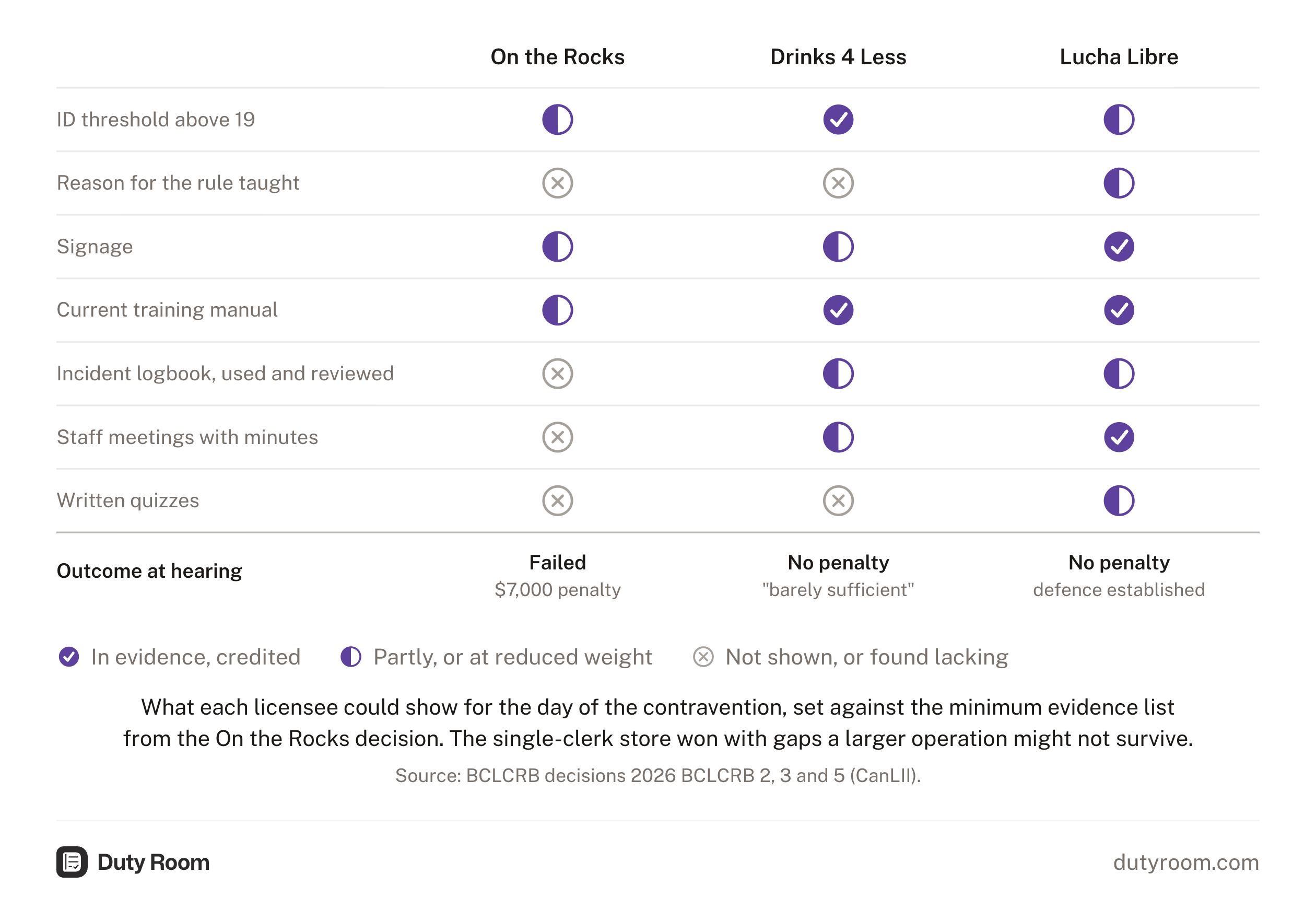
| Element | On the Rocks (failed) | Drinks 4 Less (won) | Lucha Libre (won) |
|---|---|---|---|
| ID threshold above 19 | Partial: under-25, no age-judgment training | Yes: under-40, a crucial factor | Partial: under 30/40 taught, documents said 19 |
| Reason for the rule taught | No | No; recommended afterwards | Partial: via Serving It Right, per testimony |
| Signage | Partial: no entrance sign | Partial: no under-40 policy sign | Yes |
| Current training manual | Partial: no training checklist | Yes | Yes |
| Incident logbook, used and reviewed | No: started the day after | Partial: handwriting doubts | Partial: not exhibited, less weight |
| Staff meetings with minutes | No | Partial: monthly texts credited instead | Yes: daily briefings and meetings |
| Written quizzes | No | No | Partial: verbal scenarios only |
| Outcome at hearing | Defence failed: $7,000 penalty | No penalty: defence barely sufficient | No penalty: defence established |
What a winning file looked like
Lucha Libre Taqueria, in 2026 BCLCRB 5, is the full version. A server at the Vancouver taqueria asked a MAP agent for ID and, when the agent said the ID was in the car, served the Corona anyway. The defence survived it. The file showed an employee handbook with an alcohol service policy, signed at hire; Serving It Right certification required before front-of-house work; a minimum of ten shifts of supervised shadowing; daily pre-shift briefings that covered ID checking; an incident logbook running on the 7Shifts app, open to staff on their phones; signage throughout the premises; and the server's immediate termination.
Three weeks before the test purchase, the company had sent staff a notice warning about MAP and telling them to ID anyone who looked under 30. A supervisor's evidence was that the message carried the marker "15/15": every member of staff had seen it. Drinks 4 Less, the other 2026 win, could show the same thing a different way. The owner sent monthly ID reminders to the staff group chat and, as the decision records, "is able to check who has read the messages by the checkmarks beside them".
That's the pattern across the two successful 2026 defences: reminders that were provably received, recently. A policy binder proves you wrote something down; a dated message with read receipts proves it reached the person behind the counter, days before the test.
What the losing defences couldn't produce
Licensees in the failed cases described thorough training programs, and then the delegate asked for the paperwork. Training checklists and quizzes were claimed to exist and never produced in evidence. One licensee could demonstrate three days of shadowing. Several claimed regular meetings and could show no agendas or minutes. One pointed to a whiteboard photo as proof of staff communication; the photo showed no ID reminders at all.
The delegates also graded the credibility of what was produced, and that cuts both ways. In 2024 BCLCRB 41, the JJ's Pub case, the licensee brought three pages of documents to a hearing about an employee who had yelled "liquor inspectors" as two of them came through the door. The one record on point, the employee's own logbook note of the night, was written after he had already talked to the manager, and he didn't testify. The delegate gave it "no weight", finding it "most likely made out of the employee's self-interest". Training amounted to "probably" a walk through the pub; the manager had never reviewed the terms-and-conditions handbook with staff. Drawing attention to a liquor inspector is itself a contravention, and the pub was fined $1,000, the minimum.
Drinks 4 Less won, but its incident sheets nearly hurt it: the handwriting looked the same across entries supposedly made by different staff, the manager couldn't explain why, and the delegate noted it "appears unlikely" the notes were written by different people. Lucha Libre never exhibited a page of the logbook it described, and the delegate accepted the undisputed testimony about it while giving it "less weight". A record that looks assembled for the hearing is worse than a thin one, and a described record is worth less than a produced one.
The file is judged on the day of the sale
On the Rocks is the decision to sit with, because that licensee did almost everything the marking scheme asks for. An ID and intoxication logbook. A WhatsApp reminder system with monthly messages. Quarterly re-signing of the liquor rules. An updated first-day hiring checklist.
Every one of those was dated after August 8, 2025, the day a 16-year-old MAP agent bought a six-pack of Corona at the counter. The logbook started August 9. The decision walks item by item through what existed at the store on the day of the sale: an under-25 ID policy with no training on how to judge a customer's age, no communication of why the rule matters, a POS pop-up but no entrance sign, no training checklist, no incident logbook, and no evidence of regular staff meetings. The delegate acknowledged the licensee had "since remediated" many of the gaps, found the defence failed anyway, and ordered the $7,000 minimum.
The Drinks 4 Less delegate stated the principle outright: "Post-contravention changes do not support a defence of due diligence." They show a licensee willing to improve, and that is all they show.
The calendar makes this unforgiving. Across the four decisions read for this report, the gap between the contravention and the delegate's decision ran from 102 to 302 days. A licensee has the better part of a year to build a file that matches the marking scheme, and none of that work counts.
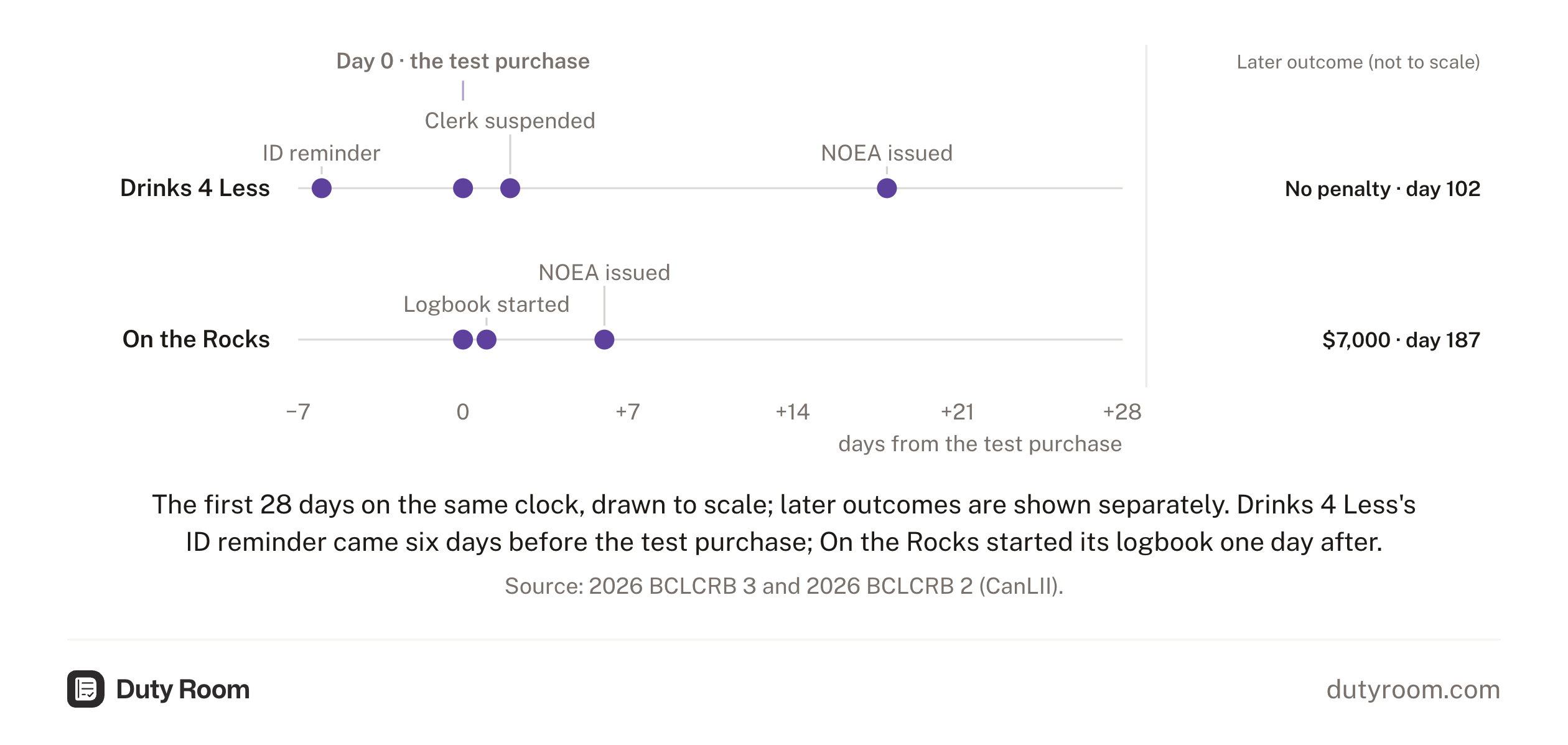
| Case | Date | Day | Event |
|---|---|---|---|
| Drinks 4 Less | November 4 2025 | -6 | ID reminder texted to the staff group chat |
| Drinks 4 Less | November 10 2025 | 0 | Sale to minor agent during a MAP inspection |
| Drinks 4 Less | November 12 2025 | 2 | Clerk suspended in writing for seven days |
| Drinks 4 Less | November 28 2025 | 18 | Notice of Enforcement Action issued |
| Drinks 4 Less | February 20 2026 | 102 | Decision: defence "barely sufficient", no penalty |
| On the Rocks | August 8 2025 | 0 | Sale to minor agent during a MAP inspection |
| On the Rocks | August 9 2025 | 1 | ID and intoxication logbook implemented |
| On the Rocks | August 14 2025 | 6 | Notice of Enforcement Action issued |
| On the Rocks | February 11 2026 | 187 | Decision: defence failed, $7,000 penalty |
The checklist: what was in the files that won
This is observed from the hearing record, not prescribed as legal advice. The standard also flexes: the delegates apply it to the size, licence type, and clientele of each operation. The three successful defences had most of it. The eight failures were missing several items, sometimes most.
-
A written alcohol service policy each employee has signed.
In the winning files the signature is on the handbook itself, dated at hire.
-
Serving It Right certification before the first shift, not within the first month.
Both 2026 winners required the certificate before staff started serving.
-
Supervised shadowing with a number attached.
Lucha Libre showed a minimum of ten shifts; Drinks 4 Less a structured two-week protocol, a week shadowing a senior clerk and a week being shadowed. Three days appeared in a failed defence and was treated as insufficient.
-
An ID threshold well above 19, written down, and the same number everywhere.
Drinks 4 Less's under-40 policy was "a crucial factor" in its win. Even in Lucha Libre's successful defence, the delegate recommended harmonizing documents that quoted different ages.
-
The reason for the rule, taught.
The marking scheme expects staff to hear why serving minors is dangerous: the effects on developing bodies and minds. Its absence was a criticism in both 2026 store cases.
-
A written quiz at the end of training.
On the delegate's minimum list. On the Rocks had no written test on the day of its sale; Drinks 4 Less won without one and the delegate still recommended adding it.
-
Recent, dated reinforcement, with proof of receipt.
Daily pre-shift briefings carried the restaurant defence; monthly texted reminders carried the single-clerk store. The read receipts, checkmarks on the group chat and a 15/15 marker on a staff notice, turned "we remind them" into evidence. On the Rocks had newsletters, but nothing showing staff had read them.
-
Staff meetings that leave minutes.
Where a one-clerk store can't hold them, the delegates accepted documented substitutes: texts, then conference calls with notes.
-
An incident logbook that is used and reviewed.
Bring pages rather than a description. The unexhibited logbook at Lucha Libre was given less weight and survived only because nothing contradicted it; the after-the-fact note at JJ's Pub got none.
-
Immediate, written consequences when the system fails.
Termination the same day in two cases; in the third, a suspension letter dated two days after the sale, signed by the clerk, with reasons and corrective steps in writing (subject to employment standards requirements).
A "check ID" prompt in the POS flow shows up on both sides of the ledger: On the Rocks had a pop-up and lost on everything around it, and the Drinks 4 Less delegate recommended adding one. The delegates treat it as reinforcement, not a defence on its own.
How small can the file be?
Drinks 4 Less, in 2026 BCLCRB 3, is the decision small operators should read. One store, usually one clerk working, no manager in post at the time of the contravention. The delegate found the due diligence evidence "barely sufficient", and said why the bar sits where it does: the standard "is not one of perfection and may vary depending on the size of a licensed establishment, the type of licence and the clientele".
Two things tipped it. The under-40 ID policy, and a text message sent to the staff group chat six days before the MAP agent walked in: "Just a friendly reminder please make sure we are checking 2 pieces of ID for everyone who looks under 40." The delegate named the recency directly, noting the reminder had gone out "as recently as six days before the contravention".
A single-clerk store doesn't need quarterly all-staff meetings with minutes. It needs the lean version of the same file: a signed policy, a real threshold, dated reminders with receipts, incident sheets that look honest. Even then the win was narrow, and the delegate said she would have liked to hear from the clerk. For a larger operation, with more staff and more shifts for standards to slip, the sliding scale runs the other way, and the expected paper grows with it.
The one thing paper can't prove
The On the Rocks employee asked the minor for ID. The minor patted their pockets and said they didn't have any. The employee said "no problem" and completed the sale.
The delegate called this the "most disturbing" element of the evidence: not a distracted server forgetting to ask, but a server who asked, heard the answer that should have ended the transaction, and finished it anyway. The Branch read it as a training failure, and specifically a confidence failure. Nothing in the training had prepared a new employee, alone in the store, to insist and refuse. The delegate's suggested fix was training that builds "the confidence to ask for identification and then to absolutely refuse service" when it isn't produced.
The file can prove the system existed. Only the person at the counter can prove it worked, in the two seconds after a customer says the ID is in the car. Refusal has to be rehearsed, and staff have to know management will back them every time, because the alternative starts at $7,000.
The math
For a first minors contravention, the statutory range runs $7,000 to $11,000, or a 7-to-11-day suspension; the standard waiver offer sits at the floor, $7,000 or 7 days. Most of the licensees in this hearing sample chose the monetary penalty. For a restaurant doing $2 million a year, 7 days closed is roughly $38,356 in lost revenue2, which is why the fine usually looks cheap next to the suspension. Repeat contraventions escalate sharply from there; the full schedule is in the penalty table.
Losing also comes with an audience. When a monetary penalty is imposed, "signs satisfactory to the General Manager" announcing it are posted in a prominent location at the premises, where your regulars can read them.
Against all of that, the components that showed up in the winning files cost roughly $2,000 to $3,000 to build and maintain3, and the recurring work is small. A pre-shift mention of ID checking takes about thirty seconds; every day for a year, that adds up to around three hours of management time4. Drinks 4 Less's margin of victory was a threshold policy and one text message, sent six days before the test, sitting in a group chat with the read receipts showing.
The delegate's line in On the Rocks is the one to build to: good intentions are not sufficient. The records have to be older than the problem.
-
An estimate of $5,000 to $15,000 for hearing preparation and attendance, based on hearing complexity. BCLCRB decisions do not record parties' legal fees.
-
$2,000,000 / 365 x 7 = $38,356. This is gross revenue rather than profit; margin, fixed costs, and payroll through the closure all change the real number.
-
Estimate covering written policies, training materials, logging systems, and the management time to maintain briefings and meetings, based on the components present in successful defences in the 2024-2026 BCLCRB sample, not a formal cost study.
-
About 30 seconds a day across roughly 365 operating days: a little over 3 hours a year.
This report is based on published enforcement data, sources available at publication, and original analysis. It is for general information only and doesn't constitute legal advice.
Build the due diligence file before you need it
Duty Room tracks the documentation that wins hearings: SIR certification, pre-shift briefing logs, refusal records, and incident reports.