Last year changed the math
WorkSafeBC Penalties Nearly Doubled in 2025
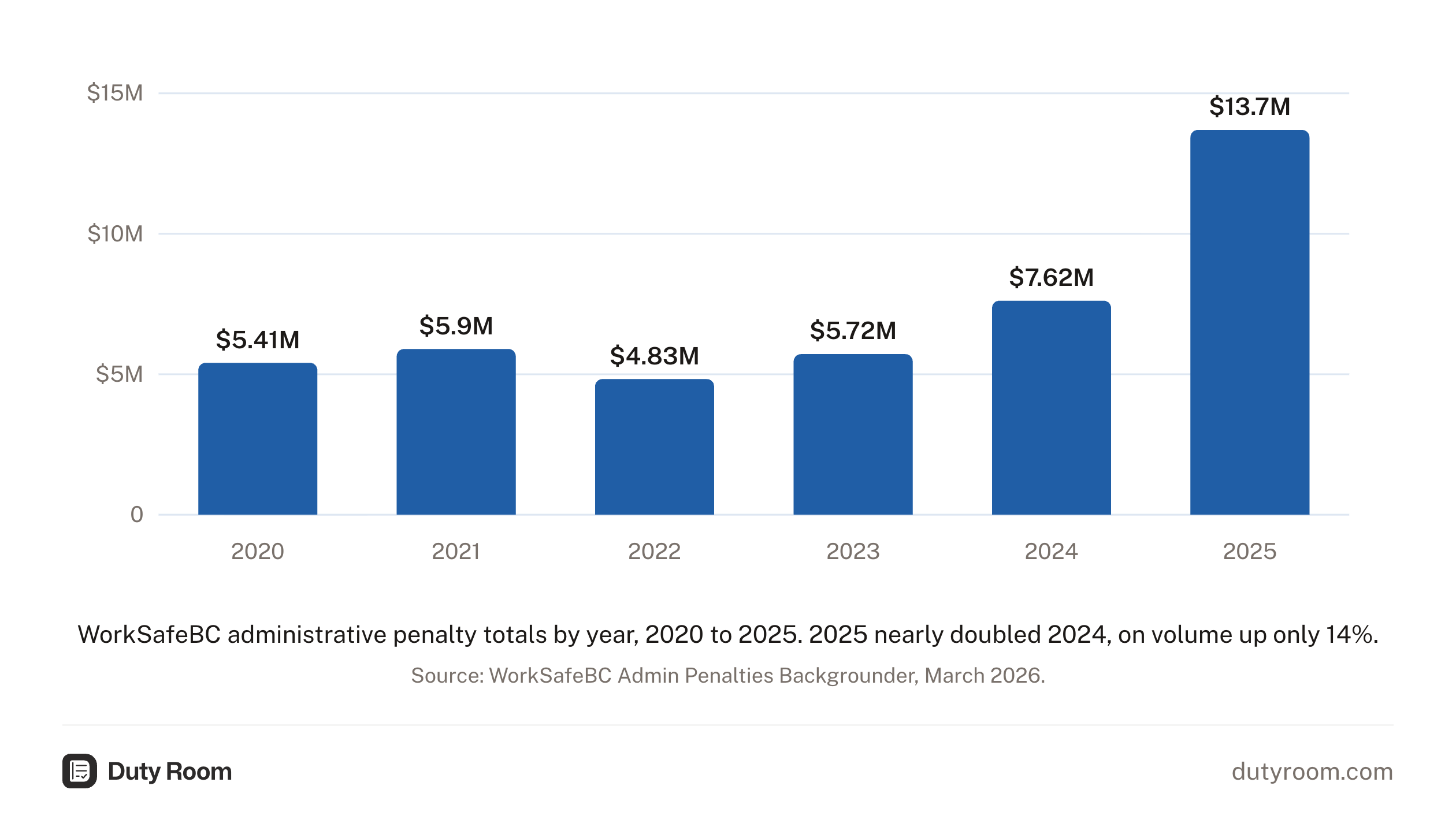
WorkSafeBC issued $13.7 million in administrative penalties in 2025, according to the agency's March 2026 Admin Penalties Backgrounder. The year before: $7.6 million. The jump didn't come from a flood of new cases. Volume rose 14%, from 361 penalties to 410. The average penalty climbed from about $21,100 to about $33,400.
| Year | Total |
|---|---|
| 2020 | $5.41M |
| 2021 | $5.90M |
| 2022 | $4.83M |
| 2023 | $5.72M |
| 2024 | $7.62M |
| 2025 | $13.7M |
The surge came in two stages. Through 2023, the annual total sat between $4.8 million and $5.9 million. It jumped to $7.6 million in 2024, then nearly doubled from there in 2025. WorkSafeBC is hitting harder than it has in at least five years.
The trend since 2020
| Year | Penalties issued | Total amount | Average penalty |
|---|---|---|---|
| 2020 | 402 | $5.41M | ~$13,467 |
| 2021 | 354 | $5.90M | ~$16,679 |
| 2022 | 371 | $4.83M | ~$13,018 |
| 2023 | 372 | $5.72M | ~$15,376 |
| 2024 | 361 | $7.62M | ~$21,107 |
| 2025 | 410 | $13.7M | ~$33,415 |
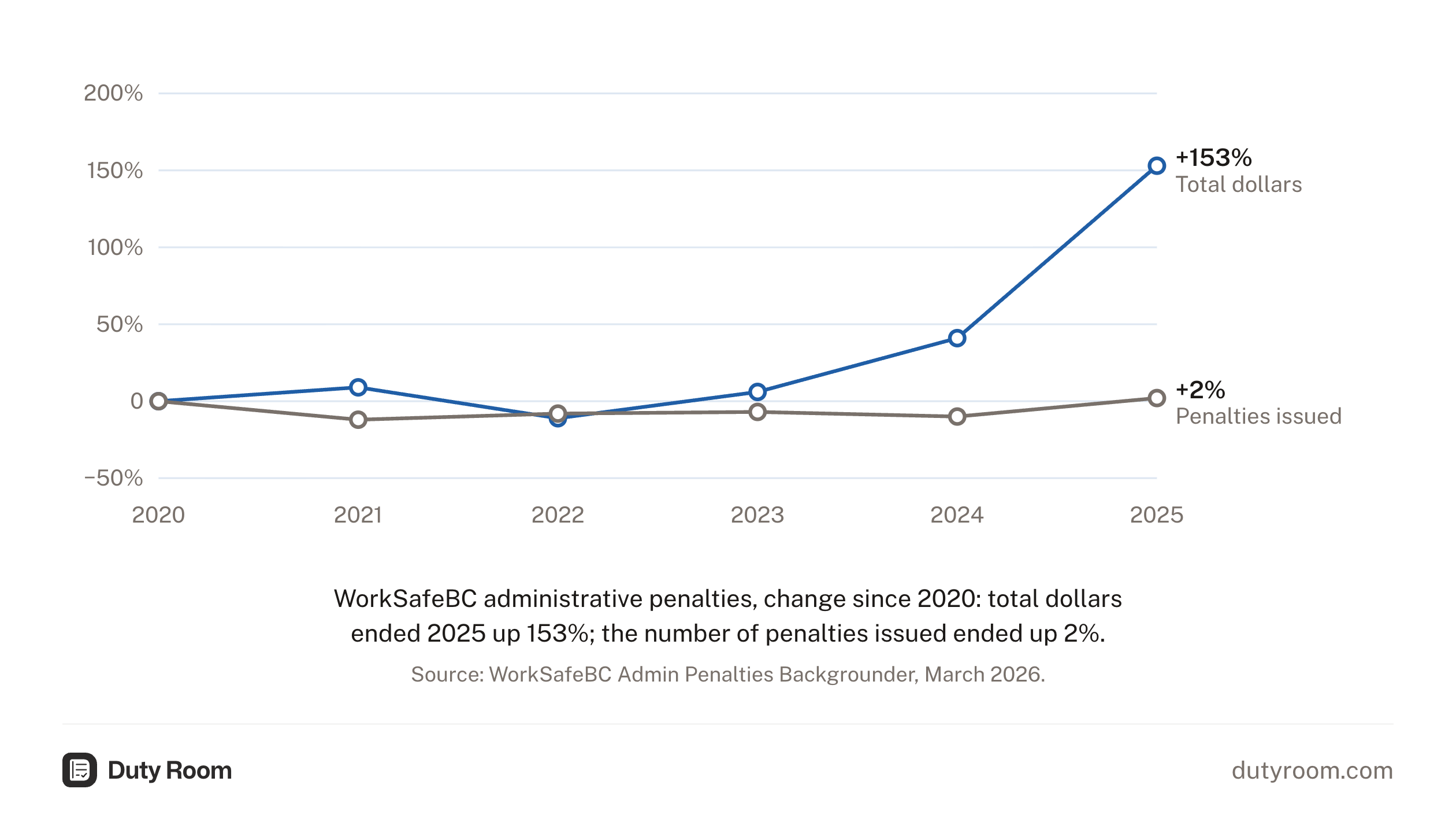
All six years are counted the same way1. The average sat between $13,000 and $17,000 through 2023, reached about $21,100 in 2024, then jumped 58% in a single year2.
| Year | Penalties issued | Total amount |
|---|---|---|
| 2020 | 402 | $5.41M |
| 2021 | 354 | $5.90M |
| 2022 | 371 | $4.83M |
| 2023 | 372 | $5.72M |
| 2024 | 361 | $7.62M |
| 2025 | 410 | $13.7M |
Why 2025 spiked
Three things converged in 2025.
Higher amounts per penalty. WorkSafeBC used more of the available range. The statutory maximum for a single penalty now stands at $816,148.69, adjusted annually for inflation, and the agency pushed individual penalties well above historical norms. In December 2025, EllisDon Corporation received $514,831 for crane-related safety failures, according to WorkSafeBC's news releases. Multiple EllisDon penalties in 2025 exceeded $1.2 million combined. In 2020, the average penalty was about $13,500. In 2025, several individual penalties exceeded $100,000.
The biggest 2025 cases were construction cases, but the rules aren't sector-specific: WorkSafeBC uses the same penalty rules for a restaurant as it does for a crane operator. The amounts differ based on risk and employer size, but the ceiling is the same.
Targeted enforcement campaigns. Crane safety drove the largest penalties. WorkSafeBC conducted over 1,500 crane inspections in 2024 alone, issuing 800+ orders, 75 stop-use orders, and 36 stop-work orders, per the agency's effectiveness measures.
When a campaign that intense runs for a full year and still finds non-compliance, big penalties follow. That pattern reaches hospitality because WorkSafeBC runs enforcement campaigns by sector and by hazard type, and falls, young worker safety, and musculoskeletal injury prevention are all active focus areas that touch restaurants and hotels directly. If the pattern holds, a targeted campaign in any of those areas could produce for hospitality what crane safety produced for construction: a sharp penalty spike concentrated in a short period.
Post-pandemic volume returning. Penalty counts dipped from 402 in 2020 to 354 in 2021 and stayed between 354 and 372 through 2024. The 2025 count of 410 is the highest in six years, but only 2% above 2020, so nearly all of the growth in the totals came from bigger individual penalties.
Falls: the enforcement priority that won't go away
Across all BC sectors, falls from heights generated 22,044 claims, 5,703 serious injuries, and 88 fatalities over the five years ending 2024, in WorkSafeBC's enforcement focus area data. Fall protection was a key enforcement focus for WorkSafeBC in 2024; it brought 152 penalties totalling just over $1 million3.
In hospitality, falls look different than on a construction site. Nobody is up on scaffolding; the hazards are icy loading docks, wet kitchen floors, worn stair treads, and uneven mats. The regulatory priority and penalty schedule are the same. Falls have accounted for 24% of hospitality injuries in BC for 23 straight years, according to the BCIRPU's Injury Data Online Tool, and after more than two decades of warning signs and non-slip footwear the share sits roughly where it was in 2001.
After 23 years without improvement on a named enforcement priority, continued attention is the predictable outcome. Hospitality falls don't make headlines the way construction falls do. They generated about 1,240 time-loss claims in 2023 alone, and the regulator treats them with the same seriousness.
Hospitality orders more than doubled while penalties lagged behind
If you run a restaurant, bar, or hotel in BC, WorkSafeBC is both your insurer and your enforcer. It sets your premiums, inspects your premises, writes orders, and levies penalties.
Enforcement orders issued to tourism and hospitality businesses in BC rose 164% from 2021 to 2024, reaching 682 in a single year, according to go2HR's 2024 Injury Insights report. For the full breakdown of that escalation, including why hotel and restaurant rates are diverging, see BC Hospitality's "Low Hazard" Problem.
Orders are upstream of penalties. Every order is an inspector telling you to fix something. Leave it unfixed long enough, and a penalty can follow at 2025 prices. If the order trend from 2021 to 2024 holds, the sector's penalty exposure is building. For context, the agency's Facts & Figures report counts 280,890 registered employers and 40,888 health and safety orders across all sectors in 2023 alone, so hospitality's 682 are a small share of the total; the concern is how fast they're rising.
The full cost of a single penalty
The 2025 average of about $33,400 understates a bad year, because a single workplace safety incident can trigger several costs at once for a hospitality operator.
The penalty itself: about $33,400 at the 2025 average across all sectors. Hospitality-specific penalties tend to be smaller than construction penalties. The sector had its own step change earlier: the average hospitality penalty jumped from around $4,000 to around $30,000 in 2023 and has not returned to four figures since.
Premium increase: WorkSafeBC's experience rating system adjusts your premiums based on claims history. A poor record adds a surcharge4. At 40%, that is an extra $3,480 a year on a restaurant's $8,700 annual base premium (CU 761035 at $0.58 per $100 of payroll), recurring. On a hotel's $19,800 base (CU 761056 at $1.32), it is $7,920.
Replacement labour: About $5,600 for a single restaurant claim, based on 35 days lost at roughly $20 per hour. That's the average time-loss claim duration from go2HR's Food & Beverage Injury Profile. Hotel claims average 51 days, which pushes replacement costs to about $8,160.
Legal costs if you appeal: $3,000 to $10,000 for a Review Division appeal. $5,000 to $20,000 if you escalate to the Workers' Compensation Appeal Tribunal. Most hospitality operators don't appeal. The ones who do carry those process costs whatever the outcome.
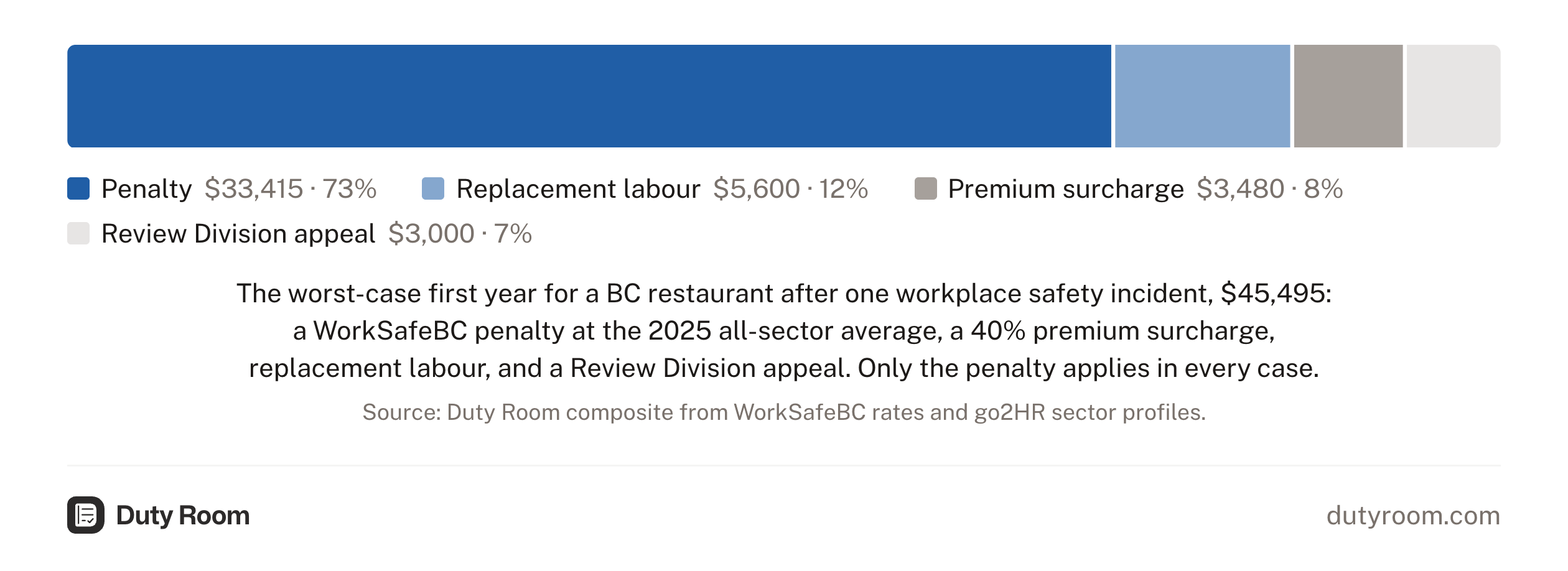
A worst-case single incident where a penalty, a claim, and an appeal all land together could produce $45,000 to $70,000 in year one5, with the premium increase recurring for several years after. Not every penalty triggers all of these costs, but none of them are unusual on their own. For a single-location restaurant doing $2 million in revenue, that's 2% to 3% of gross wiped out by one incident. For a fuller breakdown of how costs cascade across all five compliance domains, see The $186K Year.
| Component | Amount |
|---|---|
| Penalty at the 2025 all-sector average | $33,415 |
| Replacement labour (35 days at ~$20/hr) | $5,600 |
| Premium surcharge (40% illustration) | $3,480 |
| Review Division appeal | $3,000 |
| Total | $45,495 |
The COR rebate
WorkSafeBC's Certificate of Recognition program, administered through go2HR for hospitality, offers up to a 10% premium rebate for employers with a certified health and safety management system. For a restaurant paying $8,700 in annual premiums, that's $870 back. For a hotel at $19,800, it's $1,9806.
The rebate alone is small. But consider the full spread. A restaurant without COR that has a bad claims year could see premiums rise by $3,480 from a 40% experience rating surcharge on the same base. The swing between best case (COR rebate, clean record) and worst case (surcharge, no rebate) exceeds $4,000 a year for a single location. COR certification does more than earn the rebate: it shifts where you sit on the experience rating scale, and the claims data you produce for the certification process gives you early warning of problems before they become orders.
Tip reporting: only verifiable tips count now
Premiums are calculated on assessable payroll, and tips were the sore point. WorkSafeBC reassessed restaurants that had left tips out of their reported payroll, and the BC Restaurant and Foodservices Association fought the issue publicly through 2023 and 2024. WorkSafeBC settled the question on January 1, 2026: only verifiable tips count toward assessable payroll. That means tips processed through your payment system, recorded in payroll, or reported on a T4. Cash tips stay out of the calculation unless they appear on a T4.
The new rule is clearer without being softer. Make sure the payroll you report matches what your payment system can verify. A proactive correction costs less than a reassessment, and it removes the risk of a penalty on top of the back-assessment.
The rules apply everywhere
The biggest penalties of 2025 were construction cases. The enforcement machinery that produced them inspects your kitchen, your loading dock, and your housekeeping operation with the same authority and the same penalty schedule. Hospitality orders rose 164% in three years. Penalties across all sectors nearly doubled in one, landing at around two and a half times the 2023 total. The old assumption that a WorkSafeBC penalty would land around $20,000 no longer holds.
Watch for orders. Fix them fast. An inspection order resolved the same week costs almost nothing. An unfixed order that converts to a penalty enters a system where the average is now about $33,400 across all sectors.
-
Net penalties imposed, per WorkSafeBC Statistics 2024; 2025 from the March 2026 Administrative Penalties Backgrounder.
-
Averages are computed from each year's total and count; WorkSafeBC publishes totals and counts, not averages. 2024: $7,619,582 across 361 penalties, an average of $21,107. 2025: $13.7 million across 410 penalties, an average of $33,415, a 58% increase.
-
152 administrative penalties for inadequate fall protection in 2024, totalling $1,069,720. WorkSafeBC news release, April 2025. An earlier February 2025 WorkSafeBC release gave 105 penalties totalling over $1.12 million for the same year.
-
WorkSafeBC adjusts premiums up or down based on claims costs relative to the classification unit average over three years. The 40% surcharge is an illustration; surcharges can exceed it.
-
Composite of: penalty ($33,415 at the 2025 all-sector average), experience rating surcharge at the 40% illustration ($3,480 for a restaurant, $7,920 for a hotel), replacement labour ($5,600 to $8,160), and legal costs if appealed ($3,000 to $20,000). The restaurant case sums to $45,495 with a Review Division appeal and $62,495 at the top of the WCAT range; the hotel case runs $52,495 to $69,495. The penalty is the only component that applies in every case. The surcharge requires a claims history change; replacement labour requires a time-loss claim; legal costs require an appeal. A penalty with no associated claim and no appeal would cost $33,415 alone.
-
A 10% COR premium rebate is worth about $870 on a restaurant's $8,700 base premium (CU 761035) and $1,980 on a hotel's $19,800 (CU 761056). Base premiums from WorkSafeBC classification unit rates and go2HR sector profiles; both assume a 50-employee operation with $1.5 million in annual assessable payroll.
This report is based on published enforcement data, sources available at publication, and original analysis. It is for general information only and doesn't constitute legal advice.
Resolve orders before they become penalties
Duty Room tracks inspection orders, remediation deadlines, and follow-up evidence. Nothing sits unfixed until the next visit.