How Pay Mistakes Spread
What 4,472 Employment Standards Violations Tell BC Hospitality Operators
In November 2025, the Employment Standards Branch recorded 192 violations in a single month. That was the peak of a quarter that produced 564 violations province-wide, the highest on record.
In Duty Room's reclassified hospitality slice of the ESB Published Violations register, hospitality's share of those numbers has been climbing: from 12.1% of all ESB violations in 2023 to 18.1% in 20251.
The register holds 4,472 violation records spanning March 2022 to January 2026, representing $2,387,500 in penalties2 against 1,397 employers across 1,506 determinations. The register records administrative penalties only; it does not include complaints that were resolved informally, withdrawn, or settled before a determination was issued.
Termination Pay Failures Drive Nearly a Third of All Violations
The single most common violation in BC is failing to pay termination pay under s.18 of the Employment Standards Act: 917 violations, or 20.5% of the entire data. Pair it with s.63 (length-of-service liability for longer-tenured employees), and together they represent 29.6% of all violations on the register.
The pattern is predictable. An employer lets someone go and doesn't pay what they owe. The most common violation pair in the data is s.17 (paydays) plus s.18 (termination pay), appearing together in 405 separate investigations. The termination event is the trigger. Everything else the employer got wrong comes out during the investigation.
For restaurants and bars, this plays out during seasonal layoffs, post-probation terminations, and the churn that comes with high annual turnover. Every one of those exits is a potential complaint if you don't cut the final cheque within the ESA's timeline.
The second most common violation pair in the register, s.18 (termination pay) plus ESR s.46 (production of records), appeared 332 times. The third: s.18 plus s.40 (overtime), at 191 co-occurrences.
Hospitality Gets Caught for Different Things
Compared to the overall violation profile, hospitality businesses over-index on statutory holiday violations, overtime, and record-keeping failures.
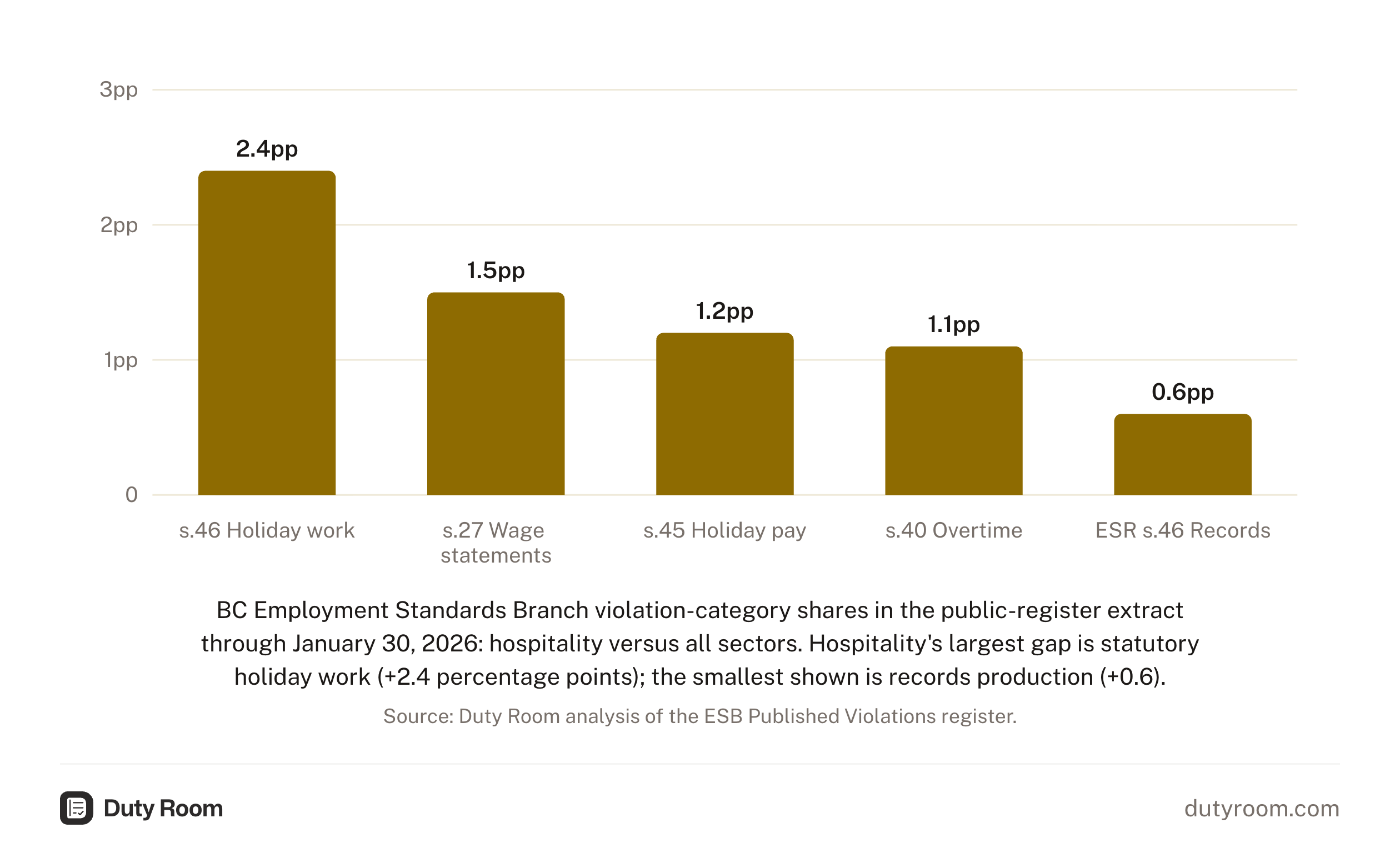
| Violation | Hospitality share | Overall share | Gap |
|---|---|---|---|
| s.46 Statutory holiday work | 8.0% | 5.6% | +2.4pp |
| ESR s.46 Production of records | 9.9% | 9.3% | +0.6pp |
| s.45 Statutory holiday pay | 6.2% | 5.0% | +1.2pp |
| s.40 Overtime | 8.3% | 7.2% | +1.1pp |
| s.27 Wage statements | 5.3% | 3.8% | +1.5pp |
Statutory holiday violations make up about a third more of hospitality's violation profile than the all-sector average3. That makes sense if you think about what hospitality looks like on Family Day, Canada Day, or Christmas. Someone's working. The question is whether they're getting paid correctly for it.
The overtime gap matters too. The ESA requires overtime at 1.5x after 8 hours in a day or 40 hours in a week. Hospitality schedules that routinely run 10- or 12-hour shifts create constant exposure.
Enforcement Is Accelerating
Violations across all sectors grew 61% over two years4, from 1,108 in 2023 to 1,785 in 2025, per the ESB register. The number of unique employers penalized grew too: 400 in 2023, 484 in 2024, 503 in 2025. The trend is both broadening and deepening.
In the same reclassified slice, the numbers are steeper. Hospitality went from 134 violations in 2023 to 323 in 2025, a 141% increase against the 61% all-sector rate: outpacing the enforcement wave, not just riding it.
Q4 2025 alone produced 564 violations, an 87% jump over Q4 2024's 301. The trend has not flattened through the available data. More employers are getting caught each year, and each investigation is turning up more violations per employer.
Record-Keeping Failures Compound Everything
Record-keeping violations (ESR s.46 production of records and s.28 payroll records) account for 15.6% of all violations on the register. They almost never appear alone.
The logic is straightforward. An employee files a complaint about unpaid termination wages. The ESB asks the employer to produce payroll records. The employer can't, or won't. Now it's two violations instead of one: the original substantive breach and the record-keeping failure. The s.18 plus ESR s.46 pair appeared 332 times in the data. The s.18 plus s.28 pair appeared 176 times.
Hospitality over-indexes here too. Production of records violations make up 9.9% of hospitality's total, compared to 9.3% across all sectors. If your payroll lives in a shoebox or you're doing manual time tracking without backups, you're carrying risk beyond the obvious.
Tip Violations Are a Small Number with Outsized Consequences
Twenty-five violations of ESA s.30.3 (gratuities) appear in the data. Every one involves a hospitality business. The section prohibits employers from withholding, redirecting, or deducting tips that belong to employees. Cases span the province, from cafes and restaurants in Vancouver to a vineyard on Salt Spring Island, all drawn from the public register.
The penalties are small, $500 each. But tip violations carry reputational risk beyond the fine. The ESB register is searchable by anyone, and prospective employees can search it. In a labour market where hospitality businesses are already competing hard for staff, a public record linking your name to tip theft is a recruitment liability that outlasts the fine.
Repeat Offenders on the Public Register
The ESB register is a public record: names, addresses, violations, and dates are all published. These employers accumulated the most violations among the businesses our hospitality analysis covers1. Knowing the pattern helps operators benchmark their own compliance: if you're making the same mistakes on termination pay and record-keeping that show up repeatedly below, the risk is not theoretical.
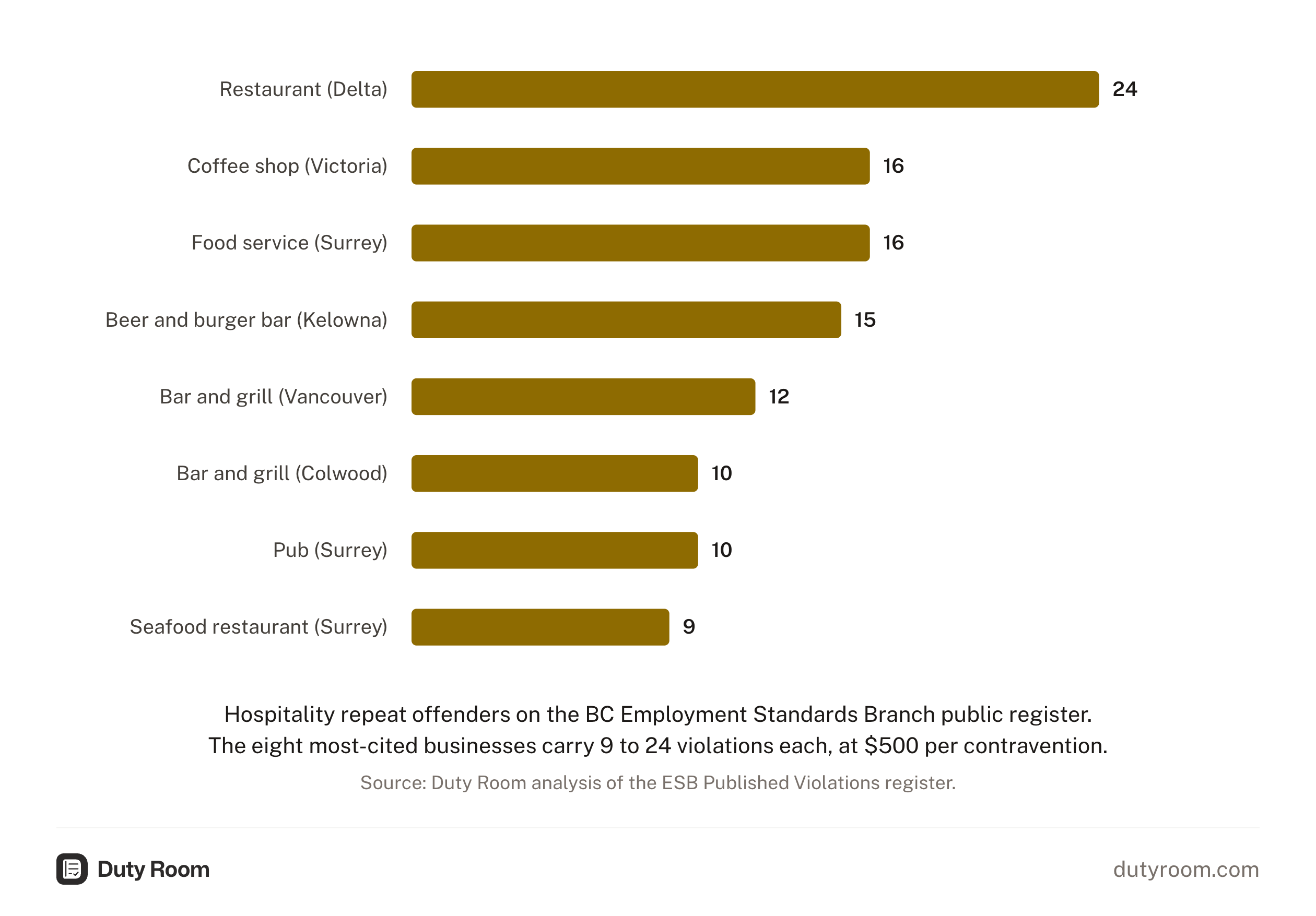
| Business type and location | Violations | Penalties |
|---|---|---|
| Restaurant (Delta) | 24 | $12,000 |
| Coffee shop (Victoria) | 16 | $8,000 |
| Food service (Surrey) | 16 | $8,000 |
| Beer and burger bar (Kelowna) | 15 | $7,500 |
| Bar and grill (Vancouver) | 12 | $6,000 |
| Bar and grill (Colwood) | 10 | $5,000 |
| Pub (Surrey) | 10 | $5,000 |
| Seafood restaurant (Surrey) | 9 | $4,500 |
That $12,000 in penalties against a single Delta restaurant sounds manageable until you consider what accompanies the fines. ESB determinations typically include back-pay orders that dwarf the administrative penalty. A $500 penalty for unpaid termination wages sits alongside an order to pay the actual termination wages owed. The penalties add up, but the back-pay orders that accompany them are typically larger. Determinations can be appealed to the Employment Standards Tribunal, and the register may not reflect variations or cancellations made on appeal.
BC's Enforcement Model Is Unusually Transparent
BC and Ontario use fundamentally different enforcement models, and the numbers reflect that difference, not a difference in compliance rates.
BC uses administrative penalties: the ESB issues $500 fines per contravention without going to court. Ontario publishes only prosecuted court convictions. That's why BC published 4,472 violation records over roughly three years while Ontario published 107 ESA convictions over roughly two. Both provinces find the same problems at the top: termination pay, overtime, statutory holidays, records. The violations are the same. The visibility is not.
The practical difference for operators: if you violate the ESA in BC, you're more likely to be penalized, more likely to be named publicly, and the record will be searchable online indefinitely. The penalties are smaller individually, but they stack fast when an investigation turns up three to five violations. The average determination on the register covers 3.0 separate contraventions5, so a typical determination runs $1,500 in penalties before back-pay orders are added on top.
The Compliance Costs That Stack
The $500-per-contravention penalty looks trivial on its own. A single investigation finding violations of termination pay, paydays, overtime, record production, and vacation pay produces five $500 penalties ($2,500) plus back-pay orders on each substantive violation. And every violation goes on the public register: your business name, your address, the specific section you breached, and the date. Searchable by anyone, permanently. Future employees, potential investors, and competitors can all find it.
The 665 reclassified hospitality violations in this data came from 172 employers across the province, concentrated in Surrey (102 violations), Vancouver (93), Richmond (41), Delta (36), and Kelowna (35), per Duty Room analysis of the addresses on the register1. Wherever you operate in BC, the ESB is active.
The most common entry point is termination pay. An employee leaves, the final cheque is late or short, and the complaint opens a file. Once the ESB starts looking, they find the overtime, the missing records, the statutory holiday gaps. Every other compliance problem in this data tends to surface because a termination went wrong first. Get that one right, and the rest of the exposure shrinks with it.
-
Duty Room analysis of the ESB Published Violations register (4,472 records scraped through 30 January 2026). The register publishes individual violation records; the sector and city breakdowns are our computation.
-
Administrative penalties across all 4,472 violation records on the register. Most contraventions carry the $500 first-contravention penalty; 57 carry elevated penalties of $2,500 or $10,000 for repeat contraventions of the same section under the ESA s.98(2) tiers. The total excludes back-pay orders, which are issued separately.
-
Combining statutory holiday pay (s.45) and statutory holiday work (s.46): 14.1% of hospitality's violations against 10.5% across all sectors, a 34% larger share. Duty Room analysis of the ESB Published Violations register.
-
Duty Room analysis of the ESB Published Violations register: 1,108 violations recorded in calendar year 2023 and 1,785 in 2025, a 61% increase.
-
Duty Room analysis of the ESB Published Violations register: 4,472 violations across 1,506 determinations, about 3.0 contraventions per determination.
This report is based on published enforcement data, sources available at publication, and original analysis. It is for general information only and doesn't constitute legal advice.
Employment records that survive an ESB audit
Duty Room tracks payroll records, termination documentation, overtime, and statutory holiday pay by site. These are the violations that trip up hospitality most.