Published tickets, 2019 to 2026
Fraser Health Food Safety Tickets: What Gets Cited and What It Costs
Fraser Health publishes a list of food safety violation tickets, with each business named. The current version lists only tickets from the previous 13 months, so older tickets drop off when it's replaced. Duty Room has collected 11 versions of the list. Together they hold 132 different tickets, dated October 2019 to July 2026.
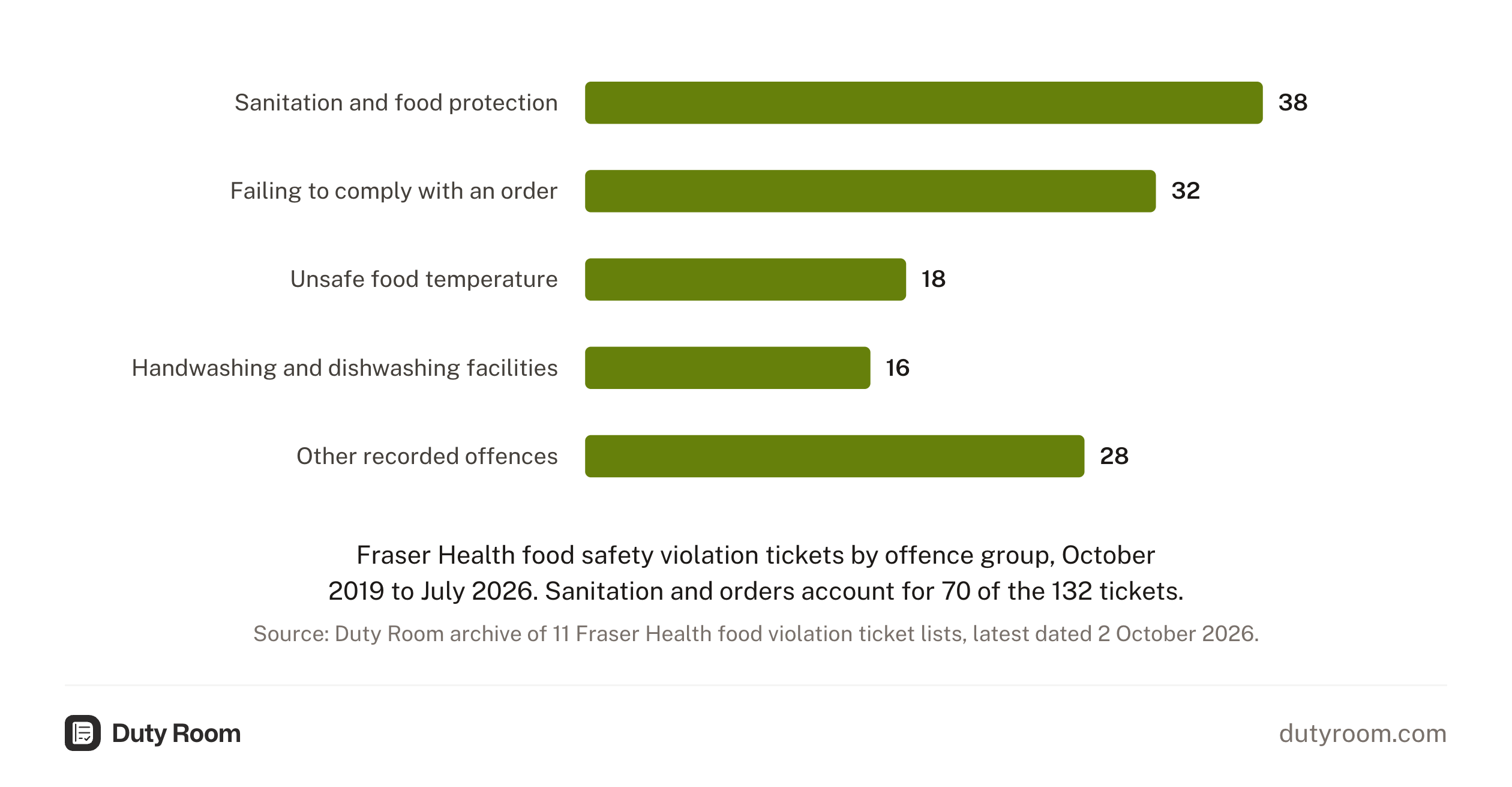
Most tickets cost $230 or $345. Four problems account for 104 of the 132: unsanitary premises or food handling, failing to comply with a health officer's order, unsafe food temperatures, and handwashing or dishwashing facilities.
The archive has gaps. Saved versions miss 3 May 2022 to 18 November 2023, and 19 December 2024 to 31 January 2025. Publication also depends on confirmed status, so a saved list can miss tickets whose offence dates fall inside its window. The counts show which offences officers ticketed. They can't show how many tickets Fraser Health issues in a year.
The offences behind the tickets
| Offence group | Tickets | Share |
|---|---|---|
| Sanitation and food protection | 38 | 28.8% |
| Failing to comply with an order | 32 | 24.2% |
| Unsafe food temperature | 18 | 13.6% |
| Handwashing and dishwashing facilities | 16 | 12.1% |
| Other recorded offences | 28 | 21.2% |
Sanitation is the largest group. Twenty-two tickets cite section 17 of the Food Premises Regulation alone: premises, equipment and utensils not kept sanitary. Another 14 cite section 12, for failing to protect food from contamination or handle it in a sanitary way; two combine sections 16 and 17.
Orders come next. A health officer can order a business to fix a problem, and failing to comply with that order is an offence under the Public Health Act. Every one of the 32 order tickets in the archive was $345. All 12 Hope tickets were order tickets, dated between 17 September and 19 October 2021 under one restaurant name. Outside Hope, order tickets still number 20, more than the 18 for unsafe temperatures. The list doesn't say what each order required.
Temperature tickets cite section 14(2), which requires potentially hazardous food to be stored or displayed at 4°C or colder, or 60°C or hotter. Seventeen of the 18 were $345. The eighteenth, at a Maple Ridge pub in September 2020, combined unsafe temperatures with inadequate refrigeration and hot-holding equipment, and cost $690.
All 16 washing-facility tickets cite section 21 and cost $230. Most concern handwashing stations or staff handwashing; one 2025 source entry describes a dishwashing station under the same section.
The other 28 tickets cite many sections. They include staff without the required food safety training, missing written food handling or sanitation procedures, pests, chemical storage, food from an unapproved source, and operating without approval. Some concern how a business deals with the officer. On one day in October 2019, a Burnaby seafood business received three tickets: $345 for not complying with an order, and $115 each for giving false or misleading information and for obstructing an officer.
Ticket amounts
| Amount | Tickets | Share |
|---|---|---|
| $230 | 56 | 42.4% |
| $345 | 68 | 51.5% |
| Other amounts | 8 | 6.1% |
The 132 tickets total $38,525 in recorded amounts. The typical (median) ticket is $345, and the average (mean) is $292. The other amounts are $115, $460 and $690. A business can receive several tickets on the same day. The list shows the amount on each ticket, not what the business paid in total or what it spent putting things right.
Tickets by city
| City | Tickets | Share | Ticket amounts |
|---|---|---|---|
| Surrey | 58 | 43.9% | $15,525 |
| Burnaby | 46 | 34.8% | $13,340 |
| Hope | 12 | 9.1% | $4,140 |
| Maple Ridge | 11 | 8.3% | $3,910 |
| Chilliwack | 3 | 2.3% | $1,035 |
| Langley | 1 | 0.8% | $345 |
| New Westminster | 1 | 0.8% | $230 |
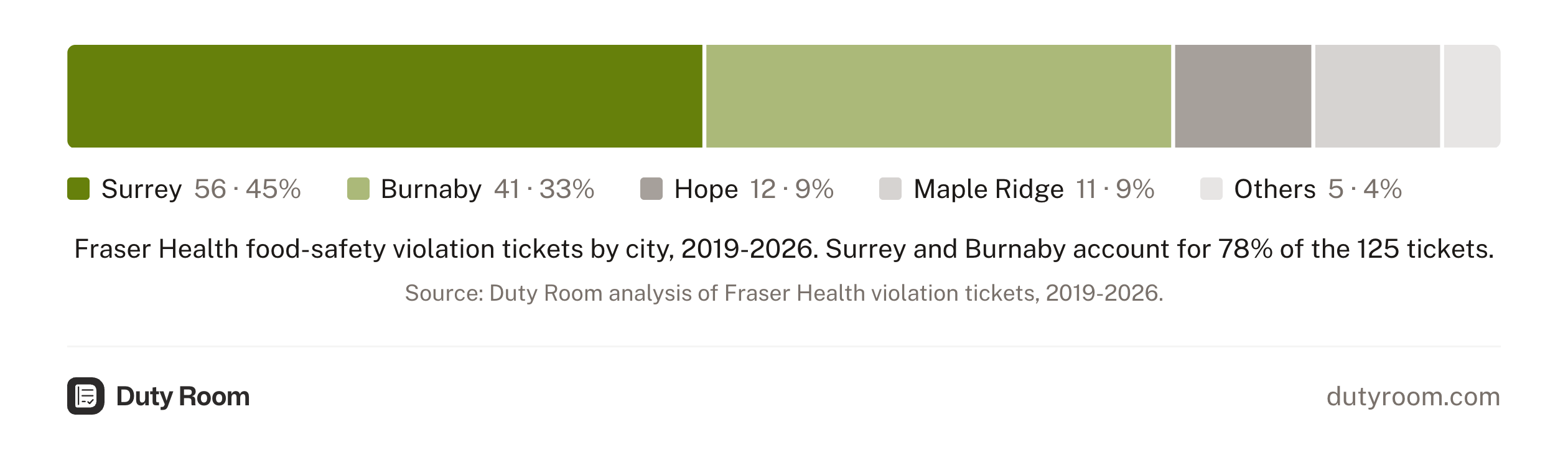
Surrey and Burnaby account for 104 of the 132 tickets (78.8%). The list gives no count of premises or inspections in each city, so it can't show that a business in one city is more likely to be ticketed than one in another. A city missing from the table may still have had tickets in a period the archive misses. Cities appear as Fraser Health printed them; we haven't checked addresses against a map.
Ticket status and gaps in the archive
Fraser Health says the list shows only tickets with a confirmed guilty status, as reported by the Insurance Corporation of British Columbia. It names three ways a ticket gets that status: expiry, a court judgment, or payment. The PDF also notes that violation tickets can be disputed in court. Duty Room hasn't checked the outcome of individual tickets. Fraser Health also says tickets issued to private individuals may not be displayed.
Tickets are one enforcement tool among several. Officers also educate operators, issue orders and go to court, and none of those appear on this list unless a ticket followed. Inspection reports are published separately on Fraser Health's inspection report site.
| Year | Tickets in archive | Ticket amounts | Coverage |
|---|---|---|---|
| 2019 | 24 | $6,785 | October to December only |
| 2020 | 22 | $6,670 | |
| 2021 | 30 | $9,315 | Includes the 12 Hope order tickets |
| 2022 | 8 | $2,415 | January to April observed; coverage ends 2 May |
| 2023 | None captured | — | Coverage resumes 19 November |
| 2024 | 18 | $4,830 | Coverage ends 18 December |
| 2025 | 22 | $6,095 | Coverage resumes 1 February |
| 2026 | 8 | $2,415 | January to July; year incomplete |
A year with no tickets in the archive isn't a year with no tickets. The gaps prevent a reliable comparison of annual ticket counts.
Records worth keeping at each site
The offence groups give an owner or site manager a useful starting point for checking records. For food service establishments, the Food Premises Regulation requires:
- FOODSAFE or an equivalent for the operator, and at least one certified employee on site when the operator is away (section 10).
- Written food handling procedures, commonly called a food safety plan (section 23).
- A written sanitation plan (section 24).
Keep the records your food safety plan or an order requires. These additional records can also help you show what happened:
- A dated temperature log for fridges, freezers and hot holding.
- Signed cleaning sheets that show the sanitation plan is followed.
- Supplier invoices that show where your food came from.
- Every inspection report and order, kept with dated proof of what you fixed.
Fraser Health publishes resources for food business operators. Your environmental health officer can tell you what your plans should record.
How we built this
Each version of the list is a PDF. We extracted the tickets from all 11 and combined them. A ticket counts once when the business, city, violation date, amount and legislation section all match; different offences on the same day stay separate. We retained source cities and legislation citations. We grouped tickets by section, using the offence description for one order ticket whose printed section appears inconsistent.
The current list is dated 2 October 2026 and covers violation dates from 2 September 2025. It lists 14 tickets: 13 already in the archive and one new ticket dated July 2026. Fraser Health's publication policy explains what the list includes.
This report is based on published enforcement data, sources available at publication, and original analysis. It is for general information only and doesn't constitute legal advice.
Keep each site's food safety records in one place
Make folders for each site and upload logs, certificates, plans and inspection reports. Every file shows who uploaded it and when.