Where accepted waivers appeared
BC Liquor Waivers by City: A March 2026 Snapshot
Snapshot context. The rolling waiver file retrieved on 2 October 2026 contains 139 contravention rows across 123 cases, including 133 liquor rows. Its signing dates run from 6 January to 30 June 2026, a shorter window than the July archive. The historical waiver examples and figures below keep their stated snapshot basis. See the waiver-window reconciliation and annual ID-check series for the later data; smaller rolling-file totals do not establish reduced enforcement.
The March 2026 files record 8 accepted liquor-waiver rows in White Rock against 57 active liquor licences, or 14.04 rows per 100 licences.1
Vancouver records 39 rows against 1,713 licences, or 2.28 per 100.
Agassiz records 29.41 per 100 and North Vancouver 0.43, a 68-fold difference between those two city ratios.2
That is a difference in recorded waiver geography, not proof that an establishment in Agassiz was 68 times as likely to be inspected, tested, or found non-compliant.
The LCRB does not publish city-level inspection or test-purchase counts, so the denominator needed for an inspection or failure rate is missing.
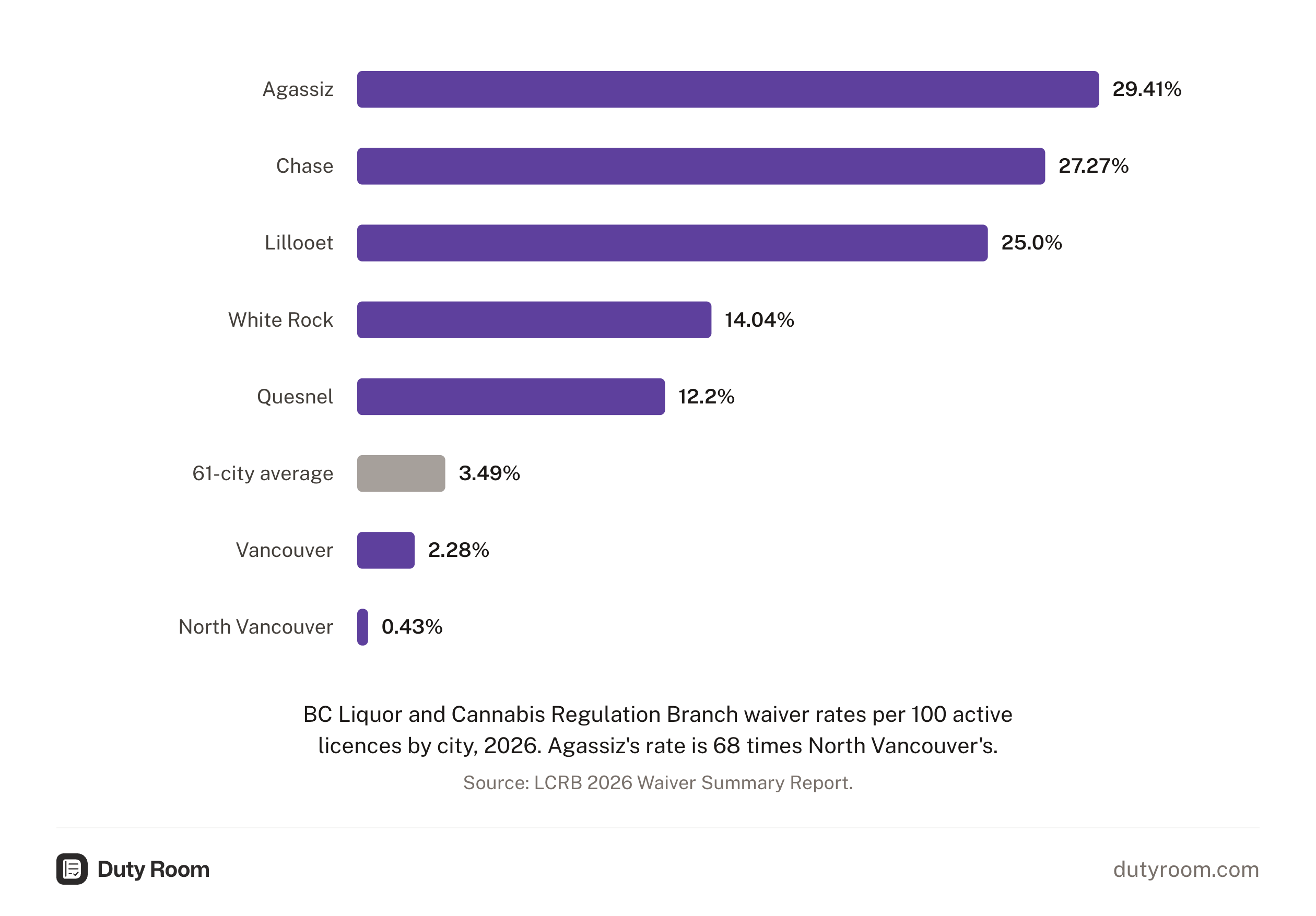
| City | Active liquor licences | Accepted liquor-waiver rows | Rows per 100 licences |
|---|---|---|---|
| Agassiz | 17 | 5 | 29.41 |
| Chase | 11 | 3 | 27.27 |
| Lillooet | 12 | 3 | 25.00 |
| White Rock | 57 | 8 | 14.04 |
| Quesnel | 41 | 5 | 12.20 |
| BC snapshot | 10,572 | 244 | 2.31 |
| Vancouver | 1,713 | 39 | 2.28 |
| North Vancouver | 232 | 1 | 0.43 |
This report compares two preserved files: the LCRB's 2026 Waiver Summary Report as downloaded in March 2026 and the active liquor-licence register published March 11, 2026.
The waiver file contains 254 accepted-waiver rows covering contraventions from February 2023 to November 2025.
Ten rows concern cannabis and are excluded from every city ratio below because the denominator contains liquor licences only.
The remaining 244 liquor-waiver rows are compared with 10,572 active liquor licences in the pinned register.3
The branch replaces both public workbooks on a rolling basis, so the live files no longer reproduce this snapshot.
One Waiver Row Is Not One Visit
A waiver row records one accepted contravention, not one inspection, test purchase, establishment, or unique enforcement case.
The 244 liquor rows belong to 206 case numbers.
Thirty-seven case numbers have more than one contravention row, accounting for 75 rows in total.
White Rock's 8 rows belong to 5 case numbers and 5 establishments, so they do not represent 8 separate premises or necessarily 8 separate visits.1
The waiver file also omits matters that did not end in an accepted waiver, including cases that proceeded to a hearing.
Without the full inspection and enforcement pipeline, the city ratios cannot measure the chance that a licensee was visited or failed a check.
Geography in the March Snapshots
The city comparison still shows where accepted liquor-waiver rows appeared relative to the number of active liquor licences in the same place.
Agassiz records 5 rows against 17 licences, Chase 3 against 11, and Lillooet 3 against 12.
Those small denominators make the ratios sensitive to a single extra row.
They do not establish a highway sweep, a deployment route, or a persistent difference in compliance.
Vancouver has the largest raw count in the file at 39 rows, but its 1,713-licence denominator produces a ratio of 2.28 per 100.
The comparison does not group small and large communities into a province-wide ranking.
Doing that fairly would require the licence counts for every city, including cities with no waiver rows, rather than conditioning the denominator on places already present in the waiver file.
Across the full March licence register, 244 accepted liquor-waiver rows against 10,572 active liquor licences produce a neutral snapshot reference of 2.31 per 100.3
What the Waiver File Does Show
Selling or supplying liquor to a minor accounts for 157 of the 244 liquor-waiver rows, or 64%.4
The separate cannabis class contains 9 minors rows among its 10 records, bringing the all-class total to 166 of 254.
The LCRB's Minors as Agents Program sends trained minors into licensed premises to attempt a purchase.
The agents are instructed to answer questions honestly and not misrepresent themselves.
The practical test is whether staff refuse the sale when valid identification is not produced.
In the 2026 Cuevas Holdings ruling (2026 BCLCRB 5), a server asked a minor agent for ID, was told it was in the car, and served the beer anyway.
The licensee established a complete due diligence defence because it could document an under-30 ID policy, ongoing training, and supervision on every shift.
The due diligence playbook covers the records that supported that result.
The month of contravention is also recorded.
Among the 244 liquor rows, February has 37 and October 4; the other months range from 7 to 24.
Those are months when contraventions later resolved by waiver occurred, not monthly MAP visit or test volumes.
For repeat offences, the penalties escalate sharply.
A second contravention of selling to a minor carries $11,000 to $15,000 or an 11- to 21-day suspension, while a subsequent contravention carries $15,000 to $25,000 or 21 to 41 days.
Reference: Accepted Liquor-Waiver Rows by City
| City | Active liquor licences | Accepted liquor-waiver rows | Rows per 100 licences |
|---|---|---|---|
| Agassiz* | 17 | 5 | 29.41 |
| Chase* | 11 | 3 | 27.27 |
| Lillooet* | 12 | 3 | 25.00 |
| White Rock | 57 | 8 | 14.04 |
| Quesnel | 41 | 5 | 12.20 |
| Tofino | 33 | 4 | 12.12 |
| Fort St. John | 53 | 6 | 11.32 |
| Langford | 49 | 5 | 10.20 |
| Salmon Arm | 57 | 4 | 7.02 |
| Revelstoke | 68 | 4 | 5.88 |
| Nanaimo | 204 | 9 | 4.41 |
| Kamloops | 213 | 7 | 3.29 |
| Kelowna | 406 | 13 | 3.20 |
| BC snapshot | 10,572 | 244 | 2.31 |
| Vancouver | 1,713 | 39 | 2.28 |
| Burnaby | 279 | 6 | 2.15 |
| Victoria | 541 | 10 | 1.85 |
| Langley | 225 | 4 | 1.78 |
| Richmond | 418 | 6 | 1.44 |
| Surrey | 417 | 5 | 1.20 |
| Coquitlam | 166 | 2 | 1.20 |
| North Vancouver | 232 | 1 | 0.43 |
*Small sample: fewer than 20 active liquor licences.
The table compares accepted liquor-waiver rows in the pinned March waiver file with active liquor licences in the pinned March register.
It does not report inspection, test-purchase, or failure rates.
-
Duty Room analysis of the pinned LCRB waiver and licence workbooks: White Rock records 8 liquor-waiver rows across 5 case numbers and 5 establishments, compared with 57 active liquor licences.
-
Duty Room analysis of the same workbooks: Agassiz records 5 liquor-waiver rows across 17 active liquor licences, or 29.41 per 100; North Vancouver records 1 across 232, or 0.43 per 100. The ratio between the unrounded city values is 68.2.
-
Duty Room analysis of the LCRB 2026 Waiver Summary Report and active licence register as downloaded in March 2026: 254 accepted-waiver rows comprise 244 liquor and 10 cannabis rows; 239 liquor rows contain a city and 5 do not. The licence register contains 10,572 active liquor licences. The BC snapshot reference is 244 / 10,572 x 100 = 2.31.
-
Duty Room analysis of the pinned waiver workbook: 157 of 244 liquor-waiver rows concern selling or supplying liquor to a minor. The separate cannabis class has 9 minors rows among 10 records, for an all-class minors total of 166 of 254.
This report is based on published enforcement data, sources available at publication, and original analysis. It is for general information only and doesn't constitute legal advice.
Keep each site's ID and training records in one place
Make folders for each site and upload refusal logs, briefing records and Serving It Right certificates. Every file shows who uploaded it and when.