The claims, penalties and licensing consequences behind decisions about pay, recruitment and staff treatment
How Employment Failures Affect Hospitality Businesses
The tribunal reforms in this report apply in Great Britain. Immigration and minimum-wage enforcement figures cover the UK; the premises-licensing examples are from England. Northern Ireland has separate tribunal rules.
Running a hospitality business means making decisions about pay, tips, recruitment, complaints and dismissal. When those decisions go wrong, the cost can extend beyond resolving one worker's complaint. A tribunal may award compensation, an authority may require repayments or penalties, and an immigration finding may put a licence at risk.
Employers face changes to those responsibilities between October and January. Right-to-work rules have covered more types of new engagement since 1 October. Harassment duties broaden on 30 October. For dismissals taking effect from 1 January 2027, more employees will qualify to claim ordinary unfair dismissal and the compensatory award will have no statutory cap. Many claim windows also lengthened on 1 October.
Managers may later have to explain a pay calculation, a recruitment check or their response to a complaint. Operators need to review how managers pay, recruit and treat staff while they can still correct a practice, and keep the records that show what happened.
Workers can challenge their treatment, tips and dismissal
A tribunal may need to establish what an employer did to prevent harassment, how it allocated tips or why it dismissed an employee. The legal tests differ, but each examines the employer's earlier conduct.
Workers gained more time to bring many claims on 1 October 2026, when regulations increased most ordinary limits from three to six months. The longer limit depends on when the relevant event happened, not just when the worker submits a claim. Older disputes do not automatically gain more time, and some claims have different deadlines.1
Harassment claims test prevention as well as conduct
A sexual harassment complaint can raise two issues: how the worker was treated and what the employer did to prevent it.
Employers have had to take reasonable steps to prevent sexual harassment since 26 October 2024. Under sections 40A and 124A of the Equality Act, a successful sexual harassment claim can carry an uplift of up to 25% if the tribunal also finds a breach of that prevention duty. The tribunal must consider an uplift even if the claimant has not asked for one. Discrimination compensation has no statutory cap, so the uplift has no fixed pound limit either.
The EHRC illustrates the effect with a £40,000 award that becomes £50,000. That increase depends on the employer's breach of the prevention duty. An employer defending its precautions needs evidence of the steps it took.
Regulations confirm 30 October 2026 as the start of two further changes. Employers must take all reasonable steps to prevent sexual harassment. They also become liable for permitting third-party harassment where they fail to take all reasonable steps to prevent it. That protection extends beyond sexual harassment to harassment related to a relevant protected characteristic, such as race or disability. A customer can be the third party.
The existing prevention duty already requires employers to consider sexual harassment by customers. The new claim makes the employer's response to that risk more consequential. The EHRC's technical guidance identifies familiar hospitality risks: alcohol, late working and customer contact. A manager's control over shifts and tips can also make a worker reluctant to report abuse.
A site risk assessment should address those conditions. Staff need a way to report a manager as well as a customer, and supervisors need to know when to intervene. Training records show who received training in the reporting and intervention procedures; incident records show how managers used them. The assessment should record the safeguards in use and when managers reviewed them.
A tipping dispute can require payments to other workers
A tribunal can order an employer to revise a tip allocation and pay workers who did not bring the claim. One worker's complaint can therefore require the business to explain how it shared tips across the site.
Workers gained these rights under the Employment (Allocation of Tips) Act on 1 October 2024. Employers must allocate qualifying tips fairly and meet the associated policy and records requirements. Workers enforce these rights through tribunals; the Fair Work Agency does not enforce them.
A worker still normally has 12 months to bring an allocation or payment claim; October's changes did not extend that limit. Compensation for the complainant's financial loss under section 27M of the Employment Rights Act 1996 is capped at £5,366 from 6 April 2026. That cap does not cover the orders to revise allocations and pay other workers under section 27L(2). The tribunal's remedy follows the failures proved; one claim does not automatically reopen every allocation since the duties began.2
Workers can also request tipping records once every three months, covering consecutive months in which they worked during the previous three years. The employer has four weeks to supply the required records, including the site's total qualifying tips and the worker's own allocation. Policy and records complaints have a separate, shorter claim window.3
The government plans to strengthen tipping-policy consultation and review requirements by the end of 2026. That date remains part of its implementation timetable, rather than a confirmed commencement date.
Employers can already check whether their records explain how they applied the allocation policy. Fair allocation does not necessarily mean equal shares. Our employment records resources explain the related tipping, pay and tax obligations.
More employees gain dismissal protection in January
A tribunal deciding an unfair-dismissal claim examines the employer's reason and procedure for ending the employment. The date the dismissal takes effect determines whether the new qualifying period and compensation rules apply.
An ordinary unfair-dismissal compensatory award is currently capped at the lower of 52 weeks' pay or £123,543, with a separate basic award.4
Commencement regulations remove the compensatory cap for dismissals whose effective termination date falls on or after 1 January 2027. They also reduce the ordinary qualifying period from two years to six months. The basic award remains.
Employers planning to dismiss staff to impose contractual changes face a separate reform. The government timetable places stronger fire-and-rehire protection in January 2027, subject to commencement. It restricts dismissal to impose certain contractual changes, with an exception for defined financial difficulties.
Under the shorter qualifying period, an area manager dismissed after eight months' service in February 2027 will be able to bring an ordinary unfair-dismissal claim. The tribunal must still decide whether the dismissal was unfair and what loss merits compensation. Removing the cap does not remove the claimant's duty to mitigate loss or the tribunal's power to reduce an award where the law permits.
Managers therefore need to review dismissal decisions involving employees with shorter service. The business should be able to explain both its reason for dismissal and the procedure it followed.
Authorities can investigate pay and recruitment failures
Workers do not have to bring a tribunal claim for an employer to face enforcement. Minimum-wage officers can investigate underpayment, and immigration officers can investigate illegal working. These investigations can require a business to repay staff or pay a penalty; immigration findings can also affect its ability to employ sponsored workers or keep a premises licence.
Minimum-wage enforcement can require arrears and penalties
A minimum-wage notice can reach back six years, with arrears payable to workers and a separate penalty payable to government. An employer needs to account for how it paid staff over that period, using its time-and-pay records.
HMRC runs minimum-wage casework on behalf of the Fair Work Agency until April 2027. The agency's enforcement policy provides for investigations following complaints and proactive work based on risk.
The September 2026 naming round named 658 employers across sectors. The government reported about £4 million repaid to more than 27,000 workers and £7 million in penalties. The sums cover historical underpayment periods, rather than one year's breaches.
Some of the agency's future powers remain uncommenced. Its power to bring tribunal proceedings in a worker's place has not taken effect, and holiday-pay enforcement is scheduled for 2027, no earlier than April. Employers already owe the underlying holiday pay; the later date concerns who enforces it.5 A payroll review can identify underpayment now and establish what the business owes its workers.
Illegal working can trigger a penalty and a licence review
An employer that takes on someone without permission to do the work can face a penalty. Correct right-to-work checks, completed at the required time and retained, can establish a statutory excuse against that penalty.
The Code in force from 1 October 2026 extends checks to qualifying worker contracts, individual subcontractors and online matching arrangements that begin on or after that date. Liability in contracting chains depends on the statutory conditions. Purchasing services from an independent business does not by itself make the purchaser responsible for checking every worker employed by that business.
The Code sets a £45,000 starting penalty per illegal worker for a first breach and £60,000 for a repeat within three years, where the employer has no statutory excuse. Three workers can therefore produce a £135,000 starting penalty for a first breach, before mitigation.
An employer can reduce the penalty by reporting the suspected illegal worker before the Home Office identifies them and obtaining a reference number. Active co-operation earns a separate reduction. A first breach can result in a warning instead if both reductions apply and the employer has effective checking practices. A first-breach penalty also qualifies for a 30% faster-payment reduction if it meets the Code's payment conditions.6
A finding can also reach the licensing authority. In England and Wales, section 179(1A) of the Licensing Act lets immigration officers enter without a warrant where they have reason to believe premises are being used for alcohol sales or late-night refreshment, to investigate connected immigration offences. The Home Office can then seek a premises licence review.
At Café Diana's July 2025 review, the council recorded a £135,000 penalty against the company operating the basement. The licensing committee also decided to revoke the premises licence, held by a different company, after considering repeated illegal working and other licensing concerns. In this case, the penalty and the licence decision affected different companies. The published record establishes the committee's decision, but no appeal outcome.
Restaurants, takeaways and cafés were the largest named category in the Home Office's 2025 visit data. Officers made 3,559 visits and 2,523 arrests in those businesses. That category covers part of hospitality; it does not measure the whole sector or an individual business's chance of a visit.
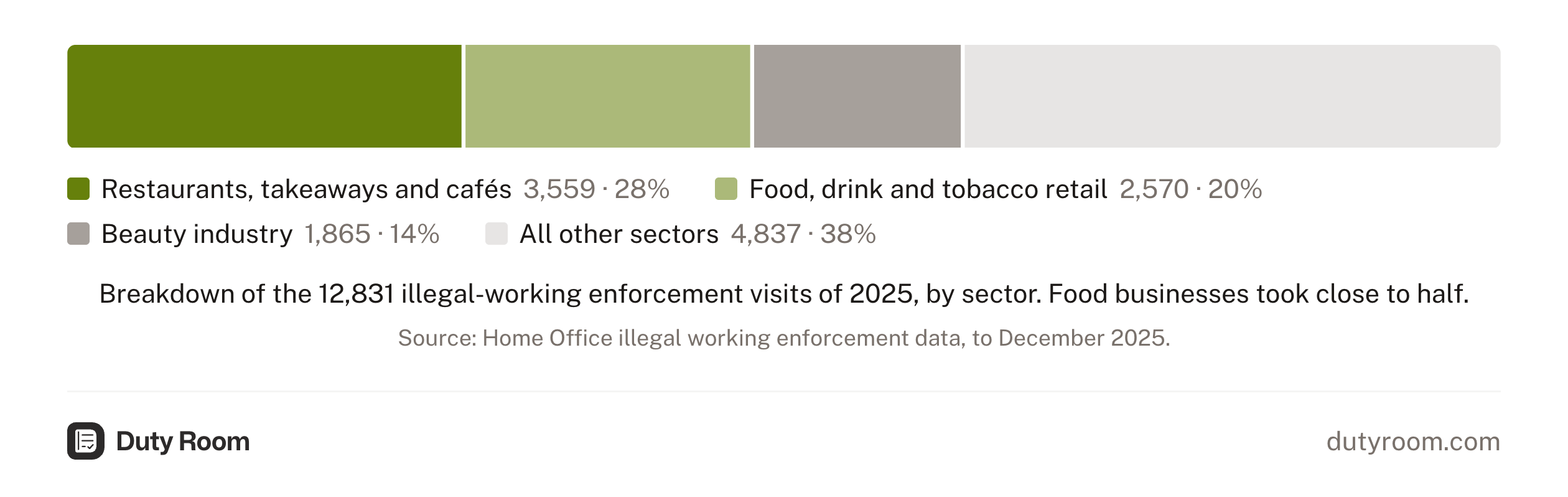
| Sector | Visits | Arrests |
|---|---|---|
| Restaurants, takeaways and cafés | 3,559 | 2,523 |
| Food, drink and tobacco retail | 2,570 | 823 |
| Beauty industry | 1,865 | 1,052 |
| Residential | 1,331 | 993 |
| Car washes | 808 | 664 |
| Warehousing, distribution and delivery | 796 | 1,106 |
| Retail (non-food) | 574 | 226 |
| Construction | 290 | 588 |
| All others | 1,038 | 1,033 |
Operators need a recruitment process that identifies who requires a check and retains the evidence from it. Our right-to-work checks briefing covers the checks and follow-up evidence.
Sponsor revocation can interrupt staffing across sites
Employers with sponsored staff must also meet their sponsor responsibilities, including monitoring immigration status, retaining documents and complying with employment law. The Home Office can withdraw the licence if the employer fails to meet those duties. That can create an immediate staffing problem.
Home Office guidance says a sponsored worker must leave the job when the employer loses its licence. The worker's permission is normally shortened to 60 days, or the remaining permission if shorter, to apply for another visa or leave the UK. A worker involved in the reasons for revocation may have their permission cancelled immediately.
If sponsored chefs at several sites work under the same licence, revocation can leave the group needing replacements across those sites. Recruitment plans need to account for that consequence as well as the immediate immigration decision.
Review the practices before you need to defend them
A worker and an enforcement officer can challenge an employer through different legal routes. Both may require the business to explain earlier actions. The useful preparation starts with the practice itself: how managers respond to abuse, allocate tips, decide to dismiss, calculate pay and check the right to work. Records then help show what happened.
The October and January changes give that review an order. Check whether new engagements fall within the right-to-work rules in force since 1 October. Before the harassment changes on 30 October, review the safeguards against abuse by colleagues and customers, including reporting and intervention procedures. Before January's dismissal changes, review how managers reach and record dismissal decisions for employees who will meet the shorter qualifying period.
A risk assessment and the response to an incident can show how the business addressed harassment. Allocation and time-and-pay records can explain what workers received. Right-to-work checks completed correctly at the required time, with the evidence retained, can establish a statutory excuse. Employers can assemble existing evidence after a letter arrives; they have a harder task proving an earlier action that nobody recorded.
-
The relevant event specified in SI 2026/954 controls the transition. Acas early conciliation and rules for the particular claim still matter. The corresponding change for Scottish employment-contract claims is scheduled for 9 November.
-
Employment Rights Act 1996, sections 27J to 27O; statutory tipping Code. The £5,366 limit is set by SI 2026/310. The six-month information-claim limit follows SI 2026/954's relevant-date transition. HMRC's tips and troncs guidance explains tax and National Insurance treatment. Tips cannot count towards minimum-wage pay, and mandatory service charges distributed to staff carry National Insurance contributions. An independent tronc, an arrangement that shares out tips, may qualify for different NIC treatment, but the employer's actual involvement matters.
-
Policy and records complaints normally have a six-month limit for relevant failures from 1 October 2026. Earlier failures retain the previous three-month limit, and conciliation or extension rules can affect the deadline. The transition follows SI 2026/954.
-
The current £123,543 ordinary compensatory limit comes from the Employment Rights (Increase of Limits) Order 2026.
-
Fair Work Agency employer guidance; Employment Rights Act 2025, section 116. The agency launched on 7 April 2026 and took over the Employment Agency Standards Inspectorate and the Gangmasters and Labour Abuse Authority. Legal responsibility for minimum-wage enforcement also transferred, with HMRC delivering that casework until April 2027. The agency's functions have different territorial limits. Minimum-wage enforcement covers the UK; the tribunal reforms discussed in this report apply in Great Britain.
-
Home Office, Code of practice on preventing illegal working, effective 1 October 2026, pages 29 and 32 to 37. Prior reporting with a Unique Reference Number and active co-operation each reduce the penalty by £5,000. Effective checking practices are an additional condition for a first-breach warning. The Faster Payment Option requires payment in full within 21 days; a timely objection preserves it subject to the revised deadline. Instalments do not qualify.
This report is based on published enforcement data, sources available at publication, and original analysis. It is for general information only and doesn't constitute legal advice.
Keep the evidence behind employment decisions
Duty Room keeps right-to-work checks, tipping records and supporting evidence together by site, so managers can find them when a claim or inspection arrives.