Staff aren't the only risk
October 2026: Third-Party Harassment and 'All Reasonable Steps'
This guidance covers Great Britain. Northern Ireland has separate employment and equality law.
Two changes planned for 30 October 2026 under the Employment Rights Act 2025 will rewrite the harassment rules for employers in Great Britain. The sexual harassment prevention standard gets harder and customers become a source of employer liability. A third change is coming behind these two: restrictions on confidentiality clauses that stop workers reporting harassment or discrimination are planned for 2027.
Staff in pubs, restaurants, and hotels serve alcohol late at night, and the EHRC's guidance expects employers to assess and address the harassment risks that follow from that.
Picture a bar supervisor at midnight dealing with a customer who has become aggressive or sexually threatening to a server. That late-night, lone-working, intoxicated-customer scenario is the kind of risk employers should address before anyone complains. The duty is preventative, and it already applies. The employer needs a plan for who will intervene and how staff can get help during that shift.
"Reasonable steps" becomes "all reasonable steps"
Since 26 October 2024, employers have had a duty under section 40A of the Equality Act 2010 to take reasonable steps to prevent sexual harassment of their workers. Section 20 of the ERA 2025 will replace "reasonable steps" with "all reasonable steps". The government's timeline puts this change and third-party liability on 30 October 2026, subject to parliamentary processes.
The difference is not cosmetic. A policy and annual training show what you did. Under the new standard, the question becomes: was there anything more you could reasonably have done that you didn't do? Employers already use an "all reasonable steps" defence in claims about harassment by their staff. The Allay case below shows why earlier training can need a refresher.
The EHRC's technical guidance makes clear that risk assessments, training, reporting channels, and response protocols should address the operation's risks. That means looking beyond a generic dignity-at-work policy to risks such as alcohol service, late-night closing, lone housekeeping staff, and a culture that tolerates sexual jokes.
The steps that count are the ones in place when an incident happens. Updating documents after a complaint won't undo an earlier failure to prevent harassment.
Section 22 of the ERA 2025 provides for regulations prescribing what counts as a reasonable step. The government plans to bring this power into force on 30 October, with the detailed rules to follow at a later date. Use the EHRC's technical guidance and Acas's advice to assess your prevention measures now.
Third-party harassment liability returns
The EHRC can already enforce employers' duty to take reasonable steps to prevent sexual harassment by customers, but workers cannot bring a standalone claim for breach of that duty. Section 21 of the ERA 2025 will let employees bring their own claims where an employer fails to take all reasonable steps to prevent third-party harassment in the course of their employment. This covers racial and other Equality Act harassment as well as sexual harassment.
For hospitality, customers are third parties: the guest who corners housekeeping staff, the regular who gropes a bartender, the wedding party that targets servers.
| Scenario | Typical gap | Steps of the kind the EHRC's guidance describes |
|---|---|---|
| Late-night intoxicated customer | No shift-level protocol; lone worker with no escalation route | Documented closing procedure naming who intervenes, with staff knowing who is expected to act |
| Repeat-offender regular | Pattern not recorded; staff warned informally not to antagonise the customer | Incident log from first report; customer told the behaviour is unacceptable, warned, then barred if it continues |
| Agency or casual worker | No harassment-specific induction; worker has no named point of contact | Same pre-shift briefing as permanent staff; a named manager on duty to report to; for agency staff, agree with the agency who receives reports and acts on them |
Where a tribunal upholds a harassment claim involving sexual harassment and awards compensation, it must also consider whether the employer breached the preventative duty. If it finds a breach, section 124A lets it increase compensation by up to 25%.
In 2023/24, the average sex discrimination award across all sectors was about £53,000. A 25% uplift on an award that size adds more than £13,000.1
The EHRC has already acted against employers in hospitality and retail. McDonald's signed a legally binding section 23 agreement under the Equality Act 2006 with the EHRC in 2023; by March 2025, the EHRC was writing to individual franchisees warning of enforcement action. Lidl signed a similar agreement after Hunter v Lidl GB found a "culture of harassment." Fuller's committed to mandatory training across its pub network after an EHRC-assisted case that settled.
NDA restrictions are planned for 2027
Section 24 of the ERA 2025 will void confidentiality clauses in agreements between employers and workers to the extent they prevent allegations or disclosures about relevant harassment or discrimination, or the employer's response to it. Regulations can provide exceptions. Acas and the government's timeline place the change in 2027, without a firm date.
Operators who have settled harassment complaints with confidentiality clauses attached should review those agreements and their templates now. How the change reaches agreements signed before commencement will depend on the regulations and any transitional rules.
This pairs with a change that already landed on 6 April 2026: sexual harassment became an express ground for a qualifying whistleblowing disclosure. Workers who report it can gain protection from detriment or dismissal if they meet the whistleblowing conditions. They must reasonably believe the disclosure is in the public interest and use a protected route, such as reporting to their employer.
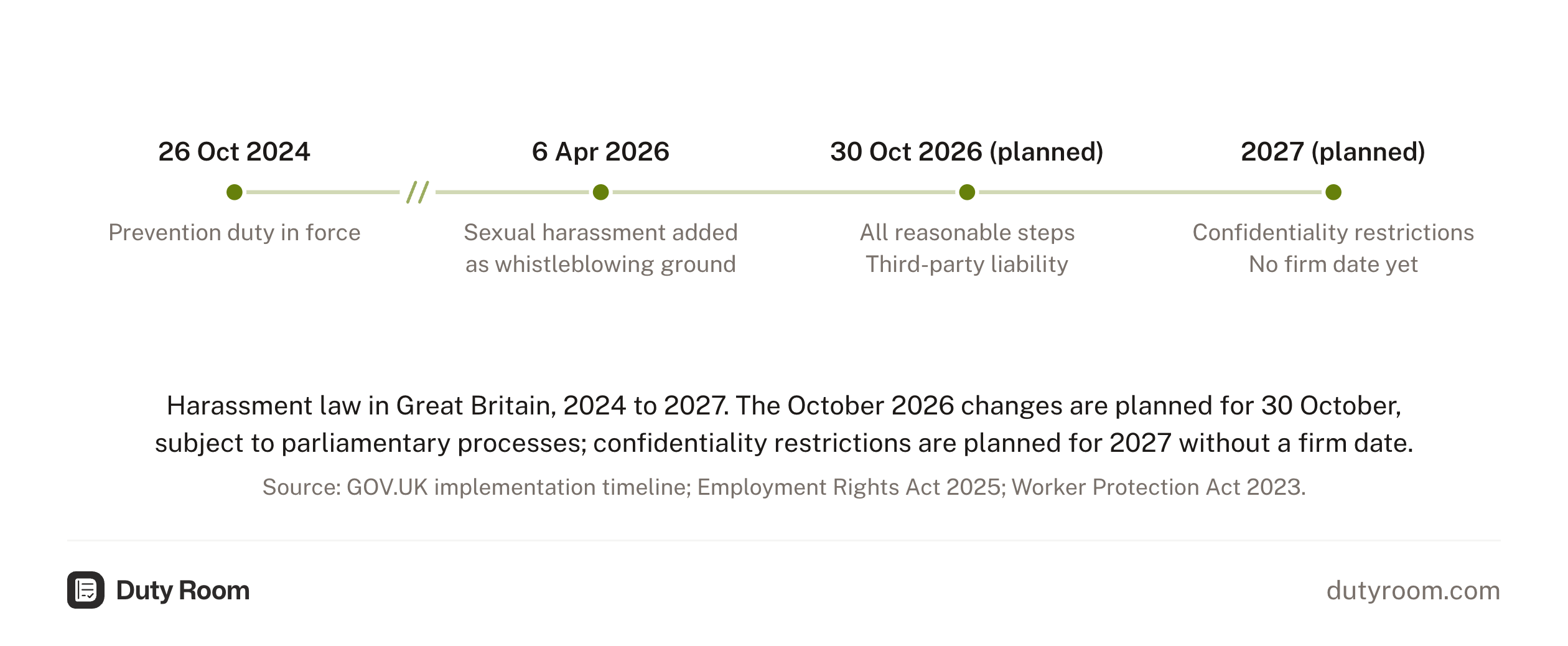
| Date | What changes | Status |
|---|---|---|
| 26 Oct 2024 | Prevention duty: reasonable steps | In force |
| 6 Apr 2026 | Sexual harassment becomes an express whistleblowing ground; protection depends on the statutory conditions | In force |
| 30 Oct 2026 | All reasonable steps; third-party harassment liability | Planned subject to parliamentary processes |
| 2027 | Restrictions on confidentiality clauses, subject to statutory scope and exceptions | Planned; no firm date |
What to prepare at each site
Name the person responsible for intervening on each shift, and tell staff how to get help or report a concern when their usual manager is off duty. Record reports and the action taken so the manager taking over knows what still needs attention.
In Allay (UK) Ltd v Gehlen, a racial-harassment case, the Employment Appeal Tribunal upheld the finding that earlier training had become stale and that refresher training was a reasonable further step. Check whether staff and managers understand their training and use it; keep records of refreshers and follow-up action.
-
Duty Room analysis of Ministry of Justice 2023/24 employment tribunal statistics: the mean sex discrimination award was £53,403, and a 25% uplift on that mean adds £13,351. The award-by-type breakdown is in the linked report.
This briefing is based on sources available at publication and is for general information only. It doesn't constitute legal advice. For advice on your specific situation, consult a qualified professional.
Produce the record when you're asked, not a week later.
The average NMW penalty is £5,545 and the naming rounds are public. Duty Room keeps right to work, working time, and tipping records current per site.