Payroll Mistakes Go Public
Hospitality Employers in HMRC NMW Naming Rounds
National Minimum Wage naming Round 24, published on 3 September 2026, named 658 employers, including 148 classified as hospitality. Duty Room analysed the government spreadsheet and found that those hospitality employers owed £402,311.59 to 7,228 workers.
But these are historical cases. The most recent hospitality arrears period ended on 5 July 2025, more than a year before the employers were named. For 134 of the 148 entries, the period ended before 2025. An employer investigated now may need to explain pay periods that ended years earlier, and the records that do that tie what happened at each site to what payroll paid.
Hospitality employers named in Round 24
Across the 148 hospitality entries, typical (median) arrears were about £1,380, and the typical number of workers affected was six. Five Guys alone accounts for just over half the total reported workers, with arrears covering December 2018 to April 2024.
The table lists the ten largest entries by arrears under the spreadsheet's "LPC Low Paying Sector" classification. Employer and trading names follow the published record. Each row is the company or person the government named, not a site. Two rows trade as McDonalds Restaurant because two separate companies were named, not the brand.
| Employer | Trading name, where listed | Arrears | Workers affected |
|---|---|---|---|
| Five Guys JV Limited | £54,642.47 | 3,699 | |
| The Sussex Food Co Limited | Purchases Chichester | £24,412.38 | 35 |
| McLean Restaurants Limited | McDonalds Restaurant | £18,307.02 | 515 |
| Y7 Hotels Limited | Tiffany's Hotel | £11,131.99 | 228 |
| Loizou Restaurants Limited | McDonalds Restaurant | £11,074.88 | 282 |
| The Retreat Pub Co Limited | The Retreat | £10,960.48 | 2 |
| Aston Management International Ltd | Hustyns Hotel & Spa | £8,760.51 | 7 |
| Durn House Ltd | £8,230.33 | 7 | |
| Mrs Nicola Anna Gould | Diamond Events Management | £8,012.33 | 1 |
| Northgate Fast Food Limited | Taco Bell | £7,976.25 | 115 |
Source: Round 24 spreadsheet; selection and calculations by Duty Room. The full spreadsheet contains all 148 hospitality entries.
These are completed enforcement cases selected for naming. They don't measure the proportion of hospitality employers underpaying staff.
More employers named, less owed in total
Round 24 named more employers than any of the previous four rounds, yet had the lowest total arrears and fewest affected workers. Compared with Round 23, the employer count rose 69%, while arrears fell 42% and the affected-worker count fell 53%.1
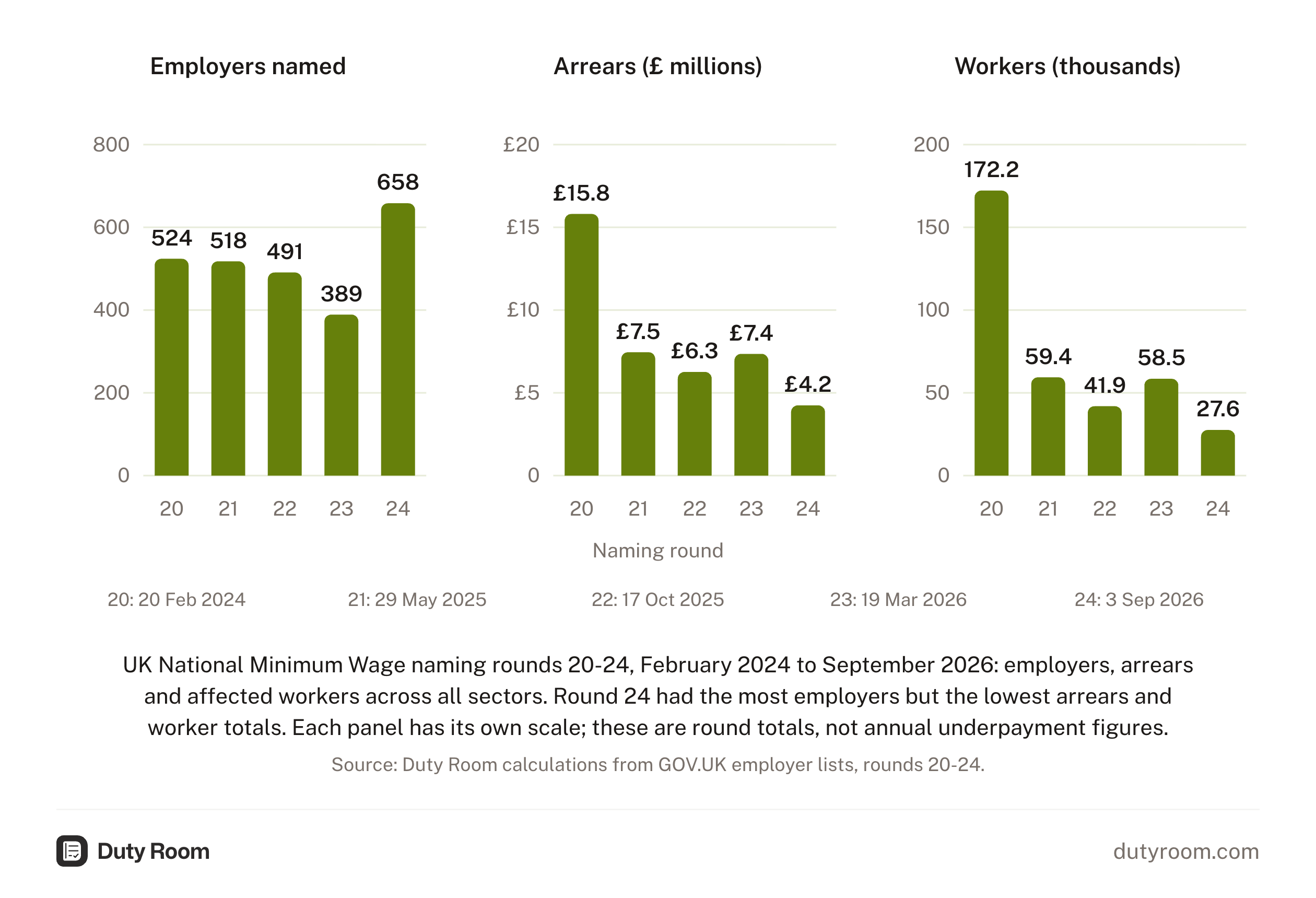
| Round | Publication date | Employers named | Arrears | Workers affected |
|---|---|---|---|---|
| Round 20 | 20 Feb 2024 | 524 | £15,805,622.13 | 172,199 |
| Round 21 | 29 May 2025 | 518 | £7,454,493.75 | 59,438 |
| Round 22 | 17 Oct 2025 | 491 | £6,267,281.97 | 41,923 |
| Round 23 | 19 Mar 2026 | 389 | £7,352,658.84 | 58,456 |
| Round 24 | 3 Sep 2026 | 658 | £4,246,021.57 | 27,617 |
The rounds cover all sectors and different historical pay periods, so these totals don't show whether underpayment became more or less common in any year. One employer can also move a round's worker total. Round 20 named Mitchells & Butlers PLC with £565,094.87 owed to 16,187 workers, and Round 21 named Pizzaexpress (Restaurants) Limited with £760,701.61 owed to 8,470 workers.
What should employers check after Round 24?
The checks below cover rate changes, working time, and deductions, including accommodation charges. The Round 24 educational bulletin focuses on applying higher minimum wage rates at the right time. Its case breakdown identifies deductions and working time as the two most common reasons for underpayment. Deductions or reductions affected 257 employers (39%); working-time errors affected 221 (34%). Another 104 employers (16%) missed a rate increase when it fell due. These figures cover all sectors, and the categories overlap.
Rate changes
Payroll needs two dates: the 1 April increase and any birthday that moves a worker into a higher age band. The higher rate applies from the first pay reference period starting on or after the change. Check the effective pay period as well as the hourly rate.
In the same round, 103 employers paid apprentices the wrong rate. An apprentice aged 19 or over who has completed their first year is entitled to the minimum wage for their age. Keep dates of birth, apprenticeship start dates and completion details available to the people updating pay.
Working time
Pre-shift briefings, cashing up after closing and mandatory training all add working time. The bulletin also flags clock-in rounding, extra hours beyond those covered by a salary, and errors in final pay when someone leaves. Compare the time recorded at the site with the hours payroll used, including clocking corrections and travel between sites during the working day. A planned rota won't explain a shift that finished late, and an employer that leaves that time out can underpay a worker whose stated rate is correct.
Trial shifts need a separate assessment: entitlement depends on their length, supervision and value to the business. A short recruitment test may fall outside the rules. Record what the applicant did and for how long, so whoever assesses pay has something to work from.
Deductions and accommodation
If staff must buy clothes to meet a dress code and aren't reimbursed, those costs reduce minimum-wage pay, even when they buy the clothes from another retailer. Check the pay period the expense fell in; an annual salary total won't show whether someone was underpaid that month.
The bulletin's deductions list extends to meals, equipment, training costs and salary sacrifice. Check the arrangements used at each site and their effect on minimum-wage pay. Salary sacrificed for benefits, including pension contributions, reduces the pay that counts towards the minimum wage.
For pubs and hotels with live-in staff, accommodation charges also belong in the calculation. The offset is £11.10 a day from April 2026; charges above it reduce minimum-wage pay by the excess. Gas and electricity charges count too. The offset isn't a rent cap. Our accommodation offset briefing works through the calculation.
Could you produce the records for one pay period?
The bulletin says employers' records must show that each worker received at least the minimum wage for every pay reference period. It lists actual hours worked, payments, deductions and proof of payment among the records an employer could keep. The minimum retention period is six years, counted from the end of the pay reference period following the one the records cover.
Pick one worker and one completed pay period at one site. Can the site and payroll records explain the rate used, hours worked, any costs or deductions, the calculation and the payment? If an entry changed, can the people responsible find the correction?
Agree who records changes at the site, who checks their effect on pay, and who keeps the supporting records available when staff leave or systems change. A folder of payslips may show what was paid without explaining the hours or expenses behind it.
If the records reveal an underpayment, keeping them doesn't put it right. The bulletin asks employers to repay workers and submit a voluntary declaration to HMRC, which enforces minimum-wage law on behalf of the Fair Work Agency.
Repayment doesn't end the consequences
Under the Fair Work Agency's enforcement policy, a minimum-wage penalty is normally 200% of the underpayment, subject to a £100 minimum and a £20,000 cap per worker. The penalty halves if the employer pays all arrears and half the penalty within 14 days, counting the day the notice is given as day one.
The public record can outlast repayment. The 2018 release naming Wagamama still lists the employer's name, the number of workers affected and the arrears eight years later.
Round 24 shows why an operator may need to explain work done long before a naming announcement. The useful record is the one that connects what happened at the site to what the worker was paid. Start with one completed pay period at one site and see whether your records explain it.
-
Duty Room calculations from the employer lists in Round 20, Round 21, Round 22, Round 23 and Round 24. Arrears and worker counts are summed across each list; percentages compare rounds 23 and 24 and are rounded to whole numbers. Worker counts may include a person under more than one employer. Chart labels round arrears and worker totals; the accessible table retains the exact sums.
This report is based on published enforcement data, sources available at publication, and original analysis. It is for general information only and doesn't constitute legal advice.
Keep employment evidence organised by site
Duty Room keeps employment records and supporting evidence together by site, so the people responsible can find them when asked.