An illegal-working finding can reach the licensing committee
UK Restaurants, Takeaways and Cafes Had 3,559 Immigration Visits in 2025
This guidance covers England and Wales. Scotland and Northern Ireland have separate licensing regimes.
Immigration Enforcement recorded 3,559 visits to UK restaurants, takeaways and cafes in 2025, the largest sector count in the Home Office release. The same sector recorded 2,523 arrests. These are activity counts, not a count of distinct businesses or a finding that every visit uncovered illegal working.
For premises in England and Wales, an illegal-working finding can also reach the licensing committee. The operator should keep evidence that answers both enquiries: who worked, what checks were made and whether the licence's own conditions were met.
Entry under section 179 has a defined purpose
Section 179(1A) of the Licensing Act 2003 lets an immigration officer enter without a warrant where they have reason to believe the premises are being used to sell alcohol or provide late-night refreshment. The purpose must be to investigate whether an immigration offence is being committed in connection with that activity.
The Home Office operational guidance limits the power accordingly. Holding an alcohol licence does not give officers an unrestricted right to enter every part of a property for any immigration purpose. The power can also apply where licensable activity takes place without a licence.
An officer exercising it must produce evidence of their authority if requested and may use reasonable force where necessary. Intentional obstruction is an offence, punishable by a level 3 fine. Section 179 excludes premises operating under a club premises certificate alone.
The check determines the civil-penalty defence
Officers may question workers and examine employment records during a visit. A correctly completed prescribed right-to-work check can establish a statutory excuse against a civil penalty. That defence depends on the check and any required follow-up, not simply on having a copy of a passport. An employer who knows that the person cannot lawfully do the work loses the excuse regardless of any checks.
The employer's guide effective from 1 October 2026 covers the expanded scheme, including qualifying arrangements beyond conventional employment contracts. Our right-to-work briefing explains the scope and checking routes.
Make the evidence retrievable by the people who may need to answer a visit. A head-office system can provide records on site if staff can access it. Check any premises-licence condition that requires records to be held at the premises or produced on demand.
Civil penalties and criminal offences have different tests
The Home Office's civil-penalty code sets calculation starting points of £45,000 per illegal worker for a first breach and £60,000 for a repeat breach within three years. Applicable reductions can lower the amount. A civil penalty concerns illegal working without a statutory excuse. A missing document alone does not establish every element.
The criminal offence reaches employers who know, or have reasonable cause to believe, that a worker is disqualified from working by their immigration status. It can carry up to five years' imprisonment and an unlimited fine. Describing it only as knowingly employing an illegal worker misses the second part of that test.
A licence review can follow the same findings
The Home Office is a responsible authority under the Licensing Act and can apply to review a premises licence where the licensing objectives are undermined. A licensing committee can change conditions, exclude a licensable activity, remove the designated premises supervisor, suspend the licence for up to three months or revoke it.
The Home Office's section 179 guidance describes a stepped approach to review referrals. A first finding involving one or two illegal workers normally prompts a warning. Three or more workers, a section 15 penalty in the previous three years or an unpaid penalty can prompt a review application. That policy does not guarantee an operator a warning before serious licence action.
Royal China Restaurant in London illustrates how the two processes can overlap. Westminster's committee report records three visits between October 2018 and May 2024, with 20 illegal workers and £470,000 in civil penalties across them.
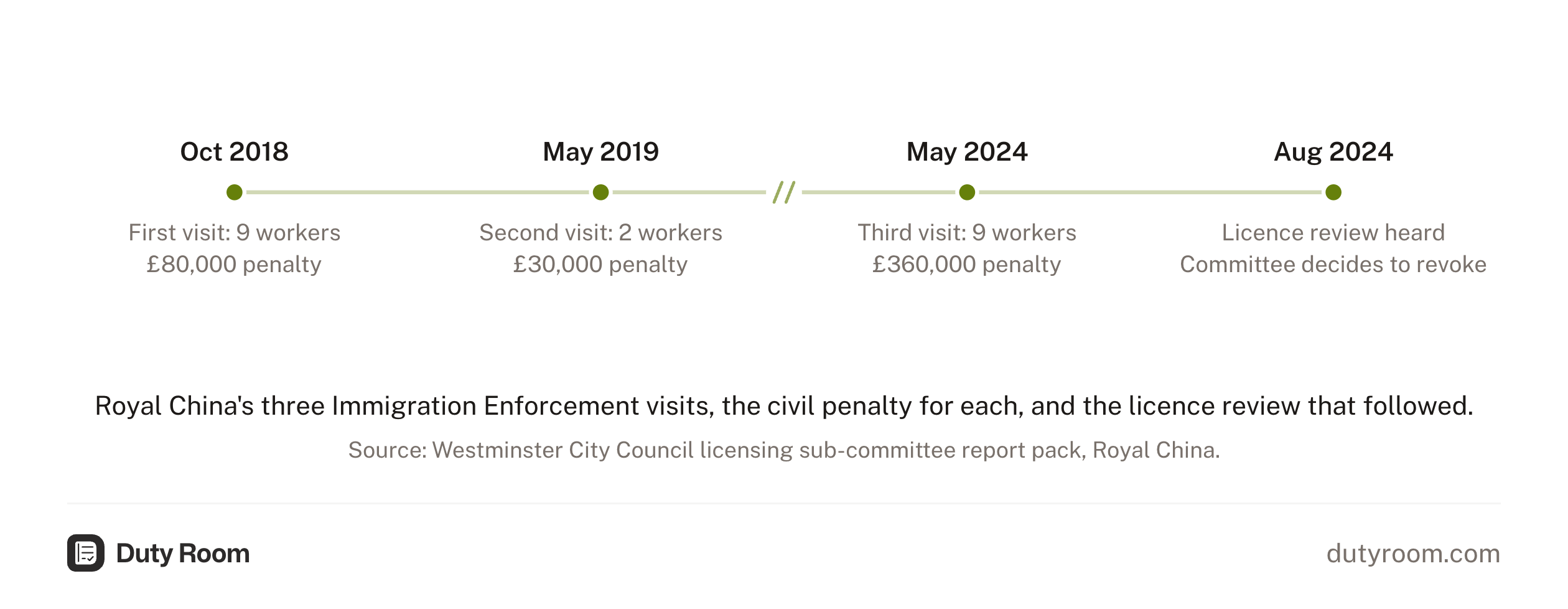
| Date | Event | Outcome |
|---|---|---|
| 25 Oct 2018 | First Immigration Enforcement visit, nine illegal workers | £80,000 civil penalty |
| 9 May 2019 | Second visit, two illegal workers | £30,000 civil penalty |
| 10 May 2024 | Third visit, nine illegal workers | £360,000 civil penalty |
| 15 Aug 2024 | Premises licence review heard by Westminster's licensing sub-committee | Decision to revoke the licence |
The committee decided to revoke the licence on 15 August 2024. The record cited here does not establish whether the restaurant appealed or what happened to its licence after that decision.
Check the licence conditions alongside the hiring file
A licence can require checks for staff and records available on demand. Failure to meet such a condition can create a licensing problem independently of whether a civil immigration penalty follows.
Keep the prescribed checks, follow-up dates and relevant licence conditions together. Give the manager on duty access, and test that access before a visit. The licence-review briefing covers the evidence a committee may examine when illegal-working findings lead to a review.
This briefing is based on sources available at publication and is for general information only. It doesn't constitute legal advice. For advice on your specific situation, consult a qualified professional.
Produce the record when you're asked, not a week later.
The average NMW penalty is £5,545 and the naming rounds are public. Duty Room keeps right to work, working time, and tipping records current per site.