A lawful hourly rate can still produce an underpayment
Fair Work Agency: Check the Hours and Deductions Behind Staff Pay
This briefing covers national minimum wage enforcement across the United Kingdom.
A wage rate on a contract does not show whether every hour was paid. Unpaid training, time worked after a shift and deductions for uniforms or staff accommodation can leave hospitality staff below the minimum wage. The Fair Work Agency can investigate the hours and deductions behind the payslip, so an employer needs records that reconstruct what each worker earned.
The agency took legal responsibility for national minimum wage (NMW) enforcement on 7 April 2026. HMRC continues to deliver the investigations on its behalf until its team fully transfers in April 2027. That change did not give employers a grace period or reduce what an underpayment costs: the employer can owe the worker arrears and the government a penalty.
Check paid time and deductions together
The hospitality cases in HMRC's NMW record include accommodation offset errors, uniform costs, unpaid training and clock rounding. Each can make the pay counted towards minimum wage lower than the employer expects.
Start with the hours actually worked in the pay reference period. A rota shows the planned shift; it may miss training or work done after the shift ends. Then check the pay and any deductions or accommodation charges that affect the minimum-wage calculation. Our accommodation offset briefing explains how staff housing can create a shortfall even when the rent is below market value.
Keep enough detail to repeat the calculation for each worker. The contract, recorded hours, payslip and relevant charges should explain the result together.
An underpayment can cost more than the missing wages
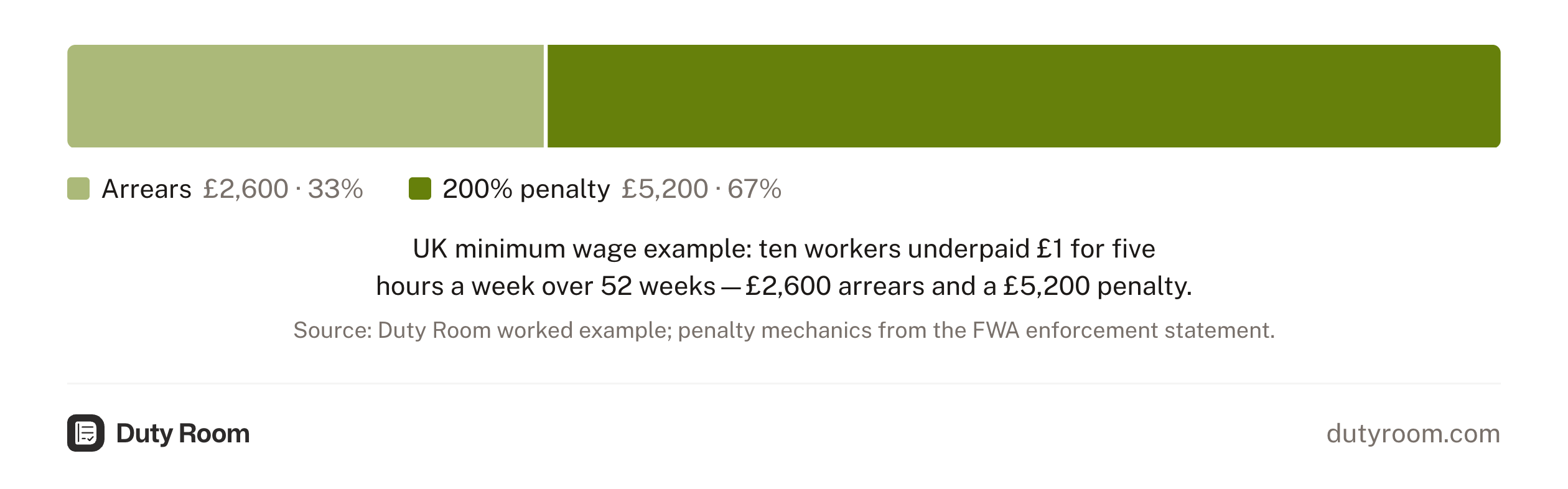
The FWA enforcement statement retains the NMW penalty of 200% of arrears, with a minimum of £100 per notice and a cap of £20,000 per worker. If the employer pays all the arrears and half the penalty within 14 days, the remaining half is waived.
A small hourly shortfall can accumulate across workers and pay periods. In the illustrative example below, a £1 shortfall for five hours a week over 52 weeks produces £260 in arrears for one worker. For ten workers, the arrears reach £2,600 and the full penalty adds £5,200.
| Element | Calculation | Amount |
|---|---|---|
| Arrears | £1 shortfall x 5 hours a week x 52 weeks x 10 workers | £2,600 |
| 200% penalty | Two times arrears, before any 14-day reduction | £5,200 |
| Total | Arrears plus full penalty | £7,800 |
| 14-day total | All arrears plus half the penalty | £5,200 |
The example excludes the statutory adjustment for increases in the minimum wage. Where the current rate is higher than the rate when the underpayment occurred, the arrears calculation uses that higher rate. A notice can cover underpayments that fell due in the six years before it was issued; the amount still depends on the actual hours, shortfalls and workers affected.
If a check reveals an error, establish when it began and which workers it affected. Correcting the current payslip does not repay earlier shortfalls. The accommodation briefing's arrears section explains the current-rate adjustment and the treatment of repayment before an investigation starts.
The records must answer the investigation
An NMW investigation can reach payroll, time, contract, rota and accommodation records that bear on whether the minimum wage was paid. A payslip may establish the amount paid; the time records and relevant charges explain whether that amount covered the worker's hours at the required rate.
The FWA's powers under Part 5 of the Employment Rights Act 2025 depend on the enforcement purpose. If a request reaches beyond the obvious wage records, record what was requested, check the written notice where one is used, and get legal advice promptly. Do not assume that the request is invalid or refuse it on the spot. The FWA inspection briefing explains the officer's powers and how to handle first contact.
Keep a calculation that another manager can follow
Before the next payroll run, check a worker's actual hours against the pay and relevant charges for the same period. Repeat the check when hours or deductions vary. Keep the source records with the calculation and any correction, so another manager can explain both what was paid and why it met the minimum wage.
This briefing is based on sources available at publication and is for general information only. It doesn't constitute legal advice. For advice on your specific situation, consult a qualified professional.
Keep the records behind staff pay
Duty Room keeps working-time evidence and employment records organised by site, so managers can retrieve them when a pay calculation is questioned.