Anyone relevant can start it
Half of Premises Licence Reviews End in Revocation, Withdrawal or Suspension
This guidance covers England and Wales. Scotland and Northern Ireland have separate licensing review processes.
In 2023/24, licensing authorities in England and Wales completed 412 premises licence reviews. Forty percent ended with the licence revoked or the certificate withdrawn; suspension took another 12%. Premises that reach a review hearing keep their licence roughly half the time, though usually with new conditions attached.
Who can apply
Any responsible authority can apply at any time, among them: police, fire and rescue, trading standards, environmental health, the licensing authority itself, Home Office Immigration Enforcement (since April 2017), the Director of Public Health, and child safeguarding bodies. Any other person (residents, businesses, community groups) can also apply, though the authority can reject those applications as frivolous, vexatious or repetitious.
Police trigger 49% of reviews. Trading standards 19%. The "Other" category, including the Home Office, has grown from 2% in 2011/12 to 18% in 2023/24. Residents account for roughly 7%.
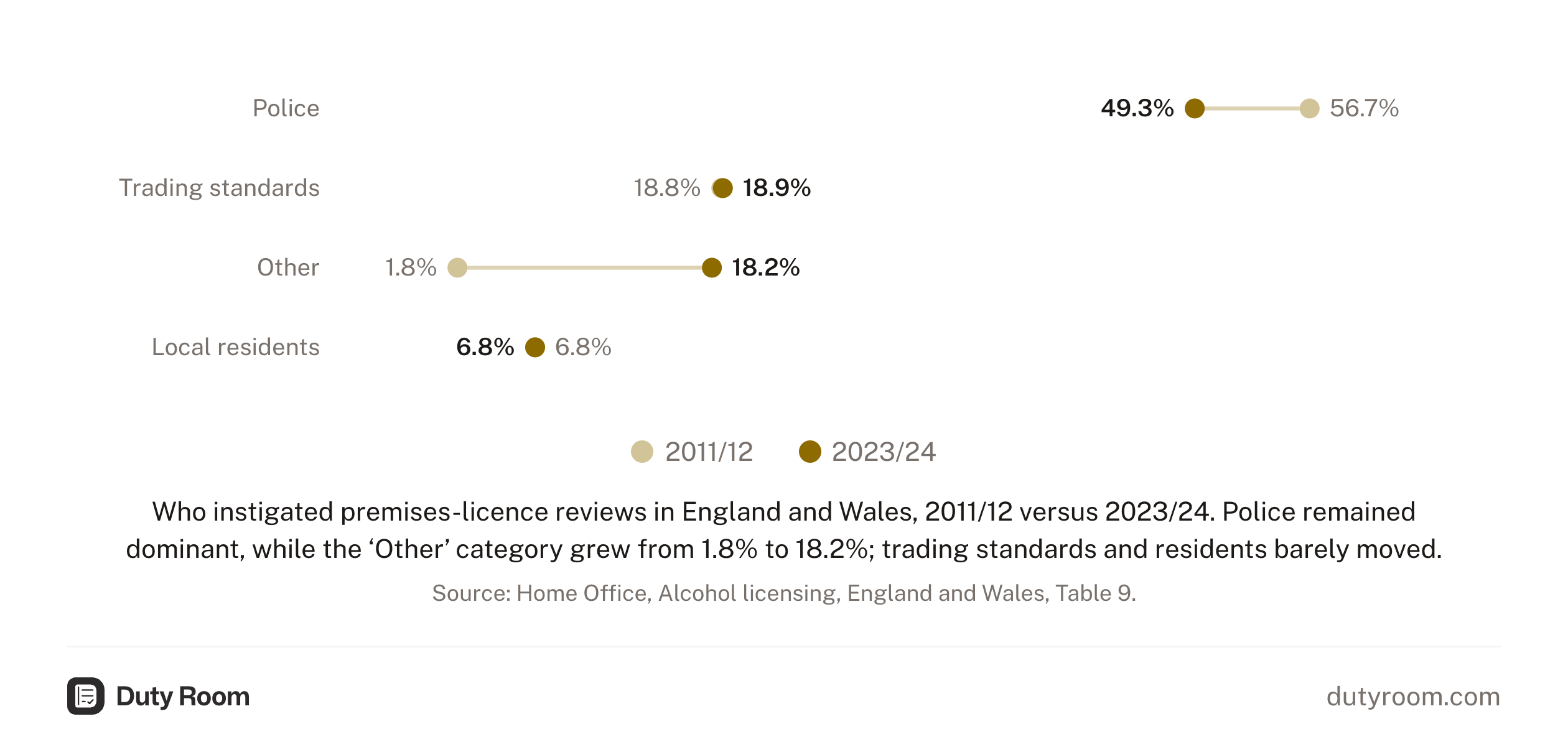
| Applicant category | 2011/12 | 2023/24 |
|---|---|---|
| Police | 56.7% | 49.3% |
| Trading standards | 18.8% | 18.9% |
| Other responsible authorities or interested parties | 1.8% | 18.2% |
| Local residents | 6.8% | 6.8% |
The review must relate to the four licensing objectives set out in s.4 of the Licensing Act 2003. Applicants cite crime and disorder in 83% of reviews. A review needs no criminal prosecution, only evidence that an objective is being undermined.
The standard process
Under s.51 of the Licensing Act 2003, the applicant submits evidence specifying which objectives are being undermined. A 28-day consultation period follows, during which other authorities and anyone else affected can make representations. The licensing sub-committee then holds a hearing.
Possible outcomes: no action, modification of conditions, exclusion of a licensable activity, removal of the DPS, suspension for up to three months, or revocation. There is no fixed ladder. The s.182 guidance requires steps that are "appropriate and proportionate." A credible remedial response might result in conditions. A serious incident can jump straight to revocation: after a drugs warrant at King VN in Birmingham found Class A supply and £30,000 in cash, the committee revoked the licence in January 2024.
Standard review decisions do not take effect until the 21-day appeal period expires. The premises can trade in the meantime.
Summary review: the 48-hour route
When police consider premises are associated with serious crime or disorder, they can apply under s.53A. Only police can use it, and the application needs a superintendent's certificate.
Within 48 hours, the licensing authority must consider interim steps: modifying conditions, excluding alcohol sales, removing the DPS, or suspending the licence. These take effect immediately and remain in force during any appeal. A premises suspended under interim steps cannot trade while it appeals. A full review follows within 28 days.
At DeCode Lounge in Walsall, a death in December 2024 led to interim suspension within days and revocation by 6 January 2025. The Jolly Collier in Cannock Chase was the district's first summary review and ended in revocation in March 2023.
Appeals
The licence holder, the review applicant, or anyone who made relevant representations can appeal to the Magistrates' Court within 21 days. The appeal is a full rehearing.
The Home Office counts appeals against application and review decisions together: 89 were completed in 2023/24, with a success rate of 24%. Fifty-five percent were withdrawn. Of the 412 review decisions that year, at most 21 fell to an appeal.
Hope and Glory [2011] EWCA Civ 31 sets the approach: the onus is on the appellant to show the decision was wrong, and the court should "pay careful attention to the reasons given by the licensing authority."
The stakes
The typical organisation fine for an underage alcohol sale, across 2017 to 2024, was under £700.1 Fleurets, a pub property agency, puts the average freehold pub sale at around £800,000. Criminal fines are a cost of doing business. Licence revocation is the end of the business.
The failed licensing inspection briefing covers what to do when an inspection has gone wrong. Our licensing resources cover how to build the compliance record that keeps a review from being called.
-
Duty Room analysis of Ministry of Justice Court Proceedings Database records (England and Wales, December 2024 release): 42 fine outcomes in the source's "02: Companies, public bodies, etc." category for underage alcohol sale offences (HO code 14379), 2017 to 2024. The source groups two of those outcomes into one combined row, so the median is identified only as between £663 and £683. Counts are fine outcomes, not distinct organisations.
This briefing is based on sources available at publication and is for general information only. It doesn't constitute legal advice. For advice on your specific situation, consult a qualified professional.
Your licence has conditions. Prove you're keeping them.
Half of premises licence reviews end in revocation or suspension. Duty Room keeps licence conditions, refusals, incidents, and CCTV checks current per site.