Every review quotes these four
The Four Licensing Objectives: What They Mean and How They're Enforced
This guidance covers England and Wales. Scotland has five licensing objectives (including "protecting and improving public health"). Northern Ireland has separate legislation.
Every licensing decision in England and Wales turns on four objectives set out in s.4 of the Licensing Act 2003. When your licence is granted, when conditions are attached, and when someone applies to review it, these are the only grounds that matter. Understanding what each one means in practice, and which ones trigger enforcement, changes how you run your premises.
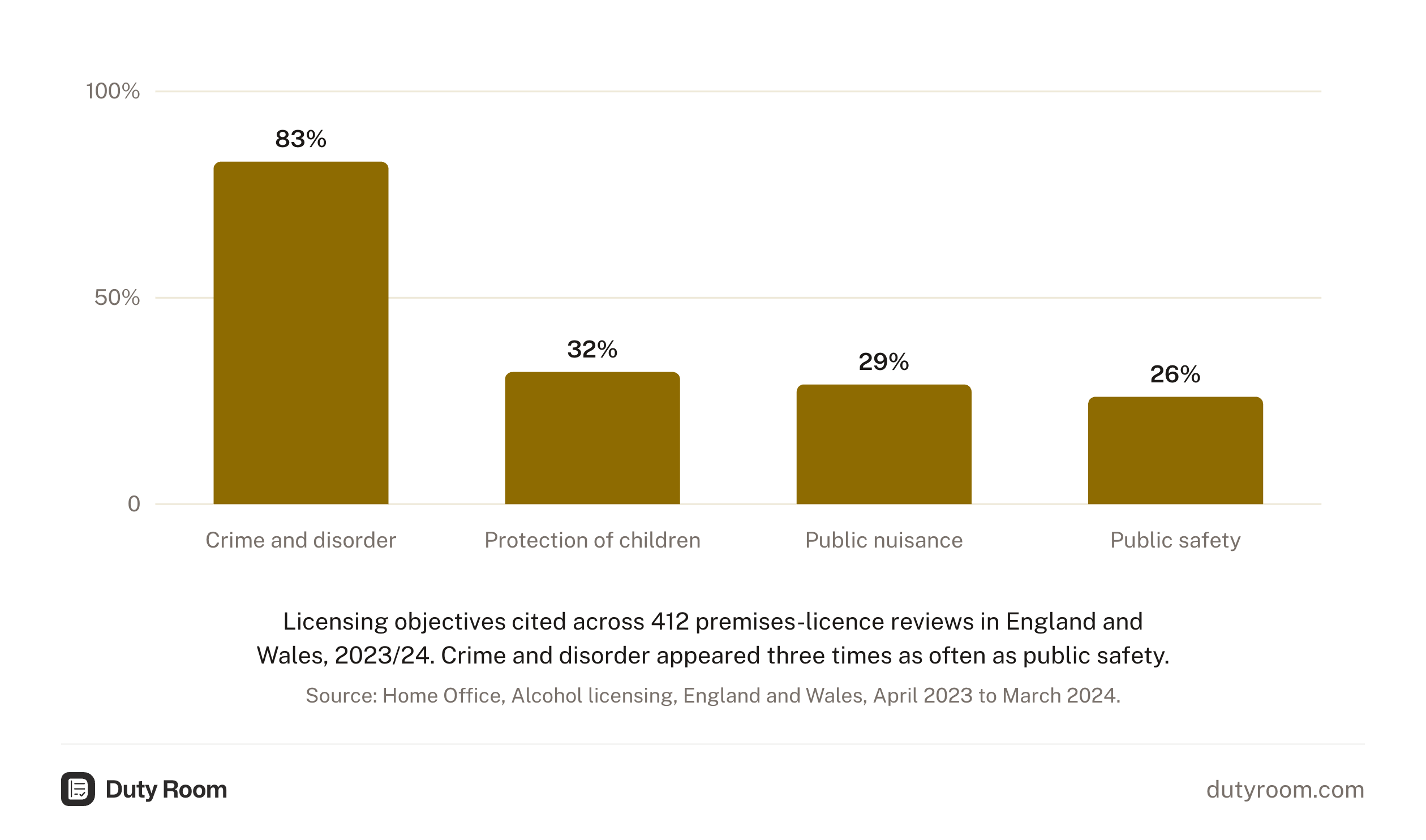
| Objective | Reviews citing it | Share |
|---|---|---|
| Crime and disorder | 343 | 83% |
| Protection of children | 130 | 32% |
| Public nuisance | 119 | 29% |
| Public safety | 108 | 26% |
1. The prevention of crime and disorder
This objective dominates. In 2023/24, 83% of the 412 licensing reviews completed in England and Wales cited crime and disorder (Home Office, year ending March 2024). That figure has risen from 64% in 2011/12. Police trigger 49% of all reviews.
"Crime" is interpreted broadly: violence, drug activity, illegal working, sale of illicit goods, sexual offences. The s.182 guidance expressly includes "prevention of immigration crime." Drink spiking was added in December 2023.
The Crane Nightclub in Birmingham had its licence revoked in January 2023 after a fatal stabbing on Boxing Day 2022. DeCode Lounge in Walsall drew an interim suspension within days of a death in December 2024, and revocation followed by 6 January 2025.
Day-to-day: CCTV that works and retains footage for the full conditioned period. SIA-licensed door staff at the right times. An incident log that records every ejection, crime reported, and seizure. A DPS the police can reach at 1am.
2. Public safety
Cited in 26% of reviews. This covers physical safety: capacity management, crowd control, prevention of accidents.
Public safety is not public health. Public health is not a licensing objective in England and Wales (it is in Scotland). The Director of Public Health is a responsible authority but can only link health data to the existing four objectives.
The O2 Academy Brixton crush in December 2022 killed two people and led to suspension followed by 77 conditions for reopening. At Proj3kt Nightclub in Burnley, the fire authority served a prohibition notice; the club opened again the same day, and the licence was revoked.
Day-to-day: count against any conditioned capacity. Match the premises plan to the physical layout. If you have sleeping accommodation above the pub, fire separation is both a fire safety matter and a licensing matter. The fire safety and licensing briefing covers the overlap.
3. The prevention of public nuisance
Cited in 29% of reviews, a share that has barely moved in over a decade. Covers noise, light pollution, litter, and odour under the broad common-law definition.
Environmental health triggers only 6% of reviews directly. Most reviews that cite nuisance are led by another authority, usually the police. The Royal Volunteer in Clay Cross was revoked in 2020 after persistent noise complaints. Club Inferno installed the required noise limiter, but the complaints continued. Tighter conditions, then further review.
Day-to-day: limiters not bypassed. Doors and windows closed during regulated entertainment. Active dispersal management at closing. Smoking areas managed after 10pm.
4. The protection of children from harm
Cited in 32% of reviews in 2023/24, up from 29% in 2021/22. This is broader than underage sales: it covers any risk of harm to children from the operation of the premises.
Trading standards trigger 19% of all reviews, primarily through test purchase operations. Approximately one in six premises fail (compiled local authority data, ~17% weighted average). Most operations target premises already under suspicion, so the headline rate runs higher than a random sweep would show. Pubs fail at roughly double the rate of off-licences.
World Superstore in Tooting sold to children in school uniforms. Revoked. London Food Centre had a signed age-verification certificate on file but failed test purchases anyway and lost its licence too. Rotherham's Best was revoked, reinstated on appeal with ten conditions, then faced a second revocation application.
Day-to-day: a Challenge 25 system that actually operates, not just signage. A refusals log with entries. Staff trained and retrained.
Equal weight, unequal frequency
Each objective carries equal importance (s.182 guidance, paragraphs 1.3-1.4). In practice, crime and disorder is cited three times more often than public safety.
But a review only needs one objective. A premises with excellent security but persistent noise complaints is still exposed. The objectives don't offset each other.
Forty percent of reviews end with the licence revoked or the certificate withdrawn. Our licensing resources set out the compliance record that keeps your premises on the right side of those numbers.
This briefing is based on sources available at publication and is for general information only. It doesn't constitute legal advice. For advice on your specific situation, consult a qualified professional.
Your licence has conditions. Prove you're keeping them.
Half of premises licence reviews end in revocation or suspension. Duty Room keeps licence conditions, refusals, incidents, and CCTV checks current per site.