It's Already In Writing
What to Do After a Failed Licensing Inspection
This guidance covers England and Wales. Scotland and Northern Ireland have separate licensing regimes.
A licensing inspection that flags problems creates a paper trail. How the premises licence holder responds shapes whether the matter ends with informal advice or escalates to a formal review.
Understanding the report
Inspection reports are not pass/fail documents. They contain findings at different levels of seriousness:
- Advisory points are recommendations. No immediate enforcement consequence follows, but advisory points left unaddressed become part of the record if a review is later called.
- Breaches of licence conditions are more serious. A premises licence includes specific conditions, and operating outside them is an offence under the Licensing Act 2003. Common examples: CCTV not meeting the required specification, incomplete incident logs, staff unable to describe the conditions that apply to their role, or missing age-verification records where required by a licence condition.
- Breaches of mandatory conditions (such as the ban on irresponsible drinks promotions, or the requirement under s.19(3) that every sale of alcohol be authorised by a personal licence holder) sit at the top. These are statutory and attract the closest scrutiny.
Each finding in the report should be cross-referenced against the specific condition in the premises licence before any response is made.
What this changes for operations: The classification of each finding sets the urgency of the response. A mandatory condition breach needs an answer in days; an advisory point can wait for the action plan. Sorting the findings by category before first contact with the licensing officer makes the response faster to write and harder to fault.
Who can act
The local council is not the only body involved. Under the Licensing Act 2003, several "responsible authorities" can influence a premises licence:
- The licensing authority itself
- Police can apply for a review on any of the licensing objectives, most often crime and disorder, and can trigger summary reviews
- Fire authority can raise public safety concerns
- Trading standards can act on consumer protection and underage sales
- Environmental health can raise noise and nuisance issues
- Home Office Immigration Enforcement can act on illegal working
- Public health, the planning authority, and the body responsible for child protection also hold responsible authority status
Any responsible authority can apply for a review at any time. So can any other person, provided the application is not frivolous, vexatious or repetitious. A failed inspection often provides the evidential basis for action.
Response to the report
Prompt, documented remedial action is the strongest card an operator holds, and the stakes at the end of that road are not abstract: of the 412 premises licence reviews completed in England and Wales in the year to March 2024, four in ten ended with the licence revoked or withdrawn, and another one in eight with a suspension. Acknowledge the findings, make the specific changes quickly, and write to the licensing officer with a timed action plan.
The s.182 guidance expects authorities to give early warning and a chance to improve. An operator who responds in writing, quickly and specifically, is using that window. One who does not respond should expect the next step to be a review application. A good written response covers each finding: what is changing, when it will be complete, and who is responsible.
Training records matter at hearings. Dated attendance records, the topics covered, and confirmation that staff understood the conditions relevant to their role (who can authorise alcohol sales, what Challenge 25 requires, when the incident log must be completed) are evidence a sub-committee can weigh. Training that was claimed but never documented is just an assertion.
The first working day. Do the immediate housekeeping while the report is still fresh:
- Update the incident log and refusals record the day the report arrives.
- Post the premises licence conditions where staff can see them.
- Adjust CCTV angles and photograph the result with a timestamp.
- Confirm DPS details are correct and displayed.
- Document and date each action.
Timestamped evidence reads as compliance culture; a verbal account of the same work reads as a promise.
Hold a staff briefing within a week of the inspection and record it (attendance list, topics, date). The briefing does not need to be long; it needs to be documented.
The review process
A licensing review is the formal mechanism for reconsidering a premises licence under Part 3 of the Licensing Act 2003. The revised guidance issued under section 182 sets out the detail, and the licensing review process briefing walks through who can trigger one and what happens at each stage.
The procedure moves in stages. A responsible authority or any other person submits a review application. The licensing authority advertises it, and written representations can be filed during the 28 days that start the day after the authority received the application. The premises licence holder, responsible authorities, and anyone else affected can all file. This 28-day window is the primary opportunity to put evidence before the sub-committee before the hearing date is set. Representations received after the close of that window may be excluded. The sub-committee then holds a hearing; the premises licence holder may attend and present evidence. The sub-committee issues its determination in writing, typically within five working days of the hearing. An appeal against the determination lies to the magistrates' court, which must be lodged within 21 days of notice of the decision.
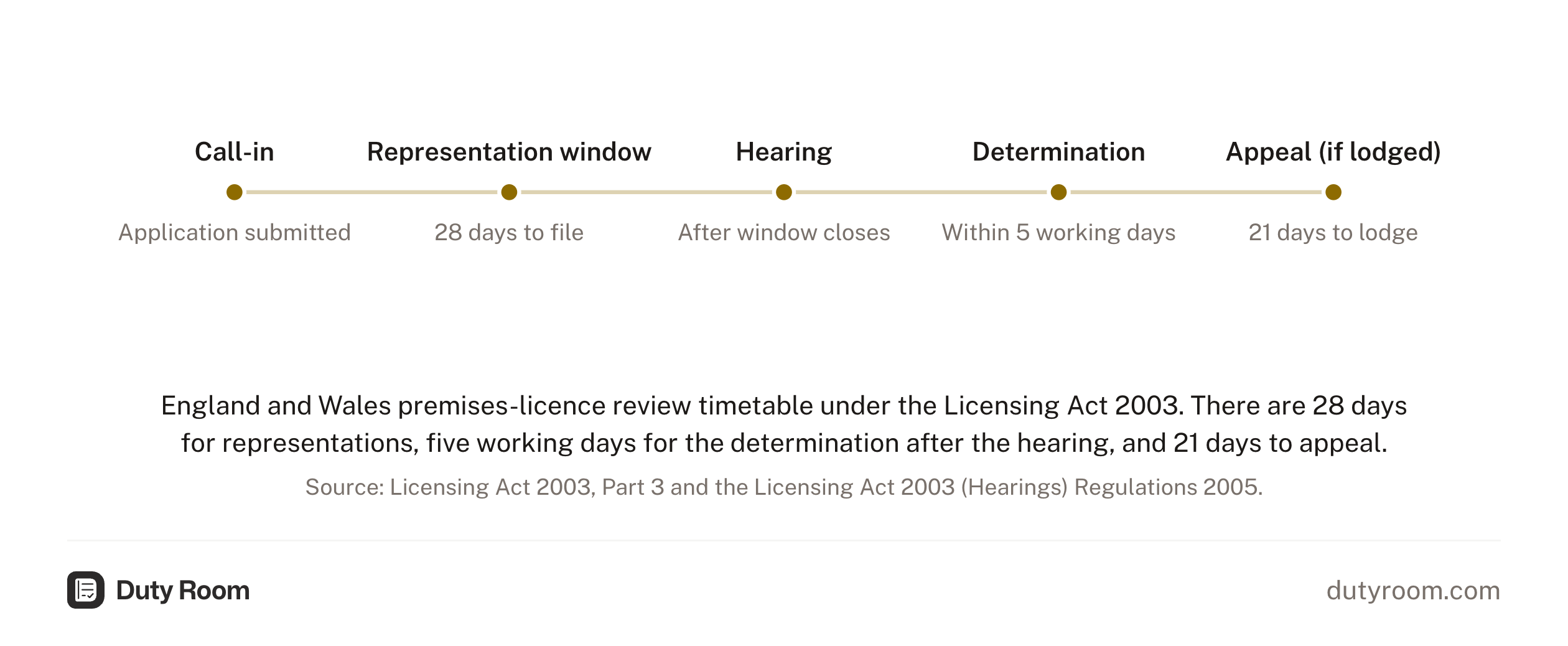
| Stage | Window | What happens |
|---|---|---|
| Call-in | Application submitted | Licensing authority accepts the application and fixes an advertisement date |
| Representation window | 28 days, starting the day after the authority receives the application | Premises holder, responsible authorities, and anyone else affected file written representations; late submissions may be excluded |
| Hearing | After window closes | Sub-committee convenes; premises holder may attend and present evidence |
| Determination | Within 5 working days of hearing | Written decision issued; one of six outcomes from no action to revocation |
| Appeal | 21 days from notice of decision | Lies to the magistrates' court; the decision does not take effect until the appeal period ends or the appeal is decided. (Summary review interim steps are the exception: they stay in force during an appeal.) |
Sub-committees proceed on the paperwork in front of them. A DPS who produces training records at the hearing is not making a new argument; they are producing evidence that existed before the incident. The distinction matters: evidence of remediation created before the hearing is treated as part of the operator's ongoing compliance culture; evidence assembled in the days before the hearing can be characterised as reactive rather than embedded.
Possible outcomes:
- No action
- Modification of conditions
- Exclusion of a licensable activity from the scope of the licence
- Removal of the Designated Premises Supervisor
- Suspension for up to three months
- Revocation
There is no fixed escalation ladder. The committee weighs evidence, the licensing objectives, and the operator's compliance history. A first breach with a strong remedial response might result in no action. Persistent problems or a single serious incident can jump straight to revocation.
Twelve days out. Twelve days before a hearing is not early; it is the window for assembling and submitting the file: written representations with an attached action plan, then the compliance file for the hearing itself (inspection report, written response, dated photographs, training records, updated logs). A sub-committee can weigh a file. It cannot weigh an oral account of good intentions.
Summary review
When police consider that premises are associated with serious crime or serious disorder, they can apply for a summary review under Section 53A.
Within 48 hours, the licensing authority must consider whether to impose interim steps: modifying conditions, excluding the sale of alcohol, removing the DPS, suspending the licence, or a combination. Interim steps take effect immediately. The full hearing follows within 28 days.
This is the one route where something close to immediate suspension can happen. It requires police involvement and a serious crime or disorder threshold, not a failed routine inspection.
Compliance history and its weight at review
The s.182 guidance states that compliance history is a material consideration at review hearings. An operator with documented remedial action, training records, and maintained logs is treated differently from one with repeated warnings and no evidence of change.
Keep a single file: the inspection report, the written response, dated photographs, training records, and logs. That file is the evidentiary basis at a hearing. A credible, costed plan with realistic timescales beats a missed deadline with no explanation.
The maintenance is ongoing, not one-off: review incident logs and refusals records regularly, verify CCTV coverage and retention, refresh staff on the conditions that apply to their roles, and periodically check the full premises licence against what the premises actually does.
Cost of inaction. A DPS who arrives at a hearing with no documented response and no compliance file gives the sub-committee nothing to weigh on the operator's side. The licence is an asset that cannot be recreated quickly. An empty evidentiary record is how it gets lost.
This briefing is based on sources available at publication and is for general information only. It doesn't constitute legal advice. For advice on your specific situation, consult a qualified professional.
Your licence has conditions. Prove you're keeping them.
Half of premises licence reviews end in revocation or suspension. Duty Room keeps licence conditions, refusals, incidents, and CCTV checks current per site.