More than a name on a form
What Licensing Reviews Test the DPS For
This guidance covers England and Wales. Scotland and Northern Ireland have separate licensing regimes.
Licensing sub-committees that take a review focused on the designated premises supervisor (DPS) usually circle the same question. Did the DPS know what was happening on the premises?
It gets put in different words at the hearing. Could the DPS describe the rota for the weekend of the incident? Was the DPS reachable when police attended? When staff were authorised to sell alcohol in the DPS's absence, what did that authorisation look like? Where reviews are brought on crime and disorder grounds under the four licensing objectives, this line of enquiry runs alongside the conduct allegations even when the DPS is not personally prosecuted.
What "day-to-day responsibility" actually tests
The s.182 guidance says at paragraph 4.61 that the DPS "will normally be the person who has been given day to day responsibility for running the premises by the premises licence holder." The test is functional. There is no statutory requirement for physical presence at a set percentage of trading hours, and paragraph 4.67 confirms the DPS "is not required to be present at all times." What review practice does treat as relevant is something a committee can verify.
Contactability runs through most review bundles. If police attend an incident at 1am and cannot reach the DPS, the absence is recorded. Written authorisations carry similar weight. Every sale of alcohol must be made or authorised by a personal licence holder under s.19(3) of the Licensing Act 2003, and a DPS's standing authorisation to named staff satisfies that requirement. The s.182 guidance describes written authorisations as "strongly recommended" rather than mandatory; review hearings often treat their absence as evidence of inadequate management. Physical presence is read against the operating pattern: a multi-site DPS visiting each premises sporadically is more exposed at review than one with regular presence on the site under review. The same applies to who answers when the licensing authority, police, or fire service ask to discuss the premises.
The s.19(2) trap at departure
Section 19(2) of the Licensing Act prohibits the sale of alcohol from any premises where the licence does not specify a DPS. The prohibition is immediate, with no grace period. The trap is the gap on the licence itself. A DPS who resigns or is dismissed stays specified until a s.37 variation replaces them or the licensing authority receives their request to be removed under s.41. From the moment the licence names no DPS, no alcohol can lawfully be sold.
The commonly cited 28-day interim period under s.47 of the Licensing Act does not apply: that provision covers the death, incapacity, or insolvency of the premises licence holder, not the departure of a DPS.
The route back is an s.37 variation specifying the new DPS, supported by the consent of the proposed DPS as the form requires. Under s.38, a variation that asks for immediate effect operates from the moment the licensing authority receives it, and the chief officer of police has 14 days to object where exceptional circumstances would undermine the crime prevention objective. The interval between the licence ceasing to name a DPS and the s.37 application being submitted is the period during which s.19(2) bites.
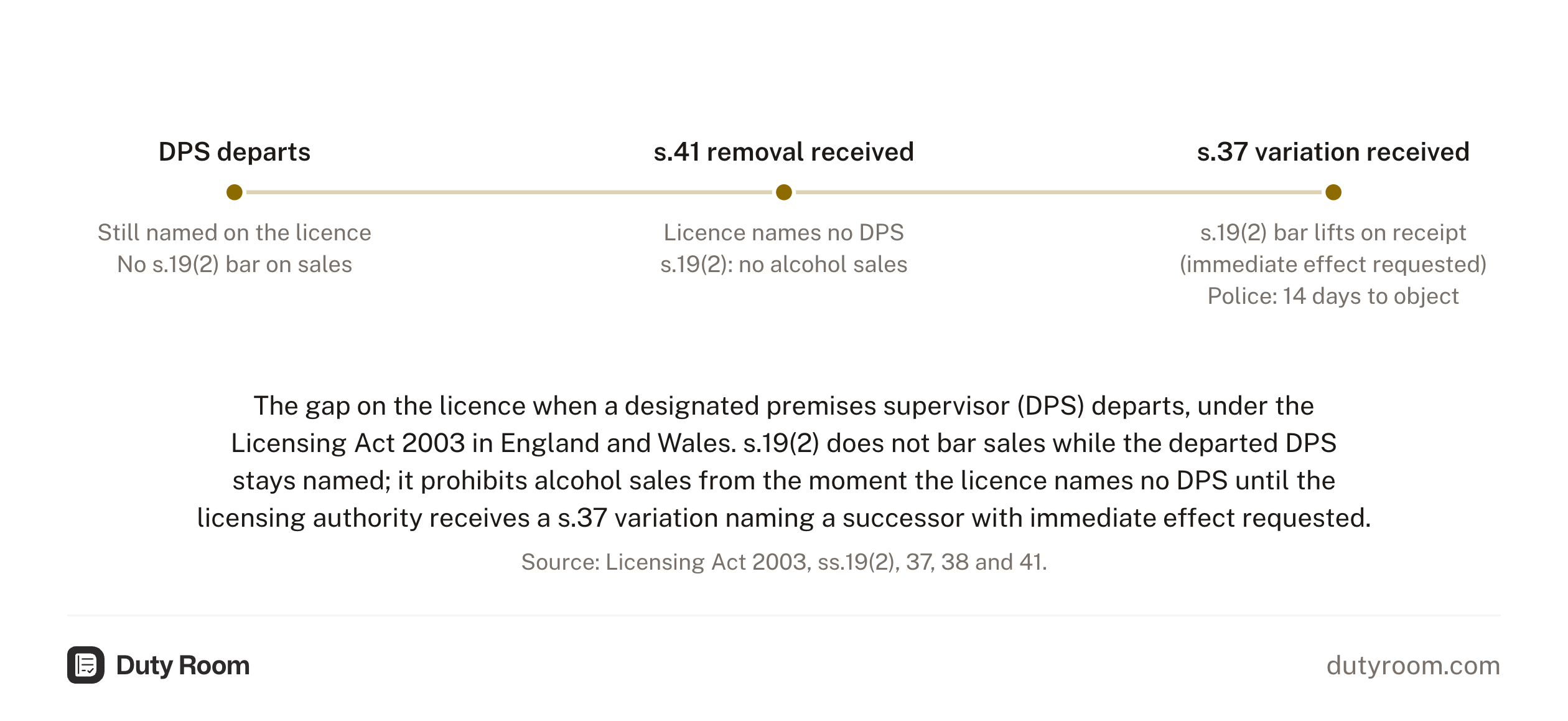
| Stage | Effect on the licence |
|---|---|
| DPS departs the job | The departed DPS stays named on the licence; the s.19(2) prohibition is not engaged |
| s.41 removal request received | The licence names no DPS; s.19(2) prohibits alcohol sales immediately |
| s.37 variation received | With immediate effect requested, the s.19(2) bar lifts from receipt; the police have 14 days to object where exceptional circumstances would undermine the crime prevention objective |
Multi-site nominations and police objection
The s.182 guidance permits one personal licence holder to be named as DPS on more than one premises. Paragraph 4.67 frames the limit functionally: "a DPS may supervise two or more premises as long as the DPS is able to ensure that the licensing objectives are properly promoted." No statutory cap applies.
Separately, the police can object to the proposed new supervisor on crime prevention grounds when the s.37 application is made. The guidance does not enumerate the patterns that attract objection; that is a matter for the police force handling the s.37 in each case.
DPS churn as a review signal
Every s.37 application appears on the licensing authority's record. A premises with three DPS changes in two years is visible to the police reviewing officer reading the file.
Paragraph 11.22 of the s.182 guidance addresses this directly: the "mere removal of the designated premises supervisor may be an inadequate response to the problems presented", and where subsequent review hearings are generated, "it should be rare merely to remove a succession of designated premises supervisors as this would be a clear indication of deeper problems that impact upon the licensing objectives." Where a committee takes that view, removing or replacing the DPS as a review outcome is unlikely to satisfy the panel. Forty percent of reviews already end with the licence revoked or the certificate withdrawn.
This briefing is based on sources available at publication and is for general information only. It doesn't constitute legal advice. For advice on your specific situation, consult a qualified professional.
Your licence has conditions. Prove you're keeping them.
Half of premises licence reviews end in revocation or suspension. Duty Room keeps licence conditions, refusals, incidents, and CCTV checks current per site.