Six Rules Hit At Once
April 2026 Employment Law Changes: What Hospitality Operators Must Know
Several employment law changes take effect in April 2026. Most are driven by the Employment Rights Act 2025, with commencement dates confirmed by the government's implementation timeline. The annual NMW uprating also lands in April, and the changes arrive a day before the Fair Work Agency starts work on 7 April.
Statutory Sick Pay overhaul
SSP gets its biggest structural change in decades. Three things happen simultaneously.
The lower earnings limit disappears. Part-time bar staff, casual kitchen porters, and zero-hours workers who previously earned too little to qualify for SSP now get it. Workers earning below £125 per week, previously excluded, are entitled from 6 April.
Waiting days are abolished. SSP is payable from the first qualifying day of sickness, not the fourth. A bartender who calls in sick on Saturday and returns on Tuesday gets SSP for all three days, not zero.
The rate itself changes. The weekly cap rises to £123.25 under the Social Security Benefits Up-rating Order 2026, with a new provision: SSP is the lower of the flat rate or 80% of the employee's average weekly earnings. For the lowest-paid workers, the actual payment may be less than £123.25. Payroll systems need to handle both calculations.
Transitional rule: the new rules also reach absences that started before 6 April 2026 and are still running. From 6 April, an eligible worker on an ongoing absence gets SSP on each qualifying day, even if the old waiting days were never served.
The fit note threshold stays at seven days.
In hospitality, where a high proportion of workers are part-time or variable-hours, the abolition of waiting days has a measurable payroll effect at scale. Every sickness episode now starts paying on day one, and staff who earned below the old £125 threshold join the eligible pool on the same date. Reprice that exposure in the April budget, particularly for sites with large zero-hours or casual workforces.
| Headcount | Sick days p.a. | Newly payable days (1-3 of each episode) | SSP per qualifying day (£123.25 ÷ 5) | Approx. added annual liability |
|---|---|---|---|---|
| 50 | ~263 | 150 | £24.65 | ~£3,700 |
| 100 | ~525 | 300 | £24.65 | ~£7,400 |
| 200 | ~1,050 | 600 | £24.65 | ~£14,800 |
Model assumptions, stated so you can rerun them on your own numbers: one sick episode per worker per year averaging 5.25 days, a five-day qualifying-day pattern (£123.25 ÷ 5 = £24.65 per day), and the flat rate throughout. Days 1-3 of each episode are the newly payable days. The 80% taper lowers the daily figure for the lowest earners, and episode-length distribution moves the total in either direction.
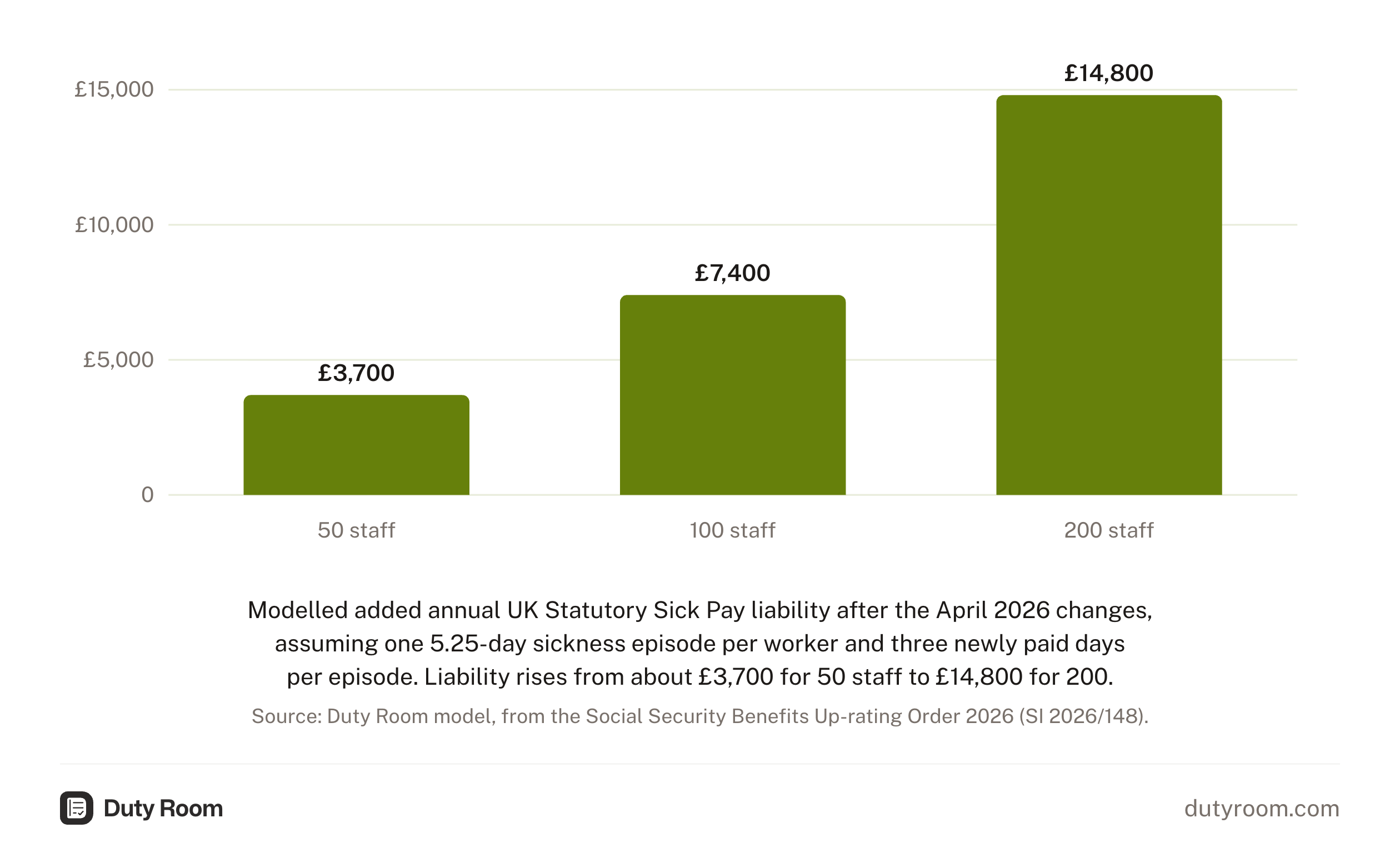
| Headcount | Sick days p.a. | Newly payable days | SSP per qualifying day | Approx. added annual liability |
|---|---|---|---|---|
| 50 | ~263 | 150 | £24.65 | ~£3,700 |
| 100 | ~525 | 300 | £24.65 | ~£7,400 |
| 200 | ~1,050 | 600 | £24.65 | ~£14,800 |
Day-one paternity leave
Paternity leave becomes a day-one right. The 26-week continuous service requirement for leave entitlement is removed.
The distinction that matters: leave is day-one, pay is not. Statutory paternity pay still requires 26 weeks' continuous service by the qualifying week. A new starter can take paternity leave but may not be entitled to the pay.
For employees who are newly eligible and whose baby is due before 26 July 2026, the notice period is temporarily shortened to 28 days (down from 15 weeks before the expected week of childbirth). Employees could begin giving notice from 18 February 2026, so leave can be taken from 6 April.
The Act also removes the restriction on taking paternity leave after shared parental leave. That sequencing constraint is gone.
Day-one unpaid parental leave
Unpaid parental leave also becomes a day-one right. The one-year qualifying service requirement is removed. The existing 21-day notice period for unpaid parental leave stays the same. These are two different rights with different notice rules.
Bereaved partners' paternity leave
A new, separate statutory right under the Bereaved Partner's Paternity Leave Regulations 2026. Where a child's mother, adoptive parent, or intended parent under a parental order dies within the first year after birth or placement, the surviving partner can take up to 52 weeks of unpaid leave. It also covers overseas adoption cases. It is a day-one right with no qualifying service.
Notice rules depend on timing: if the leave starts within eight weeks of the bereavement, notice can be oral or written and must be given before the first day absent. After eight weeks, written notice with at least one week's lead time.
Collective redundancy penalty doubles
The maximum protective award for failing to consult on collective redundancies goes from 90 to 180 days' pay per affected employee. The consultation trigger (20 or more redundancies at one establishment within 90 days) stays the same on this date. A broader reform that adds an organisation-wide trigger alongside the single-site test is in the Employment Rights Act 2025 but is not commenced yet. The doubling applies to any restructure or site closure where the trigger is met.
TULRCA s.188 is the operative statute. For a 25-person site closure with no consultation, the penalty can reach 180 days' pay for each of those 25 people. At the April 2026 NMW rate of £12.71 per hour over a 40-hour week, that's more than £450,000 for one site. A multi-site closure repeats the same math at every site.
Consultation windows are set by statute: at least 45 days for 100 or more redundancies, or 30 days for 20 to 99. As good practice, start consultation before any public announcement of the restructure.
Sexual harassment becomes a whistleblowing ground
From 6 April, sexual harassment qualifies as a "relevant failure" for whistleblowing protection. A worker who reports harassment gains protection from detriment and unfair dismissal under whistleblowing law, provided the disclosure meets the standard statutory tests: reasonable belief and public interest.
This is not automatic protection for every complaint. The whistleblowing framework still applies. It opens a second legal route alongside the Equality Act. Whistleblowing policies that predate this change don't yet reflect sexual harassment as a qualifying disclosure, and managers may not be aware that harassment reports can now carry dual legal significance.
The operational pattern that emerges: a worker raises a harassment complaint through the normal grievance route, the complaint is not upheld, and the worker is subsequently dismissed or disadvantaged. Where the original disclosure meets the reasonable-belief and public-interest tests, that sequence now potentially supports a whistleblowing detriment claim with uncapped compensation, in addition to any Equality Act claim. Multi-site operators whose managers have not been briefed on this interaction are running the higher exposure by default from 6 April. From October 2026, third-party harassment and the "all reasonable steps" standard raise the duty further.
Where payroll and policy systems need to land the changes
Payroll: the LEL check for SSP no longer applies from 6 April. The SSP rate is £123.25 or the 80% taper, whichever is lower. The three-day waiting period is gone from 6 April, including for absences that started earlier and are still running. NMW rates from April: £12.71 (21+), £10.85 (18-20), £8.00 (under 18 and apprentices). The accommodation offset rises to £11.10 per day.
Policies: sickness absence policies that reference the LEL or waiting days reflect the pre-April rules. Family leave policies need to reflect day-one entitlement for paternity and unpaid parental leave, and the new bereaved partners' paternity leave right. Whistleblowing policies need to add sexual harassment as a qualifying disclosure.
Managers: lower-paid staff who weren't previously eligible will now generate SSP claims. Harassment reports may now carry dual legal significance under both the Equality Act and whistleblowing law.
Multi-site operators who do not update processes by 6 April carry three distinct exposure categories simultaneously: SSP underpayment liability on every qualifying absence from that date, potential unfair dismissal claims from workers newly entitled to paternity or parental leave who face adverse treatment, and the doubled protective award ceiling on any redundancy programme that meets the collective trigger. The timeline is fixed; none of these commencement dates have discretionary employer lead-in periods.
This briefing is based on sources available at publication and is for general information only. It doesn't constitute legal advice. For advice on your specific situation, consult a qualified professional.
Stay ahead of regulatory deadlines
Duty Room tracks compliance calendar dates, policy review triggers, and the records each change requires.