This guidance covers England and Wales. Scotland and Northern Ireland have separate licensing frameworks.
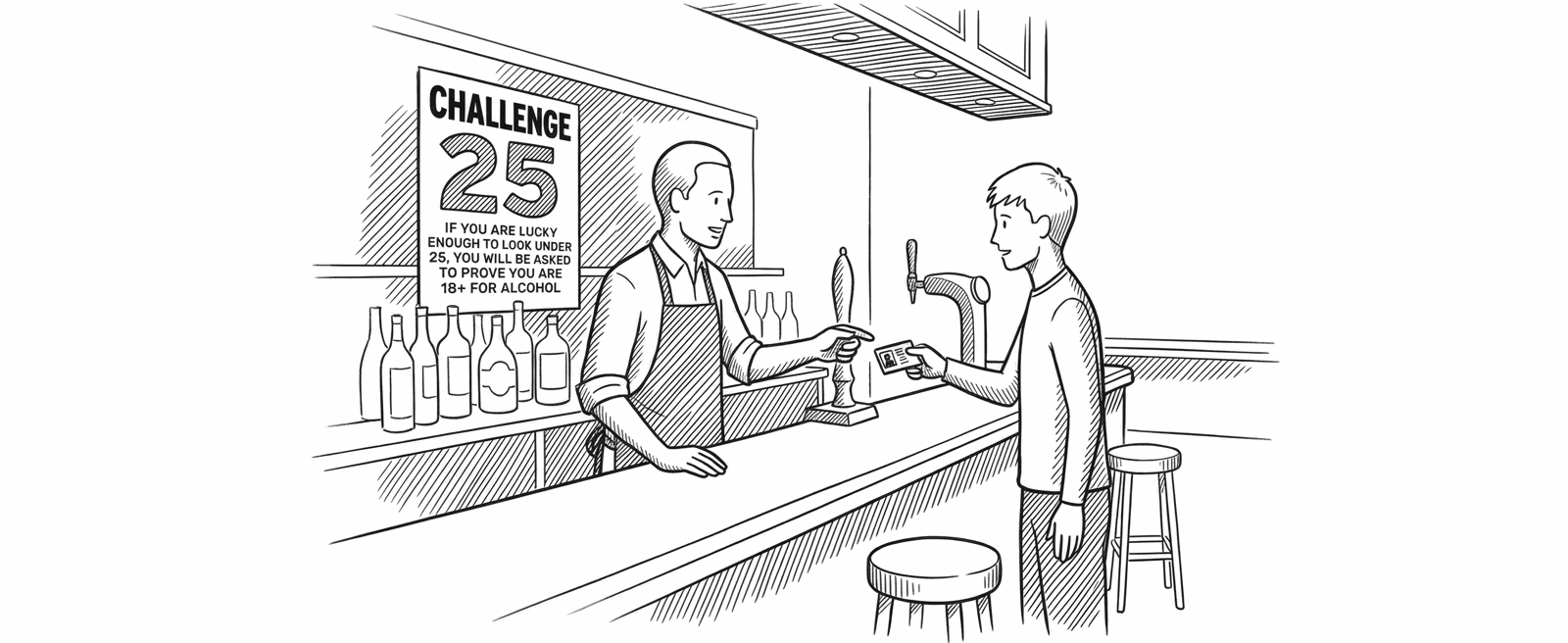
Staff apply Challenge 25 by asking customers who look under 25 to prove their age. A missed check can lead to an underage sale, a failed test purchase, or a licence review.
The legal baseline
Challenge 25 is not a universal legal requirement in England and Wales. If your premises licence requires it, you must use it. If you adopt Challenge 25 as your age verification policy, your designated premises supervisor must ensure staff follow it.
The Licensing Act 2003 makes it an offence to sell alcohol to anyone under 18. A mandatory licence condition requires an age verification policy. The policy must require acceptable proof of age before serving anyone who appears under 18, or any higher age the policy sets. The section 182 guidance encourages checks above 18 and recognises Challenge 21 and Challenge 25.
Check both your premises licence and your age verification policy before setting the age your staff must check.
Why the threshold is 25, not 18
A 17-year-old can easily look 18. Setting the challenge threshold seven years above the legal purchase age creates a buffer. If your staff challenge everyone who looks under 25, the chance of serving a minor drops sharply. Failing to operate your age verification policy properly can lead to prosecution for an underage sale, a formal licence review, additional conditions on your premises, or suspension and revocation in serious cases.
What counts as acceptable ID?
Physical ID must show a photograph, a date of birth, and a holographic mark or ultraviolet feature.
In practice, that means a passport, UK photocard driving licence, or a PASS-accredited proof of age card. A student card qualifies only if it meets those requirements and your policy accepts it. Refuse physical ID that lacks the required features. Some operators keep a narrower house list for simplicity, which is fine as long as it still satisfies the licence conditions and staff know what's on it.
Since 15 September 2026, an amendment to the mandatory licensing conditions has allowed your policy to accept digital ID. You can keep accepting physical ID only; ask for it when a customer offers digital ID your policy does not accept. If an existing licence condition expressly bans digital ID, get that condition varied before using it.
To accept digital ID, you need an agreement with a registered digital verification service (DVS). Under the agreement, the service must confirm whether the customer meets your policy's age threshold. It must provide ID that a registered DVS has verified to at least a medium level of confidence under the government's DVS trust framework.
Your policy must say that the customer has to let staff verify their digital ID on request, and that staff can accept it only under that agreement. Staff must check digital ID through the service; looking at a digital card or screenshot alone does not verify it. Age-estimation tools do not count as proof of age.
What goes wrong?
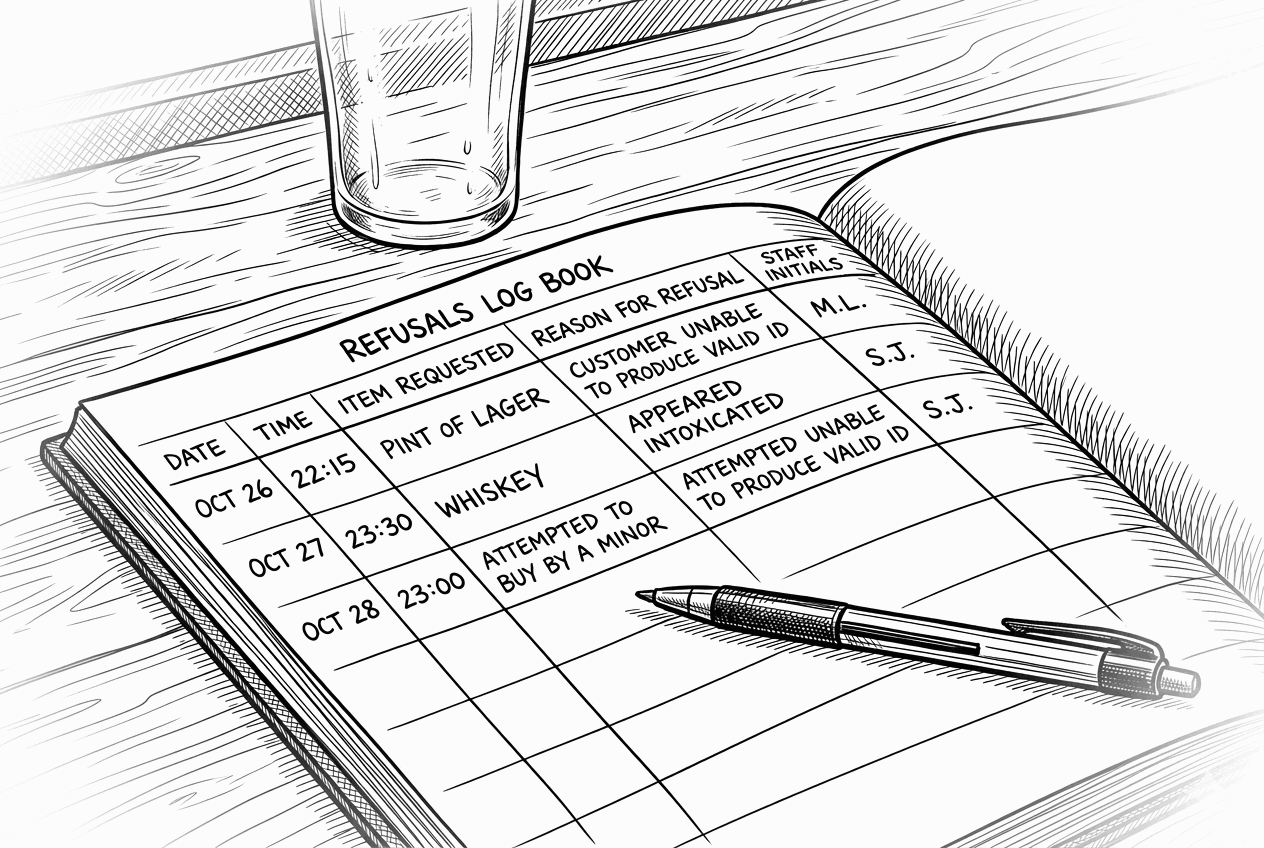
No refusals log. Every refused sale should be recorded: date, time, description of the customer, which staff member refused. Refusals logs are not a standalone statutory duty, but many licensing authorities require them as a condition, and inspectors treat them as a basic indicator of whether your age verification policy is actually operating. If you can't show any evidence of refusals, expect questions.
Untrained staff. Everyone who serves or authorises alcohol sales must understand your age verification policy well enough to explain it to a licensing officer who asks. Train staff at induction, refresh their training regularly, and keep records.
Missing signage. Display it at the point of sale and at the entrance. The signs remind staff to check ID and tell customers to expect a check.
No management oversight. Managers can find missed checks through spot-checks and team discussions.
How do test purchases work?
Trading Standards officers and the police send in volunteers who are under 18. The volunteer tries to buy alcohol without being challenged. If your staff serve them, enforcement action can follow. That can mean a fixed penalty notice, a licence review, or prosecution under the Licensing Act 2003. The server who made the sale can face personal liability too.
What does a working system look like?
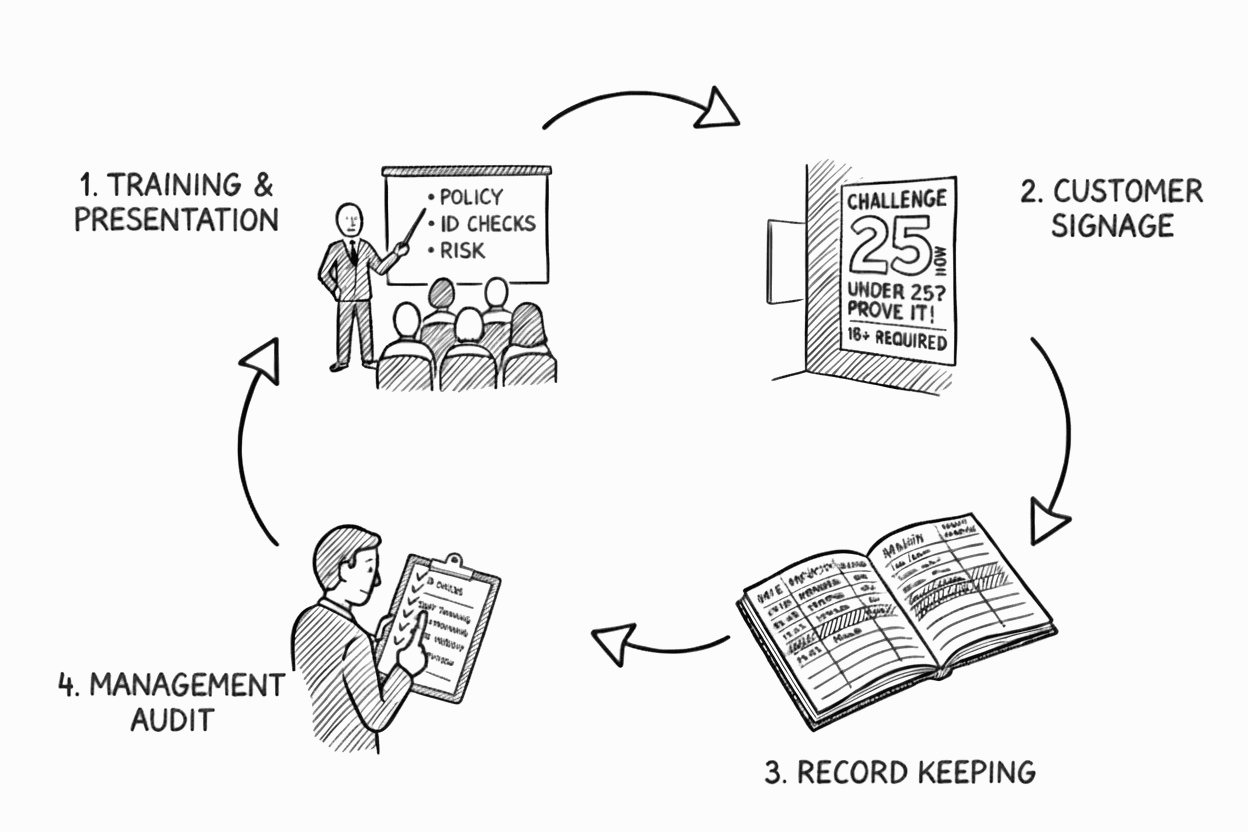
Your house policy spells out what ID you accept, how to handle a refusal, and what gets recorded. Every relevant staff member is trained on it, and the training is documented and dated.
The refusals log is the proof that the policy is working in practice. Check it weekly. If there are no entries, ask yourself whether nobody underage is coming in, or nobody is checking.
Management keeps it visible through team meetings and spot-checks.
Check that staff can explain the procedure and that the refusals log and signage match your policy.
This briefing is based on sources available at publication and is for general information only. It doesn't constitute legal advice. For advice on your specific situation, consult a qualified professional.
Your licence has conditions. Prove you're keeping them.
Half of premises licence reviews end in revocation or suspension. Duty Room keeps licence conditions, refusals, incidents, and CCTV checks current per site.