A pub with a function room
Martyn's Law Principal Use: The 15 October 2026 Regulations
The principal-use regulations extend to England and Wales, Scotland and Northern Ireland.
The UK's principal-use regulations, in force from 15 October 2026, set the test for identifying who holds the duty under Martyn's Law at premises in scope with two or more Schedule 1 uses. The operator duties haven't started; the Home Office's principal-use guidance says they aren't expected before spring 2027. The Security Industry Authority (SIA) will confirm the exact commencement date in advance.
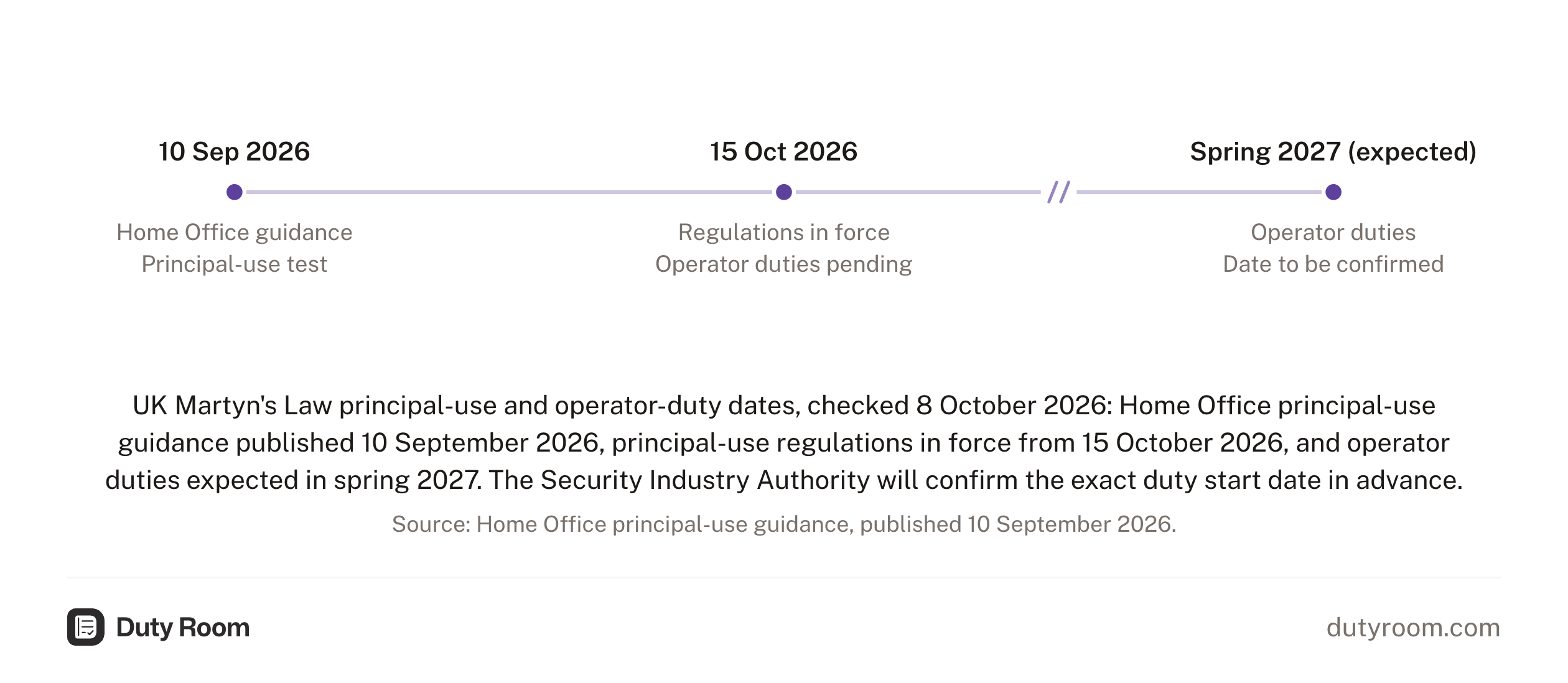
| Date or expectation | Publication or requirement | Status |
|---|---|---|
| 10 September 2026 | Home Office principal-use guidance published | Published guidance |
| 15 October 2026 | Principal Use of Premises Regulations 2026 come into force | Confirmed regulation date; operator duties have not started |
| Spring 2027 (expected) | Operator duties expected to start | Exact date to be confirmed by the SIA |
A venue's principal use is the Schedule 1 use most closely related to its purpose and nature. Section 4 of the Act generally places responsibility for qualifying premises on whoever controls them in connection with that use. Schedule 1 names the responsible body for qualifying premises whose relevant use is a hospital, a specified education use or the specified public-authority use.
How does the principal-use test work?
The test concerns one qualifying premises with several Schedule 1 uses, such as a hotel and restaurant operating as one premises. The Home Office says the test doesn't combine separate qualifying premises, such as individual shops within a shopping centre, into a single principal-use assessment. Premises with only one Schedule 1 use already have their relevant use.
Regulation 2 requires the assessment to consider four factors. Two concern the building's history and continued use: whether it was built or modified for a particular Schedule 1 use, and whether that use continues. The others concern its physical features and whether a local authority for the area treats the premises, for any purpose, as having a particular Schedule 1 use.
For that last factor, the Home Office gives planning permission and premises, alcohol and entertainment licences as examples of evidence. A premises licence therefore forms part of the assessment, alongside the other three factors.
If those factors don't identify a principal use, regulation 2 requires all relevant circumstances to be considered. These include the original four factors, whether each use occupies all or part of the premises, the proportion each occupies, the time spent on each over a relevant period, and whether one use supports another. The Home Office says these fallback factors carry equal weight. Its guidance allows opening hours, days of operation and seasonal activity to inform the time comparison.
The Home Office's examples identify a hotel with a restaurant as principally a hotel, and a stadium used for conferences and tours as a sports ground. A village hall used as a rugby clubhouse, with a function room and café, remains principally a hall. The Home Office calls these illustrations, to be considered against each premises' circumstances.
A tenanted pub with an upstairs function room
Duty Room's illustration assumes that a town pub and its function room form one qualifying premises. The pub sells drinks principally for customers to consume on site. The function room hosts hired activities principally for the benefit of visiting members of the public, so the example assumes it also meets the Act's condition for the "halls etc" use. The example doesn't settle whether a room hired for private weddings or wakes has a second Schedule 1 use.
The building was built as a pub and still trades as one. Its bar, cellar and dining area reflect that use. The council treats it as a pub, with a premises licence covering alcohol sales. Our reading of these assumed facts points to food and drink as the principal use.
The tenant controls the premises for that use. In the leased-pub example in the Home Office's 6 August 2026 correction slip, the tenant is responsible even where the brewery or pub company holds the licence.
Once the operator duties start, the Home Office says the responsible person's protection procedures must cover all activities at the premises, as appropriate and so far as reasonably practicable. In this illustration, that includes function-room nights.
Does principal use change the tier?
The function-room guests in our illustration still count when food and drink is the principal use. Section 2 asks whether premises are wholly or mainly used for one or more Schedule 1 uses. Its 200- and 800-person thresholds concern the people reasonably expected to be present from time to time, at the same time, in connection with any of those uses. The method for that headcount is in our capacity-threshold briefing.
Schedule 1 makes an exception for qualifying premises whose principal use is worship or the specified childcare, primary or secondary education, or further education uses. Those premises stay standard tier even where 800 or more people may reasonably be expected at the same time, from time to time. Higher education has no such standard-tier rule.
The Home Office illustrates this with a place of worship that also hosts concerts expecting 800 or more people. Its principal use remains worship, so it stays standard tier.
The dated principal-use record
A principal-use record is voluntary. The Home Office suggests keeping the determination and its reasoning, and its evidence list includes plans, licences, leases, operating hours, ticketing, staffing levels, capacity, floor area and trading activity.
A possible record, based on that list and the statutory factors, contains:
- The premises' address and boundaries, the assessment date and the person who assessed it.
- Each Schedule 1 use, with a description of the activity it covers.
- The four first-stage factors and their supporting documents, including plans, refurbishment records and council permissions with their dates and issuing authority.
- Any fallback reasoning: space used, operating hours, seasonal patterns and which activities support others.
- The principal use and responsible person, with the relevant lease, management agreement or Schedule 1 provision.
- A planned review date and space to record later changes.
In Duty Room's Martyn's Law area, the operator's determination and its supporting records are kept by premises, each with its date.
Premises notifications under the notification regulations will have to give the premises' relevant Schedule 1 use, which means its principal use where it has more than one. Those regulations start only when section 9(1) comes fully into force; the notification briefing explains the filing deadlines.
The Home Office says the assessment should be reviewed when circumstances change, including refurbishment, a licence change or a change in use or activity.
This briefing is based on sources available at publication and is for general information only. It doesn't constitute legal advice. For advice on your specific situation, consult a qualified professional.
Keep a dated principal-use record
Store your principal-use determination with the plans, licence and lease it relies on. Duty Room keeps each premises' records together, with their dates.