A Few Heads Matter
Martyn's Law: Does Your Venue Meet the 200-Person Threshold?
The Terrorism (Protection of Premises) Act 2025 applies to premises where 200 or more individuals may reasonably be expected to be present at the same time "from time to time." That number includes everyone: customers, staff, contractors, delivery drivers. It covers every area of the premises, from the bar and dining room to the beer garden and the function room. And it captures peaks, not averages. A pub that only hits 200 on Christmas Eve and bank holiday weekends is still in scope.
Getting this number right is the most consequential decision an operator will make under the Act. It determines whether you have duties at all, and if so, which tier you fall into.
Two tiers, one threshold question
Standard tier (200 to 799). Procedures only. You put in place evacuation, invacuation, lockdown, and communication procedures, make sure your staff know them, and notify the SIA. No physical measures required, no documentation submitted to the regulator, no formal terrorism risk assessment. The government estimates this costs around £330 per year, mainly in staff time.
Enhanced tier (800 or more). Everything in the standard tier, plus public protection measures across four categories (monitoring, movement of people, physical safety, and security of information), a documented compliance position (an assessment of how your procedures and measures reduce vulnerability and harm), and a designated senior individual who manages the affairs of, or controls, the organisation (not a lower-level employee). The compliance document must be submitted to the SIA and updated within 30 days of any revision. Maximum penalty: the greater of £18 million or 5% of qualifying worldwide revenue.
Below 200, the Act doesn't apply to your premises.
The test isn't what you'd expect
The Act doesn't use fire safety capacity, your premises licence number, or your planning permission figure. The Act puts the question plainly: is it reasonable to expect that, from time to time, 200 or more individuals may be present at the same time in connection with the premises' use? The Home Office capacity factsheet works through how to answer it.
The phrase "from time to time" is what catches seasonal peaks, event nights, and bank holiday crowds. A pub that comfortably operates below 200 on a Tuesday but fills its beer garden to 250 on a sunny Saturday afternoon in July is still a premises where 200 may reasonably be expected from time to time. The threshold doesn't need to be met routinely.
One thing it doesn't catch: a genuinely one-off, unforeseeable crowd spike that isn't expected to recur. An unexpected viral social media event that brings 300 people to a 150-capacity cafe one afternoon doesn't, by itself, make the cafe a qualifying premises.
Six ways to assess your number
The Home Office lists six methods. You can use any combination:
- Fire safety safe occupancy. Your fire risk assessment or fire authority may have assigned a safe occupancy figure. This is a useful starting point but not the answer on its own. Fire capacity measures how many people the building can safely hold, based on floor space and exits, not how many are reasonably expected to attend.
- Historic attendance data. Till transactions at peak trading, booking records, ticketing data, staff rosters. A pub with EPoS data showing peak covers of 180 on a Saturday night, plus 15 staff on shift, reaches 195 and stays below the threshold. A beer garden adding 30 on a summer evening takes the same pub to 225 and into scope.
- Fixed seating and standing positions. Count the seats. Add reasonable standing capacity where the layout permits. Add staff.
- Tickets and pre-registration. For events with controlled entry, the ticket sales ceiling plus staff is a direct measurement.
- Licence conditions. Some premises licences include capacity limits. They can support your count, but they don't settle it. A premises licence capped at 250 doesn't automatically make you standard tier if your historic attendance never exceeds 180 plus staff.
- Other reasonable means. The factsheet allows any justifiable method. The important thing is that you can explain and defend how you arrived at your number.
Staff must always be included. The guidance is explicit: the assessment must include individuals working at the premises, whatever method you use.
The immediate vicinity is different. The Home Office says you're not required to account for the pavement outside your entrance when assessing the threshold, but you do need to consider that vicinity when designing your procedures.
The pub example the Home Office actually gives
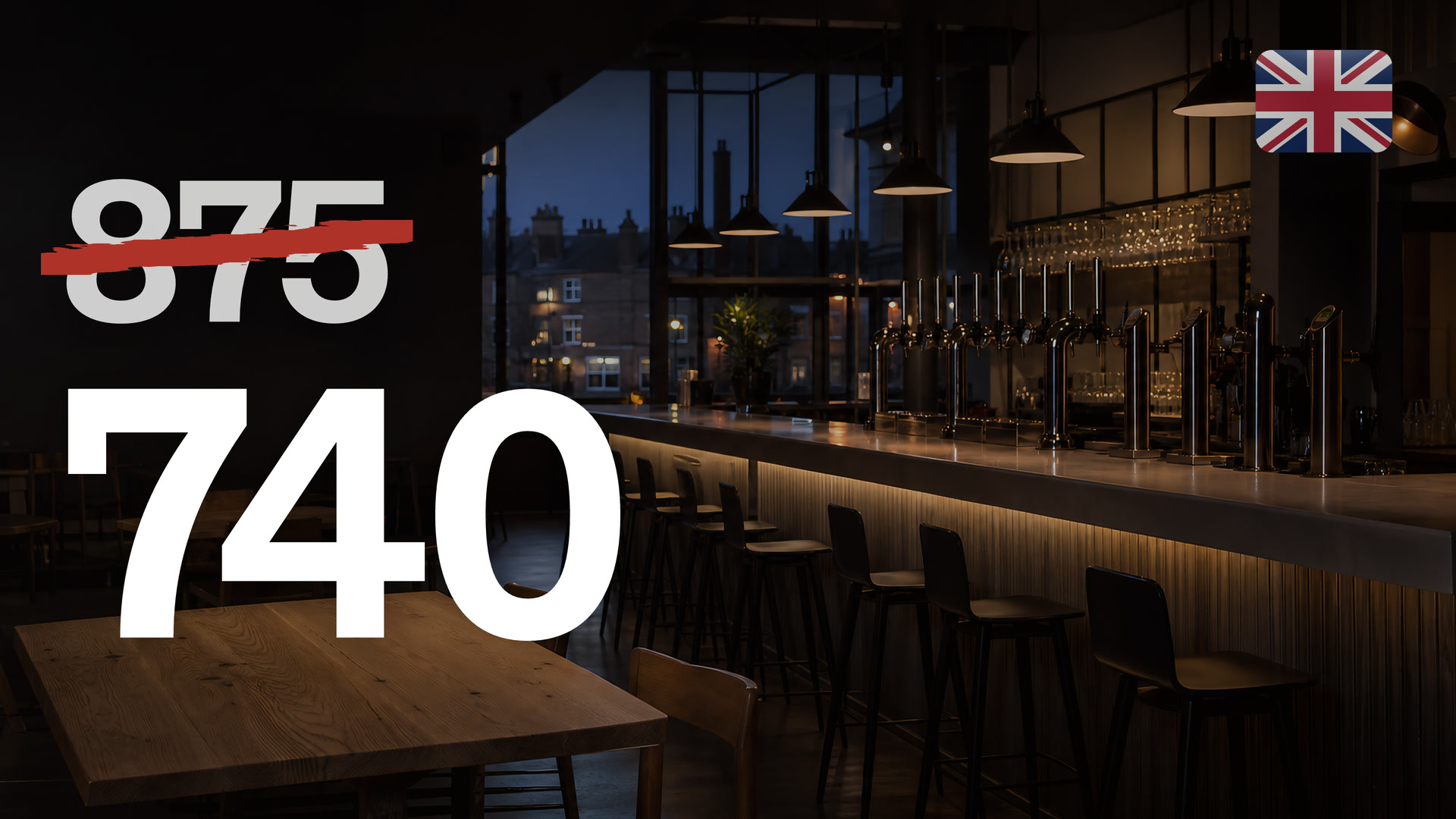
The capacity factsheet works through a large pub. Fire safety safe occupancy: 875. But the operator's historic data shows maximum public attendance of 725 and maximum staff of 15. That gives 740, well below the 800 enhanced threshold, and the pub lands in the standard tier.
The example shows how far apart the fire number and the Act's number can sit. A pub with an 875 fire capacity isn't an 875-person premises under this Act. The assessment is based on what actually happens, not what the building could theoretically hold.
Beer gardens count
A pub with a beer garden is treated as a building plus accompanying land. Both areas contribute to the capacity assessment. The Morning Advertiser and the Home Office scope guidance confirm this.
A worked example: a pub with 80 indoor seats, a beer garden that holds 100 on a warm evening, and 20 staff on a busy shift comes to 200 and is in scope. On a January Tuesday with four people in the beer garden and 12 staff, you're at 96. But the summer number is what the "from time to time" test asks about.
If you're near the line
Premises close to 200 should document their assessment now. The Act's duties on operators aren't yet in force as of September 2026. The SIA expects them to begin in spring 2027. If the SIA later queries your classification, a contemporaneous record of your method, your data and your conclusion is your best defence.
For multi-site operators, fire safe occupancy works as an initial screen. Any site with fire capacity well below 200 (accounting for the fact that fire capacity is typically higher than realistic attendance) is probably out of scope. Sites with fire capacity between 150 and 300 need deeper analysis using historic peak trading data and staff rosters. Sites above 300 should assume they're in scope and focus on whether they're standard or enhanced.
The Secretary of State has the power to amend the 200-person threshold by regulations, but can't lower it below 100. The 800-person enhanced threshold can also be amended, but not below 500. Neither change requires primary legislation; both would be made by regulations.
What this means for your premises
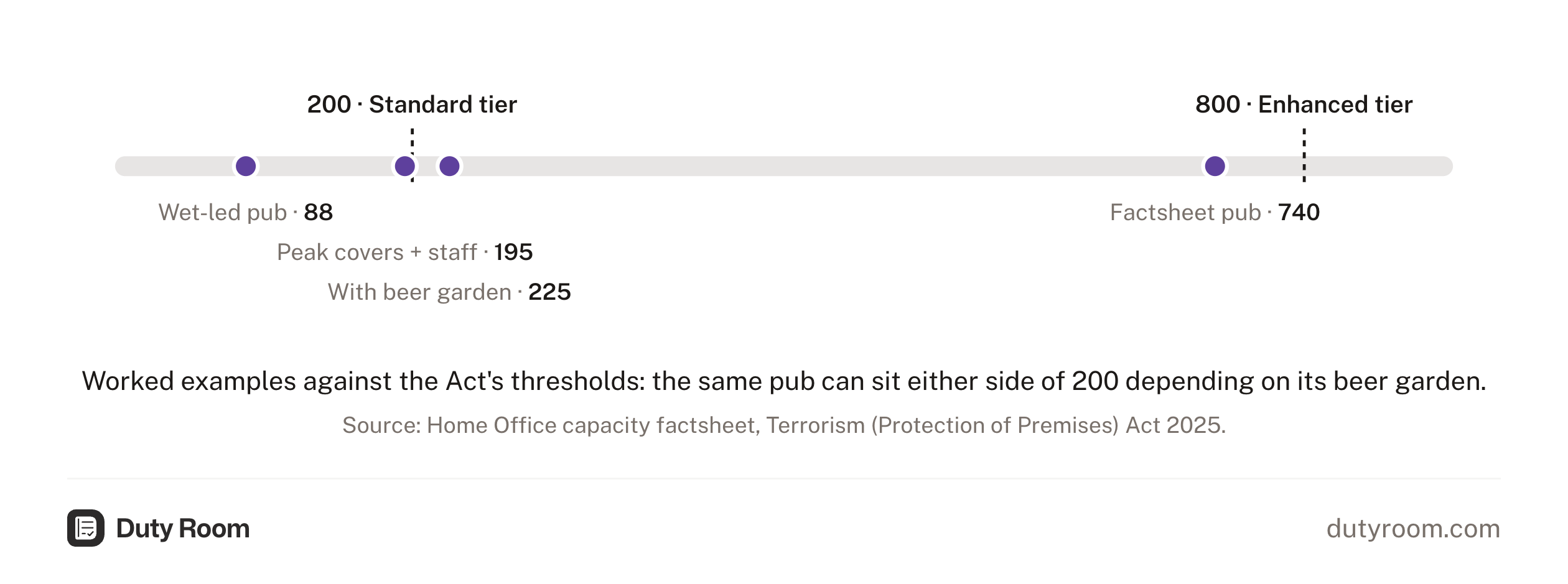
| Example | Peak headcount | Position |
|---|---|---|
| Small wet-led pub | 88 | Below the 200 threshold |
| Pub at peak covers plus staff | 195 | Below the 200 threshold |
| The same pub with its beer garden | 225 | Standard tier |
| Home Office factsheet pub | 740 | Standard tier, below 800 |
If you run a small wet-led pub with 80 seats, no outdoor space, and 8 staff at peak, you're at 88. Not in scope. Nothing to do under this Act.
If you run a food-led pub with 120 covers, a beer garden that adds 60 on a summer evening, and 20 staff at peak, you're at 200. In scope. Standard tier. Your obligations (once commenced) will be procedural: evacuation, invacuation, lockdown, and communication procedures, with staff training. No physical upgrades, no security equipment, no formal risk assessment.
If you run a large hotel with conference facilities, multiple restaurants, a spa, and 50 staff on shift, and 800 people could reasonably be on site during a conference day, you're enhanced tier. Documentation, physical measures, a senior individual designation, and SIA submission.
Work out your number now. The Martyn's Law capacity checker gives you a first pass you can save with your assumptions, and there's a worked example for every premises type, from theatres and sports grounds to places of worship, where the tier rules work differently. The tiering rules are in primary legislation and won't change unless the Secretary of State exercises specific powers requiring Parliamentary approval. Wherever you land, you can start preparing for what an SIA inspection may test. The full picture of what the Act requires at each tier is set out in the Terrorism (Protection of Premises) Act 2025 and the accompanying Home Office guidance.
This briefing is based on sources available at publication and is for general information only. It doesn't constitute legal advice. For advice on your specific situation, consult a qualified professional.
Martyn's Law is coming. Have your records ready.
Martyn's Law for UK premises: find your tier, set up evacuation, invacuation, lockdown and communication procedures, train staff, and keep the evidence.