Closure notices and orders in England and Wales
How Long Can Police Close a Pub or Shop?
These closure powers cover England and Wales.
From 26 October 2026, police and councils in England and Wales can issue closure notices for up to 48 hours, or 72 with senior authorisation. A court closure order can prohibit access for up to three months, extendable to six months in total, if the statutory conditions below are met.
The Crime and Policing Act 2026 raises the standard notice maximum from 24 to 48 hours and the senior-authorised maximum from 48 to 72. Christmas Day doesn't count towards the 72-hour notice period.
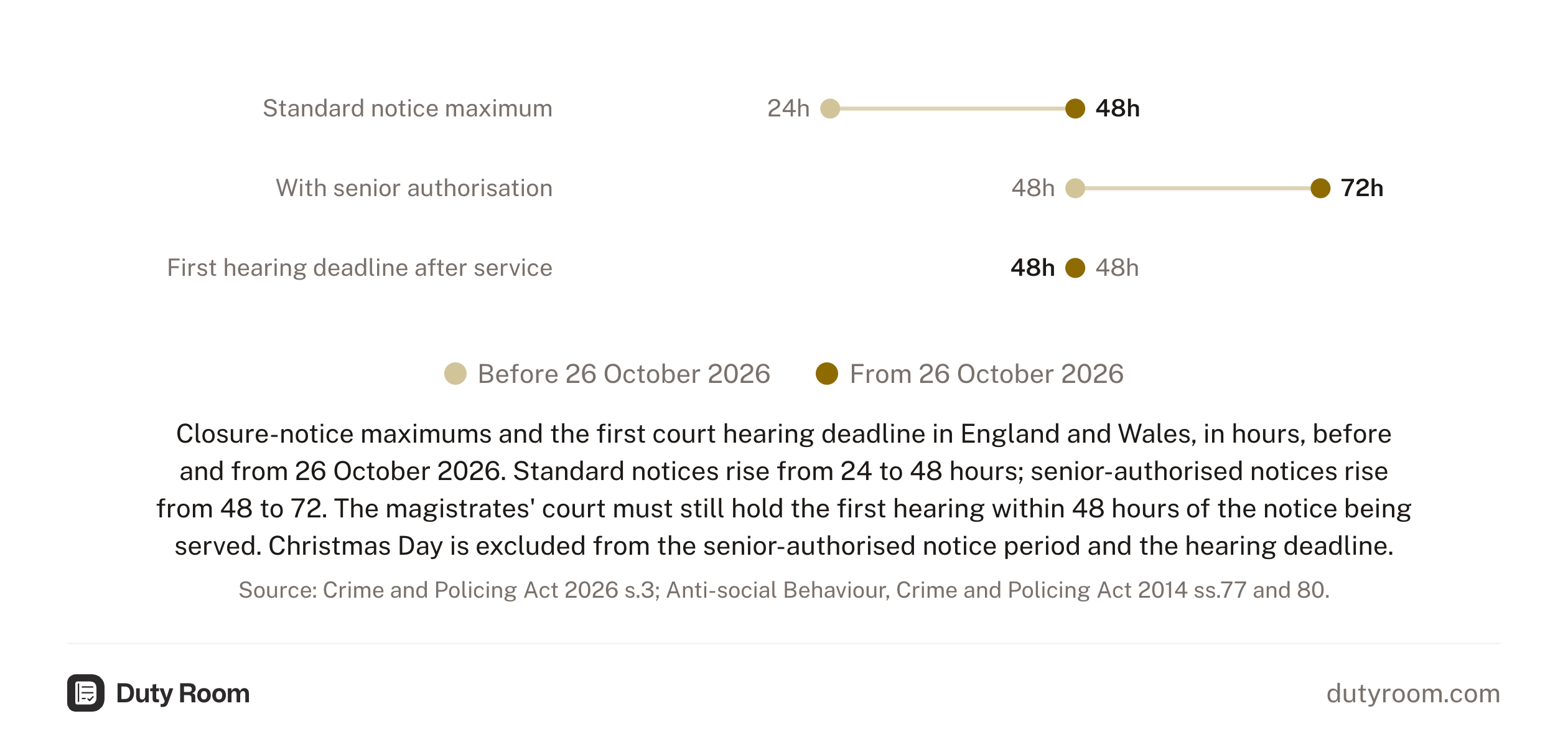
| Measure | Before 26 October 2026 (hours) | From 26 October 2026 (hours) |
|---|---|---|
| Standard closure-notice maximum | 24 | 48 |
| Closure-notice maximum with senior authorisation | 48 | 72 |
| First court hearing deadline after service of notice | 48 | 48 |
Who can issue a closure notice?
Police officers of inspector rank or above and councils can issue notices. A police notice specifying 72 hours when first issued must come from a superintendent or above; a council notice specifying that period when first issued needs the chief executive's signature or their designate's. A standard notice can also gain up to 24 hours through a separate extension notice with the required senior authorisation.
Registered social housing providers, including housing associations, can issue notices and apply for closure orders too, but only for premises they own or manage.
The issuer must be satisfied on reasonable grounds that the premises' use has caused nuisance to the public, or that nearby disorder associated with that use has occurred, or that either is likely soon without a notice. The notice must be necessary to stop the nuisance or disorder continuing, recurring or occurring. A notice must still allow access to the owner and people who habitually live there.
When does the court hear the application?
A closure-order application must follow a notice unless the notice is cancelled. Under section 80(3) of the Anti-social Behaviour, Crime and Policing Act 2014, the magistrates' court must hear it within 48 hours after service of the notice, excluding Christmas Day.
Say police serve a 72-hour notice on a pub at 8pm on a November Friday. Unless the notice is cancelled, the court must hear the application by 8pm on Sunday. That gives the pub at most two days to prepare for court.
The Home Office's October 2026 statutory guidance gives 72 hours for this hearing in one passage. Section 80(3) and the guidance's own summary table both say 48. The Act sets the deadline, so plan for 48.
If the court doesn't make a closure order at the hearing, section 81 lets it keep the notice in force for up to 72 further hours. The court must be satisfied that the premises' use has caused nuisance to the public, or that nearby disorder associated with that use has occurred, or that either is likely soon if the notice ends. Continuation must be necessary to stop the nuisance or disorder continuing, recurring or occurring.
The court can also adjourn for up to 14 days so that an occupier, someone controlling or responsible for the premises, or another person with an interest can show why an order should not be made. It can keep the notice in force until then, so the premises can stay closed for up to 14 more days without a closure order.
When can a court close premises for months?
The court must be satisfied that at least one of these has happened, or is likely if it does not make the order: disorderly, offensive or criminal behaviour on the premises; serious nuisance to the public resulting from their use; or nearby disorder associated with their use. The order must also be necessary to stop that behaviour, nuisance or disorder continuing, recurring or occurring.
Each extension can add up to three months, within the six-month total, if the court is satisfied that extending the order is necessary to prevent those same problems continuing, recurring or occurring.
Does closure trigger a premises licence review?
If a court makes a closure order for premises with a premises licence, it must notify the licensing authority. Under section 167 of the Licensing Act 2003, the authority must review the licence and decide no later than 28 days after the day it receives that notification. A closure notice on its own doesn't trigger this review. The premises licence review briefing covers the separate standard and summary review routes.
Compensation after a closure
An owner or occupier who loses money because of a closure notice or order can apply to the court for compensation under section 90 of the 2014 Act. The court must be satisfied, among other things, that the applicant isn't associated with the use or behaviour behind the closure and took reasonable steps to prevent it.
One way to show those steps is to keep licensing records that pair each dated incident or complaint with the response. A pub's closing-time noise entry could record who was on duty, what staff did and any contact with police or the council.
This briefing is based on sources available at publication and is for general information only. It doesn't constitute legal advice. For advice on your specific situation, consult a qualified professional.
Each incident logged with its response
Staff log incidents and refusals at each site as they happen, and every entry is timestamped.