A rating used to plan first aid
WorkSafeBC's "Low Hazard" Rating for Hospitality
A hotel and a restaurant can both be rated "low hazard" and still have a $9,750 difference in their annual WorkSafeBC base premium. That's the 2027 gap on the same $1.5 million of assessable payroll.
The label has a specific job: it helps determine workplace first-aid requirements. Insurance premiums use a separate calculation. And neither the label nor the premium tells a manager which task needs attention before the next shift.
The injury profiles give managers somewhere to start: kitchens and housekeeping, with front-of-house incidents worth a separate look in pubs. This report compares the three business groups and suggests ways to use the figures at your own premises.
What will the 2027 base rates cost?
WorkSafeBC's final 2027 rates put restaurants and pubs at $0.66 per $100 of assessable payroll, and hotels at $1.31. Both rates are below the provincial average of $1.55. These three classification units carry a low-hazard rating.1
| Business and classification unit | 2027 rate per $100 of payroll | Base premium on $1.5 million payroll |
|---|---|---|
| Restaurants and dining, CU 761035 | $0.66 | $9,900 |
| Pubs, bars, nightclubs and lounges, CU 761034 | $0.66 | $9,900 |
| Hotels, motels, B&Bs and resorts, CU 761056 | $1.31 | $19,650 |
The hotel base premium is almost twice the restaurant's. The gap has narrowed from 2026, when the same payroll produced an $11,100 difference.
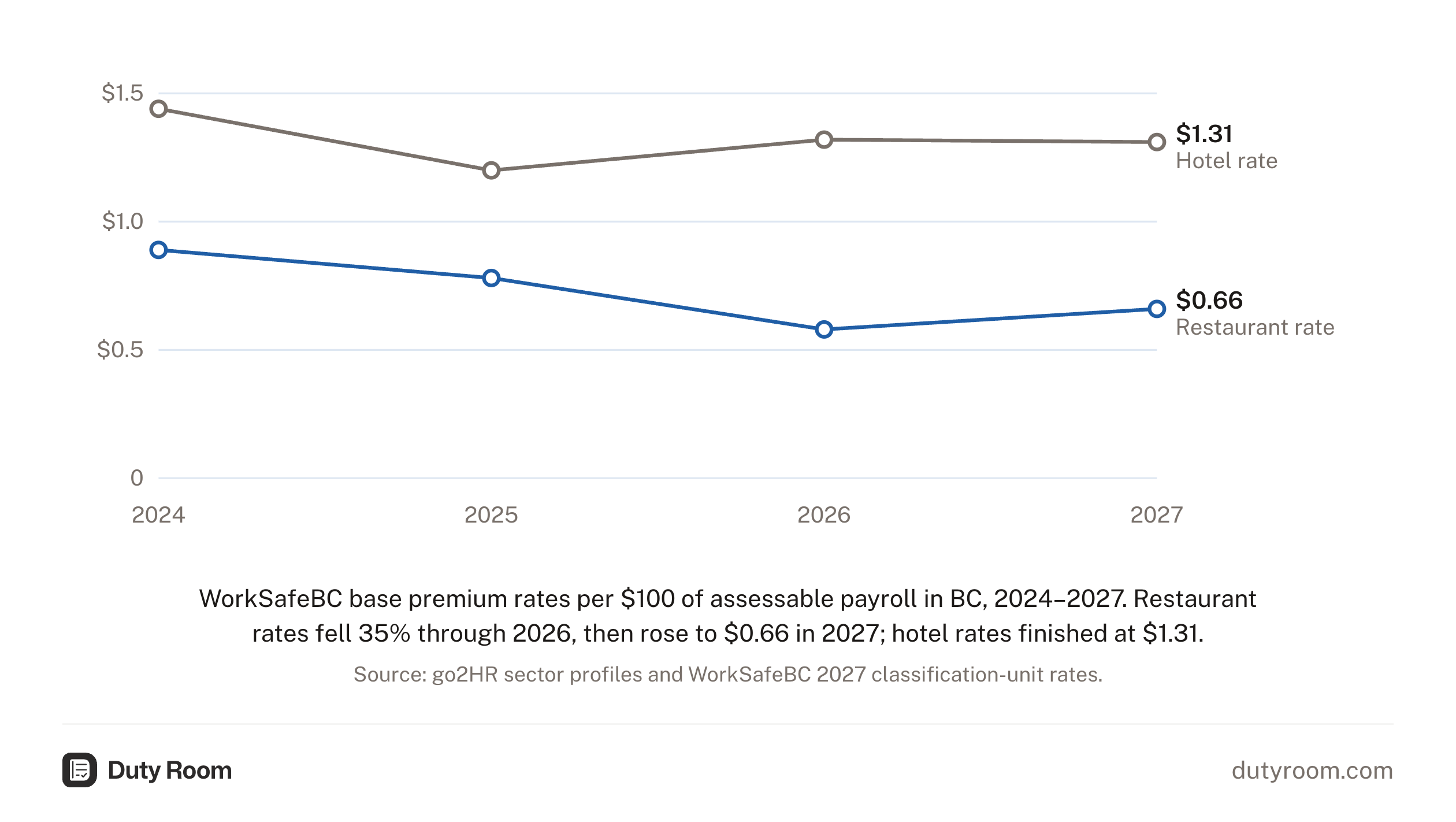
| Year | Restaurant rate (per $100) | Hotel rate (per $100) |
|---|---|---|
| 2024 | $0.89 | $1.44 |
| 2025 | $0.78 | $1.20 |
| 2026 | $0.58 | $1.32 |
| 2027 | $0.66 | $1.31 |
Restaurant and pub rates fell 35% between 2024 and 2026, then rose 13.8% for 2027. Hotels dipped in 2025, rebounded in 2026 and eased to $1.31 for 2027.
WorkSafeBC pools claim costs by rate group. Pubs and restaurants share group JF; hotels belong to group JB. That explains the shared restaurant and pub base rate. It doesn't tell us which safety measures changed a group's costs.
Your own claims costs also affect your premium through experience rating. Lower claims costs relative to industry peers can mean a discount; higher costs can mean a surcharge. For scale, an illustrative 40% surcharge would take the hotel's $19,650 base premium to $27,510, and the restaurant's $9,900 to $13,860.2 The 40% is an example, not a forecast or a maximum.
For your own budget, check the classification unit, base rate and experience-rating adjustment on your assessment rate notification. WorkSafeBC sends these each November for the coming year. The table above uses base rates; your employer-specific rate can differ.
The injury profiles also show a difference in time away from work. Hotel time-loss claims average 51 days, compared with 35 days for restaurants: 46% longer. Fourteen percent of hotel claims last at least 26 weeks, against 10% for restaurants.3 These figures cover each profile as a whole. They don't isolate housekeeping's contribution or tell you how many shifts you'll need to cover.
In hotels, start with housekeeping
Housekeepers account for 58% of accommodation-sector injuries in go2HR's injury profile, based on WorkSafeBC data as of 2024. That's a share of injuries, not a measure of an individual housekeeper's risk. Across the sector, musculoskeletal injuries make up 60% of injuries.
Lifting mattresses, pushing carts and bending over bathtubs put strain on the people cleaning the rooms. The Canadian Centre for Occupational Health and Safety recommends looking at equipment, task design, workloads and training together. Lighter supplies and better carts are among its examples.
For a hotel manager, that makes a housekeeping shift a useful place to review the work. Watch how a cart moves when it's loaded and how a worker reaches across a bed. Ask the housekeepers which tasks cause strain before choosing a change.
A pub's kitchen is only part of the picture
Kitchen workers account for 65% of restaurant claims: 35% involve cooks and chefs, and 30% other kitchen staff, according to go2HR's food and beverage profile. The share tells you where claims are concentrated, without establishing the risk per worker in each job.
Pubs also have a substantial kitchen injury problem. Cooks and chefs account for 53% of pub and bar injuries in go2HR's alcohol service profile.
Then move out to the bar. Among pub and bar front-of-house incidents, 25% are falls, 14% are overexertion injuries and 17% are acts of violence, about one in six. That last figure describes a share of recorded incidents, not a bartender's probability of experiencing violence.
A pub manager reviewing kitchen safety should give front-of-house work its own attention. Ask staff about the situations that lead to aggression and review the arrangements for getting help. The shared restaurant and pub premium rate won't draw that distinction for you.
Workers aged 15 to 24 account for 29% of pub and bar injuries and 38% of restaurant injuries. These are shares of injuries, not age-specific injury rates. They give operators a reason to look at what young and new workers are shown before they start a task, and how that instruction is followed up.
Prevention orders rose, then eased
WorkSafeBC's industry risks dashboard counts prevention orders across the wider tourism and hospitality subsector. It includes businesses beyond the three classification units compared above.4
| Year | Prevention orders | Year-over-year change |
|---|---|---|
| 2021 | 1,689 | -- |
| 2022 | 1,694 | +0.3% |
| 2023 | 2,314 | +36.6% |
| 2024 | 2,614 | +13.0% |
| 2025 | 2,326 | -11.0% |
Orders fell 11% in 2025 after the 2024 peak, but remained 38% above 2021. The counts don't establish why orders changed or how likely your premises are to be inspected.
An order tells an employer to fix something. It isn't a fine, though leaving a problem unfixed can lead to a penalty. A prior order isn't required: WorkSafeBC's penalty policy includes high-risk violations among the grounds for considering a penalty.
WorkSafeBC reported 410 net penalties totalling $13.7 million across all industries in 2025: a calculated average (mean) of about $33,400. That average isn't a forecast for your business. WorkSafeBC's penalty calculation considers payroll, the violation and factors such as repetition or deliberate non-compliance. A low-hazard rating provides no penalty discount. Our 2025 WorkSafeBC penalties report separates the overall trend from the hospitality figures.
Give the figures a job at your next safety review
The role-specific figures can help you choose a starting point. They aren't a complete list of hazards. Falls, for example, accounted for about a quarter of accepted time-loss claims in the wider accommodation, food and leisure sector throughout 2001–2023. That broader history is covered in 23 Years of Hospitality Injuries in BC.
For your next review, choose a recurring task or incident from your own workplace. Talk with the people doing the work, agree a change and name someone to follow it through. Keep the record with the relevant training or incident notes, then check whether the change worked.
A useful record should let the next manager see the hazard, the action taken and anything still unresolved. Start with one task your team can show you today.
-
WorkSafeBC final 2027 base rates per $100 of assessable payroll: restaurant CU 761035 and pub CU 761034 at $0.66; hotel CU 761056 at $1.31. The 2026 comparators were $0.58 and $1.32. Worked premiums multiply the published base rate by an illustrative $1.5 million assessable payroll; individual experience-rating adjustments are excluded.
-
A 40% surcharge adds $7,860 to the illustrative hotel base premium and $3,960 to the restaurant base premium. WorkSafeBC adjusts individual premiums based on claims costs relative to industry peers over three years. Surcharges can exceed 40%.
-
go2HR Accommodations and Food and Beverage Injury Profiles, 2024: average time-loss claim duration of 51 and 35 days respectively; claims lasting 26 weeks or longer, 14% and 10%. The profiles do not specify here whether duration days are working or calendar days. No paid-shift or replacement-wage estimate is inferred.
-
WorkSafeBC Industry risks: Prevention data dashboard, tourism and hospitality subsector 7610, prevention orders, 2021–2025. Figures checked against the live dashboard on November 3, 2026; its data was dated July 13, 2026. The table excludes partial-year 2026 figures.
This report is based on published enforcement data, sources available at publication, and original analysis. It is for general information only and doesn't constitute legal advice.
Keep each site's safety records together
Use Duty Room to keep training records, incident notes and follow-up actions organised by site.