Small Mistakes Have Prices
The Full LCRB Penalty Table: What Every Contravention Costs
Schedule 2 of BC Regulation 241/2016 sets every monetary penalty the LCRB can impose on a licensee or permittee, and every suspension day it can impose on a licensee. Fifty-four line items across 18 categories. The range runs from $1,000 for an advertising violation to $25,000 for selling liquor while your licence is suspended. If you've been told "it depends on the contravention," this is the table that determines what it depends on.
The penalties below are administrative, not criminal. Criminal prosecution under LCLA s.57 sits alongside them. The top tier, reserved for certain s.8 offences committed by individuals, reaches $100,000 and 12 months imprisonment; corporations face fines but no imprisonment. Every enforcement action in the waiver reports and published decisions Duty Room has reviewed took the administrative path: a Notice of Enforcement Action, a waiver offer, and a penalty from these ranges.
Data vintage. Schedule 2 as extracted from BC Laws on March 25, 2026. Waiver and enforcement data from the LCRB's 2026 Waiver Summary Report (254 records, February 2023 to November 2025) and 2025 report (208 records, July 2024 to September 2025). Penalty table extracted via structured parsing of Schedule 2 into a 54-row table with 16 fields per item.
How the escalation works
Most contraventions have three escalation steps: first, second, and subsequent. The LCRB looks back 24 months for licensees.1 If you had a minors contravention 23 months ago and get caught again today, you're in the second-offence column. At 25 months, the clock has reset and you're back to first-offence pricing.
For most first liquor contraventions within the lookback window, the licensee chooses between the monetary penalty and a licence suspension. The LCRB doesn't choose for you. That choice disappears for second and subsequent contraventions in some categories, where the General Manager's delegate sets the penalty. Item 51 is the exception in the other direction: it carries monetary penalties only, with no suspension option in any column.
The standard waiver offer is the minimum of the applicable range. A first-offence minors contravention gets offered at $7,000 or 7 days. Contest at hearing and the delegate can impose any penalty from the floor of the range upward. The delegate is bound by the Schedule 2 minimums, not the maximums.
Six items in the schedule (selling while suspended, obstruction-related) skip this structure entirely. They sit at $15,000 to $25,000 with no escalation between offences. More on those below.
The four buckets
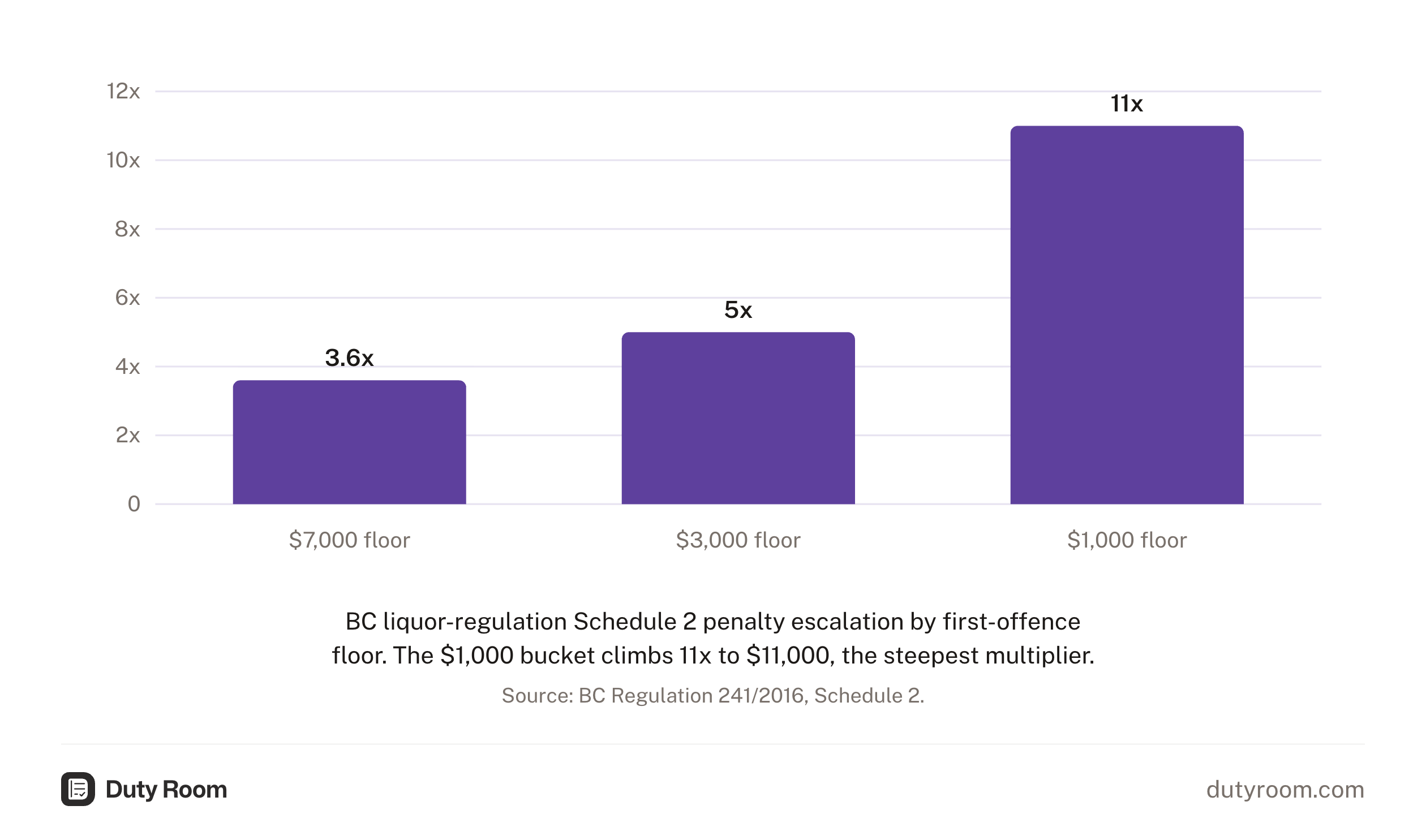
Schedule 2 sorts the 54 items into four buckets: three that escalate from a first-offence floor of $1,000, $3,000, or $7,000, and one that doesn't escalate at all. The three escalating buckets follow three distinct curves. By escalation multiplier, the bucket with the cheapest first-offence floor has the steepest climb on repeat.
| Bucket | First offence | Subsequent | Items | Multiplier |
|---|---|---|---|---|
| $7,000 floor | $7,000 | $25,000 | 16 | 3.6x |
| $3,000 floor | $3,000 | $15,000 | 20 | 5x |
| $1,000 floor | $1,000 | $11,000 | 11 | 11x |
Top bucket: $7,000 to $25,000 (3.6x climb). Sixteen items carry first-offence minimums of $7,000 and escalate to $25,000 for subsequent contraventions, a 3.6x range and the gentlest curve in the schedule. These are the contraventions the LCRB treats most seriously: unlawful sale of liquor, supplying liquor to minors, allowing violent or disorderly conduct, tied houses and inducements, failure to produce records, and providing false information. The $7,000 to $25,000 staircase is the one most operators encounter, because selling liquor to a minor (item 7) lives here and accounts for 157 of the 254 accepted waivers in the 2026 report, 62 percent of the total.
Middle bucket: $3,000 to $15,000 (5x climb). Twenty items start at $3,000 and top out at $15,000, a 5x range. Serving an intoxicated person, allowing intoxicated patrons to remain, overcrowding beyond occupant load, drink promotions encouraging intoxication, and minors present in the establishment all sit in this band. The $3,000 first-offence minimum is also where most intoxication-related waivers land (3.4% of all waivers in the 2025 report).
Bottom bucket: $1,000 to $11,000 (11x climb). Eleven items start at $1,000 and cap at $11,000 on subsequent offences, an 11x range and the steepest escalation curve in the schedule. SIR training failures, staff drinking while working, allowing liquor to leave the service area, advertising violations, entertainment non-compliance, structural alterations without approval, and the catch-all provision for anything not specifically listed all live here. The $1,000 minimum is the lowest penalty in the schedule. SIR training violations appear here and account for 12% of waivers.
Flat bucket: $15,000 to $25,000, no escalation between offences. Six items in one category don't escalate. The penalty range stays $15,000 to $25,000 and 15 to 90 days across first, second, and subsequent offences. Selling or serving liquor while your licence is suspended (items 39-42) and obstruction-related contraventions (items 43-44, refusing entry to a peace officer or General Manager) make up the group. The General Manager's delegate picks within the range based on circumstances. None of these items appear in the recent waiver reports; if the Branch follows its usual minimum-offer practice, the offer would be the $15,000 floor. A 90-day suspension for a restaurant doing $2 million in annual revenue represents roughly $493,000 in lost sales, on Duty Room's math, assuming that revenue spreads evenly across the year.
The JJ's Pub case (2024 BCLCRB 41) showed how broadly the LCRB reads the conduct that surrounds an inspection. A door employee loudly announced two liquor inspectors as they walked in during a routine public safety inspection, patrons turned to look, and that announcement alone cost the pub a $1,000 catch-all penalty under item 54. Drawing attention to a liquor inspector inside your establishment is itself a contravention.2
A seventh item behaves the same way structurally. Item 51 (failure to comply with a Liquor Distribution Act s.5 agreement) carries a flat $15,000 to $25,000 monetary penalty across all three steps, with no suspension days specified.3 Item 51 is filed under Miscellaneous rather than with the obstruction items, so the schedule doesn't visually group it with the flat-floor family, but its escalation behaviour is identical.
The full table
Unlawful sale and purchase of liquor
| # | Contravention | 1st penalty | 2nd penalty | Subsequent |
|---|---|---|---|---|
| 1 | Unlawful sale of liquor (LCLA s.8(2)(a)) | $7,000-$11,000 / 7-11 days | $11,000-$15,000 / 11-21 days | $15,000-$25,000 / 21-41 days |
| 2 | Unlawful purchase of liquor (LCLA s.8(2)(e)) | $7,000-$11,000 / 7-11 days | $11,000-$15,000 / 11-21 days | $15,000-$25,000 / 21-41 days |
| 3 | Selling or serving unauthorized liquor (LCLA s.8(3)) | $7,000-$11,000 / 7-11 days | $11,000-$15,000 / 11-21 days | $15,000-$25,000 / 21-41 days |
| 4 | Selling liquor purchased under another licence or permit (Reg s.140) | $7,000-$11,000 / 7-11 days | $11,000-$15,000 / 11-21 days | $15,000-$25,000 / 21-41 days |
Operating outside of licence purpose
| # | Contravention | 1st penalty | 2nd penalty | Subsequent |
|---|---|---|---|---|
| 5 | Food service not primary purpose under food primary licence (Reg s.18(1)(a)) | $7,000-$11,000 / 7-11 days | $11,000-$15,000 / 11-21 days | $15,000-$25,000 / 21-41 days |
| 6 | Food service not primary purpose for caterer, or caterer lacking equipment/personnel (Reg s.26(a)/(b)) | $7,000-$11,000 / 7-11 days | $11,000-$15,000 / 11-21 days | $15,000-$25,000 / 21-41 days |
Minors
| # | Contravention | 1st penalty | 2nd penalty | Subsequent |
|---|---|---|---|---|
| 7 | Supplying liquor to minors (LCLA s.77(1)) | $7,000-$11,000 / 7-11 days | $11,000-$15,000 / 11-21 days | $15,000-$25,000 / 21-41 days |
| 8 | Minors in establishment or liquor store (LCLA s.79(1)/(2)) | $3,000-$7,000 / 3-7 days | $7,000-$11,000 / 7-11 days | $11,000-$15,000 / 11-15 days |
Item 7 is the single most enforced contravention in BC. Of 254 waivers in the 2026 report, 157 were for supplying liquor to a minor, most triggered by the Minors as Agents Program. The standard waiver offer is the $7,000 minimum or 7 days. The 2025 report shows where that choice lands in practice: 93 accepted waivers were taken as 7-day suspensions and 47 as $7,000 monetary penalties, the tier where a first minors contravention sits. The suspension costs a $2 million restaurant roughly $38,356 in lost revenue, more than five times the fine, and most licensees chose it anyway.
Item 8 (minors present in the establishment) carries a lower penalty. Allowing a minor to be on the premises is a $3,000 first offence. Selling them a drink is $7,000.
Allowing disorderly or unlawful conduct
| # | Contravention | 1st penalty | 2nd penalty | Subsequent |
|---|---|---|---|---|
| 9 | Allowing violent, quarrelsome, riotous or disorderly conduct (LCLA s.61(2)(b)(iii)) | $7,000-$11,000 / 7-11 days | $11,000-$15,000 / 11-21 days | $15,000-$25,000 / 21-41 days |
| 10 | Allowing unlawful activities or conduct (LCLA s.61(2)(b)(iv)) | $7,000-$11,000 / 7-11 days | $11,000-$15,000 / 11-21 days | $15,000-$25,000 / 21-41 days |
Intoxicated patrons
| # | Contravention | 1st penalty | 2nd penalty | Subsequent |
|---|---|---|---|---|
| 11 | Selling or serving liquor to intoxicated person (LCLA s.61(2)(a)) | $3,000-$7,000 / 3-7 days | $7,000-$11,000 / 7-11 days | $11,000-$15,000 / 11-15 days |
| 12 | Allowing person to become intoxicated (LCLA s.61(2)(b)(i)) | $3,000-$7,000 / 3-7 days | $7,000-$11,000 / 7-11 days | $11,000-$15,000 / 11-15 days |
| 13 | Allowing intoxicated person to enter or remain in service area (LCLA s.61(2)(b)(ii)) | $3,000-$7,000 / 3-7 days | $7,000-$11,000 / 7-11 days | $11,000-$15,000 / 11-15 days |
Seven intoxication waivers appeared in the 2025 report (3.4%). Low volume, but these often arise from incidents with worse downstream consequences than a MAP test: injuries, altercations, police calls.
Weapons
| # | Contravention | 1st penalty | 2nd penalty | Subsequent |
|---|---|---|---|---|
| 14 | Allowing person with knife or weapon to enter establishment (LCLA s.61(2)(b)(v)) | $3,000-$7,000 / 3-7 days | $7,000-$11,000 / 7-11 days | $11,000-$15,000 / 11-15 days |
Disturbance of persons in vicinity
| # | Contravention | 1st penalty | 2nd penalty | Subsequent |
|---|---|---|---|---|
| 15 | Failure to prevent operation from disturbing persons in vicinity (term/condition) | $7,000-$11,000 / 7-11 days | $11,000-$15,000 / 11-21 days | $15,000-$25,000 / 21-41 days |
Overcrowding
| # | Contravention | 1st penalty | 2nd penalty | Subsequent |
|---|---|---|---|---|
| 16 | Person/patron capacity exceeded but occupant load not exceeded (Reg s.78(1)(a)/(2)(a)) | $1,000-$3,000 / 1-3 days | $3,000-$7,000 / 3-7 days | $7,000-$11,000 / 7-11 days |
| 17 | Person/patron capacity AND occupant load exceeded (Reg s.78(1)/(2)) | $3,000-$7,000 / 3-7 days | $7,000-$11,000 / 7-11 days | $11,000-$15,000 / 11-15 days |
| 18 | Maximum attendance/occupant load exceeded at catered event (Reg s.97(e)/(f)) | $3,000-$7,000 / 3-7 days | $7,000-$11,000 / 7-11 days | $11,000-$15,000 / 11-15 days |
| 19 | Maximum attendance/occupant load exceeded under temporary use area authorization (Reg s.101(b)/(c)) | $3,000-$7,000 / 3-7 days | $7,000-$11,000 / 7-11 days | $11,000-$15,000 / 11-15 days |
| 20 | Maximum attendance/occupant load exceeded at special event (Reg s.117(j)/(k)) | $3,000-$7,000 / 3-7 days | $7,000-$11,000 / 7-11 days | $11,000-$15,000 / 11-15 days |
The schedule distinguishes between exceeding your licensed person capacity (item 16, $1,000 first offence) and exceeding the fire-code occupant load (item 17, $3,000). Going over your liquor-licence capacity is a regulatory issue. Going over the fire marshal's occupant load is a safety issue. The penalty reflects the difference. Four capacity waivers appeared in the 2025 report (1.9%).
Liquor service
| # | Contravention | 1st penalty | 2nd penalty | Subsequent |
|---|---|---|---|---|
| 21 | Failure to complete SIR training or recertification (LCLA s.60(1)) | $1,000-$3,000 / 1-3 days | $3,000-$7,000 / 3-7 days | $7,000-$11,000 / 7-11 days |
| 22 | Failure to clear patrons within 30 minutes after service ends (Reg s.89(a)) | $1,000-$3,000 / 1-3 days | $3,000-$7,000 / 3-7 days | $7,000-$11,000 / 7-11 days |
| 23 | Unused liquor at residential event not returned / failing to take liquor from patrons within 30 minutes (Reg s.26(i)/s.90(1)) | $3,000-$7,000 / 3-7 days | $7,000-$11,000 / 7-11 days | $11,000-$15,000 / 11-15 days |
| 24 | Allowing consumption beyond 30 minutes after service ends (Reg s.91(1)) | $3,000-$7,000 / 3-7 days | $7,000-$11,000 / 7-11 days | $11,000-$15,000 / 11-15 days |
| 25 | Employees consuming liquor while working (Reg s.142(1)/(3)) | $1,000-$3,000 / 1-3 days | $3,000-$7,000 / 3-7 days | $7,000-$11,000 / 7-11 days |
| 26 | Permitting consumption of liquor not sold by licensee (Reg s.141(2)) | $3,000-$7,000 / 3-7 days | $7,000-$11,000 / 7-11 days | $11,000-$15,000 / 11-15 days |
| 27 | Allowing liquor to be taken from service area (Reg s.141(4)) | $1,000-$3,000 / 1-3 days | $3,000-$7,000 / 3-7 days | $7,000-$11,000 / 7-11 days |
| 28 | Unlimited drinks for single price or sales strategy promoting intoxication (Reg s.82(1)/s.118) | $3,000-$7,000 / 3-7 days | $7,000-$11,000 / 7-11 days | $11,000-$15,000 / 11-15 days |
SIR training failures (item 21) are the second most enforced contravention after minors: 25 waivers in the 2025 report, 12 percent of accepted waivers. The $1,000 penalty is the lowest in the schedule, but the contravention often signals a broader compliance gap. If your staff don't have current SIR certification, an inspector will note it, and the question becomes what else is out of order.
Staff drinking on shift (item 25) generated 3 waivers in the 2025 report. The enforcement heat map cross-references one of those to a multi-domain offender: the same establishment later appeared in the ESB violations database for wage theft.
Production of records
| # | Contravention | 1st penalty | 2nd penalty | Subsequent |
|---|---|---|---|---|
| 29 | Failure to produce records, liquor, or other things (LCLA s.43(a)(iii)) | $7,000-$11,000 / 7-11 days | $11,000-$15,000 / 11-21 days | $15,000-$25,000 / 21-41 days |
Advertising
| # | Contravention | 1st penalty | 2nd penalty | Subsequent |
|---|---|---|---|---|
| 30 | Advertising liquor (LCLA s.64) | $1,000-$3,000 / 1-3 days | $3,000-$7,000 / 3-7 days | $7,000-$11,000 / 7-11 days |
Entertainment
| # | Contravention | 1st penalty | 2nd penalty | Subsequent |
|---|---|---|---|---|
| 31 | Failure to comply with adult entertainment term/condition | $3,000-$7,000 / 3-7 days | $7,000-$11,000 / 7-11 days | $11,000-$15,000 / 11-15 days |
| 32 | Failure to comply with non-adult entertainment term/condition | $1,000-$3,000 / 1-3 days | $3,000-$7,000 / 3-7 days | $7,000-$11,000 / 7-11 days |
U-Brew/U-Vin
| # | Contravention | 1st penalty | 2nd penalty | Subsequent |
|---|---|---|---|---|
| 33 | Failing to ensure customer performs listed tasks (Reg s.44) | $3,000-$7,000 / 3-7 days | $7,000-$11,000 / 7-11 days | $11,000-$15,000 / 11-15 days |
| 34 | Payment, acknowledgment, invoice, storage, labelling, record-keeping requirements (Reg ss.43,45-48,50,51,172) | $1,000-$3,000 / 1-3 days | $3,000-$7,000 / 3-7 days | $7,000-$11,000 / 7-11 days |
| 35 | Failing to ensure beer or wine is not sold at U-Brew or U-Vin (Reg s.49) | $7,000-$11,000 / 7-11 days | $11,000-$15,000 / 11-21 days | $15,000-$25,000 / 21-41 days |
Tied houses and inducements
| # | Contravention | 1st penalty | 2nd penalty | Subsequent |
|---|---|---|---|---|
| 36 | Tied houses and inducements (LCLA s.62(1)/(2)) | $7,000-$11,000 / 7-11 days | $11,000-$15,000 / 11-21 days | $15,000-$25,000 / 21-41 days |
| 37 | Failure to report tied house arrangements to General Manager | $7,000-$11,000 / 7-11 days | $11,000-$15,000 / 11-21 days | $15,000-$25,000 / 21-41 days |
The largest single penalty in the waiver dataset is $1.09 million against Molson for inducements, per the March 2026 report.4
Default in monetary penalties
| # | Contravention | 1st penalty | 2nd penalty | Subsequent |
|---|---|---|---|---|
| 38 | Failure to pay monetary penalty within required time (LCLA s.51(10)/s.53.1(12)) | $7,000-$11,000 / 7-11 days | $11,000-$15,000 / 11-21 days | $15,000-$25,000 / 21-41 days |
Failing to pay a penalty is itself a $7,000 contravention. The escalation here is designed to prevent operators from simply ignoring a fine.
Suspension, cancellation, and obstruction
| # | Contravention | 1st penalty | 2nd penalty | Subsequent |
|---|---|---|---|---|
| 39 | Selling or serving liquor while licence suspended (LCLA s.8(2)(a)) | $15,000-$25,000 / 15-90 days | $15,000-$25,000 / 15-90 days | $15,000-$25,000 / 15-90 days |
| 40 | Selling liquor at catered event while licence/endorsement suspended or cancelled | $15,000-$25,000 / 15-90 days | $15,000-$25,000 / 15-90 days | $15,000-$25,000 / 15-90 days |
| 41 | Manufacturer selling liquor while licence/endorsement suspended or cancelled | $15,000-$25,000 / 15-90 days | $15,000-$25,000 / 15-90 days | $15,000-$25,000 / 15-90 days |
| 42 | Selling at food/beverage festival while licence/endorsement suspended or cancelled | $15,000-$25,000 / 15-90 days | $15,000-$25,000 / 15-90 days | $15,000-$25,000 / 15-90 days |
| 43 | Obstructing peace officer or refusing entry (LCLA s.44(6)) | $15,000-$25,000 / 15-90 days | $15,000-$25,000 / 15-90 days | $15,000-$25,000 / 15-90 days |
| 44 | Not allowing General Manager entry, not facilitating inspection, or obstructing General Manager (LCLA s.43(a)(i)-(ii)/s.43(b)) | $15,000-$25,000 / 15-90 days | $15,000-$25,000 / 15-90 days | $15,000-$25,000 / 15-90 days |
These six items have no escalation between first, second, and subsequent offences. The penalty starts at $15,000 and stays there. The 90-day maximum suspension is the longest in the schedule. The LCLA statutory maximum for s.8 violations is $50,000; for other contraventions, $25,000. Items 39 through 44 approach those statutory ceilings from the first offence.
Miscellaneous contraventions
| # | Contravention | 1st penalty | 2nd penalty | Subsequent |
|---|---|---|---|---|
| 45 | Providing false or misleading information (LCLA s.57(1)(c)) | $7,000-$11,000 / 7-11 days | $11,000-$15,000 / 11-21 days | $15,000-$25,000 / 21-41 days |
| 46 | Selling at catered event without catering authorization (LCLA s.8(2)(a)) | $3,000-$7,000 / 3-7 days | $7,000-$11,000 / 7-11 days | $11,000-$15,000 / 11-15 days |
| 47 | Manufacturer selling at market without market authorization | $3,000-$7,000 / 3-7 days | $7,000-$11,000 / 7-11 days | $11,000-$15,000 / 11-15 days |
| 48 | Selling at food/beverage festival without temporary off-site sale authorization | $3,000-$7,000 / 3-7 days | $7,000-$11,000 / 7-11 days | $11,000-$15,000 / 11-15 days |
| 49 | Selling or serving without temporary use area authorization (LCLA s.8(2)(a)) | $3,000-$7,000 / 3-7 days | $7,000-$11,000 / 7-11 days | $11,000-$15,000 / 11-15 days |
| 50 | Structural alteration or changing service area without amending licence (Reg s.79(1)(a)/(2)) | $1,000-$3,000 / 1-3 days | $3,000-$7,000 / 3-7 days | $7,000-$11,000 / 7-11 days |
| 51 | Failure to comply with Liquor Distribution Act s.5 agreement (term/condition)3 | $15,000-$25,000 | $15,000-$25,000 | $15,000-$25,000 |
| 52 | Failing to keep register of liquor purchases (Reg s.80(4)) | $1,000-$3,000 / 1-3 days | $3,000-$7,000 / 3-7 days | $7,000-$11,000 / 7-11 days |
| 53 | Unlawful dilution or adulteration of liquor or refilling bottles (Reg s.144(1)/(3)) | $3,000-$7,000 / 3-7 days | $7,000-$11,000 / 7-11 days | $11,000-$15,000 / 11-15 days |
General (catch-all)
| # | Contravention | 1st penalty | 2nd penalty | Subsequent |
|---|---|---|---|---|
| 54 | Contravention of any provision not specifically referred to in this Schedule | $1,000-$3,000 / 1-3 days | $3,000-$7,000 / 3-7 days | $7,000-$11,000 / 7-11 days |
Item 54 is the catch-all. Anything not covered by the other 53 items falls here at $1,000 for a first offence. The JJ's Pub contravention mentioned above, an employee drawing attention to liquor inspectors, was penalised at this item's first-offence minimum.
Where the penalties actually land
The table sets ranges. The waiver data shows where penalties cluster in practice.
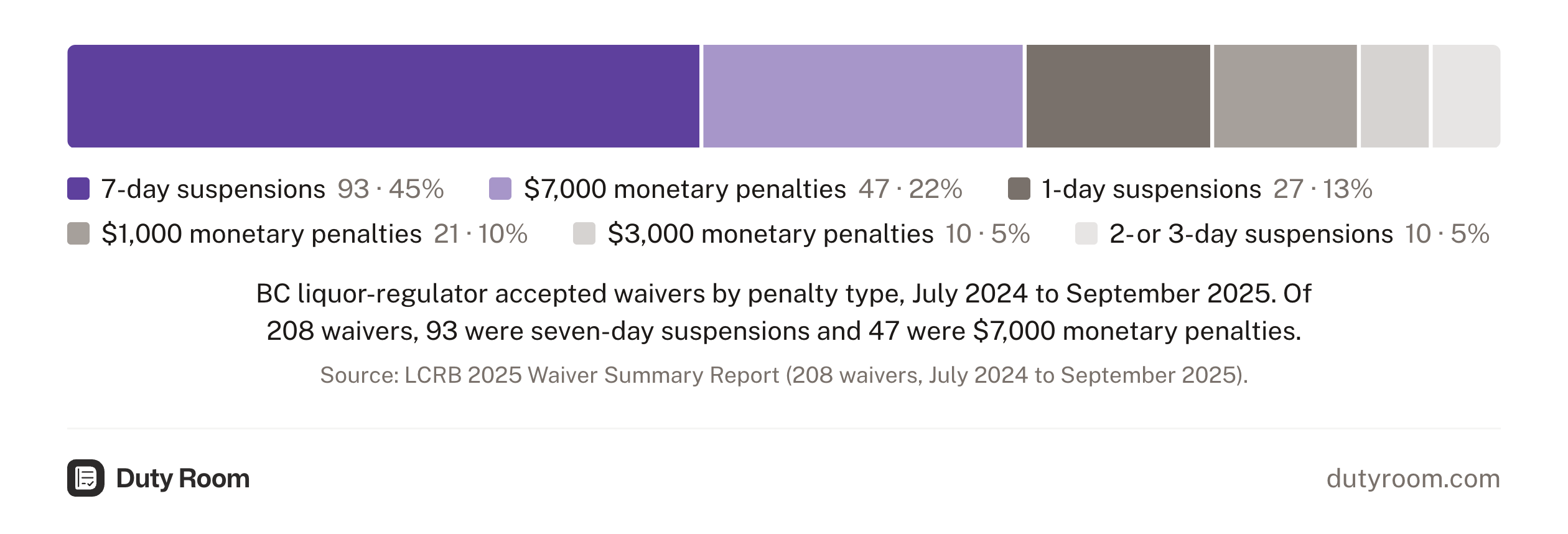
Of 208 waivers in the 2025 report, 93 were 7-day suspensions, 47 were $7,000 monetary penalties, 27 were 1-day suspensions, 21 were $1,000 monetary penalties, and 10 were $3,000 monetary penalties. The remaining 10 were 2- or 3-day suspensions.
| Penalty type | Waivers |
|---|---|
| 7-day suspension | 93 |
| $7,000 monetary penalty | 47 |
| 1-day suspension | 27 |
| $1,000 monetary penalty | 21 |
| $3,000 monetary penalty | 10 |
| 2- or 3-day suspension | 10 |
| Total | 208 |
That distribution tells you two things. First, enforcement concentrates on the $7,000 tier (minors contraventions) and the $1,000 tier (SIR training, service area violations). The $3,000 middle tier shows up less often. Second, suspensions outnumber monetary penalties about five to three among licensees who accept waivers. The economics behind that choice are covered in the minors enforcement record.
The enforcement heat map shows where these penalties land geographically. White Rock, small highway towns, and tourist corridors produce enforcement rates per licence many times higher than Vancouver.
Building a due diligence defence
If you're reading this table after receiving a Notice of Enforcement Action, the penalty range tells you the financial exposure. The due diligence playbook covers the specific documentation that separates the licensees who beat their contravention at hearing from the 73% who don't.
The penalty table is the price list. The playbook is the insurance policy.
-
Schedule 2 of BC Regulation 241/2016 defines a "first" contravention as one with no same-type contravention at the same establishment in the preceding 24 months for licensees. Permittees are not subject to the escalation columns at all: every permittee contravention is penalised from the first-contravention column. Contraventions count as the same type only when they fall within the same item number.
-
JJ's Pub (2024 BCLCRB 41) was penalised $1,000 after an employee repeatedly yelled "liquor inspectors" as two inspectors entered during a routine public safety inspection. The licence terms and conditions prohibit drawing attention to inspectors because it puts their safety at risk, and the contravention was penalised under the item 54 catch-all range rather than the obstruction items 43-44. The delegate treated it as a first contravention and imposed the minimum after the licensee said it preferred a monetary penalty to a suspension; the employee's intent did not matter, because the contravention is one of strict liability.
-
Item 51 carries monetary penalties only; no suspension days are specified in Schedule 2 for this contravention.
-
LCRB 2026 Waiver Summary Report as downloaded March 2026, case EH25-112: Molson Canada 2005, manufacturer licence, Chilliwack, contravention "Inducements", $1,093,000 penalty, waiver signed December 16, 2025. The live report is a rolling snapshot and has since been replaced; Duty Room retains the March 2026 data. The next-largest penalty in that dataset is $7,000.
This report is based on published enforcement data, sources available at publication, and original analysis. It is for general information only and doesn't constitute legal advice.
Good intentions won't save your licence. Records will.
55% of accepted LCRB penalty waivers were for liquor sales to minors. The first offer is $7,000 or 7 days. Duty Room keeps the records due diligence stands on.