Permits and records per asset
TSBC Investigation Fees: $335/h From 1 January 2027
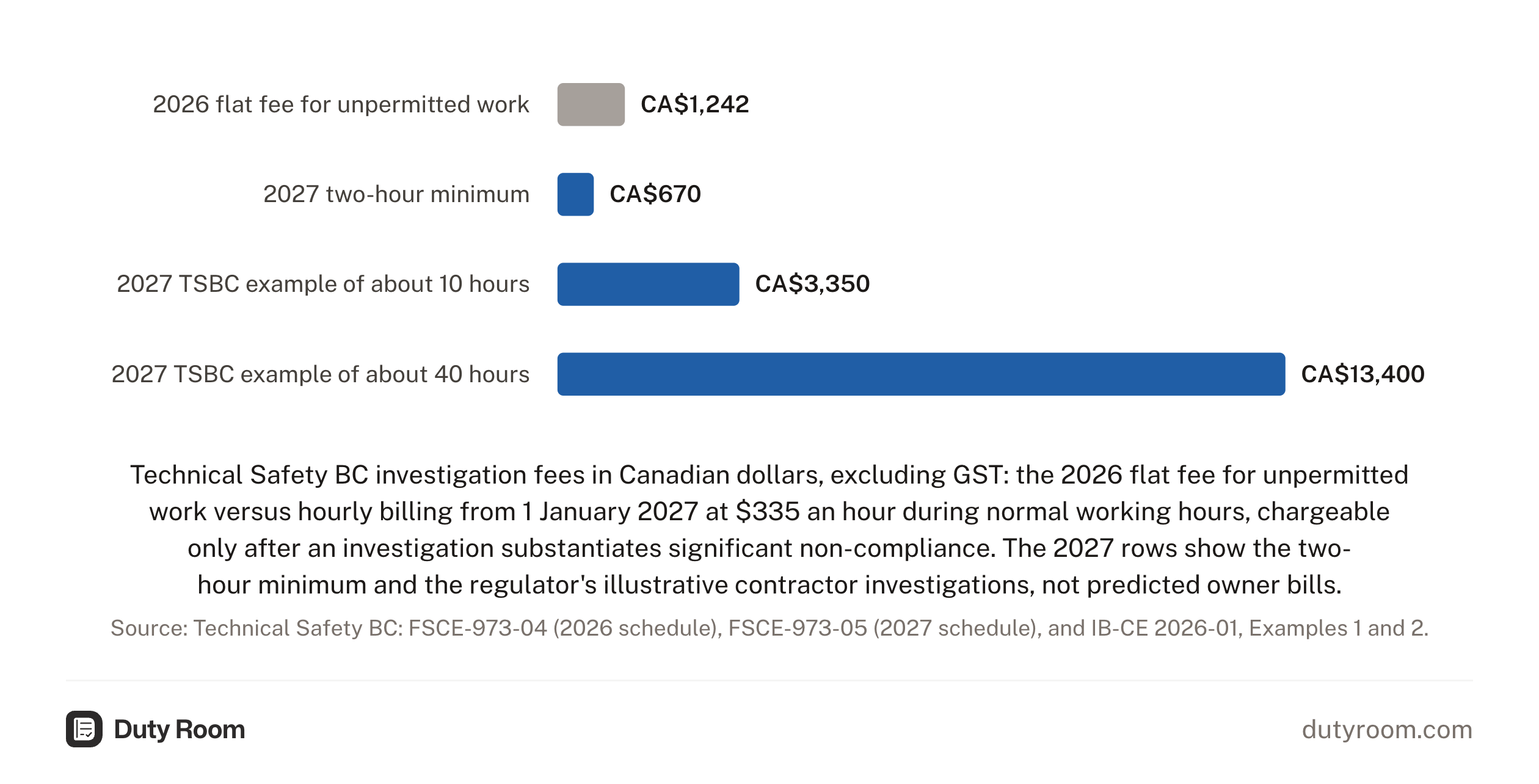
Technical Safety BC (TSBC) will replace its $1,242 flat fee for investigating unpermitted work with hourly billing from 1 January 2027. TSBC may charge $335 an hour during normal working hours, with a two-hour minimum, only after an investigation substantiates significant non-compliance.
Its 22 September 2026 bulletin, IB-CE 2026-01, names equipment owners as possible payers. Duty holders found compliant won't face these fees.
| Investigation fee basis | Fee (CAD excluding GST) |
|---|---|
| 2026 flat fee for investigating unpermitted work | 1,242 |
| 2027 two-hour minimum at the normal-hours rate | 670 |
| 2027 TSBC contractor example of about 10 hours | 3,350 |
| 2027 TSBC contractor example of about 40 hours | 13,400 |
How much can an investigation cost?
The two-hour minimum comes to $670 before GST. TSBC's bulletin gives an example of about 10 hours investigating multiple unpermitted jobs by a licensed contractor: $3,350. Its example of repeated, serious non-compliance takes about 40 hours: $13,400.
TSBC also says investigation costs may range from approximately $8,000 to $15,000 or more, depending on complexity. Its own $3,350 example sits below that range. The examples illustrate contractor cases; they don't predict a building owner's bill.
The January 2026 schedule sets today's $1,242 flat charge for an unpermitted-work investigation and $213 for an undervalued-work investigation. The 2027 schedule combines them into the hourly Investigation Fee. At the minimum, an unpermitted-work investigation costs less than today's flat charge; longer investigations can cost more.
Normal working hours run from 8:00 a.m. to 4:30 p.m., Monday to Friday, excluding holidays. The 2027 investigation rate rises to $503 an hour for weekday overtime and $670 on Saturdays, Sundays and holidays. GST applies to these charges.
Can TSBC bill the building owner?
The bulletin lists business owners, strata corporations and landlords among those who may face fees. The Safety Standards Act includes a lessee in its definition of owner, so leasing a hotel or restaurant doesn't itself remove the operator from that definition. The bulletin's definition of a duty holder also covers anyone who authorizes regulated work.
The 2018 bulletin, now rescinded, already included owners, so this revision changes billing and scope without bringing owners in for the first time. The current bulletin names owners as possible payers but illustrates fees through contractor cases; it doesn't explain how TSBC divides a charge when both are involved.
TSBC says significant non-compliance may include serious, repeated, systemic, deliberate or ongoing breaches, including unauthorized work. Unauthorized work includes work without the required permit, licence, certification or other authorization, work outside a licence or certificate's scope, and work by an unqualified person. The investigation fee follows a completed investigation that substantiates significant non-compliance.
TSBC calls these cost-recovery fees. Where warranted, it may apply them alongside compliance orders, discipline orders or monetary penalties. An unpaid fee can also affect permission to operate: section 18.1 of the Act allows a licence, certificate, permit or other permission to be refused, suspended or revoked when the applicant or holder owes overdue fees, penalties or other money under the Act.
Inspection and audit fees
The 2026 special-inspection charge is $206 per inspection of unpermitted work. From January 2027, the Unauthorized Work Inspection fee uses the Safety Services Rate, $223 an hour in normal working hours, and extends to unlicensed and unqualified work too.
Reinspection of unauthorized work uses the same hourly rate. TSBC says this revision applies only to follow-up inspections of unauthorized work; the ordinary safety-officer reinspection fee remains unchanged.
Compliance audits are renamed regulatory audits. Lead investigating officer time uses the $335 normal-hours rate, while a new line charges Enforcement Investigation Specialist time at $90 an hour in normal working hours. The bulletin allows audit fees where significant non-compliance is found and says fees may be waived where it isn't.
Permits, contractor checks and inspection records
An equipment register can connect each asset to its permit number, contractor licence check and last inspection. Each row rests on a different duty, and an owner's copy of the contractor's elevator log is a suggested extra.
| Equipment | Records and duties | Primary source |
|---|---|---|
| Elevators | Operating permit renewed before its annual expiry. Licensed maintenance contract for at least quarterly maintenance, unless the owner is licensed and performs its own maintenance. The contractor retains maintenance and test records for at least five years in hard copy and electronic form. The owner can request the electronic records and keep a copy. | TSBC permits; maintenance regulation, section 21; maintenance records |
| Boiler and pressure-vessel plants | Where section 62.1 requires a plant operating permit, the owner must post it and keep the equipment record and certified-staff list on site, with a named person responsible for the records. Required plant records must be kept for at least seven years, or longer where required. | Plant regulation, sections 69.1 and 72 |
| Regulated refrigeration | Operating permit where required; installation permit and Class REF contractor details for a refrigerant substitution. Certified systems also need the written authorizations described below. | Plant regulation, sections 62(1)(b) and 62(2); Refrigerant directive |
| Electrical systems | Where an electrical operating permit is required, it names a Field Safety Representative, the certified person responsible for the electrical work. TSBC lists hotels, nursing homes and strata buildings among sites likely to need one. | TSBC electrical permits |
| Gas installations and alterations | Installation permit for regulated work, plus the contractor's licence or other authorization to do that work. | General Regulation, section 17; Safety Standards Act, section 23 |
The permit holder must correct non-compliances recorded on a certificate of inspection and notify the safety officer when corrections are complete. TSBC's licensed-contractor search supplies a check that can be dated and attached to the equipment file. Duty Room files permits, contractor checks and inspection follow-ups by site, each with its date.
Owners of covered Category IV gas boilers must also keep inspection, service, test and repair records for the boiler and its venting, including other corrective work, and give them to TSBC on request. Our boiler safety order briefing explains which boilers are covered and the owner's duties.
Permit requirements depend on the equipment. The plant regulation excludes refrigeration plants below 5 kW prime-mover nameplate rating and water heaters with heat input of 120 kW or less. It also excludes heating, refrigeration and pressure-vessel plants in buildings with four or fewer self-contained residential units, except plants with toxic or flammable contents.
Some electrical permits and assessments belong to delegated local governments. Their natural-gas installation permits cover fully detached dwellings served by one meter at no more than 2 psi (14 kPa). For other premises, the meter pressure must be no more than 2 psi (14 kPa) and the total connected load no more than 409,600 BTU/hr (120 kW). TSBC lists Burnaby, Maple Ridge, Vancouver, and the City and District of North Vancouver; Kelowna and Richmond for gas only; and Surrey, Victoria and West Vancouver for electrical only. TSBC still oversees contractor licensing and other technologies, including elevators, boilers and refrigeration, in those areas.
A walk-in cooler gets a different refrigerant
Consider a fictional restaurant with a regulated, certified walk-in refrigeration system. A service company replaces its refrigerant with a different type without an installation permit.
TSBC's separate directive D-BP 2026-01 treats the substitution as an alteration requiring an installation permit and a Class REF licensed contractor with a quality-control program covering that alteration. Before substitution in a certified system, written authorization must come from the original manufacturer or a professional engineer, and from the accredited body responsible for the original certification. Those authorizations must confirm that the substitution was evaluated for the equipment's specific make and model and does not invalidate the original product certification. They accompany the installation-permit application. The directive also requires the system to meet the latest CSA B52 refrigeration code and carry a new permanent sign with the specified equipment and refrigerant details.
Duty Room's reading is that this unpermitted refrigerant change counts as unauthorized work under the fee bulletin. Neither document cites the other. Where TSBC identifies significant non-compliance, it may apply inspection and follow-up fees; an investigation fee follows only once an investigation substantiates it. The example doesn't establish who would pay.
The permit and authorizations record what was approved for this cooler. A contractor licence check and a photograph of the new sign can sit beside them in the cooler's file.
This briefing is based on sources available at publication and is for general information only. It doesn't constitute legal advice. For advice on your specific situation, consult a qualified professional.
Keep equipment records together
Duty Room files each asset's permits, contractor checks and inspection records by site, every record dated.