Overtime, not the minimum wage, is the expensive part
DOL Has Recovered $57M From Florida Hospitality
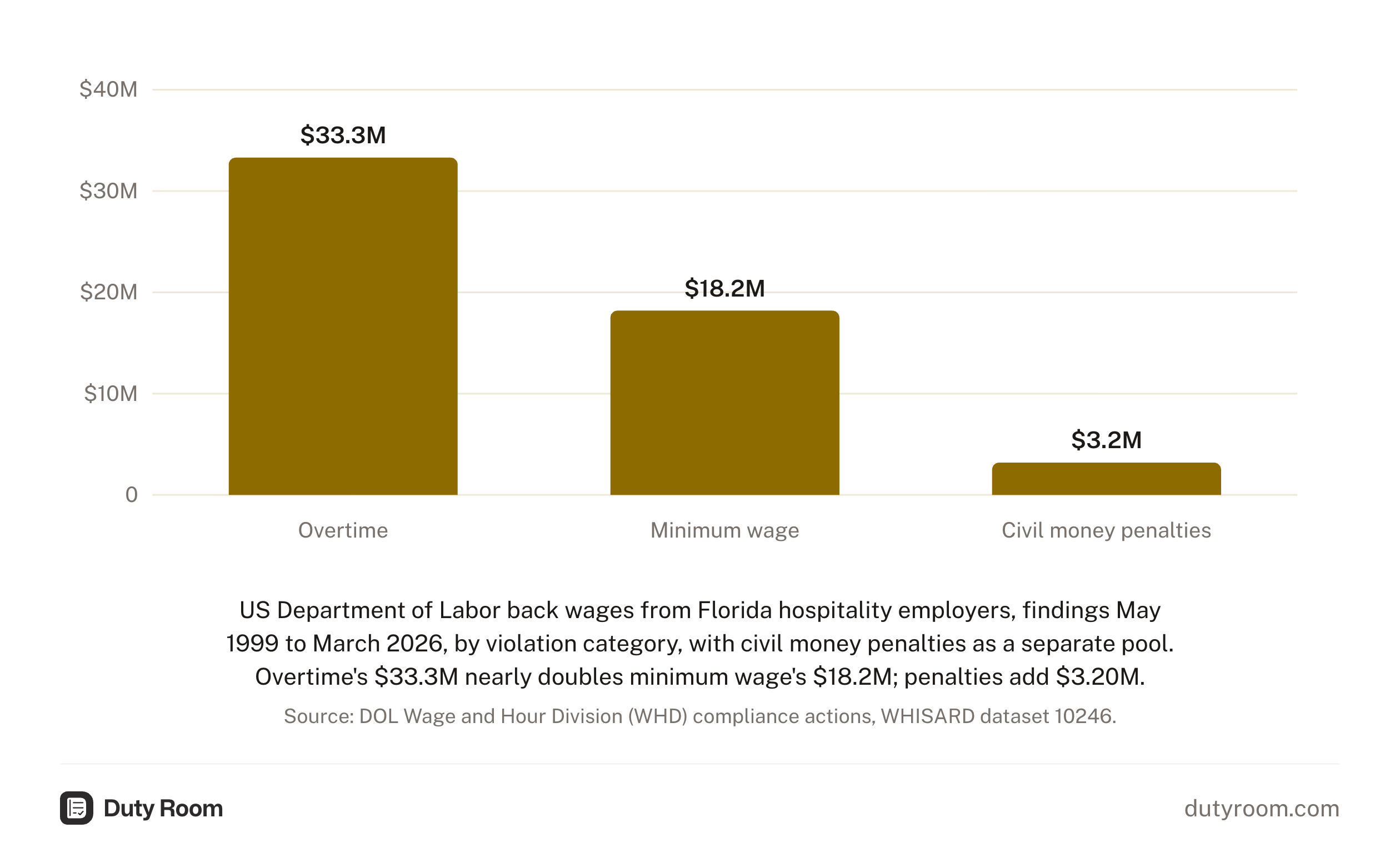
The typical Florida hospitality wage case that pays out costs $3,097. That median covers the 4,143 cases that paid, 59.9% of concluded investigations; the other 2,773 recovered no back wages. The largest cost $3.61M, at Disney Florida Resorts in Orlando. Across 6,916 concluded investigations, the U.S. Department of Labor (DOL) has recovered $57,461,025 in back wages from Florida hospitality employers. The expensive failures are overtime, not the minimum wage everyone watches: overtime is 58.0% of the back wages.1
Florida has no state labor department. For wage-and-hour enforcement, the main public record is federal: the DOL's Wage and Hour Division, or WHD. This is a different federal file from I-9 and ICE worksite enforcement. WHD looks at hours, wages, tips, payroll records and classifications. The concluded cases show where the money has been.
The violation mix
The Florida WHD record is mostly an overtime record.
| Category | Cases | Dollars | Share of back wages |
|---|---|---|---|
| Overtime | 3,492 | $33.3M | 58.0% |
| Minimum wage | 2,119 | $18.2M | 31.7% |
| Civil money penalties | 669 | $3.20M |
Civil money penalties sit outside the $57.5M back-wage total: 669 cases where WHD imposed $3.20M in penalties on top of the back wages.
That tilt toward overtime makes sense in the operator's world. A server works tipped hours and non-tipped side work. A prep cook clocks in early, then a manager edits the time. A closing bartender stays after the register is counted. A "manager" spends most of the week on service work and still gets treated as salary-exempt. None of those facts looks dramatic on its own. In a WHD file, they become arithmetic.
Overtime is unforgiving because the math multiplies the mistake. A wrong regular rate carries into the time-and-a-half rate. An incorrect tip credit can distort the overtime premium too. Missing hours become premium hours once the week passes 40.
Minimum wage is still $18.2M of the back wages, nearly a third of the total. Even there, it is rarely as simple as an employer paying below the posted rate. More often, the failure sits where tips, overtime, off-the-clock work and job duties meet.
Full-service restaurants are the volume
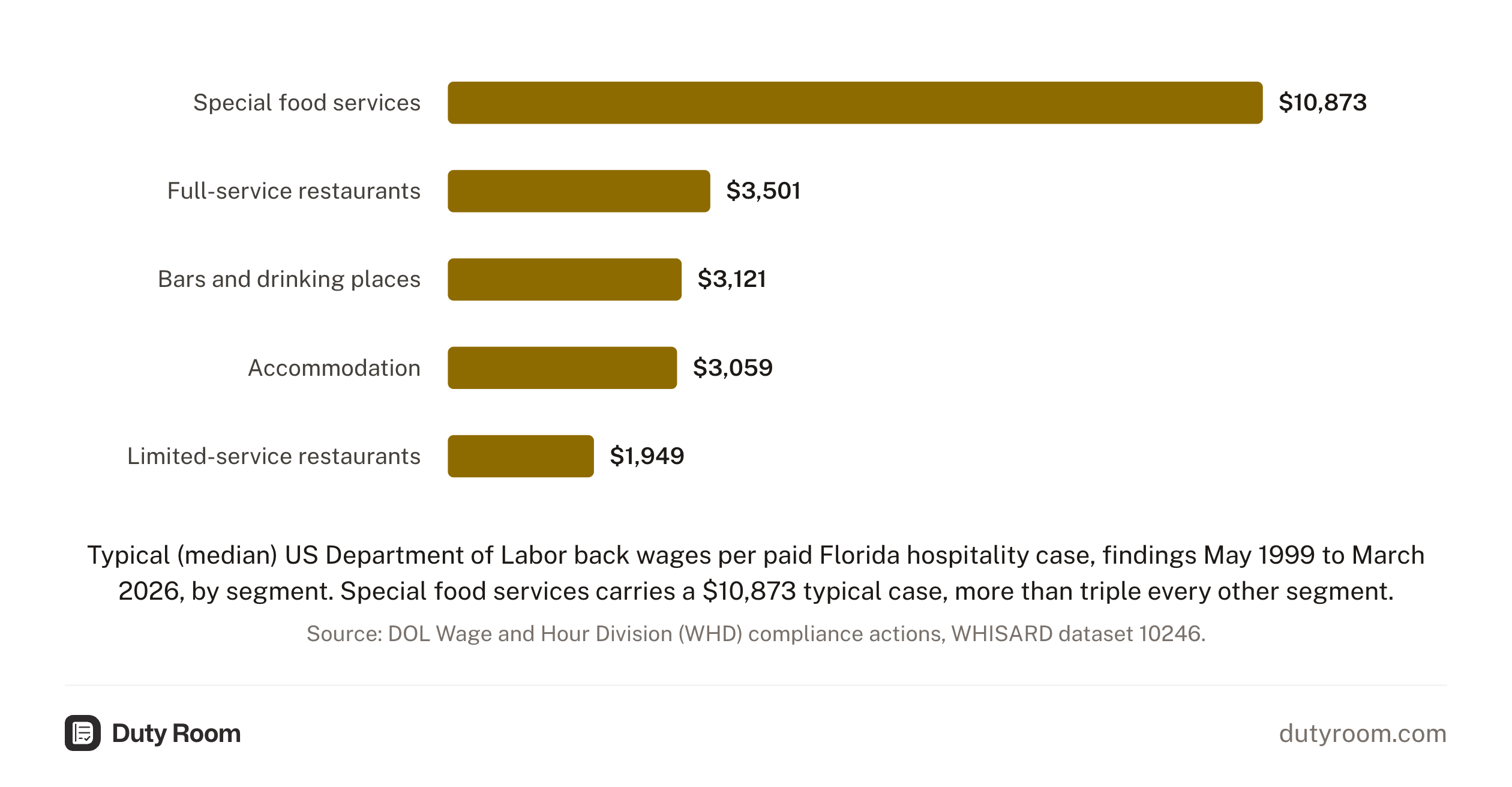
Full-service restaurants dominate the case count and back wages.
| Segment | Cases | Back wages | Median recovery where paid |
|---|---|---|---|
| Accommodation | 1,300 | $9.6M | $3,059 |
| Full-service restaurants | 3,864 | $34.9M | $3,501 |
| Limited-service restaurants | 1,472 | $7.2M | $1,949 |
| Special food services | 94 | $4.4M | $10,873 |
| Bars and drinking places | 186 | $1.3M | $3,121 |
Those five NAICS families cover all 6,916 concluded cases.
A typical full-service case looks like the $3,500 file WHD closed at a Jacksonville diner in 2017. Limited-service restaurants add plenty of cases, but the typical paid case is smaller. By typical paid case, bars and drinking places sit in the middle of the file: tips, late nights and cash handling are part of how they run, not a guarantee of higher recoveries.
Special food services are the expensive outlier
Special food services, including caterers and food contractors, appear only 94 times in the dataset. The typical paid case is $10,873, by far the highest of any segment in the Florida hospitality file.
Special food services work can mix travel, load-in, banquet setup, offsite service, breakdown and irregular crew schedules. The WHD record doesn't need every caterer to fail for the segment to stand out. A few bad files can produce large recoveries because reconstructing hours across event work gets messy fast.
Accommodation exposure
Accommodation's typical paid recovery was $3,059, close to the all-case number. The segment's exposure shows up at the top of the file.
The largest single case in the Florida hospitality dataset was Disney Florida Resorts in Orlando, with $3.61M recovered in 2017. That recovery was the largest part of the $3.8 million Disney settlement the Department of Labor announced that year, after finding uniform deductions that pushed pay below the minimum wage and unpaid pre- and post-shift work. The next largest cases were KMONEY in Winter Garden at $1.26M in 2022 and Star Payment Systems in Ocala at $1.02M in 2021, both coded to special food services, then CFI/Westgate Resort in Orlando, another accommodation case, at $868K in 2009.
Names like KMONEY and Star Payment Systems can look out of place in a hospitality file. The dataset lists the legal entity WHD recorded and the industry code the agency assigned, and a company's registered name often says little about the hotel or restaurant business it operates.
Hotels and resorts run many job types under one roof: housekeeping, front desk, food service, banquets, maintenance, valet, recreation and back office. When the payroll error is broad enough, one case can pass $1 million.
Most cases won't look like the Disney Florida Resorts recovery; the typical paid case sits in the low thousands.
Repeat exposure
Duty Room counted 401 repeat or willful violators of the Fair Labor Standards Act (FLSA) in the Florida hospitality dataset. Those cases are 5.8% of concluded investigations.
A repeat or willful flag changes the nature of the case. It says the employer had been through this before, or that the agency saw the conduct as worse than a first-time mistake. The same operators come back.
Wage-and-hour risk is often filed under "payroll paperwork." In repeat or willful cases, WHD looks at the employer's history as well as the current pay records.
The $15 step raises the pressure
Florida's minimum wage reaches $15 per hour on September 30, 2026. The tipped cash wage reaches $11.98 on the same date. Our Florida minimum wage briefing covers the rate schedule and tip-credit mechanics.
This report is the enforcement record behind that rate change. Florida hospitality runs on the tip credit, so payroll still has to prove that tips plus cash wages meet the required minimum for the workweek, that the overtime math starts from the correct regular rate, and that tip pools exclude anyone who can't be in them when the employer takes the credit. A manager's classification still has to match the work they actually do.
As the base rate rises, the value of each bad hour rises with it. A missing hour, an off-the-clock closing task, a misclassified manager week or a tipped overtime error turns into back pay at a higher wage floor than it would have five years ago.
The records exercise
A WHD investigation starts as a records exercise.
The investigator asks for:
- Time records
- Pay records
- Employee lists
- Payroll registers
- Tip-credit notices and tip-pool records
- The overtime math that ties them together
Edited hours need an edit trail in the file. Tip-credit use needs the notice and pay record. Salary-exempt treatment needs a job record and pay basis that support the classification.
Duty Room's part in this is narrow. It keeps time-and-pay evidence ready to produce for a location or an account. It doesn't run payroll, calculate wages, or determine FLSA classification.
Operators lose ground when they can't produce a clean file after the request lands. When WHD asks for the documents, the job is to have them.
-
Duty Room analysis of U.S. Department of Labor Wage and Hour Division (WHD) compliance actions, WHISARD dataset 10246 at data.dol.gov. Florida, NAICS 72. Findings May 1999 through March 2026; extracted June 2026.
This report is based on published enforcement data, sources available at publication, and original analysis. It is for general information only and doesn't constitute legal advice.
Produce the record when you're asked, not a week later.
Florida operators keep I-9 and E-Verify checks, SB 606 disclosures, and $15 minimum wage records current. Duty Room keeps the evidence and deadlines aligned with your HR adviser.