The Last Scheduled Step
Florida's $15 Minimum Wage: September 30, 2026
Florida's minimum wage rose to $15 per hour on September 30, 2026. The tipped cash wage rose to $11.98. These are the final scheduled increases under Amendment 2, the constitutional amendment voters approved in November 2020 with 60.82% of the vote.
After $15, the rate adjusts automatically every year based on inflation. There is no further legislative step.
The schedule
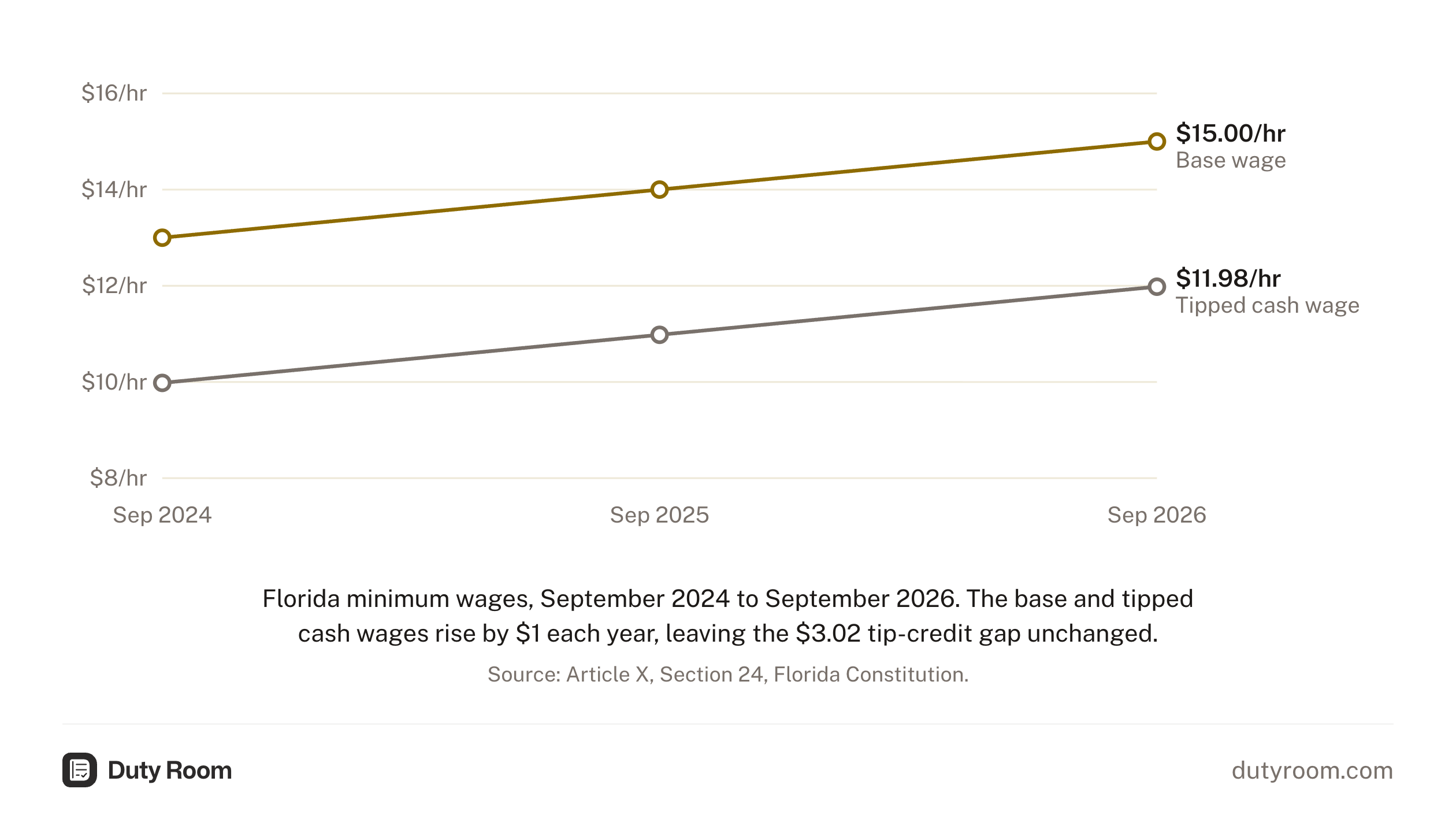
| Effective date | Base wage | Tipped cash wage |
|---|---|---|
| September 30, 2024 | $13.00/hr | $9.98/hr |
| September 30, 2025 | $14.00/hr | $10.98/hr |
| September 30, 2026 | $15.00/hr | $11.98/hr |
| January 1, 2028 | CPI-adjusted | CPI-adjusted |
The $15 step is the last of the annual $1 increases that followed the jump to $10 in 2021.
The tip credit stays at $3.02
Article X, Section 24 of the Florida Constitution caps the tip credit at "the allowable FLSA tip credit in 2003," which was $3.02. Raising it would take another amendment, though lawmakers can cut the credit by statute and have never done so.
The tipped cash wage rises by the same amount as the base wage. At $15, the cash wage is $11.98, which exceeds the federal tipped minimum ($2.13) by nearly $10.
If tips plus the $11.98 cash wage don't reach $15 in any workweek, the employer owes the difference. That guarantee applies per employee, per workweek.
| Rate | Cash wage | Tip credit | Employer's full wage bill if tips = $0 (40-hr week) | |
|---|---|---|---|---|
| Sept 30, 2025 | $14.00 | $10.98 | $3.02 | $560.00 |
| Current (Sept 30, 2026) | $15.00 | $11.98 | $3.02 | $600.00 |
A server who works 40 hours in a week with no tips costs the employer the full $600 in wages: the $479.20 cash wage plus a $120.80 make-up payment. The tip credit can never exceed the tips the server actually received.
Annual inflation adjustments start in 2027
After the $15 step, F.S. 448.110 sets the annual adjustment process. The state uses the Consumer Price Index for Urban Wage Earners and Clerical Workers (CPI-W) for the South Region:
- September 1: the 12-month measurement period ends.
- By October 15: the state publishes the new rate on the Department of Commerce website.
- January 1: the adjusted rate takes effect.
The first adjusted rate publishes by October 15, 2027 and takes effect January 1, 2028. The same dates apply each year after that, without new legislation or rulemaking for each rate. Check the rate each October and update payroll before January 1.
Florida claims and federal investigations
Employees can bring a Florida minimum-wage claim under F.S. 448.110, after giving the employer written notice and 15 calendar days to resolve it. The state Attorney General can also sue; willful violations carry a $1,000 state fine per violation. The federal Wage and Hour Division (WHD) separately enforces federal wage law.
Duty Room's analysis of WHD data extracted in June 2026 found $57.5 million in back wages owed across 6,916 Florida hospitality investigations.1 Where a case finds back wages, the median amount owed is about $3,100, and the largest exceeded $1 million. Overtime violations account for 58% of those back wages.
One Florida restaurant chain paid $314,553 in back wages in a case where the DOL found it redirecting gratuities to the business. A Tampa brewery paid $70,575 in a case where managers were included in the tip pool.
Payroll, tip pools and the poster
Employers with staff in more than one state must apply the Florida rate to hours worked in Florida, as F.S. 448.110 requires.
Managers and supervisors cannot keep employees' tips, whether or not the employer takes a tip credit. If the employer takes the credit, the pool can include only staff who customarily and regularly receive tips. If the employer pays the full $15 in cash and takes no credit, federal rules allow the pool to include non-tipped staff such as cooks; managers remain excluded.
A September 2026 WHD opinion letter says a supervisor who meets the management duties test cannot take pooled tips, even while tending bar. The test uses actual duties, not job titles. An employee whose primary duty is bartending or serving rather than management does not meet that duties test. Managers can keep tips a customer gives them for service they directly and solely provide, but cannot share in other employees' tips.
Each employer must display the minimum-wage poster in a conspicuous, accessible place at each establishment (F.S. 448.109). The Department of Commerce publishes the poster in English and Spanish by December 1 each year.
Our Florida employment compliance resources cover the payroll and tip-credit records to keep.
-
Duty Room analysis of 6,916 Florida records (NAICS 72, accommodation and food services) from the U.S. Department of Labor WHD compliance action dataset (data.dol.gov, dataset dated June 4, 2026; extracted June 10, 2026), with repeated case records counted once. Median back wages owed where a case recorded any: $3,097 overall, $3,501 for full-service restaurants, $3,121 for bars. Overtime back wages: $33.3 million of $57.5 million (58.0%). These figures replace an earlier extract ($51.2 million, 6,818 investigations, bars median $4,912, 57% overtime) that double-counted some cases and missed others.
This briefing is based on sources available at publication and is for general information only. It doesn't constitute legal advice. For advice on your specific situation, consult a qualified professional.
Produce the record when you're asked, not a week later.
Florida operators keep I-9 and E-Verify checks, SB 606 disclosures, and $15 minimum wage records current. Duty Room keeps the evidence and deadlines aligned with your HR adviser.