Audit Deadlines, Fines And Valid Forms
I-9 Compliance for Florida Restaurants: 3 Days, $2,861 per Form
ICE initiated more than 264 Form I-9 inspections in all of FY 2024. At the last worksite-enforcement peak, in FY 2019, it ran 6,456. The audit program spent four years at a few hundred a year. In 2025, the current administration began rebuilding it from that low base.
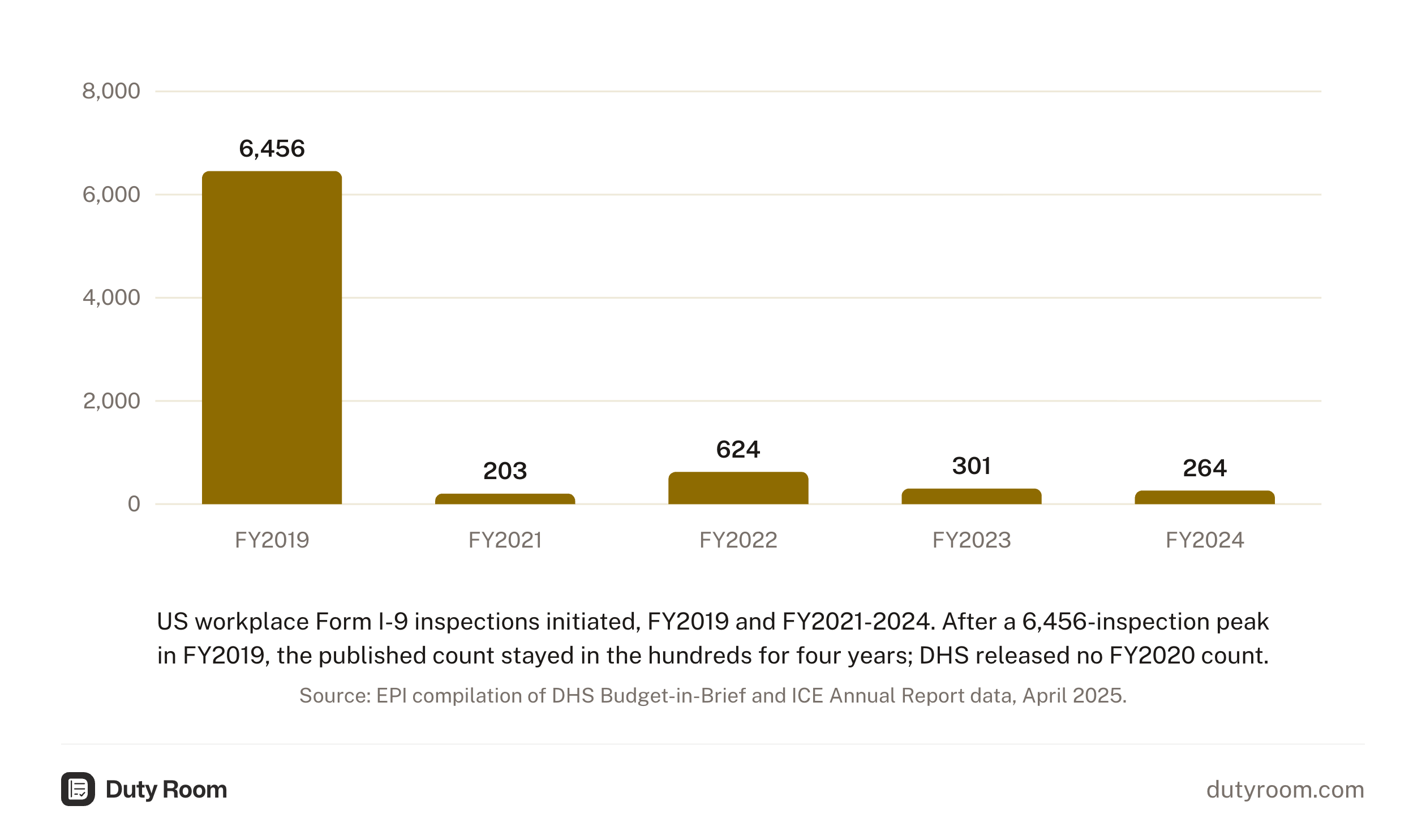
| Fiscal year | Inspections initiated |
|---|---|
| FY2019 | 6,456 |
| FY2021 | 203 |
| FY2022 | 624 |
| FY2023 | 301 |
| FY2024 | over 264 |
As of October 8, 2026, the latest annual report on ICE's statistics page covers FY 2024. ICE has published no official FY 2025 audit count there. Treat the big numbers in circulation with care. The most-quoted figures (2,540 in a quarter, more than 5,200 in a year) come from ICE's 2018 two-phase operation, and the "ten times the old pace" claims appear in vendor and law-firm commentary, not in any ICE annual report.
The record does show ICE rebuilding its enforcement capacity: raids on restaurants and hotels through 2025, $8 billion for ICE hiring, a workforce the agency says doubled in a year, and a March 2026 change in its inspection guidance that removed the correction window for many common paperwork errors.
An audit notice gives you three business days
An I-9 audit begins when ICE serves a Notice of Inspection. From that moment you have at least three business days to produce your original I-9s, and agents usually request payroll records, a list of current and former employees, articles of incorporation, and business licenses alongside them. The review that follows can take months.
ICE changed its inspection guidance on March 16, 2026. Technical failures still get a correction window of at least ten business days. But ICE's current inspection fact sheet now lists a long set of common mistakes as substantive violations, which get no correction window at all: a missing date of birth or attestation checkbox in Section 1, missing document details in Section 2, an electronic I-9 system that can't produce compliant audit trails. Substantive violations and uncorrected failures can bring fines of $288 to $2,861 per form.
Two more deadlines apply during an audit. If a new hire presented a receipt for a lost, stolen, or damaged document, you have 90 days to verify the replacement, and missing that window is itself a substantive violation. If the audit ends in a Notice of Intent to Fine, you have 30 days to request a hearing. After that the fine becomes a final order, with no appeal.
Florida's alcohol regulator is now an immigration partner
In April 2025, the Division of Alcoholic Beverages and Tobacco (ABT) signed a 287(g) Task Force Model agreement with ICE. Under the agreement, ABT's 106 sworn officers (not its civilian inspectors) gained federal authority to perform immigration enforcement functions. By January 2026, ABT had logged 375 shifts and 2,894 hours under the agreement [source: DBPR press release, Jan 7, 2026]. The agency split is covered in our Florida regulator briefing.
In a May 1, 2025 Operation Tidal Wave briefing, Governor DeSantis said ABT and other Florida regulatory agencies operate in "target-rich environments," and that their routine inspection and investigative duties put special agents in contact with people who may be in the country illegally.
The source review for this briefing found no documented case linking a routine alcohol compliance visit to an immigration check. The legal authority for sworn ABT officers exists under the agreement, but how and whether it gets used during routine visits remains an open question.
The federal money behind this
The One Big Beautiful Bill Act, enacted July 4, 2025, allocated $8 billion for ICE personnel. The hiring plan: 2,500 new positions in FY 2025, then 1,875 per year through FY 2029, for a total of 10,000. ICE reported doubling its workforce from 10,000 to 22,000 officers and agents during 2025.
Separately, ICE asked the IRS for taxpayer records covering about 1.28 million people under a data-sharing memorandum. The IRS matched and shared data for roughly 47,000 of them.
Hospitality is a named target
On June 17, 2025, Reuters reported that DHS told staff raids on hotels and restaurants should continue. A brief internal pause (a June 12 email) was reversed within days. A DHS spokesperson said: "There is no safe harbor, whether it be a church or a courthouse or a worksite."
An analysis of Census Bureau survey data puts the foreign-born share of Miami's hotel workforce at 65%. The sector's workforce profile makes it a focus for enforcement, and federal officials have said so openly.
Florida has already seen large-scale actions. In May 2025, an ICE Tampa operation in Wildwood, about 20 miles south of Ocala, led to 33 arrests, and a Tallahassee raid the same month brought more than 100. Both were construction-site operations, but restaurants are in the record too: in February 2025, the owner of a Jacksonville Beach sushi restaurant pleaded guilty to harboring undocumented workers, forfeiting a house and a transit van as part of the plea.
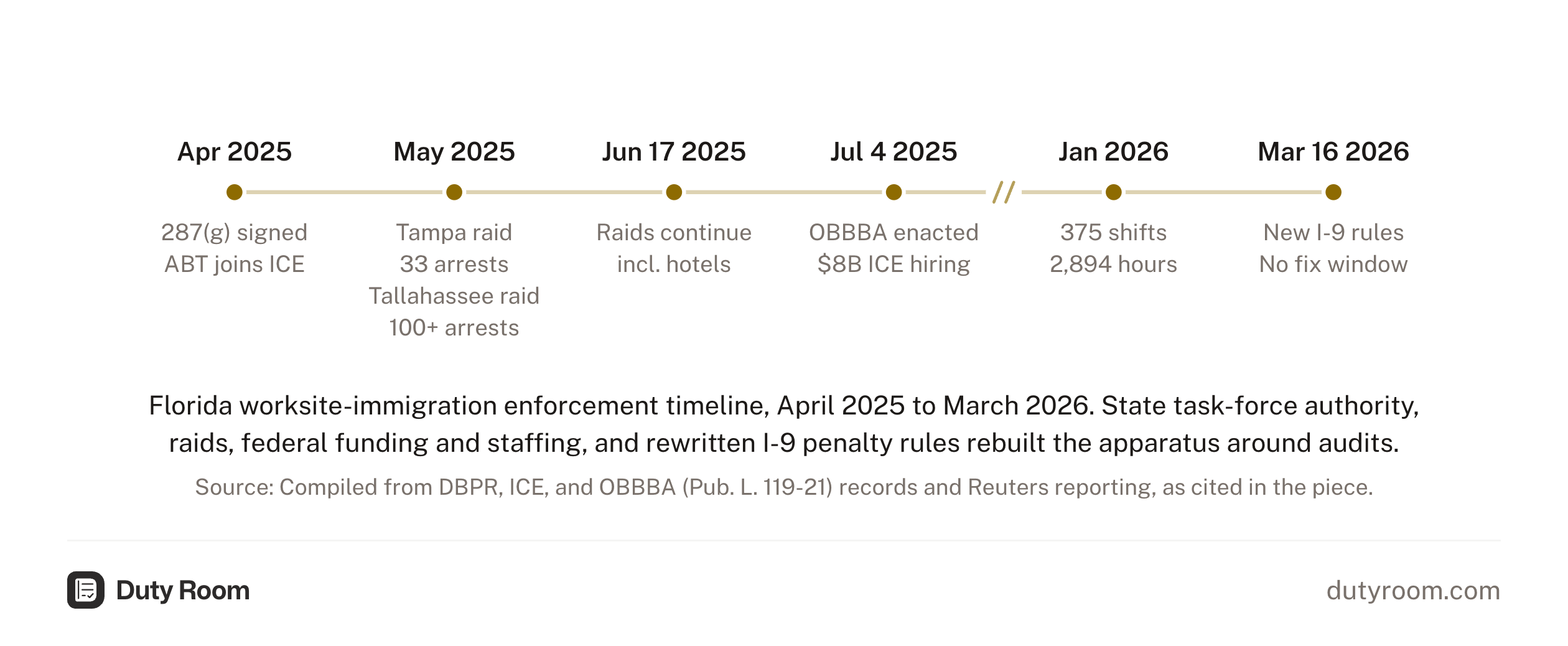
| Date | What changed |
|---|---|
| Apr 2025 | ABT signs a 287(g) Task Force Model agreement with ICE |
| May 2025 | Tampa worksite operation (33 arrests) and Tallahassee raid (100+ arrests) |
| Jun 17 2025 | DHS tells staff raids on hotels and restaurants should continue (Reuters) |
| Jul 4 2025 | OBBBA enacted, allocating $8 billion for ICE hiring |
| Jan 2026 | ABT logs 375 shifts and 2,894 hours under the 287(g) agreement |
| Mar 16 2026 | I-9 penalty rules rewritten; correction window removed for substantive errors |
E-Verify and the I-9 forms you can use
SB 1718 (codified at F.S. 448.095) makes E-Verify mandatory for private employers with 25 or more employees. You have three business days after a new hire's first day of paid work to run the verification, and you keep the records for at least three years.
State enforcement is graduated. If the Department of Commerce finds you didn't use E-Verify, it notifies you and gives you 30 days to cure it. A third violation inside 24 months brings a $1,000-a-day fine until you prove compliance, and at that point noncompliance is grounds for suspending your licenses until it's cured.
Since August 1, 2026, you can no longer use the 08/01/23 version that expired on July 31, 2026. Two versions remain valid: the 01/20/25 edition and the 08/01/23 edition that expires May 31, 2027. Both expire on May 31, 2027. The edition date is printed at the bottom of the form and the expiration date at the top. If your electronic system still generates the July 31, 2026 version, update it now. ICE treats using an out-of-date version for a new hire as a technical failure, with at least ten business days to correct it after notice. Keep properly completed existing I-9s: ICE checks whether the version was current when the form was first completed.
Congress has funded the hiring, ICE says it has doubled its workforce, and the inspection guidance has changed. If ICE audits you, it will ask for the records you keep now. Our Florida employment compliance resources cover the I-9 and E-Verify records you need to keep.
This briefing is based on sources available at publication and is for general information only. It doesn't constitute legal advice. For advice on your specific situation, consult a qualified professional.
Produce the record when you're asked, not a week later.
Florida operators keep I-9 and E-Verify checks, SB 606 disclosures, and $15 minimum wage records current. Duty Room keeps the evidence and deadlines aligned with your HR adviser.