Warnings Became Court Files
34 Fire Safety Prosecutions, From Blocked Exits to a £362,000 Fine
This guidance covers England and Wales. Scotland and Northern Ireland have similar but separate fire safety legislation.
Blocked exits. People sleeping above takeaways. Alarm logs recording checks that never happened. Duty Room's July 2026 source audit identified 34 completed prosecution outcomes under the Regulatory Reform (Fire Safety) Order 2005 at hospitality and customer-facing commercial premises in England and Wales, from October 2021 to July 20261. Together they show how serious fire-safety failures move up the enforcement ladder and into court.
Prosecution is rare. In the year ending March 2025, fire and rescue services in England completed 51,026 fire safety audits, issued 2,955 formal notices (enforcement, prohibition, and alteration combined), and brought 35 prosecutions2. Most operators comply before it gets that far. The businesses in this report did not.
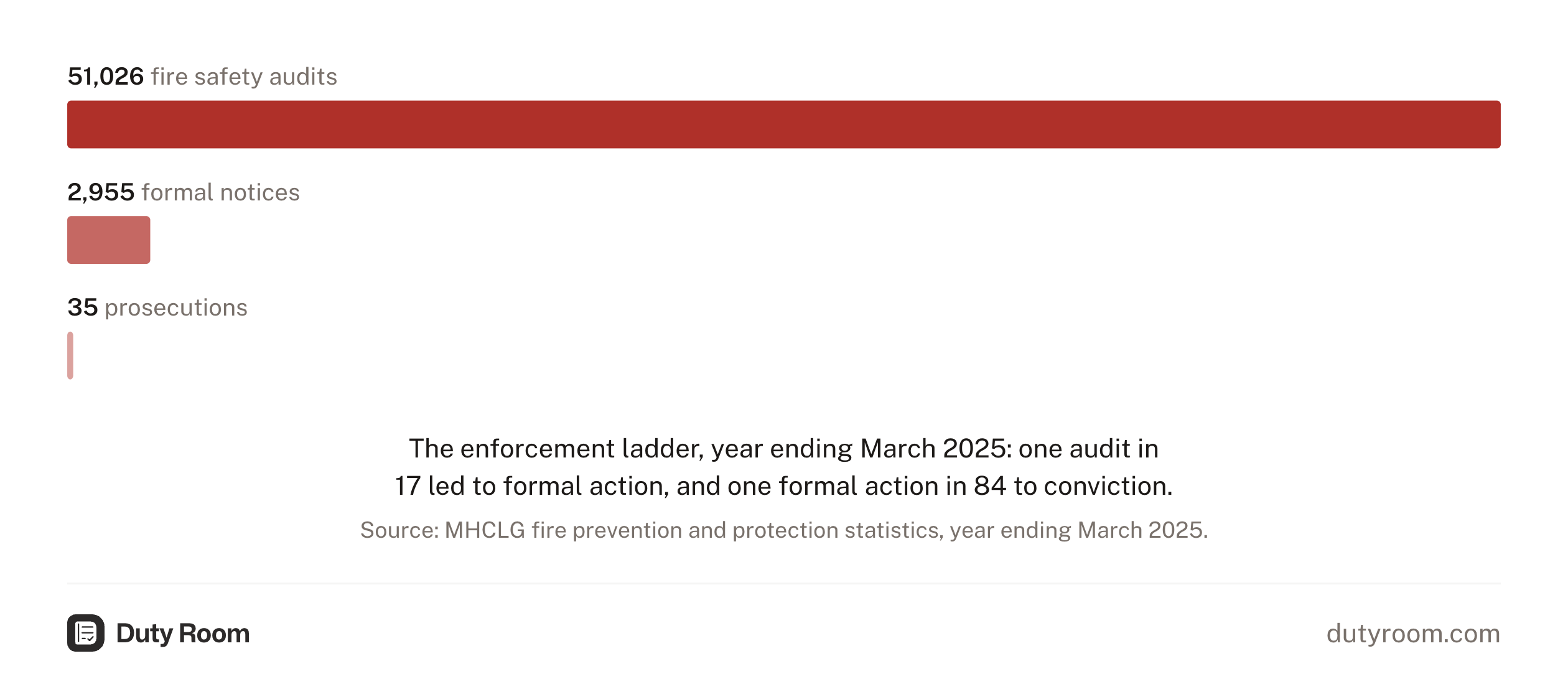
| Stage | Count | ||
|---|---|---|---|
| Fire safety audits | 51,026 | ||
| Formal notices (enforcement | prohibition | alteration) | 2,955 |
| Prosecutions | 35 |
The sports bar that ignored the enforcement notice
In October 2025, a Huddersfield bar company was fined £160,000 after West Yorkshire Fire and Rescue Service found it had failed to comply with an enforcement notice. The breaches: blocked exits, no fire detection in the kitchen, and no physical separation between the fryer and the bar area where customers were drinking. The fire service described the conditions as "appalling." The fine is among the largest in the compiled file. When the service announced it, the company had already submitted an appeal.
The company wasn't prosecuted on a first visit. Officers had already been, had already said what needed fixing, and came back to find it hadn't been done.
At the extreme end of the same pattern, two connected companies operating the Falstaff Hotel in Leamington Spa were sentenced at Warwick Crown Court in October 2021 after pleading guilty to 38 charges including a breach of a prohibition notice. The fines, £212,000 against one company and £150,000 against the other, came to £362,000, with prosecution costs of £67,679 split between them. It is the largest hospitality fine in the case file behind this report.
Staff sleeping above restaurants
The pattern repeats across several restaurant prosecutions, all involving people sleeping on premises where the fire protection couldn't support it.
In Watlington, Oxfordshire, a former restaurant owner was fined and given a suspended prison sentence in 2025 after fire officers found staff bedrooms above the restaurant with an inadequate fire risk assessment, defective detection, and unprotected escape routes. A prohibition on sleeping had to be imposed.
In Northampton, the same restaurant premises appeared in court twice. The owner was ordered to pay £6,350, including a £4,000 fine, in November 2023 after breaching a prohibition notice within three days of it being served. Workers had been sleeping in basement storerooms converted to bedrooms, with faulty alarms and inadequate escape routes. A different defendant at the same restaurant was prosecuted again in October 2024 for the same problem: people sleeping on the premises, this time accessed through a loft hatch and ladder, with no fire detection at all.
In September 2025, a company director was ordered to pay £6,200 at Brighton Magistrates' Court over an Indian street food takeaway in West Sussex with residential flats above. Five charges: no fire alarm system, inadequate means of escape, inadequate fire safety arrangements, no testing or maintenance of alarms or lighting, and no staff fire training. People were sleeping in the building while the ground floor kept trading.
In Birmingham, a restaurant owner and the property management company were fined a combined £145,000 in April 2023, and the individual received a 16-month prison sentence, suspended for 21 months, for FSO breaches at a restaurant with residential flats above.
Two 2026 sentences extended the same pattern. The director of Central Grill in Truro received a 16-month sentence suspended for two years after five offences, including failure to comply with an enforcement notice, at a food outlet with sleeping accommodation above. In Windsor, two managers of a property above a restaurant received 14-week suspended sentences after investigators found no linked detection between the commercial and residential units, inadequate emergency lighting, and inadequate fire doors.
False records
At a pub with guest rooms near Bath, a fire broke out in September 2022 while sixteen guests were sleeping. One guest suffered burn injuries. The subsequent prosecution found three breaches of the Fire Safety Order: failure to ensure adequate emergency procedures, failure to maintain fire precautions, and false logbook entries. The former landlord received a nine-month prison sentence suspended for fifteen months, plus 150 hours of unpaid work.
The logbook contained entries for checks that had not been carried out. When the fire happened, the safety net that was supposed to be in place existed only on paper. (For what belongs in a working record, see our fire safety resources.)
Hotels that let systems degrade
Several recent cases show what happens when alarm systems and fire protection quietly fall apart over years.
A routine inspection of the Hind Hotel in Wellingborough in May 2024 found a faulty fire alarm system that had possibly been defective since 2021. Northamptonshire Fire and Rescue Service served an enforcement notice, and a follow-up visit in September 2024 found the system still hadn't been fixed. The hotel was fined £75,000 in November 2025.
At the Mollington Banastre hotel and spa in Chester, the director was ordered to pay £67,000 after prosecution for inadequate escape routes, poor compartmentation, electrical maintenance failures, deficient fire doors, insufficient emergency lighting, and missing alarm maintenance records. The initial audit had been in June 2018. The prohibition notice came in April 2019. The prosecution didn't conclude until November 2023, more than five years after the first visit.
The owner of the Schooner Hotel in Alnmouth had been served four enforcement notices for similar breaches between 2009 and 2019. In August 2023 Newcastle Crown Court sentenced him on ten FSO breaches: two consecutive 12-month custodial terms, 24 months in total, suspended for two years, plus a 250-hour community order.
The hotel cases continued into 2026. The owner of Brandon House Hotel was fined £27,000 and ordered to pay £6,858.99 in costs after guests stayed during refurbishment despite a fire risk assessment saying that no one should sleep there. In July, Prestleigh Inn B&B Ltd was fined £26,000, with £5,700 in costs, after inspectors found no fire risk assessment, nine alarm faults, defective fire doors, and inadequate maintenance.
Bars, pubs, and restaurants without sleeping accommodation
Sleeping accommodation is the biggest aggravating factor, but not a prerequisite for prosecution.
A Kent pub in West Malling was fined £30,000 plus £16,215 in costs in July 2024 after five charges: combustible material in escape routes, no fire risk assessment, no fire detection or alarms, a complex single escape from the first floor, and no emergency lighting.
In Ross-on-Wye, a restaurant company and its director were ordered to pay roughly £32,000 in July 2023 after inspectors found no fire risk assessment, inadequate alarms, poor lighting, deficient fire doors, and poor maintenance.
The shared failures
Prior formal action was common, but not universal. In 17 of the 34 reviewed outcomes, the published record documents a breached or unfinished enforcement or prohibition notice, an agreed action plan left incomplete, or ignored statutory information requests before prosecution1. Across the sample, the same failures recur: blocked or locked escape routes, missing or outdated fire risk assessments, detection systems that were absent, faulty, or the wrong type for the premises, and fire doors that did not close, did not seal, or did not exist. And a gap between what the paperwork said and what the building actually looked like at 11pm on a Saturday.
These failures rarely turn up one at a time. On the NFCC National Enforcement Register, the typical formal notice names six articles of the Fire Safety Order, and only about one notice in nine rests on a single article. Across Duty Room's subset of notices issued to licensed premises and hotels, Article 14 (emergency routes and exits) appears more often than Article 9 (fire risk assessment)3. The FRA tends to be one failure inside a larger cluster, not a standalone finding.
Fines, costs, and who pays
Ministry of Justice court proceedings data puts a range around what businesses are actually paying4. Between 2023 and 2025, the courts recorded 35 organisation fine outcomes under the Fire Safety Order in England and Wales, with a median fine of £25,000 and a mean of £50,570. The smallest organisation fine in that window was £100; the largest was £500,000. Individuals drew 15 fine outcomes over the same three years, with a median fine of £3,800 and a maximum of £19,000.
The fine is only part of the bill. Among the 19 reviewed outcomes that report exact, separable positive fine and prosecution-cost components, costs ranged from about 6% of the fine to more than ten times it5. At Tops Pizza in Maidstone, combined fines of £1,466 came with £15,400 in prosecution costs. At Falstaff Hotel, £362,000 in fines was paired with £67,679 in costs. Costs don't disappear when the fine does: the Schooner Hotel prosecution produced no fine at all, but the owner received a suspended sentence and was ordered to pay £24,124 in costs.
Main Fire Safety Order offences under Article 32 already carry unlimited fines in both the magistrates' court and the Crown Court. Section 156 of the Building Safety Act 2022, in force from October 2023, also removed a small residual cap on some lesser FSO offences. The practical result is that for any serious hospitality prosecution, the ceiling on the fine is now whatever the court decides the conduct deserves.
When courts reach for prison
Eight of the 34 reviewed outcomes ended in a custodial sentence, and every one was suspended rather than immediate1. The Fire Safety Order does provide for up to two years' imprisonment on indictment for a serious Article 32 offence, and the owner of the Schooner Hotel in Alnmouth reached that length in aggregate: two consecutive 12-month terms, suspended for two years. Inside the Birmingham restaurant case covered earlier, the individual defendant received a 16-month sentence, suspended for 21 months, alongside the £145,000 in combined fines.
Wider FSO caselaw, outside this report's hospitality scope, shows the pattern reaching further. A care home director linked to Revive Health Care Ltd received nine months suspended plus 150 hours of unpaid work at Nottingham Crown Court in February 2025. A fire risk assessor connected to the Tower Chambers flats in Hartlepool received a six-month sentence suspended for 18 months, a rare instance of an FRA author, rather than a building owner, being sentenced under the order. The common thread is a named individual with personal responsibility rather than a corporate defendant in isolation.
Custodial sentences have tended to follow three situations: continued operation after a prohibition notice, sleeping accommodation with no functioning protection, and vulnerable occupants on the premises. Suspended doesn't mean nominal. A suspended sentence still shows on a criminal record, and it still sits over the defendant's head for the length of the suspension.
Fewer prosecutions, more enforcement notices
Only 58% of the year's 51,026 audits were rated satisfactory, matching the low end of the time series in MHCLG's published data. Of the 2,955 formal notices, 1,745 were enforcement notices, 959 were prohibition notices, and 251 were alteration notices2.
Prosecution volumes have fallen by about a third since the year ending March 2020, when 52 convictions were recorded. Formal enforcement notices alone are up by roughly the same proportion over the period, from 1,347 to 1,745. Fire and rescue services are escalating more cases to formal action and fewer to court.
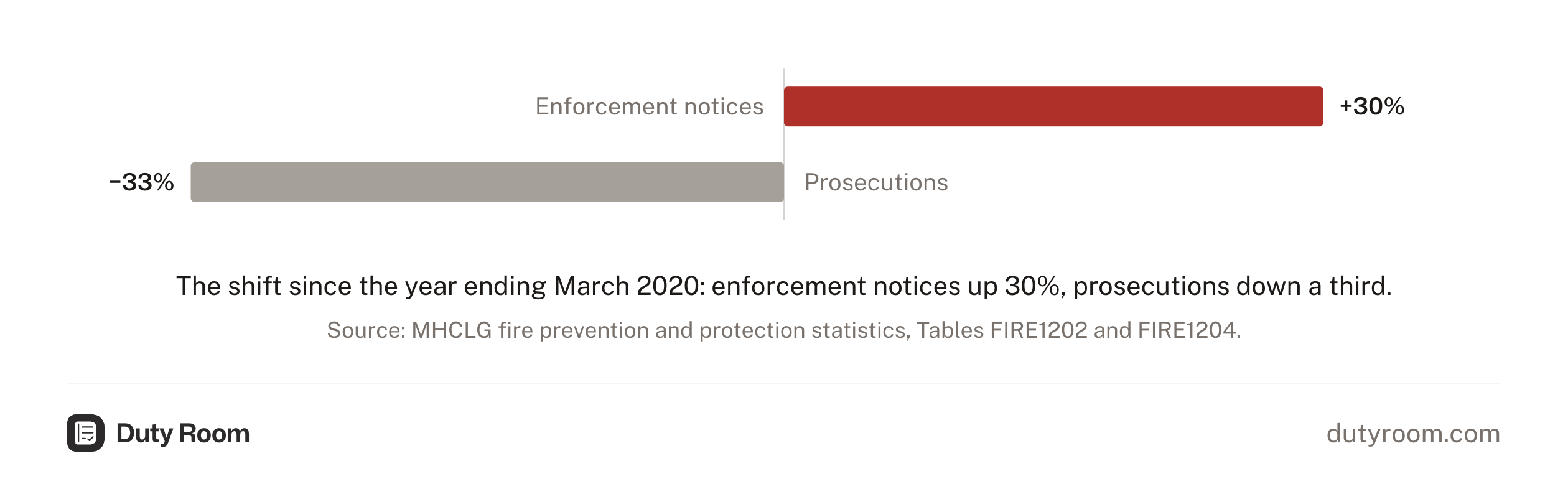
| Measure | YE March 2020 | YE March 2025 | Change |
|---|---|---|---|
| Enforcement notices | 1,347 | 1,745 | +30% |
| Prosecutions | 52 | 35 | −33% |
Individual case timelines reinforce the trend. The Mollington Banastre prosecution took more than five years from the initial audit in June 2018 to the conviction in November 2023. The Hind Hotel prosecution ran 18 months from the first enforcement notice to the £75,000 fine. Most operators fix the problem somewhere along that timeline.
That changes the risk picture for hospitality operators in a specific way. Fire and rescue services use formal notices far more often than prosecution, and the reviewed court outcomes repeatedly show notices, prohibitions, and earlier warnings in the history. Not every prosecution followed prior formal action, so a notice is not a prerequisite. But if you have received one, treat it as a documented opportunity to put the premises right before the case can move further.
About this dataset
This report covers 34 completed cases under the Fire Safety Order. Each involved a hotel, pub, restaurant, or other business open to customers in England or Wales. Courts passed sentence between October 2021 and July 2026.
We found the cases in fire and rescue service and council reports. We searched public registers, local news, and the fire-safety press. We included buildings with both a business and sleeping rooms. The two parts had to share fire precautions or an escape route.
We left out repeat entries and cases in which the court had not yet passed sentence. We also left out cases when we could not confirm the type of place or the result. Each case needed a reliable source. This report does not cover care homes, private housing, student housing, or industrial sites.
The list is not complete or random. There is no central public list of Fire Safety Order sentences. Some fire services and councils publish more cases than others. The counts and percentages apply only to these 34 cases.
The Ministry of Justice figures are separate. They count each recorded fine, not each person, business, or full case4.
After an enforcement notice
If you receive an enforcement notice, follow it and meet its deadlines. Our failed inspection briefing explains the first steps. The enforcement ladder shows how a case can move from inspection to court.
-
Duty Room analysis of 34 completed FSO prosecution outcomes at hospitality and customer-facing commercial premises in England and Wales, sentenced between October 2021 and July 2026 and source-audited on 28 July 2026. In 17, the published record documents an unfinished or breached formal notice or action plan, or ignored statutory information requests; eight resulted in custody, all suspended. This is a non-exhaustive published-case sample, not a national prevalence estimate.
-
MHCLG, Fire prevention and protection statistics, England, year ending March 2025, Tables FIRE1202 and FIRE1204. Figures follow the current workbooks; the release narrative differs slightly on totals.
-
Duty Room analysed 4,503 enforcement notices citing Fire Safety Order articles in the NFCC National Enforcement Register snapshot taken on 13 March 2026 (notices issued 2010 to 2026). The median notice cites six articles of the Fire Safety Order, and 519 notices (11.5%) cite only one. Across licensed premises and hotels, Article 14 is the article cited most often.
-
Ministry of Justice Court Proceedings Database (December 2025 release), 2023 to 2025, England and Wales. Counts are fine outcomes on a principal-offence and principal-disposal basis, not distinct defendants or complete case totals, and cover every premises type. The report uses the source's "02: Companies, public bodies, etc." and "01: Person" categories; nine "03: Not known" fine outcomes are excluded from both. Fine element only; total financial penalties including prosecution costs are typically higher.
-
Prosecution cost-to-fine ratios calculated from the 19 reviewed outcomes with exact, separable positive fine and prosecution-cost components. Costs ranged from 5.6% of the fine (Hind Hotel: £4,200 / £75,000) to 10.5 times the fine (Tops Pizza: £15,400 / £1,466). Five further outcomes imposed no fine but did award prosecution costs; one source did not state the cost amount.
This report is based on published enforcement data, sources available at publication, and original analysis. It is for general information only and doesn't constitute legal advice.
Advice from your assessor, action from your sites.
Main Fire Safety Order offences carry unlimited fines, and organisation fine outcomes averaged £50,570. Duty Room keeps FRA actions, alarm tests, and fire door checks current per site.