You Now Have A Deadline
What to Do After a Failed Fire Safety Inspection
This guidance covers England and Wales. Scotland and Northern Ireland have similar but separate fire safety legislation.
A failed fire safety inspection triggers a statutory process under the Fire Safety Order. The notice type received, and how quickly the responsible person engages, determines whether it resolves within the notice period or escalates toward prosecution.
The "responsible person" under the Fire Safety Order is legally the employer or whoever controls the premises. In leased and multi-occupancy buildings, duties are often shared between landlord and tenant, depending on the lease and who controls which parts of the building. There is no automatic landlord/tenant split. Directors face personal criminal liability under the Order. For community-owned venues, the management committee or trustees hold responsibility collectively.
After an audit under the Regulatory Reform (Fire Safety) Order 2005, the fire and rescue authority can take several actions:
- Notification of Deficiencies. A non-statutory letter identifying failures and the timeframe for correction.
- Enforcement Notice. Statutory: it specifies failures the responsible person must remedy within a set period (minimum 28 days), and non-compliance is a criminal offence.
- Prohibition Notice. Issued where the authority finds a serious risk to people; where the notice states the risk is imminent, it can restrict or close the premises immediately.
- Alteration Notice. Requires the responsible person to notify the fire authority before making specified changes.
An Enforcement Notice permits continued operation while remediation work is carried out. Only a Prohibition Notice restricts use of the premises. The FSO allows 21 days to appeal an Enforcement Notice to the Magistrates' Court. Appealing a Prohibition Notice does not lift the restriction while the appeal runs, unless the court specifically directs it.
The typical enforcement notice lists six separate breaches of the Fire Safety Order1. A missing fire risk assessment rarely appears alone; it usually arrives bundled with physical failures like blocked escape routes and faulty detection.
The enforcement sequence. Fire authority enforcement typically moves through a recognisable sequence: written notification of deficiencies, then an enforcement notice, then a prohibition notice where risk demands it, with prosecution available at the authority's discretion. Under Article 32 FSO, failure to comply with an enforcement notice is a criminal offence.
| Stage | Notice type | Typical timescale | Consequence of non-engagement |
|---|---|---|---|
| 1 | Notification of deficiencies | No statutory deadline set | May lead to a formal notice |
| 2 | Enforcement notice | Minimum 28-day compliance period; 21-day appeal window | Criminal offence; roughly 1 in 13 go uncomplied |
| 3 | Prohibition notice | Immediate effect where the notice declares imminent risk; median 74-day resolution | Operational restriction; prosecution |
An Alteration Notice sits outside this sequence: it doesn't demand remediation, it requires the fire authority to be told before specified changes are made to higher-risk premises.
The first 48 hours after an enforcement notice
The Fire Safety Order requires the responsible person to remedy each identified breach within the notice period. How quickly remediation starts shows up later: the prosecution case reports describe accumulated, unaddressed failures over months or years, not single missed deadlines.
On licensed premises and hotel notices, escape routes are the most-cited article1, with detection and firefighting equipment and maintenance close behind. The physical reality behind those citations (wedged-open fire doors, blocked exits, untested emergency lighting) is also among the cheapest to fix. Dated photographs before and after the work aren't required by anyone, but they date-stamp the moment remediation began and answer questions before they're asked.
What this changes for operations. Starting immediately matters because the compliance clock is short. Twenty-eight days is the statutory minimum, and the zero-cost deficiencies can be corrected and photographed on day one.
What the compliance period requires
The Regulators' Code requires fire authorities to act proportionately. A written response acknowledging each finding, with a timetable for remediation and named owners for each item, starts the paper trail that distinguishes engaged operators from the ones who end up in the prosecution reports.
Where practical constraints affect the timetable (listed building consent, committee budget approval, contractor availability), fire authorities can agree revised deadlines where the responsible person shows a credible plan.
Check your insurance position at the same time. Policies vary in what fire safety records they expect you to hold, and the gap surfaces at claim time. The insurance claim denial briefing covers how insurers use these records.
Cost framing. A prohibition notice closure costs the full trading revenue for the median 74-day resolution period, plus remediation, plus any legal costs1. Set whatever an assessor or contractor quotes against that number.
What the systemic record shows
Fire risk assessment. The FSO requires a suitable and sufficient fire risk assessment (Article 9), and guidance expects whoever carries it out to be competent. Third-party certification schemes like BAFE SP205 provide a route to finding registered assessors, though the scheme is voluntary, not a legal requirement.
Fire logbook. Drills and staff training are statutory duties under the FSO (Articles 15 and 21); the expectation to keep records of testing, maintenance, drills, and training comes from the supporting guidance. A logbook is the standard means of evidencing ongoing compliance at re-inspection.
Staff training. Article 21 of the FSO requires the responsible person to provide adequate safety training to employees. Where audit evidence shows staff couldn't demonstrate basic fire procedures, enforcement officers record that as a breach.
Fire drills. The FSO requires drills where the risk assessment calls for them, and guidance says to record the results. The date, who took part, and the evacuation time are what make the record useful at re-inspection.
For multi-site operators, each premises requires its own assessment, logbook, and training records under the FSO.
At re-inspection, the authority examines the premises and the records: the original notice, written correspondence, the current fire risk assessment, training records, and logbook entries. For what the audit itself covers, see the fire safety inspection briefing.
Sleeping accommodation and listed buildings
Hotels, B&Bs, holiday lets, care homes, caravan parks, pubs with guest rooms, and premises with flats above all face significantly higher requirements under the FSO. Common measures cited in notices for these premises include interlinked detection, protected escape routes, and fire-rated separation between sleeping and commercial areas.
Where guests or residents may need help evacuating, notices focus on evacuation planning: personal emergency evacuation plans and staged evacuation procedures.
Listed buildings carry an additional dimension. Fire safety guidance for historic buildings recognises that alternative measures (upgraded detection, management procedures) may be accepted in place of physical alterations to protected fabric. Structural changes require listed building consent; fire authority and local planning authority agreement is needed where the two requirements interact.
Follow-up and escalation
The fire authority will typically revisit around the deadline date. Responsible persons who complete remediation early can request an earlier re-inspection. At that inspection, the authority looks for evidence that each finding has been addressed and that ongoing compliance systems are in place.
A compliance programme that visibly started at the beginning of the notice period reads very differently from a scramble in the final week.
Temporal anchors. The enforcement notice specifies a compliance deadline (minimum 28 days from service). The 21-day appeal window runs from the date of service for both notice types; a prohibition notice's restriction stays in force during an appeal unless the court directs otherwise.
Timelines differ by notice type. Premises that receive a Prohibition Notice resolve it in a median of 74 days. Enforcement Notices take roughly twice as long: 150 days at the median1. No prohibition notice in the NFCC register is recorded as uncomplied. Enforcement Notices are a different story: roughly 1 in 13 go uncomplied1.
One in six premises that appear on the NFCC enforcement register receive a second notice1. The register is public, and notices stay visible for about three years, longer if they remain in force or uncomplied.
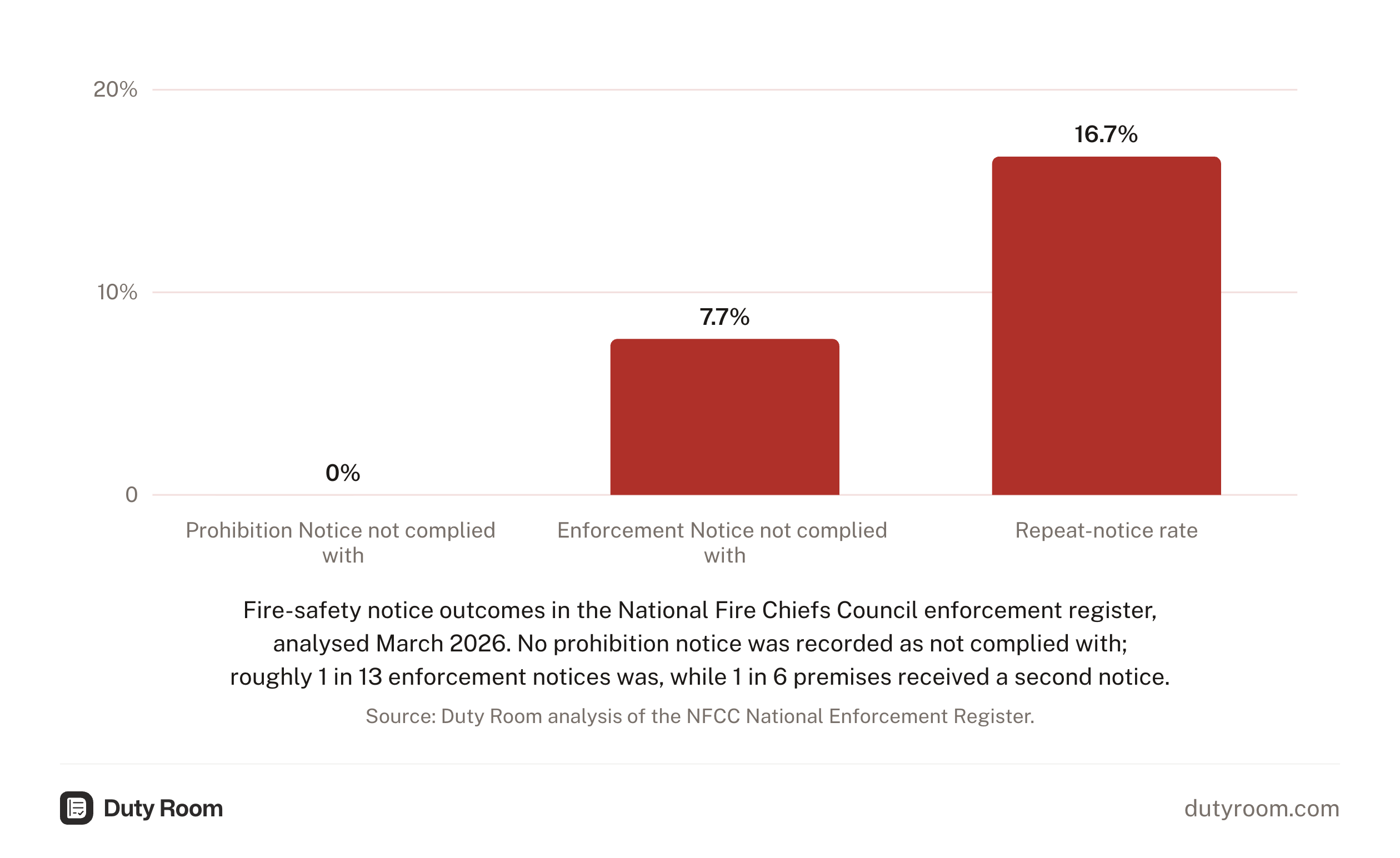
| Rate | Share | As stated in the register analysis |
|---|---|---|
| Prohibition Notice not complied with | 0% | None recorded |
| Enforcement Notice not complied with | ~7.7% | Roughly 1 in 13 |
| Repeat-notice rate | ~16.7% | One in six premises |
What non-remediation looks like in the record. FSO prosecutions follow a recognisable pattern. The case reports describe notice periods that elapsed without engagement, re-inspections that found nothing addressed, and, in the higher-fine cases, earlier deficiency letters that had also gone unanswered. The common thread is silence and inaction, not the severity of the original breach.
Where a notice goes uncomplied, the authority can prosecute. Prosecution under the Fire Safety Order carries unlimited fines and up to two years' imprisonment. The fine typically lands around £25,000 for an organisation, and the worst cases run into six figures2. Prosecution costs can exceed the fine. In one reviewed case, they were more than ten times it3.
Engage in writing on day one, photograph the fixes, and request re-inspection as soon as the work is done. Everything after that gets more expensive.
-
Duty Room analysis of 9,429 notice-level entries (enforcement, prohibition, and alterations notices) on the NFCC National Enforcement Register, extracted March 2026. Statistics specific to one notice type use that type's subset (4,503 enforcement notices for article and compliance counts).
-
Duty Room analysis of Ministry of Justice Court Proceedings Database records (England and Wales, December 2025 release): across 35 organisation fine outcomes (the source's "02: Companies, public bodies, etc." category) under the Regulatory Reform (Fire Safety) Order 2005, January 2023 to December 2025, the median fine was £25,000 and the mean £50,570.
-
Duty Room analysis of 34 completed Fire Safety Order prosecution outcomes at hospitality and customer-facing commercial premises in England and Wales, sentenced from October 2021 to July 2026. Nineteen report exact, separate positive fine and prosecution-cost amounts. Costs ranged from 5.6% of the fine to 10.5 times it; five more outcomes imposed no fine but awarded costs. This is not a complete or random sample.
This briefing is based on sources available at publication and is for general information only. It doesn't constitute legal advice. For advice on your specific situation, consult a qualified professional.
Track remedial actions and build the evidence file
Duty Room schedules follow-up checks, logs fixes with photos and dates, and builds the evidence file for re-inspection.