Every Rung Leaves a Record
The Fire Safety Enforcement Ladder: 51,026 Audits, 2,955 Notices, 35 Prosecutions
This guidance covers England and Wales. Scotland and Northern Ireland have similar but separate fire safety legislation.
Fire officers don't arrive with a fixed penalty in mind. They arrive with a toolbox. The Regulatory Reform (Fire Safety) Order 2005 gives them a range of actions, from a quiet word to a criminal prosecution, and the Regulators' Code points them to the lightest tool that will fix the problem. Which rung an officer starts on depends on what they find, how dangerous it is, and whether you've been told before.
In 2024/25, English fire and rescue services issued 2,955 formal notices and brought only 35 prosecutions out of 51,026 audits. Most enforcement stays at the lower rungs. But the distance between a friendly conversation and a court appearance is shorter than operators assume.
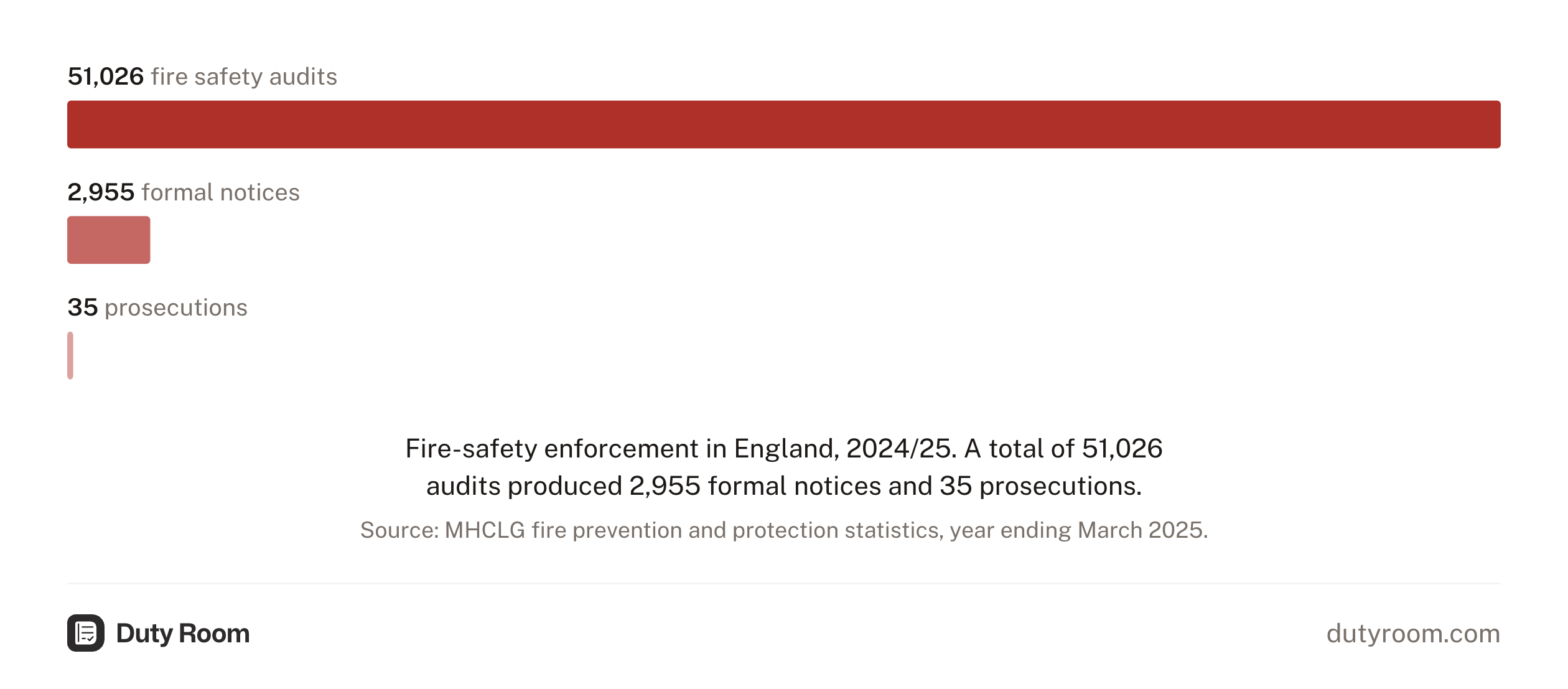
| Stage | Count |
|---|---|
| Fire safety audits | 51,026 |
| Formal notices | 2,955 |
| Prosecutions | 35 |
Informal advice and Notification of Deficiencies
The officer points out problems verbally or follows up with a non-statutory letter listing deficiencies and deadlines. No formal legal power is being exercised. You won't appear on any register.
That doesn't mean it's optional. Ignoring a non-statutory notice isn't a separate offence, but it becomes evidence. If the fire authority returns and finds nothing has changed, they escalate, and the original letter shows prior warning. Officers document informal advice on file. It is the cheapest rung of the ladder and the point at which escalation costs the least to avoid.
Enforcement Notice (Article 30)
A statutory notice. The officer has found failures and is giving you a deadline to fix them, minimum twenty-eight days. You can keep operating while you do the work.
The typical enforcement notice cites six separate articles of the Fire Safety Order at once1. Only 11.5% cite a single article1. By the time the officer writes up the fire risk assessment, they've already found blocked exits, missing alarms, and fire doors that don't close. The problems arrive as a bundle.
You have twenty-one days to appeal to the Magistrates' Court. Failing to comply is a criminal offence. Enforcement notices take a median of 150 days to reach compliance, and roughly 1 in 13 go uncomplied1. Those are the ones that escalate.
Prohibition Notice (Article 31)
Issued when the officer believes there is a serious risk of death or serious injury. A prohibition notice restricts or shuts down use of the premises, and it can take effect immediately.
In West Midlands and Tyne and Wear, 77-83% of formal actions are prohibition notices. In West Yorkshire, that figure is closer to 24%1. The variation is local enforcement culture, not different legislation: some fire authorities treat prohibition as the default response to serious failings, while others reserve it for the worst cases. You won't know your local authority's approach until you're on the receiving end.
An appeal does not suspend the restriction. The premises stays closed, or partly closed, until the notice is lifted. Compliance takes a median of 74 days1. Prohibition appeals are specialist regulatory litigation.
Alteration Notice (Article 29)
Less common but worth understanding. An alteration notice doesn't require you to fix anything today. It requires you to notify the fire authority before making certain changes to your premises, the services and fittings inside them, the dangerous substances you store, or what the building is used for. If the officer thinks your building is borderline safe and could tip into danger with the wrong change, this is the tool they use.
Prosecution
Criminal proceedings under Article 32 of the Fire Safety Order. Fines are unlimited. Individuals face up to two years' imprisonment.
Prosecution is rare. Fewer than 2% of formal enforcement actions end up in court2. But when it happens, the numbers land. The fine for a business typically lands around £25,000, and the worst cases run into six figures3. Prosecution costs can exceed the fine. In one reviewed case, they were more than ten times it4.
The cases that reach court follow a pattern. A Huddersfield bar company was fined £160,000 in 2025 after failing to comply with an enforcement notice: blocked exits, no kitchen fire detection, no separation between the fryer and the bar area. West Yorkshire Fire and Rescue Service said the company had submitted an appeal when it announced the fine. A Kent pub paid £46,405 in 2024 after five charges including no fire risk assessment, no alarms, and no emergency lighting. A Chester hotel director was ordered to pay £67,000 after prosecution took more than five years from the first audit. In the Chester and Huddersfield cases, the officer started lower on the ladder, and prosecution followed because the problems weren't fixed.
The public record
Formal notices (enforcement, prohibition, and alteration) are placed on a public register, in most areas the NFCC National Enforcement Register, a public database with over 9,400 entries1. Entries remain visible for roughly three years, longer if the notice is still in force or uncomplied. Licensed premises account for 1,334 entries; hotels for 5771. Your competitors, insurers, and local authority licensing team can search it.
One in six premises on the register receives a second notice1. The register doesn't record informal action or satisfactory audits. It records the premises where things went wrong and stayed wrong long enough for statutory action.
How you respond to the first rung determines whether you see the next one. For what the audit itself involves, see our fire safety inspection briefing. If you've already received a notice, see our briefing on responding to a failed inspection.
-
Duty Room analysis of 9,429 notice entries on the NFCC National Enforcement Register, extracted March 2026. Article citation counts and co-occurrence derive from the 4,503 enforcement notices recording article-level data; compliance timelines, repeat-notice rates, and FRS-level variation from structured fields on the register.
-
MHCLG, Fire prevention and protection statistics: England, year ending March 2025. 35 prosecutions (FIRE1204 data table) against 2,955 formal notices (1,745 enforcement, 959 prohibition, 251 alteration).
-
Duty Room analysis of Ministry of Justice Court Proceedings Database records (England and Wales, December 2025 release): across 35 organisation fine outcomes (the source's "02: Companies, public bodies, etc." category) under the Regulatory Reform (Fire Safety) Order 2005, January 2023 to December 2025, the median fine was £25,000 and the mean £50,570. Fine element only; total financial penalties including prosecution costs are typically higher.
-
Duty Room analysis of 34 completed Fire Safety Order prosecution outcomes at hospitality and customer-facing commercial premises in England and Wales, sentenced from October 2021 to July 2026. Nineteen report exact, separate positive fine and prosecution-cost amounts. Costs ranged from 5.6% of the fine to 10.5 times it; five more outcomes imposed no fine but awarded costs. This is not a complete or random sample.
This briefing is based on sources available at publication and is for general information only. It doesn't constitute legal advice. For advice on your specific situation, consult a qualified professional.
Advice from your assessor, action from your sites.
Main Fire Safety Order offences carry unlimited fines, and organisation fine outcomes averaged £50,570. Duty Room keeps FRA actions, alarm tests, and fire door checks current per site.