The Walkthrough Starts Quiet
What Happens During a Fire Safety Inspection
This guidance covers England and Wales. Scotland and Northern Ireland have similar but separate fire safety legislation.
Fire safety audits do not go well for a large number of premises. In 2024/25, fire and rescue services in England completed 51,026 audits across all premises types and only 58% were found satisfactory, level with the previous year's fourteen-year low1. Hotels fare worse: 55% of hotel audits found unsatisfactory conditions1.
Fire and rescue services run risk-based audits. Notice periods vary, but a few weeks is typical. If someone has complained or your premises has been flagged on a risk register, officers may turn up unannounced. They carry authorisation under the Regulatory Reform (Fire Safety) Order 2005 and will show ID. Audit length depends on the size and complexity of the building. Shorter business safety checks, often carried out by operational crews, tend to be quicker. Notice dates on the national enforcement register suggest audit activity peaks in October and November and drops off in February, likely driven by winter fire risk campaigns and post-summer catch-up2.
The Fire Safety Order places legal responsibility on the "responsible person," usually the employer or whoever has control of the premises. In multi-occupancy buildings, fire safety duties are often shared depending on the lease, who controls what areas, and the layout. There is no automatic landlord/tenant split. Directors can face personal criminal liability. For community-owned venues, the management committee or trustees hold responsibility collectively.
The document check
The officer asks for documentation before walking the building. The following items form the core fire safety paperwork that should be available on the premises:
- Your fire risk assessment. This must be a full written document, not a mental note. Written assessments became a legal requirement in October 2023 under section 156 of the Building Safety Act 2022; the Section 156 briefing covers what the duty requires.
- Fire safety policy and emergency evacuation plan.
- Fire logbook.
- Fire drill records.
- Staff training records: who was trained, when, and what was covered.
- Weekly fire alarm test log.
- Monthly emergency lighting test log.
- Fire extinguisher service certificates.
- Fire alarm maintenance certificate (BS 5839 recommends six-monthly servicing; check your system requirements).
The following are relevant where the system or installation exists on your premises:
- Electrical installation condition report (where required by your insurer or risk assessment).
- Portable appliance testing records (expected where your risk assessment identifies it as a control measure, but not a blanket legal requirement).
- Gas safety certificate (where gas appliances are present).
- Kitchen extraction cleaning certificates (where commercial cooking takes place).
If an officer asks for a document and you cannot produce it, it will likely be noted. Producing paperwork after the fact is unlikely to change what was recorded on the day. Insurers read the same records at claim time. The insurance claim denial briefing covers how missing certificates defeat claims.
The physical walkthrough
After the paperwork, the officer walks the building, typically starting at the top floor and working down. This is where most findings come from. Across the 4,503 enforcement notices on the NFCC National Enforcement Register, escape routes and emergency exits are cited more often than the fire risk assessment2. The physical state of the building drives enforcement, not the paperwork.
Fire doors attract close attention. Officers check whether they self-close properly, whether any have been wedged open, and whether the intumescent seals around the edges are intact. Damaged or missing seals are a frequent finding.
Escape routes must be clear and unobstructed. No stock in corridors, no locked fire exits. The fire alarm panel should show no faults and the zone plan should be current. Emergency lighting gets tested. Extinguishers are checked for the right types and current service tags.
In the kitchen, extraction and suppression systems face scrutiny: cleaning certificates, maintenance records, and whether staff know how to activate suppression equipment. Outside, bin storage should be away from the building to reduce arson risk.
Compartmentation gets close attention if your building has multiple uses or accommodation above. These are the fire-rated walls, floors, and doors that prevent fire spreading between different parts of a building.
Premises-specific requirements
Sleeping accommodation. Hotels, B&Bs, pubs with guest rooms, holiday lets, care homes, and caravan parks all attract higher expectations. The specifics depend on the fire risk assessment for the individual premises, but common measures include interlinked detection, protected escape routes, and fire separation between sleeping and commercial areas. Premises with vulnerable or non-ambulant occupants may also need personal emergency evacuation plans. The risk assessment should drive the detail, not a generic checklist.
Commercial kitchens. Extraction ducting and suppression systems face scrutiny, including cleaning certificates and whether staff can activate suppression.
Late-night venues and basements. Expect questions about capacity management, alternative escape routes, and emergency lighting adequacy.
Events venues. Officers want documented evacuation plans specific to each event type and capacity. A single generic plan is unlikely to satisfy.
If any of these apply, your fire risk assessment needs to address the additional requirements. You may need a specialist assessor. Each premises needs its own fire risk assessment, logbook, and training records.
Staff interviews
Officers often pull aside individual staff and ask questions. Common ones: what would you do if you discovered a fire, where are the fire exits, when were you last trained, and who is the fire warden on duty. Kitchen staff tend to get additional questions about suppression systems and which extinguisher to use on a cooking oil fire.
Staff who cannot answer are a significant concern. It suggests that training records may not reflect what is actually happening. Findings about training and procedures attach to the responsible person.
Possible outcomes
The outcomes below sit on an escalating ladder. The enforcement ladder briefing maps the full progression from informal advice to prosecution.
Satisfactory. No issues, no further action.
Informal advice. Minor issues pointed out verbally.
Notification of Deficiencies. A non-statutory letter listing what needs fixing, with actions and deadlines.
Alteration Notice. Requires you to notify the fire authority before making specified changes to the premises.
Enforcement Notice. A statutory notice requiring changes within a set period (minimum twenty-eight days). Appealable. The typical enforcement notice cites six separate failures at once2. Only 11.5% cite a single article of the Fire Safety Order. By the time an inspector writes up the fire risk assessment, they've already found blocked exits, missing alarms, and unmaintained fire doors. The problems come as a bundle. For what to do after receiving one, see the failed fire safety inspection briefing.
Prohibition Notice. Issued when the authority decides the risk of serious injury is high enough that use of the premises must be restricted. Takes effect immediately where the notice states the risk is imminent. Some fire authorities skip straight to prohibition in the majority of cases. In West Midlands and Tyne and Wear, 77-83% of formal actions are prohibition notices; in West Yorkshire, it's closer to 24%2. The legislation is the same everywhere; which fire service covers your premises changes the formal action you are likely to receive.
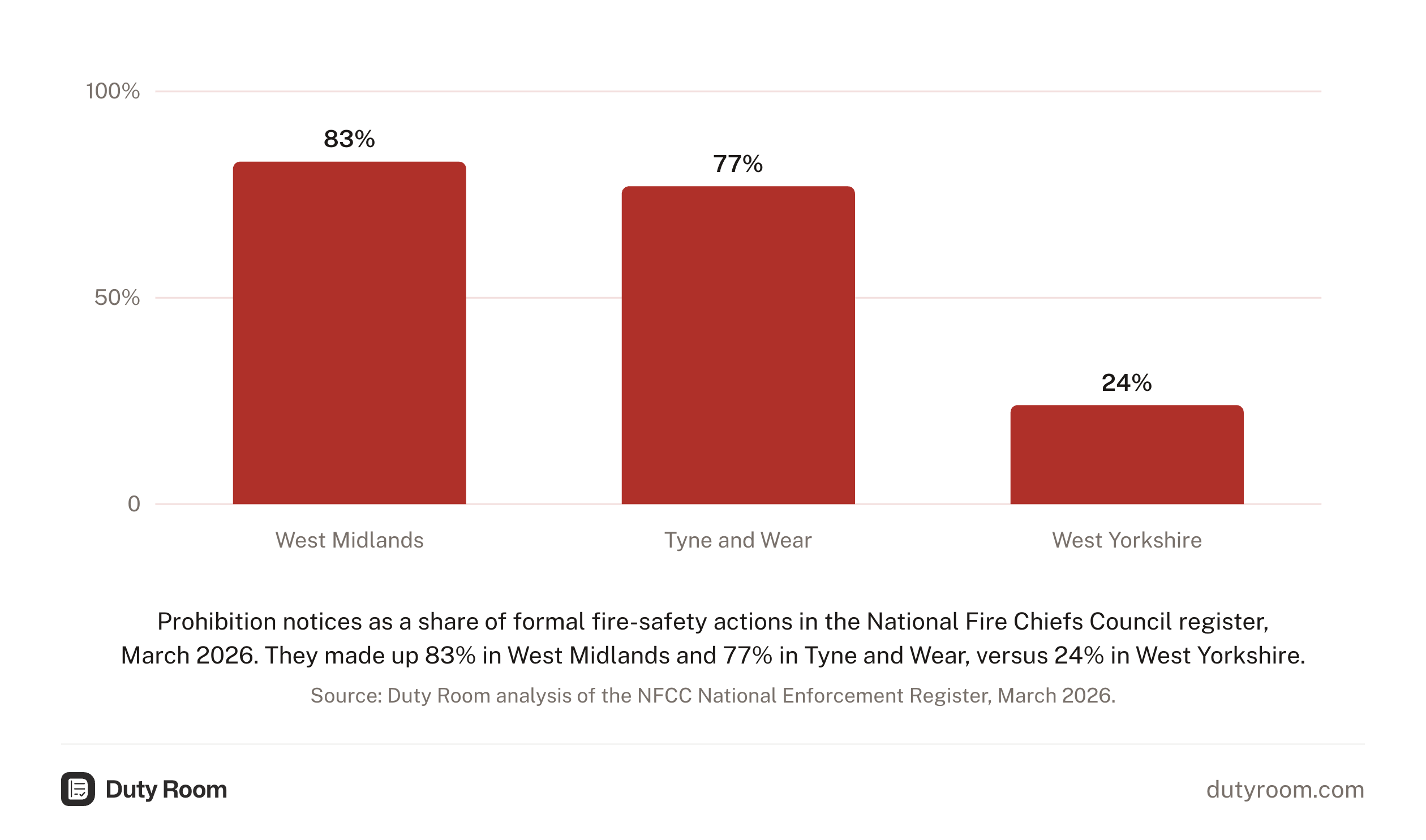
| Fire and rescue service | Prohibition notice share |
|---|---|
| West Midlands | 83% |
| Tyne and Wear | 77% |
| West Yorkshire | 24% |
- Prosecution. Fines are unlimited. Custodial sentences of up to two years are possible. Prosecution is rare: 35 cases out of 51,026 audits in 2024/251. But when it happens, the fine typically lands around £25,000 for an organisation, and the worst cases run into six figures3. Prosecution costs can exceed the fine. In one reviewed case, they were more than ten times it4. The fire safety prosecution cases report groups 34 recent cases by failure pattern.
What passes audit
The 58% satisfactory rate and the 55% hotel failure rate are not driven by random misfortune. The premises that pass share a consistent pattern:
- A current written fire risk assessment produced by a competent assessor (the BAFE SP205 scheme is one voluntary certification route), with the findings acted on
- Fire doors that close fully
- Escape routes that are clear
- Staff who can answer the common questions above
- The documents on the list above available on-site and current
The failures cluster just as consistently: assessments that had not been reviewed for years, fire doors wedged open for operational convenience, escape routes repurposed for storage, and records held off-site that could not be produced on the day.
-
MHCLG, Fire prevention and protection statistics: England, year ending March 2025. Tables FIRE1202, FIRE1204. Figures follow the published workbooks; the release narrative differs slightly on totals.
-
Duty Room analysis of the NFCC National Enforcement Register, extracted March 2026: 9,429 notice-level entries of all types, of which 4,503 are enforcement notices. Article citation counts and co-occurrence are derived from the enforcement-notice subset; seasonality and FRS-level variation from all formal actions on the register.
-
Duty Room analysis of Ministry of Justice Court Proceedings Database records (England and Wales, December 2025 release): across 35 organisation fine outcomes (the source's "02: Companies, public bodies, etc." category) under the Regulatory Reform (Fire Safety) Order 2005, January 2023 to December 2025, the median fine was £25,000 and the mean £50,570.
-
Duty Room analysis of 34 completed Fire Safety Order prosecution outcomes at hospitality and customer-facing commercial premises in England and Wales, sentenced from October 2021 to July 2026. Nineteen report exact, separate positive fine and prosecution-cost amounts. Costs ranged from 5.6% of the fine to 10.5 times it; five more outcomes imposed no fine but awarded costs. This is not a complete or random sample.
This briefing is based on sources available at publication and is for general information only. It doesn't constitute legal advice. For advice on your specific situation, consult a qualified professional.
Advice from your assessor, action from your sites.
Main Fire Safety Order offences carry unlimited fines, and organisation fine outcomes averaged £50,570. Duty Room keeps FRA actions, alarm tests, and fire door checks current per site.