Chain operators leave a trail
Florida Multi-Site Operator Compliance Scorecard
Walt Disney Parks and Resorts operates 164 food-service locations in Florida. Across nearly a full fiscal year of health inspections to mid-June 2026, DBPR inspectors recorded six High Priority violations in 230 visits to those locations, and 99% of the visits ended with no further action. East Coast Waffles Inc., a wholly owned Waffle House subsidiary operating 95 Florida locations, recorded 263 High Priority violations in 239 visits and passed clean on 59% of them. Both operators are subject to the same DBPR violation codes and the same enforcement consequences. The gap between them is a compliance management gap, not a regulatory one.
This report scores 30 of Florida's largest multi-site food-service operators on three metrics drawn from DBPR's July 2025 to June 2026 inspection extract: High Priority violations per inspection, clean inspection rate, and formal enforcement exposure. It covers operators with ten or more Florida locations and enough inspection history to produce meaningful rates. The underlying data is 137,862 food-service inspections (routine, complaint, and licensing) from DBPR's seven district extract files, joined against establishment records for 65,893 active licenses.1
The leaderboard: full rankings
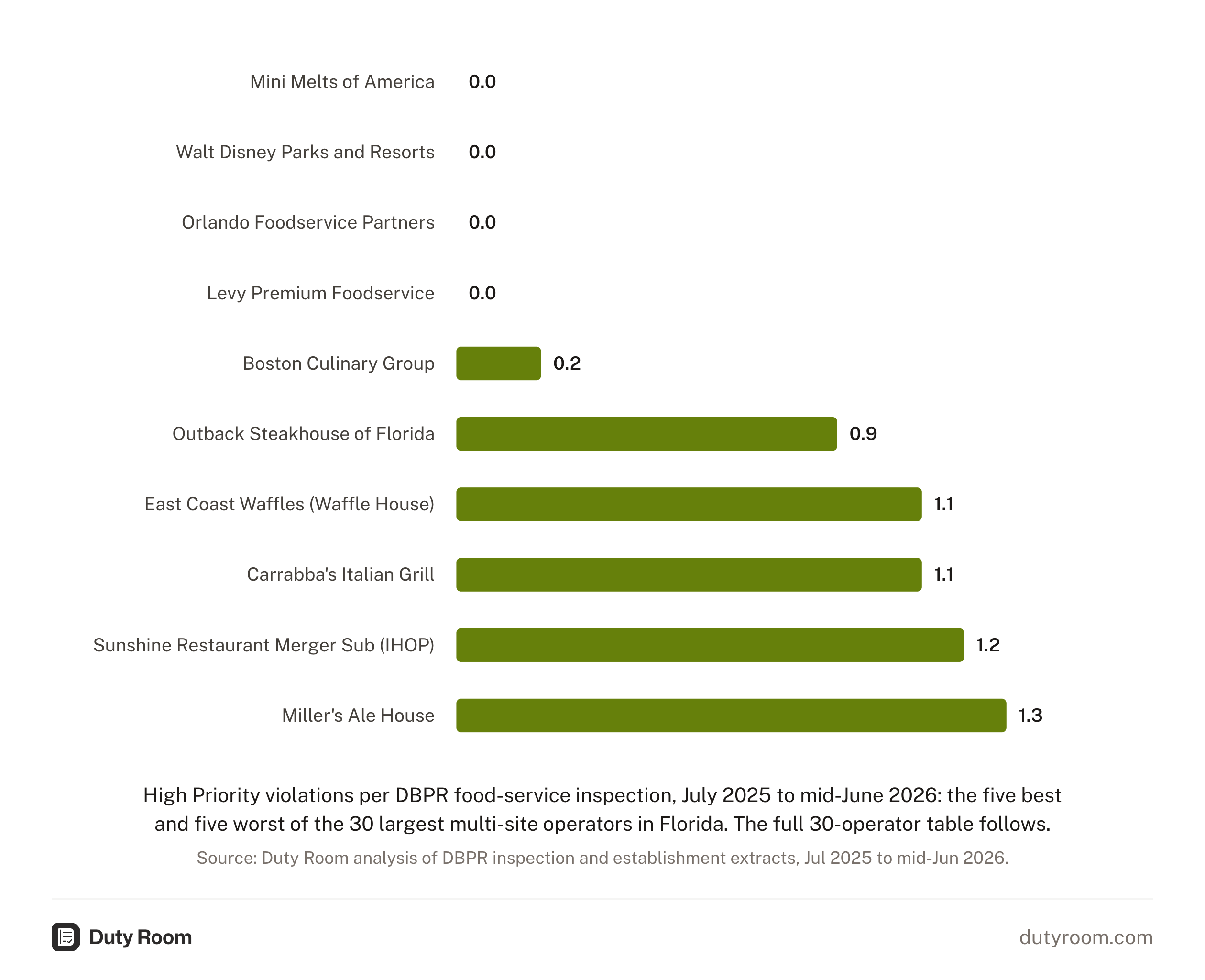
The table ranks the restaurant chains and food-service operators by High Priority violations per inspection, best to worst. DBPR's High Priority category covers the violations most directly tied to foodborne illness: temperature control, raw food separation, handwashing access, food source approval, pest presence, toxic storage.
| Operator | Sites | Inspections | HP viol/insp | Clean rate | Admin complaints recommended | Emergency orders |
|---|---|---|---|---|---|---|
| Mini Melts of America | 145 | 149 | 0.0 | 100% | 0 | 0 |
| Walt Disney Parks and Resorts | 164 | 230 | 0.0 | 99% | 0 | 0 |
| Orlando Foodservice Partners | 67 | 68 | 0.0 | 100% | 0 | 0 |
| Levy Premium Foodservice | 170 | 183 | 0.0 | 100% | 0 | 0 |
| Boston Culinary Group | 78 | 144 | 0.2 | 99% | 0 | 0 |
| Checkmate Pizza (Domino's) | 79 | 109 | 0.2 | 72% | 2 | 0 |
| Hut Florida (Pizza Hut) | 143 | 165 | 0.2 | 91% | 2 | 0 |
| CFL Pizza (Pizza Hut) | 85 | 128 | 0.2 | 86% | 2 | 0 |
| Sizzling Caesars (Little Caesars) | 64 | 97 | 0.3 | 57% | 2 | 1 |
| Taco Bell of America | 159 | 371 | 0.3 | 92% | 8 | 1 |
| BravoTampa (Burger King) | 66 | 88 | 0.4 | 93% | 2 | 0 |
| Wendy's Properties | 110 | 252 | 0.5 | 77% | 2 | 1 |
| Adiser Orlando (Burger King) | 88 | 137 | 0.5 | 67% | 3 | 2 |
| Chipotle Mexican Grill of Colorado | 303 | 759 | 0.5 | 80% | 27 | 3 |
| Legends Hospitality | 109 | 93 | 0.5 | 92% | 1 | 0 |
| Pollo Operations (Pollo Tropical) | 116 | 269 | 0.6 | 93% | 6 | 0 |
| Panera | 70 | 157 | 0.6 | 76% | 9 | 1 |
| McDonald's Restaurants of Florida | 63 | 97 | 0.6 | 69% | 2 | 0 |
| Florida SE (Olive Garden) | 64 | 152 | 0.6 | 79% | 5 | 0 |
| Brinker Florida (Chili's) | 104 | 233 | 0.6 | 90% | 5 | 0 |
| Sailormen (Popeyes) | 101 | 283 | 0.6 | 68% | 16 | 5 |
| Panda Express | 115 | 199 | 0.6 | 72% | 10 | 0 |
| Waffle House Inc. (parent) | 96 | 248 | 0.7 | 61% | 13 | 0 |
| First Watch Restaurants | 143 | 314 | 0.8 | 75% | 13 | 1 |
| HZ Coffee Group (Dunkin') | 82 | 133 | 0.8 | 54% | 13 | 2 |
| Outback Steakhouse of Florida | 97 | 255 | 0.9 | 62% | 12 | 5 |
| East Coast Waffles (Waffle House subsidiary) | 95 | 239 | 1.1 | 59% | 15 | 0 |
| Carrabba's Italian Grill | 66 | 181 | 1.1 | 52% | 17 | 1 |
| Sunshine Restaurant Merger Sub (IHOP) | 126 | 339 | 1.2 | 60% | 23 | 4 |
| Miller's Ale House | 69 | 207 | 1.3 | 42% | 21 | 0 |
| Waffle House Inc. + East Coast Waffles (combined) | 191 | 487 | 0.9 | 60% | 28 | 0 |
The table includes a combined Waffle House row because the brand operates through two separate legal entities in Florida, one a wholly owned subsidiary of the other. Their records get their own section below.
Disney and the venue operators
Disney's score is not a statistical accident. Its 164 Florida food-service locations include quick-service restaurants, table-service restaurants, food carts, and stadium-style concessions across Walt Disney World's parks, hotels, and resorts. The range of venue types should produce a wide violation profile. It doesn't: 228 of 230 inspections ended with no further action, and inspectors recorded six High Priority violations at the entire fleet all year.
One plausible explanation is scale economics: compliance infrastructure, training, and supplier controls carry roughly the same fixed cost whether they cover 50 locations or 164, so the per-site cost drops while the per-site standard rises.
Disney has company at the top, and it is nearly all from the same corner of the industry. Levy Premium Foodservice, which runs concession stands and premium dining across Florida's stadiums and arenas, drew six HP violations across 183 inspections of its 170 sites and passed every one clean. Boston Culinary Group, another venue concessionaire, ran 0.2 HP violations per inspection at a 99% clean rate. Orlando Foodservice Partners, which operates 67 concession stands at Orlando's arena and stadium venues, passed every one of its 68 inspections clean. Mini Melts, whose 145 locations are ice-cream vending kiosks, drew three HP violations all year. Part of that is risk surface: a beer stand or an ice-cream kiosk gives an inspector less to find than a full kitchen, and event venues see fewer visits per site, as the Sites and Inspections columns above show. But Disney's fleet includes full table-service kitchens, and the venue pattern has an exception that argues against a purely structural explanation.
The exception is Jacksonville Sportservice, which runs the food service at Jacksonville's stadium venues. It falls below this table's size cut at 49 locations, but scored on the same method it recorded 1.25 HP violations per inspection, a rate only one operator in the table exceeds, and every one of its eight non-clean inspections went straight to an administrative complaint recommendation. Levy, Boston Culinary, and Orlando Foodservice Partners, its concession-industry peers, hold three of the top five positions on the leaderboard. The venue type doesn't set the outcome.
The Waffle House record
East Coast Waffles Inc. operates 95 Waffle House locations in Florida under its own DBPR licenses. It is not an independent franchise group: a 2024 federal court order records that East Coast Waffles is a wholly owned subsidiary of Waffle House Inc., and corporate registry filings list its officers at Waffle House's Norcross, Georgia headquarters.2 The same corporate group, through two legal entities, holds two separate Florida enforcement records.
Neither record is good. The parent entity, with 96 Florida locations of its own, ran 0.7 HP violations per inspection and a 61% clean rate. The subsidiary ran 1.1 and 59%. Between them, the brand's 191 Florida locations drew 448 High Priority violations across 487 inspections and 28 administrative complaint recommendations, though no location was closed by emergency order. A complaint recommendation is the inspector referring the location for formal enforcement, not a warning. A filed complaint can end in a fine, and a record of three disciplinary final orders within two inspection cycles moves a location to Risk Level 3, which means three inspections per year instead of two.
The subsidiary's HP rate runs about half as high again as the parent's, on nearly identical inspection counts, so the two entities are not interchangeable. But the sharper fact is where both sit: in the bottom third of the table, alongside each other. Shared ownership produced two versions of the same problem, and DBPR's records let you see each one separately, because enforcement records belong to legal entities, not brands.
Sunshine Restaurant Merger Sub: the invisible brand
Most people outside the industry don't know the name Sunshine Restaurant Merger Sub LLC.
It operates 126 Florida food-service locations. In this data it shows 23 administrative complaint recommendations, four emergency closures, a 60% clean rate, and 1.2 High Priority violations per inspection, the second-worst rate in the table. The name belongs to the company behind a large share of Florida's IHOP restaurants, operating them as a franchisee.
An emergency order is DBPR's most serious finding: conditions bad enough that the location cannot keep serving that day. Emergency orders mean immediate closure. Four of them in a year, on top of 23 complaint recommendations, is a portfolio generating formal enforcement at a pace the brand name never shows.
Emergency closures are not rare at chain scale
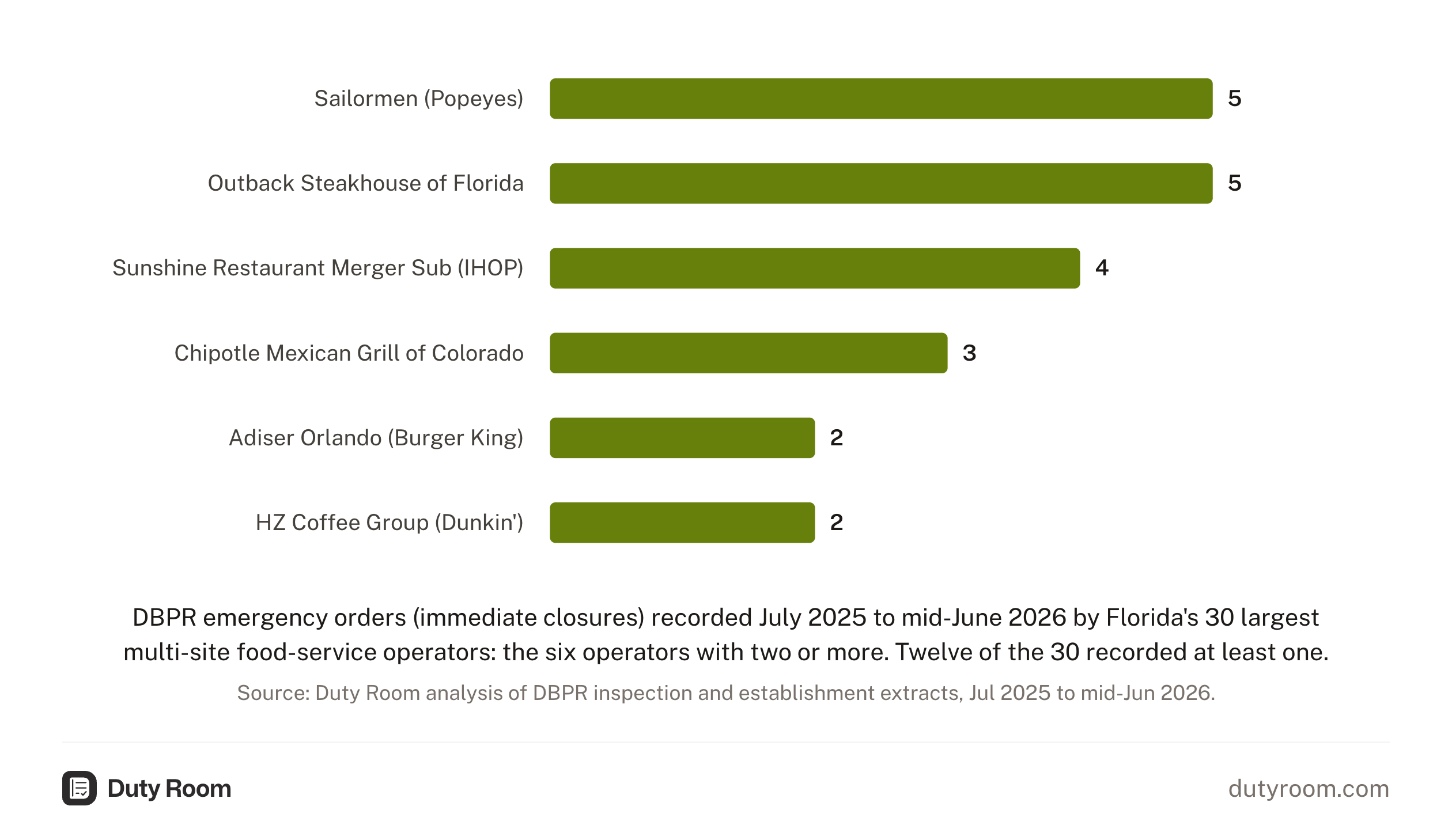
Twelve of the 30 operators in this table had at least one location closed by emergency order during the year. Sailormen, which runs 101 Popeyes locations, and Outback Steakhouse of Florida had five closures each. Sunshine Restaurant Merger Sub had four, and Chipotle three.
| Operator | Emergency orders |
|---|---|
| Sailormen (Popeyes) | 5 |
| Outback Steakhouse of Florida | 5 |
| Sunshine Restaurant Merger Sub (IHOP) | 4 |
| Chipotle Mexican Grill of Colorado | 3 |
| Adiser Orlando (Burger King) | 2 |
| HZ Coffee Group (Dunkin') | 2 |
These are large, professionally managed chains, and more than a third of them had at least one kitchen reach the point where an inspector would not let it keep serving. One emergency closure can be a single location's worst day. Five across a portfolio in a year points at the corrective-action layer above the kitchens rather than any one of them.
The casual-dining bottom
Full-service and long-hours formats dominate the bottom band of the table. Miller's Ale House posted the table's worst line: 1.3 HP violations per inspection, a 42% clean rate, and 21 complaint recommendations against 69 locations, the heaviest rate per location in the table. Carrabba's Italian Grill passed clean on 52% of its inspections and drew 17 complaint recommendations. Outback Steakhouse combined 0.9 HP violations per inspection with those five emergency closures. Both Waffle House entities sit in the same band, and so does HZ Coffee Group, which runs 82 Dunkin' locations at a 54% clean rate.
Two of those names share a parent, and the pattern extends past this table's size cut. Outback Steakhouse of Florida, Carrabba's Italian Grill, and Bonefish Grill are all subsidiaries of Tampa-based Bloomin' Brands, and Bonefish, at 45 Florida locations, scored 1.2 HP violations per inspection with two emergency closures and 15 complaint recommendations. Three sibling entities, one parent, one bottom band. Whatever is driving the numbers is not confined to a single brand. Cracker Barrel, just outside the 30 largest at 60 locations, fits the same profile: 1.0 HP violations per inspection and a 66% clean rate.
At the other end, the limited-menu operators cluster high. The three pizza delivery entities, Hut Florida and CFL Pizza under the Pizza Hut brand and Checkmate Pizza under Domino's, all sit at 0.2 HP violations per inspection. Taco Bell of America runs 0.3 with a 92% clean rate across 371 inspections. A kitchen with a narrow menu, few raw proteins, and drilled prep steps gives an inspector structurally less to find. But the gradient is a tendency, not a law, and the exceptions run in both directions: Panda Express posts a 72% clean rate, Sailormen's five emergency closures came from a fried-chicken menu, and McDonald's own Florida corporate entity passes clean on 69%. Chipotle, the largest operator in the state at 303 sites and the most inspected at 759 visits, lands mid-table at 0.5 and 80%, though its 27 complaint recommendations are the highest raw count in the table. The sample is 30 operators; treat the pattern as a lean, not a rule.
The entity gap is real
The Waffle House pair and the Bloomin' trio show the same mechanic from two directions: enforcement records belong to legal entities, and a brand or a parent can span several of them. When a brand operates through more than one legal entity in Florida, each entity builds its own inspection record, and those records can diverge, or converge on the same bottom band, without the brand name ever telling you which.
For a VP of Operations at a multi-site operator running locations through more than one legal entity, whether subsidiaries or franchisees, the per-entity breakdown is worth quantifying with your own data. The DBPR inspection extract can produce it using the same method applied here.
The 662-operator universe
The 30 operators profiled here are the top of a much longer list. DBPR's establishment extract shows 662 operators controlling five or more Florida locations, collectively running 10,995 sites, 16.7% of all active Florida food-service establishments.
Most of the 662 are small: 386 hold five to nine locations.
These 662 multi-site operators face an enforcement environment that has grown 146% more active since 2020. DBPR issued 4,659 enforcement actions in 2025, up from 1,890 in 2020. The typical (median) fine is still $400, but 16% of callback inspections escalate toward formal enforcement, and three disciplinary final orders within two inspection cycles move a location to Risk Level 3.
The recommendation rates in the leaderboard translate directly. The bottom of the table runs 0.16 to 0.3 complaint recommendations per location per year. For a 20-location operator at those rates, that is three to six a year, and where the filed complaints end in disciplinary final orders, individual locations start approaching the Level 3 threshold within two inspection cycles.
Benchmarks for portfolio operators
If you're running 8 to 20 Florida locations, these are the thresholds worth measuring against.
HP violations per inspection: below 0.5. That puts you with the top dozen of these thirty operators; the top third of the table sits at 0.35 or below.
Clean rate: 85% or higher. Twelve of the thirty hit it, and the top third run 90% or better. The table's midpoint is 77%. Below 80%, more than one inspection in five is ending in something other than "no further action": across a 15-location portfolio, that's six or more adverse findings a year, and at bottom-of-table clean rates it's twelve or more.
Zero emergency orders. Eighteen of these thirty operators recorded none, so it is an achievable standard at chain scale. More than one puts you among the worst six.
Administrative complaint recommendations below 0.1 per location per year. For a 15-location portfolio, that's no more than one or two a year. The bottom of this leaderboard runs 0.16 to 0.3 per location per year.
-
Duty Room analysis of 137,862 DBPR inspection records (July 1, 2025 to mid-June 2026) and 65,893 active establishment records from DBPR's public records page, downloaded 2026-06-11. Inspections are attributed to operators by license number. An operator is a registered licensee name; clerical spelling variants of the same registrant are grouped after checking the registered mailing address, and distinct legal entities are kept separate. The 30 profiled operators are the largest by active Florida site count with 10 or more locations and at least 40 inspection records in the window. Brand names in parentheses come from each operator's own registered business names. HP violations per inspection is the count of High Priority violations divided by total inspections for that operator. Clean rate is the share of inspections with disposition "Inspection Completed - No Further Action." Administrative complaint counts are inspections with disposition "Administrative complaint recommended," the inspector's referral for formal enforcement; emergency order counts use the corresponding disposition. Callback visits sit inside the same inspection types and are included.
-
Byndom v. Waffle House, Inc. and East Coast Waffles, Inc., No. 6:23-cv-1971 (M.D. Fla.), order of April 23, 2024, recording that discovery in the case indicates East Coast Waffles, Inc. is Waffle House, Inc.'s wholly owned subsidiary.
This report is based on published enforcement data, sources available at publication, and original analysis. It is for general information only and doesn't constitute legal advice.
The records the inspector looks for, per site
Florida operators keep temperature logs, Food Manager certifications, and cleaning records current for DBPR inspections. Duty Room organizes the evidence and shares it across every site.