Your turnover sets the table
The Average Health and Safety Fine Is £276,368, 20 Times the Food Hygiene Average
The fine data covers England and Wales (Ministry of Justice Court Proceedings Database). Scotland and Northern Ireland have separate court systems and sentencing.
England and Wales courts imposed £153.1 million in health and safety fines on organisations from 2023 to 2025.1 Across 554 fine outcomes, the average (mean) was £276,368. That was about 20 times the food hygiene average and about 178 times the licensing average in the same court data.
Those 554 outcomes cover every industry, including hospitality. The count is fine outcomes recorded against a principal offence, not cases or distinct organisations. The average isn't a price for a pub, restaurant or hotel's breach. Turnover, culpability and harm set the range.
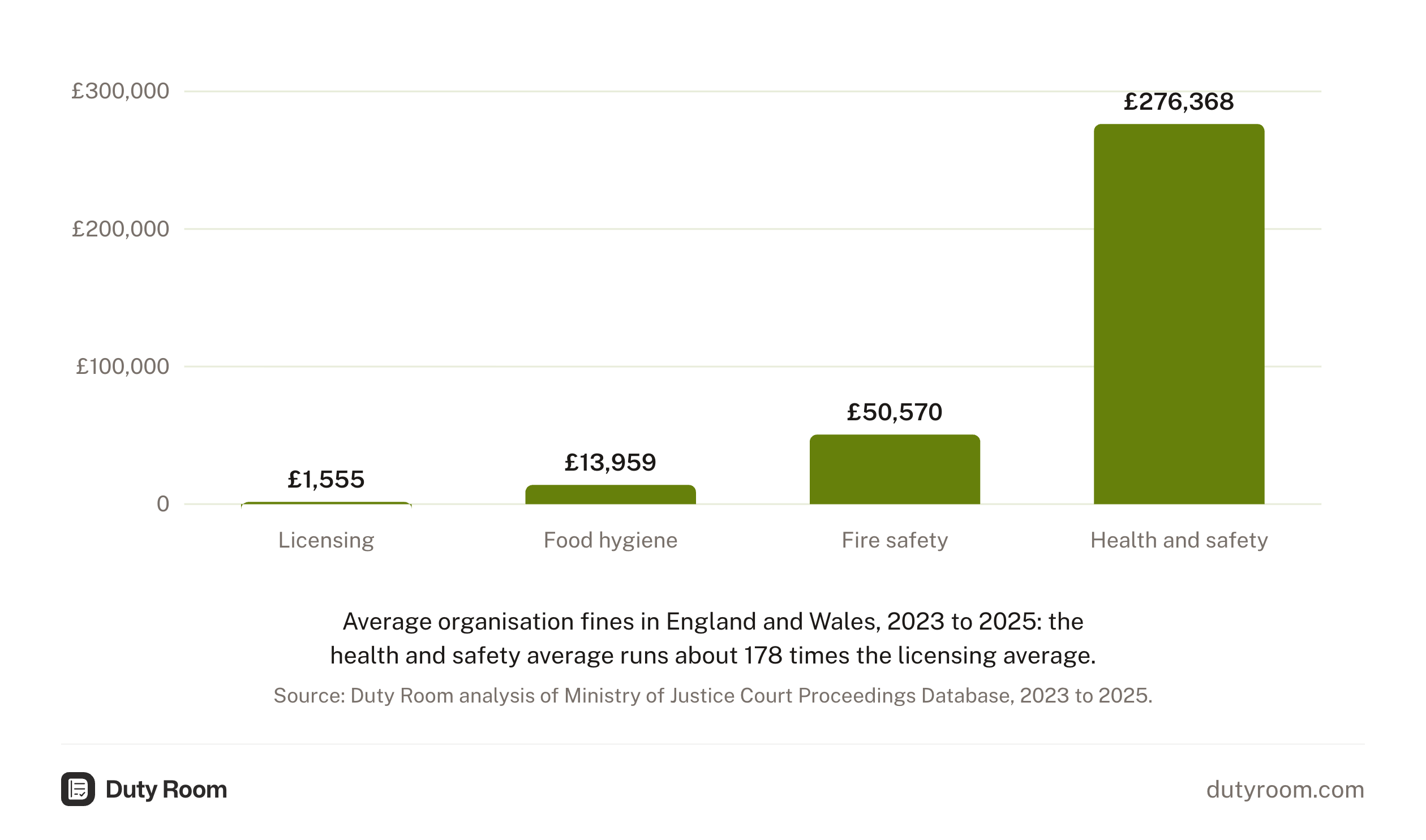
| Domain | Fine outcomes (02: Companies, public bodies, etc.) | Mean fine |
|---|---|---|
| Licensing | 41 | £1,555 |
| Food hygiene | 428 | £13,959 |
| Fire safety | 35 | £50,570 |
| Health and safety | 554 | £276,368 |
The middle of the data is a range
Some Ministry of Justice rows combine several fine outcomes and provide one total for the row, so the individual amounts cannot be reconstructed. At least half of the 554 fine outcomes were £40,000 or more; the exact middle sits between £40,000 and £80,000, and the source can't narrow it further.
Turnover, culpability and harm set the range
The Health and Safety Offences Sentencing Guideline starts with the breach. The court decides the organisation's level of culpability, then assesses the seriousness and likelihood of the harm risked. Actual harm and the number of people exposed can affect that assessment.
Once the offence category is set, annual turnover selects the relevant sentencing table. A pub turning over £500,000 and a hotel group at £20 million face different starting points for the same breach. The court then works within the category range, taking account of the facts of the offence and the organisation's financial position.
Culpability is where management decisions enter the calculation. A deliberate breach sits differently from a failure allowed to develop over time. An incident can also occur despite systems intended to prevent it. Harm is assessed from the risk created as well as the injury that occurred. A serious risk can therefore place an offence high in the matrix even when the eventual injury was limited.
Two-thirds of the outcomes, 370 of 554, fall under the general duty-of-care offence tied to sections 2 and 3 of the Health and Safety at Work etc. Act 1974. Those sections cover duties to employees and people outside the workforce. An inadequate risk assessment or safe system of work found after an incident can lead to this charge. Gas safety, electrical safety, COSHH and water hygiene prosecutions also land in these broad codes.
A June 2025 amendment added guidance for very large organisations and formalised the approach courts had already taken in case law. The £276,368 average describes the whole dataset. The matrix shows where a particular organisation and breach sit within that spread.
Annual averages follow the case mix
The annual average moved from £360,009 in 2023 to £223,702 in 2024 and £242,407 in 2025. The series is volatile because a few seven-figure fines can move a year's result, while a different mix of defendants and offences pulls it back.
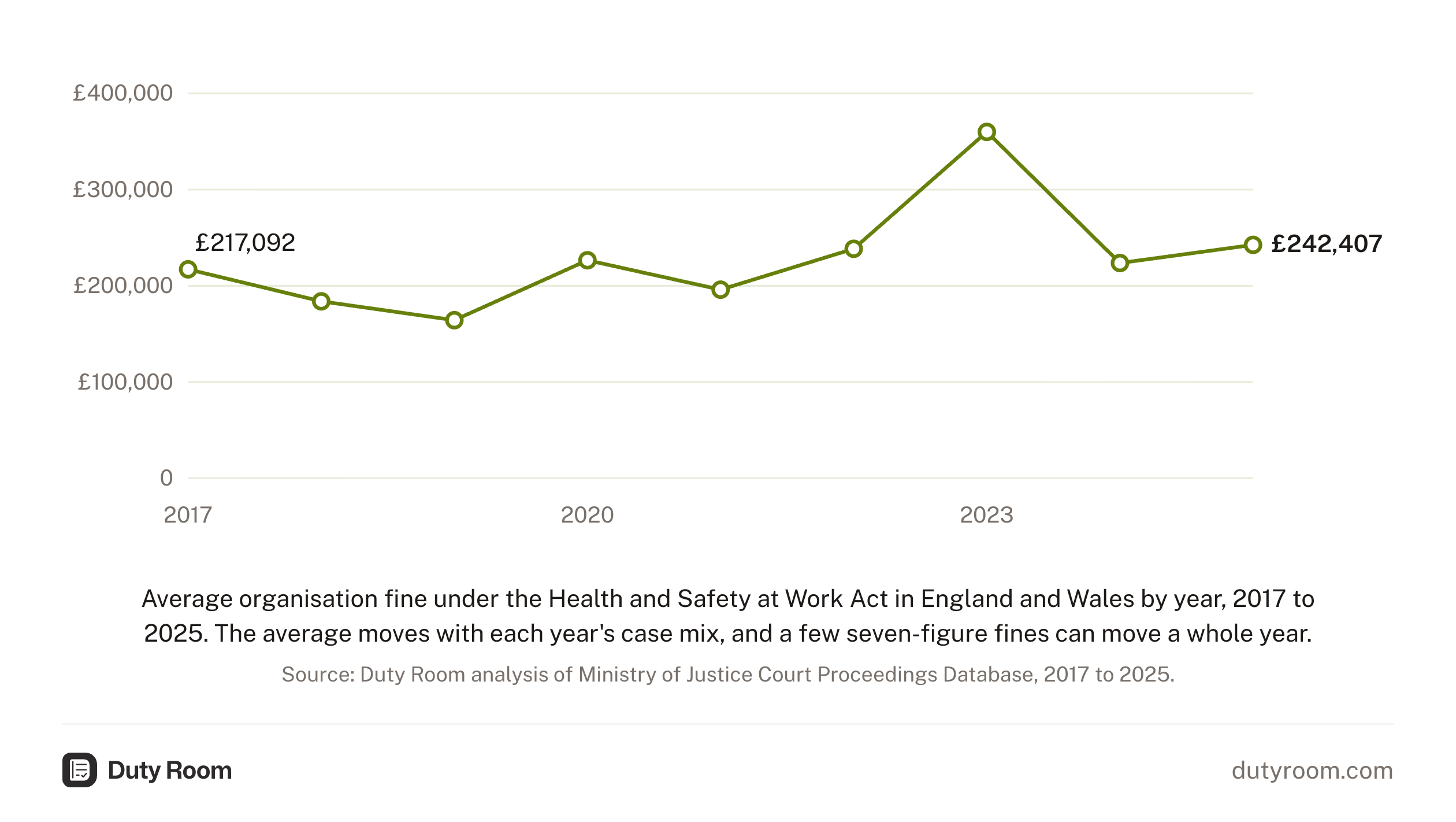
| Year | Fine outcomes (02: Companies, public bodies, etc.) | Mean fine |
|---|---|---|
| 2017 | 427 | £217,092 |
| 2018 | 327 | £183,829 |
| 2019 | 288 | £164,208 |
| 2020 | 147 | £226,569 |
| 2021 | 236 | £195,940 |
| 2022 | 177 | £238,455 |
| 2023 | 191 | £360,009 |
| 2024 | 195 | £223,702 |
| 2025 | 168 | £242,407 |
From 2017 to 2022, the annual average moved between £164,208 and £238,455. The largest single fine the data identifies is £3,750,000, in 2025. The series provides historical context; at sentencing, the guideline sets the range.
Oxford Active's costs were twice its fine
In January 2026, Oxford Active Ltd, a children's holiday camp operator, was sentenced at Chichester Crown Court after a child was found face-down in a pool during a free-play session. The child recovered.
The case concerned unclear pool safety procedures and controls that had been poorly communicated to staff. The court imposed a £6,000 fine and ordered £12,000 in prosecution costs. Those amounts belong to this case and don't establish a general costs multiplier.
The hourly bill before any prosecution, where HSE enforces
Fee for Intervention (FFI) applies when an HSE inspector identifies a material breach that requires written notification. HSE charges the business £188 per hour for the inspector's time spent identifying the breach and advising on the remedy. The charge is a regulatory bill issued before any prosecution.
Many hospitality premises are enforced by local authorities, which have no FFI equivalent. Whether FFI can land on your premises depends on which authority enforces them.
Operators who keep detailed licensing files and daily food hygiene diaries often have nothing equivalent for health and safety. Of the four domains in the court data, health and safety costs the most on conviction.
-
Duty Room analysis of MoJ Court Proceedings Database (England and Wales, December 2025 release), HO codes 08501 to 08505 and 08509, organisations = the source's "02: Companies, public bodies, etc." category; counts are fine outcomes on the principal-offence basis, not distinct organisations. Totals and averages are exact; the source aggregates some outcomes into combined rows, so middle values are reported only as bounds.
This briefing is based on sources available at publication and is for general information only. It doesn't constitute legal advice. For advice on your specific situation, consult a qualified professional.
Log the hazard before it becomes a claim
Average health and safety fine in England and Wales, 2023 to 2025: £276,368. Duty Room keeps risk assessments, COSHH, and accident records current per site.