The Fine Is Only Part of the Bill
The Average Food Hygiene Fine Is Now £13,959, Not £7,100
The fine data covers England and Wales (Ministry of Justice Court Proceedings Database). Scotland and Northern Ireland have separate court systems and sentencing.
Consultants and trade press still cite the Sentencing Council's £7,100 average (mean) organisation fine for food hygiene offences. That figure comes from a 2019 analysis of data collected in the months after the sentencing guideline took effect. The current average is nearly double that figure.
Ministry of Justice court data for 2023 to 2025 shows 428 organisation fine outcomes for food hygiene offences across England and Wales.1 The average fine was £13,959. Individuals drew another 176 fines in the same period; at least half of those were £800 or less. The guideline was designed to raise corporate penalties, and it has.
These are fine amounts only. They do not include prosecution costs or victim surcharges. In 88 published food hygiene prosecutions from 2022 to 2026, compiled from council press releases, the fine was typically 50 to 70% of the total bill. Prosecution costs added £1,000 to £7,000. The typical (median) total payment ordered by courts was £14,375. For smaller defendants, prosecution costs regularly exceeded the fine itself.
Who pays what
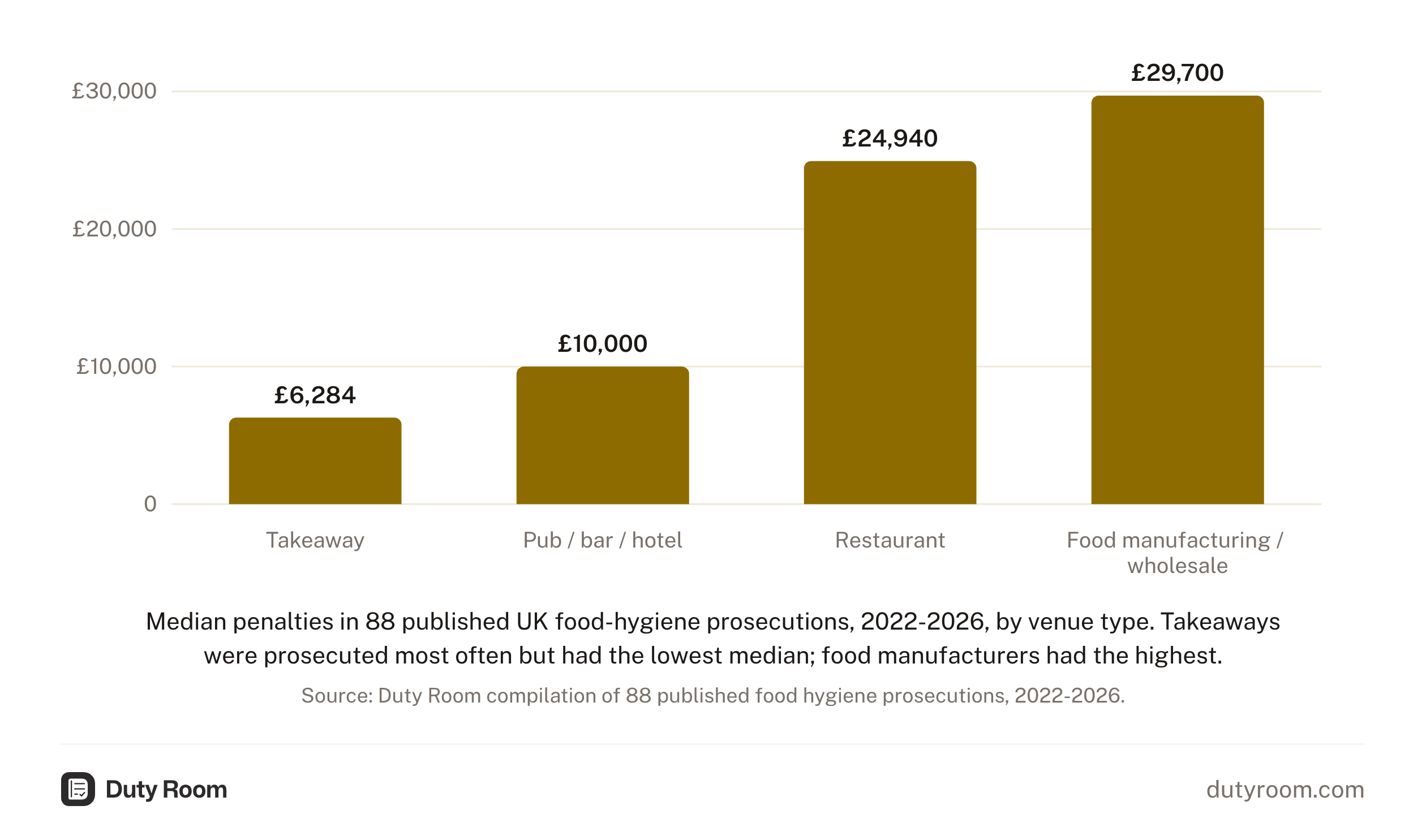
The sentencing guideline ties organisational fines to turnover. This produces consistent patterns by venue type.
| Venue type | Cases | Median total penalty |
|---|---|---|
| Takeaway | 25 | £6,284 |
| Pub / bar / hotel | 7 | £10,000 |
| Restaurant | 14 | £24,940 |
| Food manufacturing / wholesale | 9 | £29,700 |
Takeaways are the most frequently prosecuted venue type in our dataset but attract the lowest penalties, reflecting smaller turnover. Restaurants pay more. Food manufacturers more again. Roughly 59% of all cases in our dataset resulted in total penalties exceeding £10,000.
Large corporates occupy a different tier entirely. McDonald's paid £497,190 after a mouse dropping was found in a cheeseburger at its Leytonstone branch. Asda was fined £640,000 at Cardiff for selling expired food at scale. A restaurant in Tower Hamlets paid £103,922 for uncontrolled mouse infestation across five charges. These are turnover-based calculations applied to businesses with substantial revenue, not a measure of uniquely severe offending.
At the other end, a restaurant in Torbay was fined £2,000 for dirty premises. Costs and surcharge brought the total to £3,000. That is still a week's profit for many small operators.
The enforcement ladder
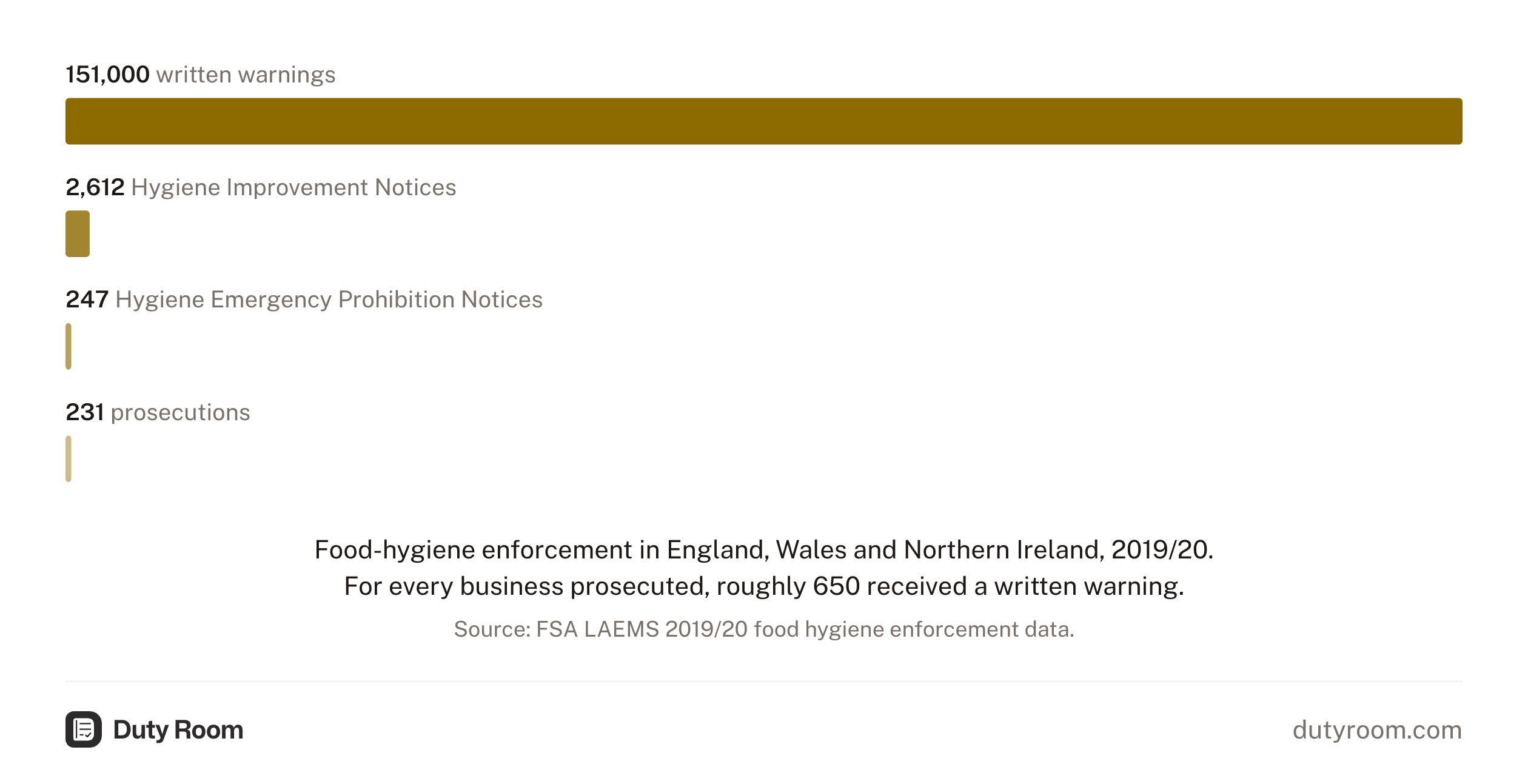
Prosecution sits at the top of a structure that widens at every lower level. In 2019/20, the last year with detailed national data, local authorities completed 231 food hygiene prosecutions. They also issued 2,612 Hygiene Improvement Notices, served 247 Hygiene Emergency Prohibition Notices, and sent over 151,000 written warnings. For every business prosecuted, roughly 650 received a warning letter.
| Stage | Count |
|---|---|
| Written warnings | 151,000+ |
| Hygiene Improvement Notices | 2,612 |
| Hygiene Emergency Prohibition Notices | 247 |
| Prosecutions | 231 |
The ladder matters because each step leaves a different record:
- Written warnings are the base. The officer writes you a letter. No legal force, but it goes on file. If the officer returns and finds the same problems, that letter becomes evidence of prior warning.
- Hygiene Improvement Notices require specific fixes within a set deadline, minimum fourteen days. They carry legal force. Failing to comply is a criminal offence in its own right.
- Hygiene Emergency Prohibition Notices close your business the day they are served. The officer issues one when they believe there is an imminent risk of injury to health. A magistrate must confirm within three days. Until the council certifies the risk has been removed, you stay shut. Your food hygiene rating drops. Delivery platforms may suspend your listing.
- Prosecution follows when formal enforcement has failed, or when what the officer finds is severe enough to bypass the earlier steps.
Formal enforcement is rising. The FSA reported 6,199 formal food hygiene actions in 2024/25, 30% above pre-pandemic levels. Approximately 95,000 inspections remained overdue as of late 2024, down from 142,000 the year before. Inspectors are clearing the backlog. Businesses that avoided scrutiny during the pandemic catch-up period should not assume that will continue.
What gets prosecuted
Rodent infestation. In roughly 75% of those 88 prosecutions, inspectors found mice, rats, or both. The droppings photograph well. The structural gaps that allowed entry (unsealed pipework, gaps beneath doors, damaged air vents) demonstrate a failure of premises maintenance. And absent pest control records tell the court that nobody was monitoring the problem.
Inadequate HACCP documentation appears in roughly 38% of cases. The Food Safety and Hygiene (England) Regulations 2013, implementing Retained Regulation (EC) 852/2004, require a documented food safety management system. A deli in Grantham paid £32,313 after 20 charges including breach of an improvement notice, expired food, and no food safety management system. A bakery in Hertfordshire paid £19,282 on its third prosecution for similar failings.
These two problems overlap routinely. Rodents enter through structural defects. Absent documentation shows the management system didn't catch it. One root cause, failures across two dimensions, and a penalty that reflects both.
Allergen failures carry their own severity. A restaurant in Uxbridge was fined £35,000 after a customer was hospitalised from an allergic reaction. A restaurant in Coventry and its director together paid £40,873 after a Salmonella outbreak that made 29 people ill. Swansea prosecuted five takeaways in 2025 for placing unsafe food on the market through undeclared allergens: three in a single batch in March, two more in September.
Repeat offenders lose any remaining discretion. A food shop in Newcastle was prosecuted for breaching a Hygiene Prohibition Order. The director of a Chelmsford restaurant received a three-month suspended prison sentence after breaching a prohibition notice and failing to comply with seven improvement notices. In at least eight of the 88 cases, courts imposed Hygiene Prohibition Orders banning individuals from managing food businesses entirely. Prison sentences are rare for food hygiene offences, but the Food Safety Act 1990 provides for up to two years.
What this costs beyond the fine
The 88 cases in our dataset produced £4.37 million in total financial penalties. That figure understates the real cost. Closure days, lost bookings, cancelled delivery partnerships, staff departures, and reputational damage don't appear in the court order but often cost more than the fine did.
A business that receives a HEPN loses revenue from day one and cannot reopen until the council certifies the risk has been removed. Voluntary closures, of which there were 939 in 2019/20, carry the same operational impact even if the formal enforcement consequences are lighter.
The controls that would have prevented most of these cases are inexpensive. Pest control contracts with monthly visits, documented reports, and acted-on recommendations. Food safety management systems maintained daily by staff. Structural maintenance sealing the gaps rodents use to enter. Training records showing who learned what and when.
These are the same controls tracked for the food hygiene rating. Premises running a current SFBB diary, a pest control contract, and a maintenance schedule rarely reach prosecution. The 88 cases we reviewed share a common thread: systems that either did not exist or had not been maintained for months before the inspection that triggered enforcement.
-
Duty Room analysis of Ministry of Justice Court Proceedings Database records (England and Wales, December 2025 release), 2023 to 2025. Organisation counts are fine outcomes in the source's "02: Companies, public bodies, etc." category, and individual counts are fine outcomes in its "01: Person" category, not distinct defendants. The data covers every industry, not just hospitality.
This briefing is based on sources available at publication and is for general information only. It doesn't constitute legal advice. For advice on your specific situation, consult a qualified professional.
The rating on your door starts with your records.
Organisation food hygiene fines in England and Wales average £13,959, nearly double the £7,100 figure from the Sentencing Council's 2019 assessment. Duty Room keeps temperature, SFBB, and allergen records current.