Check the assessor’s experience against your premises
BAFE Adds Competence Tiers for Fire Risk Assessors
This guidance covers England and Wales. Scotland and Northern Ireland have separate fire safety legislation.
An assessor's experience should match the risks at your premises. BAFE SP205 Version 6 now uses tiers aligned with BS 8674:2025, the competence standard for individual assessors. A hotel with sleeping guests and a small ground-floor shop present different risks; ask the assessor to explain which kinds of premises they can assess.
The scheme remains voluntary. In England and Wales, the responsible person still has the legal duty to obtain a suitable and sufficient fire risk assessment, whether they write it themselves or appoint someone else.
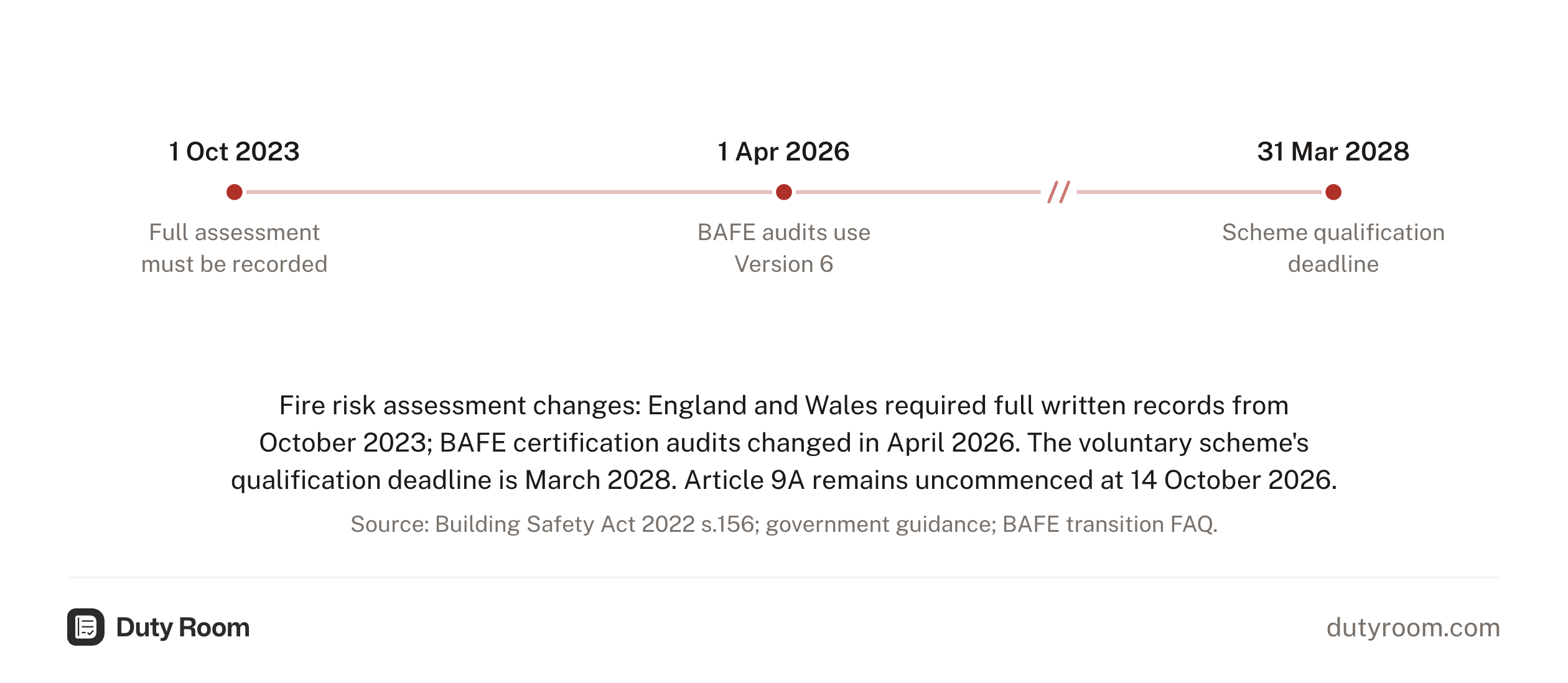
| Date | Requirement |
|---|---|
| 1 Oct 2023 | Responsible persons in England and Wales must record the full fire risk assessment |
| 1 Apr 2026 | BAFE SP205 certification audits use Version 6 |
| 31 Mar 2028 | Qualification requirements become mandatory within the voluntary BAFE scheme |
Certification audits changed on 1 April 2026
BAFE's transition guidance applies Version 6 to certification audits from 1 April 2026. Certification bodies assess existing registered organisations against the revised requirements at their next surveillance audit. The qualification requirements become mandatory within the scheme on 31 March 2028.
The tiers are foundation, intermediate and advanced. They describe increasing levels of assessor competence under BS 8674:2025. The scheme's timetable is not a statutory deadline requiring every assessor to register with BAFE.
BAFE SP205 certifies organisations, including sole traders, through accredited certification bodies. When a firm offers to assess your premises, check both its current certification scope and the experience of the person who will do the work.
Article 9A has not taken effect
Section 156(4) of the Building Safety Act 2022 provides for Article 9A in the Fire Safety Order. That provision would expressly require a responsible person to appoint a competent person when seeking help to make or review an assessment. The legislation and government guidance, checked on 14 October 2026, leave it uncommenced.
The existing duties still apply. Article 9 requires a suitable and sufficient assessment. Article 18 requires competent help with preventive and protective measures, subject to its exceptions. Those measures include the precautions identified through the assessment.
The government recommends checking an assessor's competence now. Certification can support that choice, but the certificate cannot establish that the finished assessment covers the actual building, its occupants and its use.
Keep the evidence behind the appointment
Before commissioning the work, give the assessor an accurate account of the premises: its layout, uses, occupancy and any sleeping accommodation. Ask which parts of the work their competence covers and whether they need specialist help.
Keep their scope, credentials and relevant experience with the assessment. When the report arrives, check that it describes the premises you operate, then assign and track the required actions. Commissioning a report does not transfer the responsible person's duty to the assessor.
The written-assessment requirements introduced in October 2023 concern what must be recorded; they did not create the original duty to assess fire risk. Our fire safety prosecution report shows the consequences when operators leave required action undone.
This briefing is based on sources available at publication and is for general information only. It doesn't constitute legal advice. For advice on your specific situation, consult a qualified professional.
Advice from your assessor, action from your sites.
Main Fire Safety Order offences carry unlimited fines, and organisation fine outcomes averaged £50,570. Duty Room keeps FRA actions, alarm tests, and fire door checks current per site.