Sewage gets expensive fast
Ontario's $21 Million Environmental Fine Problem
Ontario environmental convictions reach ordinary operators. Across 310 public cases with reconciled fine amounts since 2019, the typical (median) fine was $25,000 and about three in ten were under $10,0001. Campgrounds, food processors, trailer parks, and waste haulers keep appearing in the same court bulletins as Imperial Oil and ArcelorMittal.
Camp Barcovan, a tent and RV resort in Quinte West, was fined $51,000 after it discharged sewage and failed to comply with ministry orders. Two directors and an officer were personally convicted for failing to ensure the discharge was reported and to prevent the company's order breaches, bringing the case total to $75,0002. The unfulfilled orders required a qualified consultant and reports on the sewage works.
Our sample comes from Ministry of the Environment, Conservation and Parks court bulletins published between May 2019 and October 7, 2026. It totals $21,994,653 in fines, combining all defendants in each case and excluding surcharges, recovery orders and restitution. Three cases with conflicting official amounts are excluded, and an earlier case repeated in an expanded bulletin is counted once1.
Sewage approvals and missed water samples
The Ontario Water Resources Act appears in 69 reconciled case announcements in this period, more than any statute except the Environmental Protection Act3. The property cases include sewage systems operated without the required approval and failures to act on ministry orders.
Comfort Estates, another trailer park, was fined $100,000 in 2025 for offences including raw sewage discharge and operating unapproved sewage works. Its former director, Amin Hooda, was fined $15,000 for offences that included failing to take all reasonable care to prevent an order breach2. For a site with private sewage works, check the approval and its conditions against the system actually in use. Some sewage systems fall under the Building Code rather than the Ministry's approval process4.
A private drinking-water system can bring separate sampling and operator requirements. In convictions announced in June 2026, a children's summer camp was fined $11,000 under the Safe Drinking Water Act after missing two months of required well-water sampling during its summer season. A childcare centre on a small well system was fined $18,000 for missed sampling and failing to ensure that a trained person operated the system5. Those cases began with routine work that wasn't done.
Municipalities themselves aren't exempt: the City of Hamilton was fined $2.1 million in 2023 under the Ontario Water Resources Act, after city public health declared Chedoke Creek a health hazard6. In a case announced in October 2026, the city was fined a further $600,000 under the same Act. A hole in a combined sewer, suspected to date from roadworks in 1996, had sent an estimated 337 million litres of sanitary sewage into Hamilton Harbour over about 26 years6. For a business connected to municipal services, trace where your own discharges go. The Environmental Protection Act's general discharge prohibition turns on whether a contaminant causes or may cause an adverse effect, subject to specified exceptions; the Water Resources Act also prohibits discharges that may impair water quality4.
A late spill call is its own offence
Reporting a spill is a separate duty from preventing one. Unless an exemption applies, the Environmental Protection Act requires anyone controlling a spilled pollutant, or causing or permitting its spill, to notify the Ministry forthwith. They must also notify the municipality, or the regional municipality if the spill occurs within a region, and the pollutant's owner or controller where required. The duty starts when they know or ought to know of the spill4.
NOVA Chemicals was fined $150,000 in a case announced in October 2026 for a single offence: failing to notify the ministry of a benzene spill. About 1,475 litres leaked from a failed pump seal at its Corunna plant in January 2024. NOVA sent an alert to local subscribers, but it notified the ministry only about two hours after the spill, once ministry staff directed it to7. In a case announced the week before, Rain Carbon was fined $200,000 for failing to report a discharge at its Hamilton coal tar plant, where ministry air monitoring had detected high benzene levels and a patched tank kept leaking for two more days7. In each case the reporting failure was the only conviction, and NOVA's fine for it is larger than 275 of the 310 case fines in this sample.
For a site that stores fuel, solvents or other chemicals, identify the required reporting contacts before a spill and assign responsibility for calling them. Keep the ministry's spill-reporting number with the spill kit, and log the time each call is made.
Waste stored wrong is a recurring charge
A recurring prosecuted failure across these cases is waste that doesn't match the conditions on an approval. Material piled too high, stored on unapproved land, or still sitting there after an order to move it.
GFL Environmental was fined $343,000 in 2023 for approval and logging failures. The offences included soil piles above the permitted eight metres, a missing daily waste-weight log, and unprotected waste cylinders6. The records and the physical storage conditions both formed part of the case.
For a hotel or restaurant, the waste exposure is more mundane: grease interceptors that overflow, dumpster areas that drain toward storm sewers, cooking oil that escapes onto the ground. Use those as places to check where waste could leave the approved collection and disposal arrangements.
An approval can require the records
Missing records can themselves be an offence when an approval or order requires them. The obligation depends on the conditions that apply to the site.
Tradition Fine Foods, an industrial bakery, was fined $12,000 in 2024 for two offences: failing to prepare and maintain the operating manual required by its approval, and operating new equipment without the required approval. The manual was supposed to cover equipment maintenance and measures to reduce noise and odors6.
Start with the conditions on your site's approval. If they require inspection logs, an operating manual or maintenance records, keep those alongside the approval so the person running the site can check what is due. For contractor-serviced equipment, retain the service report and follow up on the defects it identifies. A receipt alone may say little about whether a fault was fixed.
Directors get named personally
Across all 319 bulletin titles, 55 name a director or officer among the fined parties8. Ontario's environmental statutes impose duties on directors and officers to take all reasonable care to prevent specified corporate contraventions, including certain discharge, reporting and order breaches4.
If you run a site and are also a company director, the same incident can lead to separate penalties for the company and for you. At Comfort Estates, the $100,000 company fine and Hooda's $15,000 personal fine were distinct. The workplace-safety fine data also includes announcements with several convicted defendants; an announced case total is not necessarily one person's penalty.
Ignoring an order adds another offence
Camp Barcovan's directors were convicted for failing to prevent the company from breaching a director's order. A case announced in February 2026 against a waste company and its two directors reached $1,025,000 in combined fines, covering unauthorized waste deposits, failures to comply with removal orders, and false information submitted to a provincial officer9.
Albert Rumph and his company were convicted in 2023 over sewage works and again in 2024 over drinking-water failures at the same property; the second case was announced in January 2025. The two cases brought $105,000 in combined fines, including $15,000 against Rumph personally9. The second prosecution lands on top of the first.
When an order arrives, give each requirement an owner and a deadline, and retain the reports or confirmation the Ministry requires. Booking a contractor is not the same as completing the ordered work.
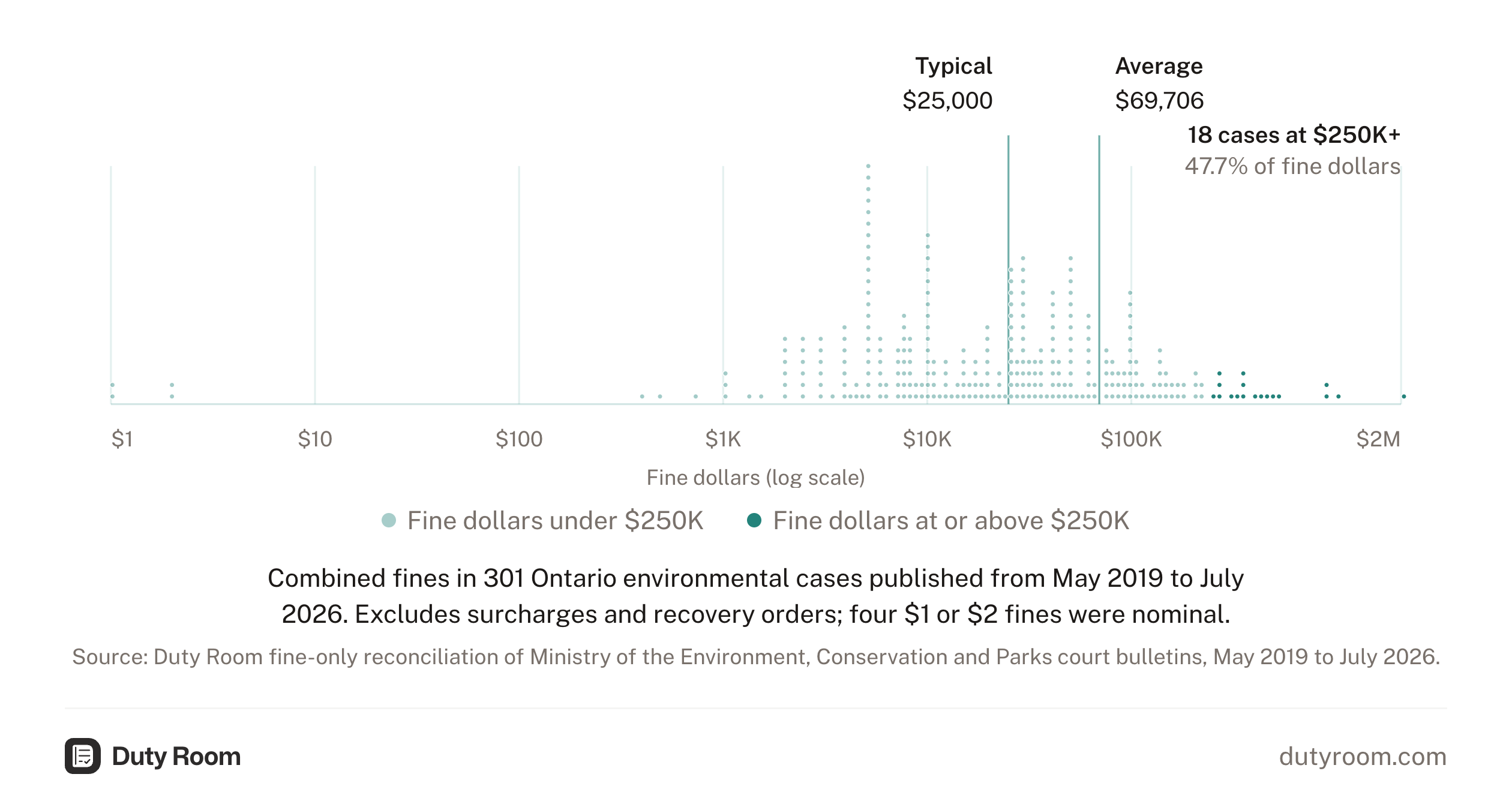
Fine distribution
| Measure | Value |
|---|---|
| Median combined fine | $25,000 |
| Average combined fine | $70,950 |
| Cases at $250,000 or more | 18 of 310 (5.8%) |
| Share of all fines in those 18 cases | 47.2% |
| Range | Reconciled cases | Share |
|---|---|---|
| Under $10,000 | 96 | 31% |
| $10,000 to under $25,000 | 54 | 17% |
| $25,000 to under $50,000 | 61 | 20% |
| $50,000 to under $100,000 | 40 | 13% |
| $100,000 to under $250,000 | 41 | 13% |
| $250,000 or more | 18 | 6% |
Just over two-thirds of case fines fall below $50,00010. The 18 cases at $250,000 or more account for 47.2% of all fines, pulling the average (mean) to $70,950, with the City of Hamilton's $2.1 million at the top11. These are combined case amounts, not predicted penalties for a restaurant, campground or building owner.
Fines can also understate the financial consequences. One October 2026 bulletin announced $358,000 in penalties: $33,000 was fines, while $325,000 was restitution to a property owner who paid to clean up buried waste12. Only the fines enter this distribution.
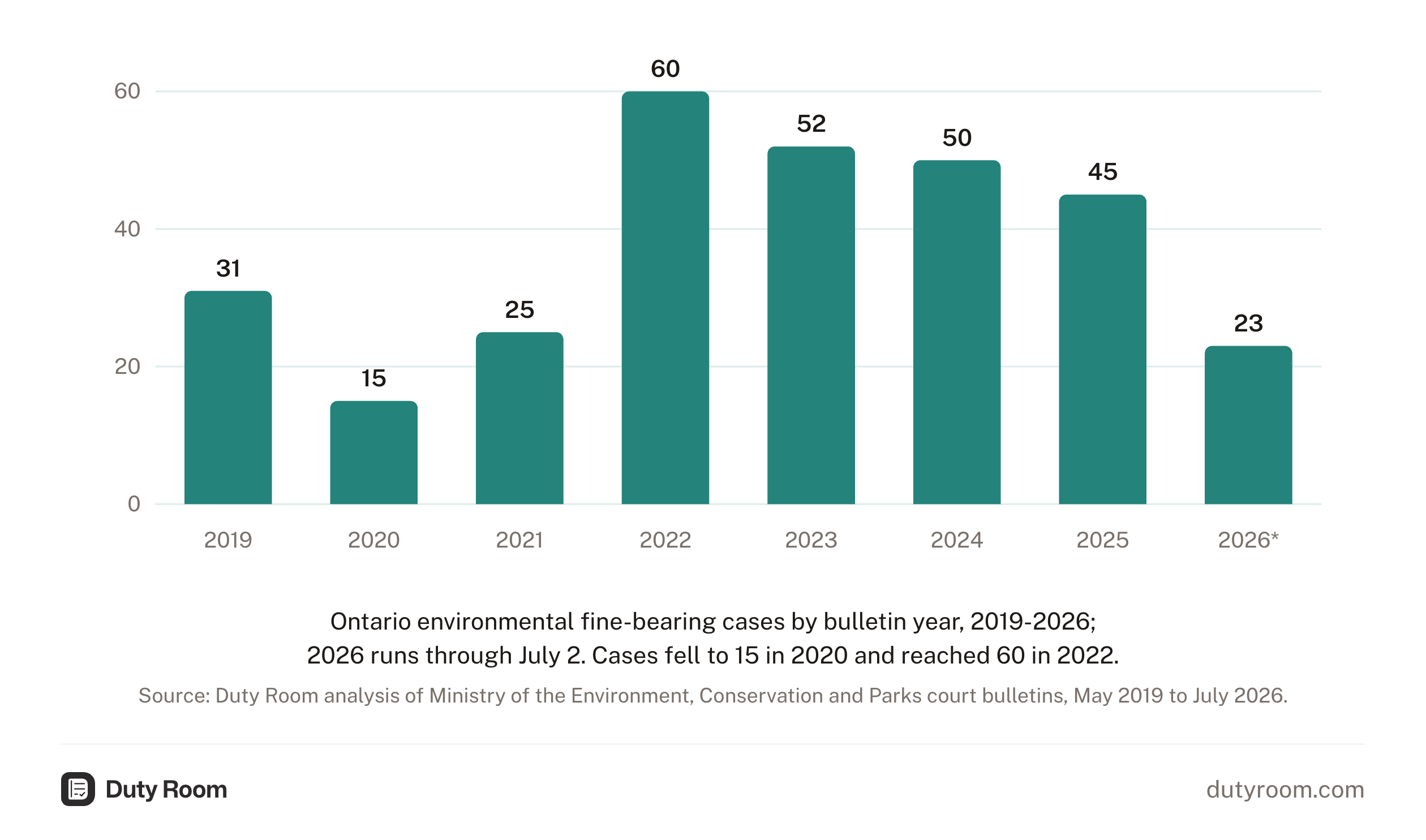
Case announcements after the pandemic
| Publication year | Reconciled cases |
|---|---|
| 2019 (from May) | 30 |
| 2020 | 15 |
| 2021 | 24 |
| 2022 | 58 |
| 2023 | 52 |
| 2024 | 50 |
| 2025 | 45 |
| 2026 (to October 7) | 36 |
The sample contains 15 announcements in 2020, rising to 58 in 2022 and remaining at or above 45 a year through 202513. The first and last years are partial, and publication can follow conviction by months or years. The table tracks these published cases, not the Ministry's entire enforcement workload.
Open the file for the system you run
Pick one system your site depends on: the sewage works, drinking-water supply or waste-storage area. Compare its approval and operating requirements with the latest sample results, inspection notes and service reports. If a sample was missed or a repair remains open, assign the work and a completion date. The useful record is the one that lets the next person running the site see what was done and what still needs attention.
-
Duty Room analysis of MECP court bulletins, published May 2019–October 7, 2026. Of 319 bulletins, five have no fine, one repeats an earlier adjudication inside a later expanded case, and three have unresolved conflicting fine amounts. The monetary sample is the remaining 310 cases: $21,994,653 total, $25,000 median, 96 (31.0%) below $10,000. Fines combine all defendants in a case and exclude victim surcharges, orders and restitution. Blue Water, Huronia and Mansteel are excluded until their headline/body differences can be resolved. The expanded South Winds case is counted once; two historical fine amounts were corrected from body components. The July snapshot remains historical at 301 cases/CAD 20,981,650: subsequent corrections and exclusions remove CAD 553,000 and four rows; thirteen later bulletins add CAD 1,566,003. The net change is not a like-for-like measure of enforcement growth. Original API responses, excluded rows and the reproduction script are archived in the research vault. These selected public bulletins are not a complete convictions register, and the amounts do not establish payment.
-
Camp Barcovan bulletin, 8 January 2025: company CAD 51,000; two directors and one officer CAD 8,000 each. The order appeal was dismissed in September 2022; convictions were on 23 September 2024. Comfort Estates bulletin, 22 May 2025: company CAD 100,000 and former director CAD 15,000, convicted 7 February 2025. Each was convicted of multiple offences; the totals are not attributed solely to missing records. Surcharges excluded.
-
Statute membership across the 310 reconciled cases: Environmental Protection Act 186, Ontario Water Resources Act 69, Safe Drinking Water Act 28, Pesticides Act 23. A case can name several statutes. Counts follow conviction and penalty text where it conflicts with a headline; two bulletins contain such conflicts.
-
Environmental Protection Act, sections 14, 15, 91, 92 and 194; Ontario Water Resources Act, sections 30, 53 and 116; O. Reg. 675/98. Official e-Laws Word consolidations retrieved and archived in full on 7 October 2026 (the regulation on 8 October). EPA 14(1) uses "causes or may cause an adverse effect", subject to subsection 2; its prospective "likely" amendment is not yet in force in the retrieved consolidation. EPA 92(1)–(2) requires forthwith notice by the person controlling the pollutant and anyone who spills or causes or permits its spill, once they know or ought to know of it. Recipients include the Ministry and the municipality, or the regional municipality where the spill occurs within a region. Clauses 92(1)(c)–(d) also require notice to the owner or controller when their identity is known or readily ascertainable. EPA 91 defines the scope of this duty, and O. Reg. 675/98 provides conditional exemptions and reporting requirements. EPA 15(1) separately requires forthwith notice of other discharges that are out of the normal course of events and cause or are likely to cause an adverse effect. OWRA 53 contains approval exceptions, including systems subject to the Building Code Act. EPA 194 and OWRA 116 list specific reasonable-care duties and allow personal conviction whether or not the corporation has been prosecuted or convicted. Site-specific approval, registration and operating requirements must be checked separately.
-
Conestoga Bible Camp bulletin, 24 June 2026: four SDWA violations, CAD 11,000, convicted 18 December 2025; monthly raw-water and distribution sampling missed in July–August 2023. Quiet Waters Montessori Academy bulletin, 17 June 2026: four violations, CAD 18,000, convicted 13 November 2025; missed raw-water, distribution and lead sampling, plus trained-operator failure. Surcharges excluded.
-
Hamilton bulletin, 18 August 2023: CAD 2.1 million fine, separate CAD 525,000 surcharge and CAD 364,500 restitution. Hamilton bulletin, 7 October 2026: one OWRA violation, convicted 20 March 2026; CAD 600,000 fine, separate CAD 150,000 surcharge and a CAD 80,000 probation-order payment to the Bay Area Restoration Council. The 1996 roadworks origin, the 337-million-litre volume and the 26-year duration are estimates reported in the bulletin. GFL bulletin, 6 March 2023: nine EPA violations, CAD 343,000. Tradition Fine Foods bulletin, 22 March 2024: two EPA violations, CAD 12,000 combined; missing required operating manual and operation of unapproved equipment. Surcharges excluded.
-
NOVA Chemicals bulletin, 7 October 2026: one EPA violation for having control of a spilled pollutant (benzene) and failing to notify the ministry; spill 20 January 2024, convicted 22 June 2026; CAD 150,000 fine, separate CAD 37,500 surcharge. The bulletin states NOVA did not notify the ministry until "approximately 2 hours after the spill, after being directed to do so by ministry staff." Rain Carbon bulletin, 1 October 2026: one EPA violation for failure to report a discharge to the natural environment; benzene detected by ministry air monitoring on 23 and 25 October 2023 and a tank still leaking until 25 October; convicted 26 February 2026; CAD 200,000 fine, separate CAD 50,000 surcharge. Both fines are in the 310-case sample; 275 of its case fines are below CAD 150,000.
-
Across all 319 MECP bulletin titles, 55 name a director or officer among the fined parties, excluding "Director's Order" matches. This is a title-based floor, not a count of all individual convictions.
-
Waste-company case bulletin, 11 February 2026: company CAD 500,000, one director CAD 300,000 and the other CAD 225,000; convictions in 2024, sentencing completed in 2024/2025. False-information offence belongs to Wesley Dass, not Mario Cascio. Rumph and company, 22 November 2023 and 9 January 2025: convictions 9 March 2023 and 24 October 2024; case fines CAD 60,000 and CAD 45,000, of which Rumph personally CAD 10,000 and CAD 5,000. Sewage and drinking-water duties respectively; same Wainfleet property.
-
Distribution bands are lower-inclusive and upper-exclusive: a $25,000 fine sits in the $25,000-to-under-$50,000 row. 211 of 310 cases (68.1%) fall below $50,000.
-
The 18 of 310 case fines at $250,000 or more total $10,373,000, or 47.2% of all reconciled fines. Mean $70,950; median $25,000. Seven cases exceed $500,000, topped by Hamilton's $2.1 million. Exclusions and the duplicate correction are applied consistently to this distribution and the annual table.
-
Property owner and landscaping companies, 1 October 2026: fines CAD 25,000+4,000+4,000=33,000; separate restitution CAD 325,000. The bulletin also reports surcharges, which are outside both the fine series and the CAD 358,000 headline. Its printed CAD 100 surcharge for Nature's Green is retained in the source archive without speculative correction.
-
Counts use bulletin publication year, not conviction year. 15 cases in 2020 rose to 58 in 2022 (3.87×); 2023–2025 have 52, 50 and 45. 2019 begins in May and 2026 ends October 7. Historical counts reflect the reconciled sample, including removal of a superseded bulletin and exclusion of the three conflicting amounts.
This report is based on published enforcement data, sources available at publication, and original analysis. It is for general information only and doesn't constitute legal advice.