Keep a dated photo of each CCTV sign
BC CCTV Under PIPA: Signs and Records
Status: in force · Next review April 8, 2027
A "cameras in use" sticker gives no reason for the recording. In its retailer review, BC's Office of the Information and Privacy Commissioner (OIPC) says a retail CCTV sign must state why the business records people. Four of the six OIPC decisions compared below had no sign wording in evidence.
In force. PIPA's rules apply now; the orders below decided their own facts. Checked October 8, 2026; next review April 8, 2027.
BC's Personal Information Protection Act (PIPA) governs private organizations, including operators of bars, restaurants, hotels, shops and privately operated long-term care homes. A recording of an identifiable person is personal information. PIPA excludes public bodies, information covered by BC's public-sector privacy law, and collection, use or disclosure covered by the federal Personal Information Protection and Electronic Documents Act.
What must a BC CCTV sign say?
The OIPC's retail guidance describes signs that customers can read before they choose to enter and before collection begins. The retailer review, from 2021, covered 30 liquor and cannabis retailers and received 26 notices. All 26 announced cameras; nine stated a purpose. The review counted 21 retailers without adequate notice and called for signs at every entrance.
PIPA section 10(1) requires notice of the collection purposes. On request, the organization must also give the title and contact details of an officer or employee who can answer questions. Section 10(3) exempts collection covered by the deemed-consent provisions in sections 8(1) and 8(2).
The OIPC's 2008 private-sector surveillance guidelines recommend putting a contact on the sign itself.
An illustrative bar entrance sign could read:
Video surveillance is in use at the entrance and in customer areas to investigate theft, assaults and property damage. For privacy questions or access to your images, contact the general manager at [the bar's contact details].
The wording must match the actual purposes. In Order P21-06, a strata's security wording covered theft and property damage but failed to notify people of lifeguarding and health-emergency monitoring.
Keep a copy of the sign's wording on file too. In P23-05, a landlord said it posted signs but supplied neither copies nor an explanation of their wording or location. The adjudicator could not find that it had met the purpose-notice requirement. In P22-08, removed signs with no text supplied could not establish notice either, although a separate privacy policy did provide notice to the resident. P21-06's adjudicator could inspect a photo of the sign and confirm that it was visible.
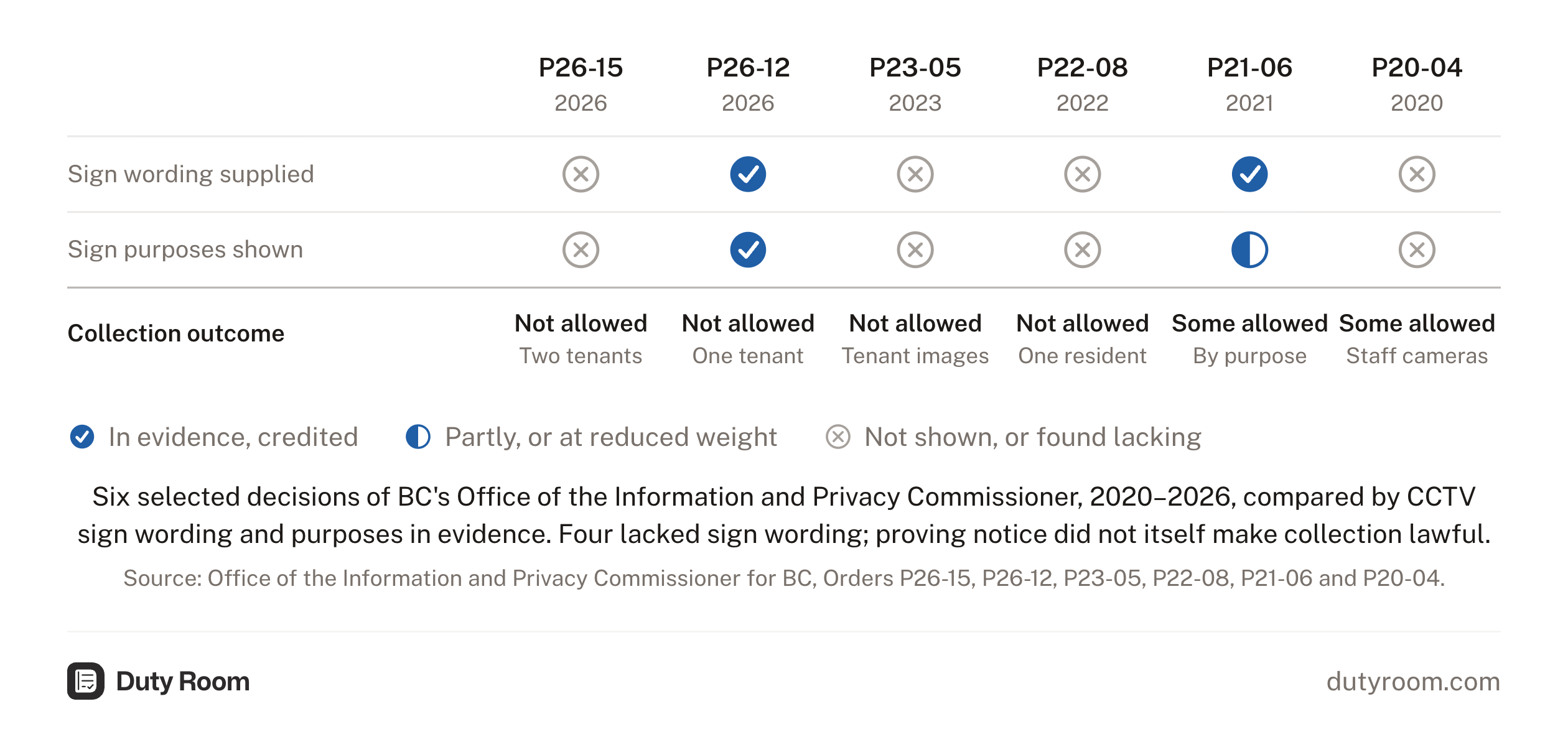
| Order and operator | Sign wording supplied | Sign purposes shown | Collection outcome |
|---|---|---|---|
| P26-15, Park Village (2026) | Not shown: stickers described | Not established | Unauthorized collection of the two complainants' information; stop, disable relevant functional cameras and delete their images |
| P26-12, Affordable Housing Societies (2026) | Yes: May 2026 sign quoted | Purpose wording supplied; notice adequacy not decided | Unauthorized collection of the complainant's images; stop and delete |
| P23-05, FHBW Investments (2023) | Not shown | Not shown | Unauthorized collection; relevant cameras to be disabled |
| P22-08, Bellevue West (2022) | Not shown: removed signs | Not shown on signs; separate policy met notice | Unauthorized collection of the complainant's images; stop and delete |
| P21-06, Strata BCS1964 (2021) | Yes: visible sign photo | Covered security purposes, not lifeguarding or health-emergency monitoring | Some purposes authorized; others not authorized |
| P20-04, Teck Coal (2020) | Not shown | Employee purposes not meaningfully communicated | Some collection and use allowed; operations monitoring and working-hours surveillance in hallways outside maintenance offices to stop; staff notice ordered |
What Order P26-15 decided
Order P26-15, issued September 14, 2026, concerned two tenants at Park Village Mobile Home Park. The adjudicator decided whether the park was an organization under PIPA and whether it had authority to collect their personal information under section 6. Section 10 notice was not one of the issues.
PIPA section 6 requires consent, authority under the Act to proceed without consent, or consent deemed under the Act. Section 11 separately requires collection purposes appropriate to a reasonable person that fulfil the disclosed purposes or are otherwise permitted by PIPA.
For deemed consent under section 8(3)(a), the park's description of its stickers showed only a warning that cameras were nearby; no purpose was proven.
The residents also had no choice about using their home and the only permitted access road. The adjudicator found no consent, no applicable authority to collect without consent, and no deemed consent.
The park had to stop collecting the complainants' information, delete their images and physically disable functional cameras capable of viewing areas either could reasonably be expected to access. That included cameras able to turn towards those areas despite software restrictions.
The order set October 28, 2026 as the compliance date. Under PIPA section 53(2), a judicial-review application brought within section 53(1)'s 30-business-day period after the organization receives the order stays it from filing until a court orders otherwise.
An earlier 2026 order shows that a sign stating its purposes doesn't establish consent by itself. In P26-12, a seniors' rental building had posted a sign naming security, safety and preventing misuse of its laundry room. The resident objected and had no meaningful alternative to that room. The operator still lacked authority to collect her images. In both orders, the operator could not infer agreement from a resident entering a monitored area the resident could not avoid.
For a bar or shop, the retailer review describes implicit consent where notice is given and the customer chooses to enter. The sign file shows the notice; choice and reasonable purposes still need assessment.
The records behind each camera
The OIPC's 2008 guidelines recommend documenting each camera's location, view, capabilities and purpose. They cover overt surveillance of the public in publicly accessible areas, excluding employee surveillance. PIPA prescribes none of the forms below; they apply the statute and the decisions.
| Record | What the file should show | Primary source |
|---|---|---|
| Camera-purpose register | Camera ID, location, purpose, recording times, audio or zoom capabilities, staff areas captured, and less intrusive options considered | 2008 guidelines; P21-06, paragraph 122 |
| Camera map | Dated view from each camera, its full range of movement and areas it can record | P26-15, paragraphs 40–44 and 77 |
| Sign file | Exact wording, location, photo in place, posting date and replacement history | P23-05, paragraph 34; P21-06, paragraph 64 |
| Staff notice | Purposes for collecting and using employee information, the notice given and when staff received it | PIPA, sections 13 and 16 |
| CCTV policy and privacy contact | Responsible person, public contact, purposes, recording, complaints, retention and deletion | PIPA, sections 4–5; retailer review, recommendation 13 |
| Retention and deletion log | Overwrite period and reason; saved clips, decision dates, reasons for keeping them and deletion dates | PIPA, section 35 |
| Viewer access list | People allowed to view or export clips; contractor access and controls | PIPA, sections 4(2) and 34 |
| Access-request log | Written request, receipt date, deadline, footage preserved, editing assessment, response and any extension notice | PIPA, sections 23 and 27–31; P26-04 |
| Disclosure log | Recipient, request and authority, clip released, date and person who released it | PIPA, sections 18 and 23(1)(c); 2008 guidelines |
| Review note | Continuing problem, camera effectiveness and less intrusive options | 2008 guidelines |
Park Village's map marked narrow active zones, but the adjudicator found that its cameras could see or record wider areas. Check mapped coverage against actual views and movement ranges.
Duty Room holds these records for each site, each one dated. Canadian pricing lists the plans; BC resources covers other BC premises records.
Staff cameras need their own assessment
PIPA sections 13 and 16 permit collecting and using employee personal information without consent where this is reasonable for establishing, managing or ending the employment relationship. For that route, the employer must notify staff of the collection and use and their purposes beforehand. PIPA includes volunteers as employees.
"Employee personal information" means information about an individual collected, used or disclosed solely for purposes reasonably required to establish, manage or end their employment relationship with the organization; it excludes information unrelated to their employment.
In Investigation Report P17-01, cameras on chicken-catching crews also served to defend the company's reputation. The OIPC found that the footage fell outside employee personal information, so that exception did not authorize collection.
The OIPC's employee guidance describes continuous staff surveillance as reasonable only as a last resort after less intrusive methods have been explored. In P20-04, involving Teck Coal, the adjudicator rejected continuous operations monitoring and recording in hallways outside maintenance offices during working hours, on the evidence presented. Operating those hallway cameras after employees left for the night was reasonable in that case. Teck's signs announced cameras without communicating the purposes, and Teck was ordered to give staff that notice.
A till camera that records customers and staff needs an assessment of both purposes and authority. A staff acknowledgement records that notice was received. It can't show that the surveillance is reasonable.
How long can a business keep footage?
PIPA sets no fixed CCTV overwrite period. Section 35(2) requires destruction or removal of identifying information once it is reasonable to assume that retention no longer serves the collection purpose and is no longer necessary for legal or business purposes. Record how the chosen overwrite cycle serves that purpose.
Section 35(1) sets a different rule for footage used to make a decision that directly affects someone. The organization must keep that information for at least one year after using it to make the decision. A saved clip used to ban a patron therefore needs a record of that use and a hold outside routine overwriting.
A customer asks for their footage
PIPA section 27 requires a written request detailed enough to identify the person and information with reasonable effort. Subject to the Act's exceptions, section 23 gives people access to their information, how it has been used and the names of people and organizations it was disclosed to.
The usual response deadline is 30 business days after receipt. PIPA excludes Saturdays and holidays from its definition of a day; the Interpretation Act includes Sundays as holidays. Section 31 permits up to 30 additional business days for specified reasons, or longer with the commissioner's permission. Those reasons concern insufficient request details, large searches that would unreasonably disrupt operations, or necessary consultation with another organization or public body.
An extension notice must give the reason, expected response date and the applicant's complaint rights. Section 29 also pauses the clock while the commissioner considers the organization's application to disregard the request or the applicant's challenge to a fee estimate.
In P26-04, Market Place IGA, the OIPC ordered the store to mask others and release the portions containing the applicant's image. The store's lack of editing skills did not establish an unreasonable burden. The adjudicator needed evidence of time or cost, such as editing quotes, to assess whether removal was reasonable.
PIPA section 32 permits a minimal access fee, with a written estimate before the service, except for the applicant's own employee personal information.
Police requests and audio settings
PIPA section 18(1)(j) permits voluntary disclosure without consent to a Canadian law enforcement agency concerning an offence under Canadian or provincial law. The disclosure must assist an investigation, or a decision to investigate, to determine whether the offence occurred or to prepare for charges or prosecution. Section 18(1)(i) also permits disclosure to comply with a subpoena, warrant or order from a body with power to compel production. Section 18(1)(j) permits disclosure; by itself it doesn't require the operator to hand over footage.
The OIPC's landlord guidance recommends asking for an oral police request in writing, with the authority and file number. A disclosure log records what was released and to whom, information a person can request under section 23.
Audio needs a separate check. The 2008 guidelines advise recording sound only where there is a specific need. In Audit Report P16-01, a clinic's sign failed to state its purposes or mention audio collection, and so did not meet PIPA's notice requirement. Criminal Code section 184 separately governs interception of private communications, with exceptions including express or implied consent from the originator or intended recipient.
Worked example: an eight-camera bar
A fictional Liquor Primary bar has eight cameras. Its manager records each camera's purpose, viewing range and less intrusive options considered.
Camera 1 covers door incidents at the ID-check podium, and its sign sits before the recorded area. At the till, Camera 2 is there for theft and cash discrepancies, so the assessment includes staff as well as customers. Camera 3 watches the dance floor and seating area for theft, assaults and property damage.
The back-office safe gets Camera 4, which records after staff leave. Cameras 5 and 6 cover stock theft in the stockroom and keg cooler. Camera 7 covers patio incidents; its view is restricted to exclude passers-by on the sidewalk. Camera 8 covers after-hours break-ins at the rear exit. These purposes go into the customer notice, and audio is disabled.
Camera 2's register entry reads: bar till; theft and cash discrepancies; records all opening hours; captures staff throughout their shifts; audio off; no pan or zoom; alternative tried, till reconciliation alone; staff notice given September 1, 2026. That entry still needs evidence supporting continuous staff recording as a last resort.
BC's Liquor and Cannabis Regulation Branch (LCRB) Liquor Primary handbook allows an inspector to direct cameras where ID-check procedures are ineffective. The manager keeps any direction with the camera file. The handbook also prohibits taking, saving or distributing photographs or video of inspectors or contracted minor agents.
A fight breaks out at 1:40 a.m. on Saturday. The manager saves entrance and dance-floor clips, logs the export and prevents routine overwriting. The bar uses the footage to impose a six-month patron ban, which triggers section 35(1)'s minimum of one year after that use.
Police ask for the clip on Sunday. The manager obtains the request in writing with the file number; it identifies an investigation into whether an assault occurred. After assessing section 18(1)(j), the manager releases the relevant clip voluntarily and logs the recipient, clip and date.
Three weeks later, the patron emails a sufficiently detailed request for all footage of himself. His request starts the usual 30-business-day deadline, counted without Saturdays and holidays, and the log records any applicable extension or pause. After getting a masking quote, the bar releases the portions showing the patron, subject to any applicable access exception.
PIPA section 56(1)(b) makes disposing of personal information to evade an access request an offence. The saved clip remains under its recorded hold. If the incident brings a Notice of Enforcement Action as well, the bar's separate response is covered in the LCRB violation briefing.
A hotel can record purposes for lobby, front-desk, parkade and corridor views, and front-desk cameras need the staff assessment too. The OIPC's 2008 guidance treats washroom and spa-treatment-room surveillance as inappropriate and warns against aiming into windows. The hotel's review keeps views out of guest rooms and change areas.
This guide reflects the rules and sources available at its last review and is for general information only. It doesn't constitute legal advice. For advice on your specific situation, consult a qualified professional.
Keep each site's camera records together
Duty Room keeps your camera register, sign photos and request logs organized and dated by site.