A Notice Opens A File
What to Do When You Get an LCRB Violation
Most enforcement actions begin as compliance gaps: a training record that was never created, a refusal script that was never reinforced, a reminder that arrived the day after the sale instead of the day before. The same published decisions that describe what happens after a Notice of Enforcement Action arrives also describe what would have prevented it. Operators who recognise the pattern in the data before receiving a notice are reading the same material as operators who received one last month.
When a Notice of Enforcement Action arrives, operators face two options: pay the penalty or contest it. Most pay. The 2026 LCRB Waiver Summary Report shows 254 accepted waivers,1 and of the 11 operators who raised a due diligence defence in a Duty Room sample of recent BCLCRB hearing decisions, three succeeded and eight failed.2 Operators who contest with counsel and lose pay legal costs on top of the penalty.
What the notice actually is
A Notice of Enforcement Action (NOEA) is not a conviction and not a fine due immediately. It's a proposed penalty with two options.
The NOEA names the contravention, the section of the Liquor Control and Licensing Act or Regulation, and the proposed penalty. The options are: accept the penalty by signing the waiver, or request a hearing before a delegate.
The penalty comes from Schedule 2 of BC Regulation 241/2016. Penalties scale by offence history, and the clock resets every 24 months. Under the Schedule, "first contravention" means no same-type contravention at the establishment in the preceding 24 months, not an operator's career history and not an ownership history.
For the most common contravention, selling or supplying liquor to a minor, the Schedule 2 ranges are:
- First: $7,000 to $11,000 monetary, or 7 to 11 days suspension
- Second (within 24 months): $11,000 to $15,000, or 11 to 21 days
- Subsequent: $15,000 to $25,000, or 21 to 41 days
Lower-tier contraventions (SIR training violations, capacity overage, operational matters) start at $1,000 to $3,000 or 1 to 3 days. Serious obstructions like refusing an inspector entry or selling while suspended sit at a flat $15,000 to $25,000 regardless of offence history.
| Contravention tier | First (no prior in 24 mo.) | Second (within 24 mo.) | Subsequent |
|---|---|---|---|
| Sale to minor | $7,000-$11,000 / 7-11 days | $11,000-$15,000 / 11-21 days | $15,000-$25,000 / 21-41 days |
| SIR / operational (lower tier) | $1,000-$3,000 / 1-3 days | $3,000-$7,000 / 3-7 days | $7,000-$11,000 / 7-11 days |
| Obstruction / selling while suspended | $15,000-$25,000 (flat) | $15,000-$25,000 (flat) | $15,000-$25,000 (flat) |
The 2026 LCRB Waiver Summary Report shows what operators actually paid: 157 of 254 waivers (62%) were for selling to a minor.
Waiver or hearing: the real calculation
Signing the waiver means paying the proposed penalty and closing the matter. Going to a hearing doesn't mean the penalty can be argued down. If the contravention is proven, the delegate must impose at least the Schedule 2 minimum. The only paths to nothing owed are showing the Branch hasn't proven the contravention, or mounting a successful due diligence defence. In the 11 decisions involving that defence in a Duty Room sample of recent BCLCRB hearing decisions, it worked three times. Those are not encouraging odds, but they're not zero.
What the successful defences show: The three operators who succeeded had documented compliance systems:
- Employee handbooks with signed alcohol service policies
- Serving It Right certification required before first shift
- Briefing logs with attendees and topics
- Incident logbooks with actual entries
- Records of regular training
The employees who made the sales were not the "directing mind" of the business. Under the test from Beverly Corners Liquor Store Ltd. v. LCRB, 2012 BCSC 1851, where the person responsible for the compliance system is also the person who made the sale, the defence collapses.
What the failed defences show: Where training was described verbally, policies existed but weren't documented or signed, and records couldn't be produced at a hearing, the defence failed. In 2026 BCLCRB 5 (Lucha Libre Taqueria), the licensee who won the defence presented an employee handbook, evidence of shadowed training shifts, testimony about daily pre-shift briefings, WhatsApp message threads and a 7Shifts incident logbook recording service incidents, and evidence that the server was terminated after the contravention. Published decisions treat that level of documentation as the benchmark. Without records near that standard, a hearing adds legal costs on top of the penalty.
Active, recent reinforcement of the ID-check policy was a common thread in the successful defences. In 2026 BCLCRB 3 (Drinks 4 Less), one decisive factor was a WhatsApp reminder sent six days before the contravention, telling staff to check ID. A policy binder collecting dust didn't carry the same weight as a timestamped reminder.
The "asked but still sold" finding: In 2026 BCLCRB 2 (On the Rocks), the server did ask the minor for ID. When the minor said they didn't have any, the server said "no problem" and completed the sale. The delegate described this as "most disturbing." The published decision found that the server knew to ask but didn't know they could refuse. A policy that collapses at the point of refusal is not a defence. The decision implies that a training system must address management backing for every refusal, without exception.
Suspension or cash
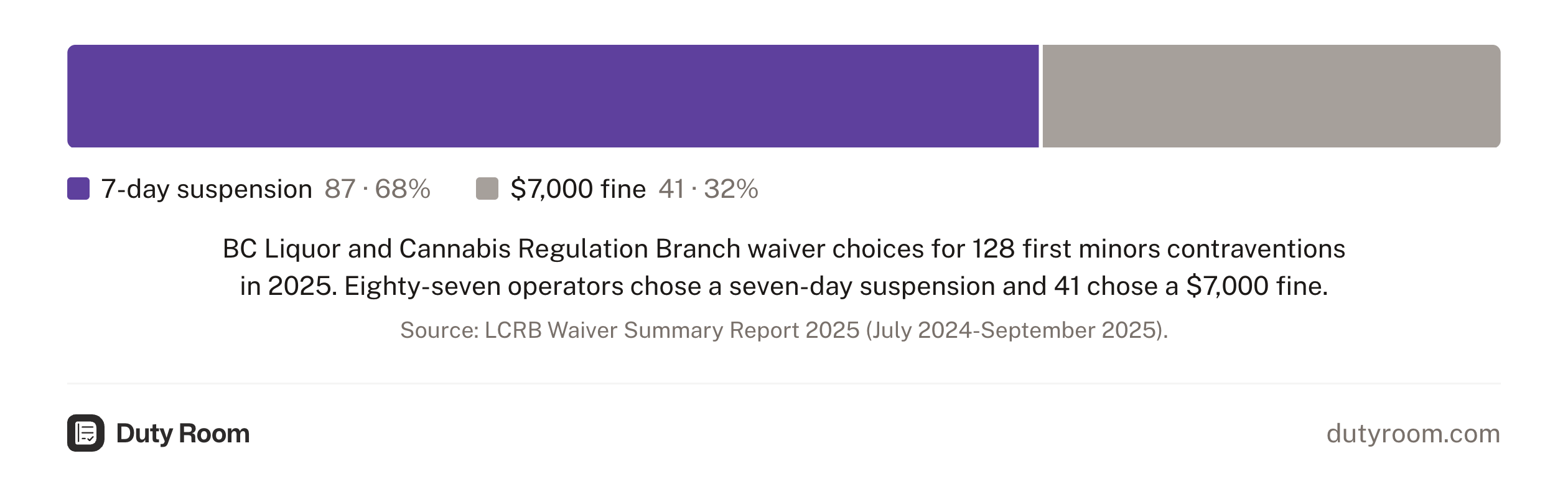
On a first minors contravention, the waiver presents a choice between the monetary penalty and the suspension. In the 2025 waiver data for selling liquor to a minor, 87 operators chose the 7-day suspension and 41 chose the $7,000 fine.
| Choice | Operators |
|---|---|
| 7-day suspension | 87 |
| $7,000 fine | 41 |
Revenue scale affects which option stings more. At $2M annual revenue, a 7-day suspension closes roughly $38,356 in sales, more than five times the $7,000 fine. The illustration represents operators toward the upper end of the single-site range. For a restaurant doing $1.5M to $1.8M in annual revenue, the suspension math is proportionally lower (approximately $28,800 to $34,600), but the cash demand is the same $7,000 on the same short timeline. The comparison still favours the fine arithmetically at most scales.
The likely reason 87 operators chose suspension over the fine is cash flow. A $7,000 fine due on short notice is a working capital demand. A week of closure spreads the cost across seven days instead of one.
A second factor: under the Liquor Control and Licensing Regulation (s.154), the general manager may require a licensee who receives a monetary penalty to post signage in a prominent location. Customers will see it. The waiver data suggests some operators find a week's closure preferable to that sign in the window.
What settlement doesn't close
Settlement doesn't end exposure. It creates a compliance history entry that the LCRB uses when assessing future contraventions. A second same-type contravention within 24 months falls in the second-offence range: $11,000 to $15,000 or 11 to 21 days. A third is $15,000 to $25,000.
The gap the contravention revealed in the training system remains. The three successful CanLII defences show what an adequately documented compliance programme looks like at the establishment level.
The 24-month clock runs from the date of the contravention, which defines a specific remediation window. A compliance system rebuilt to the CanLII benchmark within that window changes what a second NOEA in month 20 looks like at hearing. The same NOEA with the same training records the Branch saw the first time does not.
A sequence that matches what the published decisions reward: The published decisions reward a recognisable order, not a simultaneous rebuild.
- Confirm the record baseline. Before deciding anything about the NOEA itself, operators establish what records currently exist. That list runs: signed handbook acknowledgements, dated SIR certificates, pre-shift briefing logs, refusals logbook entries, shift schedule for the contravention date, and any digital messages referencing ID checks. This is the same record set a delegate would request at a hearing. What exists already sets the starting position.
- Identify the specific failure point. The published decisions distinguish between systemic failure (no policy existed) and point-of-refusal failure (On the Rocks: policy existed, server couldn't act on it). The remediation that follows differs. Systemic failure requires building records from the ground up. Point-of-refusal failure requires adding explicit refusal authority and management-backing language to what already exists.
- Make the immediate operational change. The Drinks 4 Less WhatsApp message, sent six days before the contravention, illustrates what active reinforcement looks like in the documented record. Operators who treated the NOEA as a starting gun for that kind of reinforcement created a timestamped trail of post-contravention action. Operators who didn't created a silence in the record from the contravention date onward.
- Document the server response. In Lucha Libre Taqueria, the server's termination was presented as evidence of the operator's seriousness. Published decisions treat post-contravention personnel action as part of the compliance narrative, not a separate matter.
- Assess hearing viability against the Lucha Libre Taqueria benchmark. With the record baseline confirmed and gaps identified, the question of waiver versus hearing has a factual answer: whether the records that exist, plus whatever can be documented between now and the deadline, clear the benchmark the published decisions treat as load-bearing. If they don't, a hearing adds legal costs on top of the penalty.
What the process requires
The NOEA sets the response timing. Signing the waiver gives up the hearing; not signing moves the matter to a hearing.
A workable order after receiving an NOEA: verify the Schedule 2 item number and prior-contravention count against the licensee's own 24-month history (penalties scale on prior same-type contraventions at the establishment); pull the records the CanLII decisions treat as load-bearing (handbook sign-offs, dated SIR certificates, briefing logs, refusals entries, shift schedule for the contravention date, digital messages referencing ID checks); and assess whether those records clear the Lucha Libre Taqueria benchmark or sit closer to the failed-defence pattern. That assessment determines whether a hearing is viable before legal costs are committed.
The published decisions show that a viable due diligence defence depends on being able to produce actual records: handbook sign-offs, Serving It Right certificates with dates, pre-shift briefing logs, refusals logbook entries, and the shift schedule for the contravention date. Operators who went to a hearing without that record base paid legal costs on top of the penalty. Where the server was disciplined or let go, the published decisions treated that documented response as supporting evidence.
Timestamps are what separates a compliance system from a binder assembled after the NOEA. In 2026 BCLCRB 3, one decisive document was a WhatsApp reminder sent six days before the contravention, not the day after. A delegate reading dated records sees what existed in the operation before the sale and what was produced in response to the notice. Records created after the NOEA carry weight as post-contravention remediation, not as evidence of pre-existing due diligence.
For the penalty choice itself, the revenue analysis above applies: the monetary penalty vs. suspension decision turns on cash flow and the s.154 signage requirement.
At any future hearing, a delegate will ask what changed after the notice. Published decisions treat post-contravention remediation records as material evidence, not a narrative. "We took it seriously" doesn't satisfy that standard. Records do.
The LCRB's inspection conduct expectations extend beyond the contravention itself. In 2024 BCLCRB 41 (JJ's Pub), an employee loudly identified LCRB inspectors inside the premises during an inspection and the licensee was fined $1,000 for breaching a licence condition. Drawing attention to an inspector is itself a contravention, and it can run alongside any underlying enforcement action and compound it.
-
LCRB Waiver Summary Report 2026, as downloaded from gov.bc.ca on March 25, 2026. The LCRB publishes this as a rolling workbook, and the live file has since been replaced. The 2025 report covering July 2024 to September 2025 shows 208 accepted waivers.
-
Duty Room analysis of 13 BCLCRB hearing decisions from 2024-2026 on CanLII (canlii.org/en/bc/bclcrb/). Of the 11 decisions where due diligence was raised, 3 succeeded (27%) and 8 failed (73%). All waiver statistics and hearing-derived figures in this briefing are from these sources.
This briefing is based on sources available at publication and is for general information only. It doesn't constitute legal advice. For advice on your specific situation, consult a qualified professional.
Good intentions won't save your licence. Records will.
55% of accepted LCRB penalty waivers were for liquor sales to minors. The first offer is $7,000 or 7 days. Duty Room keeps the records due diligence stands on.