Friday service can end early
26 Florida Restaurants Shut Down Every Week
DBPR issued 1,374 emergency closure orders in fiscal 2025-26, an average of about 26 per week.
That's from 142,203 inspections statewide. Sixty-three percent of inspections end clean. Another 12% get a warning. But 1% end with the doors locked and the staff sent home.
Pests: uncommon but catastrophic
Pest and rodent activity (Violation #35) appears on 90.8% of emergency closures. No other violation comes close.
The strange part is that pests are only the 14th most common violation overall. Out of 665,528 total citations in the same period, just 19,615 involve pests, 2.9% of all violations. Pest citations are uncommon overall, yet they appear on nine in ten closure records.
A dirty prep surface or a missing thermometer gets written up. Roaches in the walk-in get you closed, because pest activity usually shows up alongside a long list of other failures. The data bears this out.
Closures aren't one bad day
The average closed restaurant has 12.4 violations on its emergency order. The average restaurant inspection finds 4.7. A closure isn't a single failure. It's a dozen failures stacked on top of each other, visible all at once.
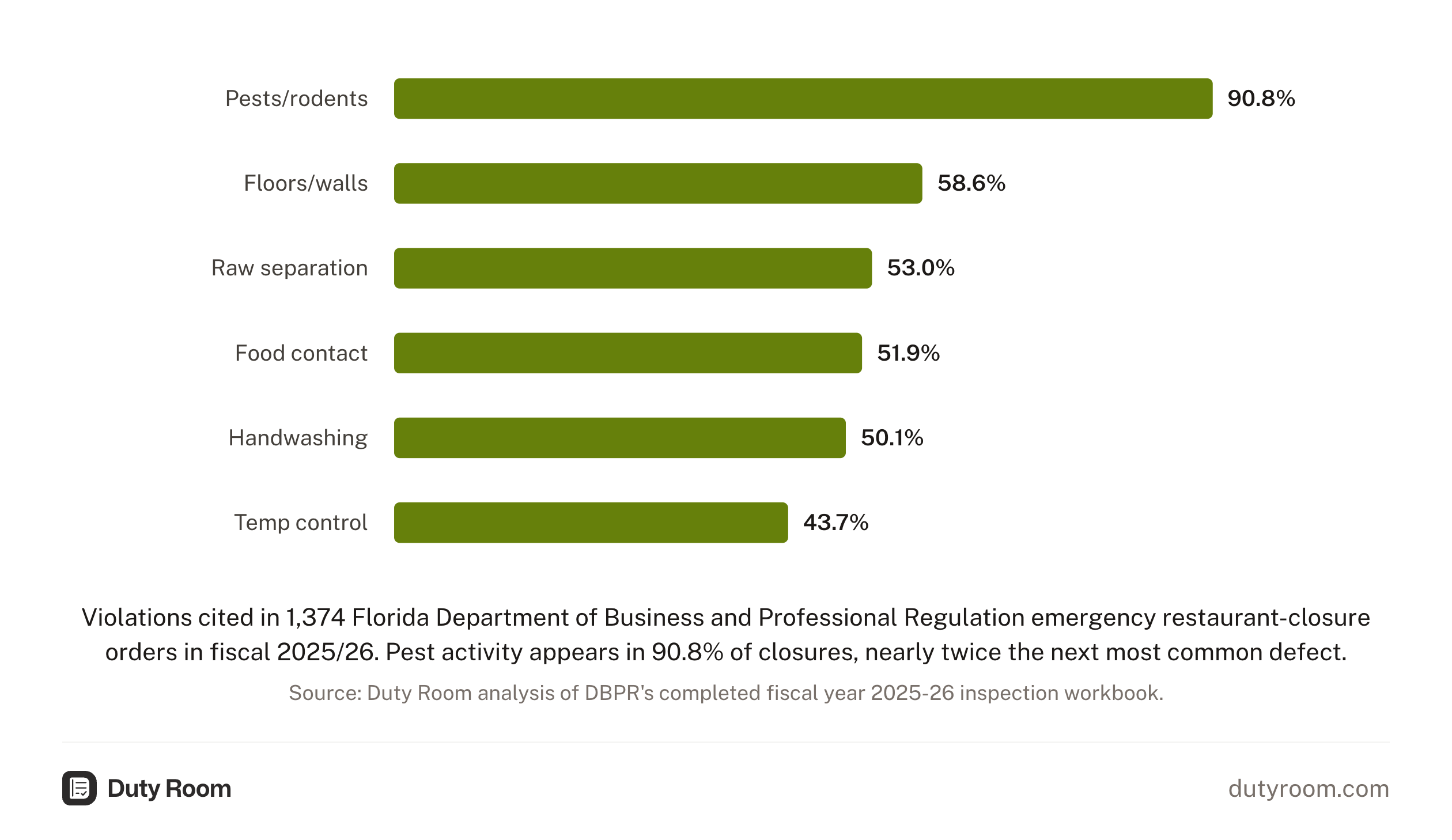
| Violation | Share of closures | Count |
|---|---|---|
| Pests/rodents (#35) | 90.8% | 1,248 |
| Deteriorated floors and walls (#36) | 58.6% | 805 |
| Raw food separation (#08) | 53.0% | 728 |
| Dirty food-contact surfaces (#22) | 51.9% | 713 |
| Inadequate handwashing facilities (#31) | 50.1% | 688 |
| Temperature control (#03) | 43.7% | 600 |
The fuller Florida restaurant shutdown analysis breaks those combinations down by district and year.
Certification gaps on a quarter of closures
One in four closures (26.3%) cites a food manager certification or employee training violation (Violation #53). Part of this is paperwork: at least the certification component could have been caught by checking an expiration date.
What a closure actually costs
The median DBPR fine is $400, and it has held at that level in five of the past six years. But the fine isn't the cost of a closure. A shut-down restaurant loses all revenue for every day the doors stay closed. Staff go unpaid or find other work. Suppliers reroute deliveries. The closure becomes public record on DBPR's searchable license database.
Enforcement is increasing
DBPR filed 4,659 enforcement actions in 2025, up from 1,890 in 2020. That's a 146% increase in five years. The broader trend is covered in the Florida DBPR enforcement report. Inspectors recommended administrative complaints on 8,616 inspections in fiscal 2025-26.
If your last inspection was clean two years ago, it doesn't predict what an inspector will find at the next one.
Where to start
The 26.3% certification figure is the place to start, because it's the fastest fix. Pull your food manager certificate and check the date. If it's lapsed, renew it before the inspector finds it for you.
Pest control deserves a harder look than most operators give it. Monthly vendor visits are standard, but the inspection doesn't ask whether your vendor came last month. It asks whether there's evidence of pests today. If your kitchen has gaps in baseboards, standing water, or unsealed dry storage, the monthly spray is treating symptoms.
Walk your kitchen and check the three violations that appear on the majority of closures: pest evidence, the state of floors and walls, and raw food separation. Sixty-three percent of Florida restaurants pass their inspections clean. The ones that don't tend to fail on a dozen things at once. Our Florida food safety resources cover the records behind those daily checks.
This briefing is based on sources available at publication and is for general information only. It doesn't constitute legal advice. For advice on your specific situation, consult a qualified professional.
The records the inspector looks for, per site
Florida operators keep temperature logs, Food Manager certifications, and cleaning records current for DBPR inspections. Duty Room organizes the evidence and shares it across every site.