Powers Are On The Books
BC's Fire Safety AMPs: Up to $50,000 for Ignored Orders
The Office of the Fire Commissioner can impose administrative monetary penalties of up to $50,000 on a corporation for ignoring fire safety orders or failing to meet specific obligations under the Fire Safety Act. As of September 2026, no public record shows a penalty issued.
The new Fire Safety Act came into force on August 1, 2024, the first substantial overhaul of BC's fire safety legislation since 1979. The change that matters for operators is administrative monetary penalties: up to $25,000 for an individual and $50,000 for a corporation. Each day of continuing non-compliance after an order is ignored can attract a separate penalty, each up to the maximum. Three weeks of accumulated daily penalties at the corporate maximum reaches seven figures.
Before August 2024, that kind of penalty didn't exist at the provincial level. Fire code violations went through the courts, which meant slow timelines and uncertain outcomes, with municipalities carrying most of the enforcement load. The AMP system changes that. It gives the OFC a tool that works more like a parking ticket than a criminal prosecution: issued directly, no courtroom required.
No public record of a penalty yet
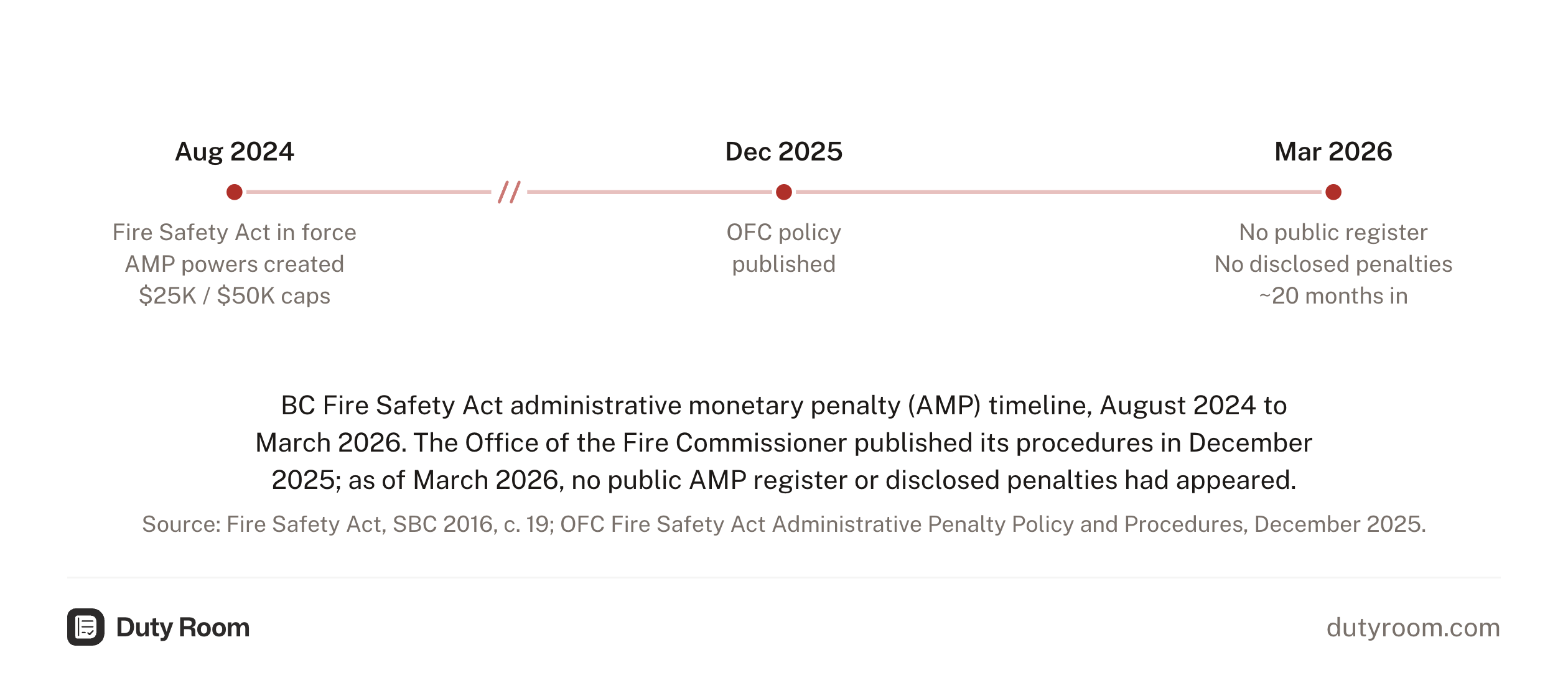
| Date | What changed |
|---|---|
| Aug 2024 | Fire Safety Act in force; AMP powers created ($25,000 individual / $50,000 corporate) |
| Dec 2025 | OFC publishes penalty policy and procedures |
| Sep 2026 | No public AMP register or record of a penalty issued found, two years in |
The regime has been in force since August 2024. As of September 2026, no AMP register has appeared in public sources. The OFC's Fire Safety Act reference page lists its December 2025 penalty procedures, an overview and a request form, but no register of penalties issued. The OFC's 2024 annual report doesn't publish enforcement metrics such as orders issued or penalties levied at the provincial level. Whether that means no AMPs have been issued or they simply haven't been disclosed isn't clear.
Why BC, and why now
The context matters for BC operators: the province has 32% more structural fires per capita than Ontario. In 2021, BC recorded 785 structural fires per million residents; Ontario recorded 594.1 Ontario's structural fire count dropped 45% between 2005 and 2021 (from 15,490 to 8,450). BC's rose 26% over the same period (from 3,124 to 3,928).
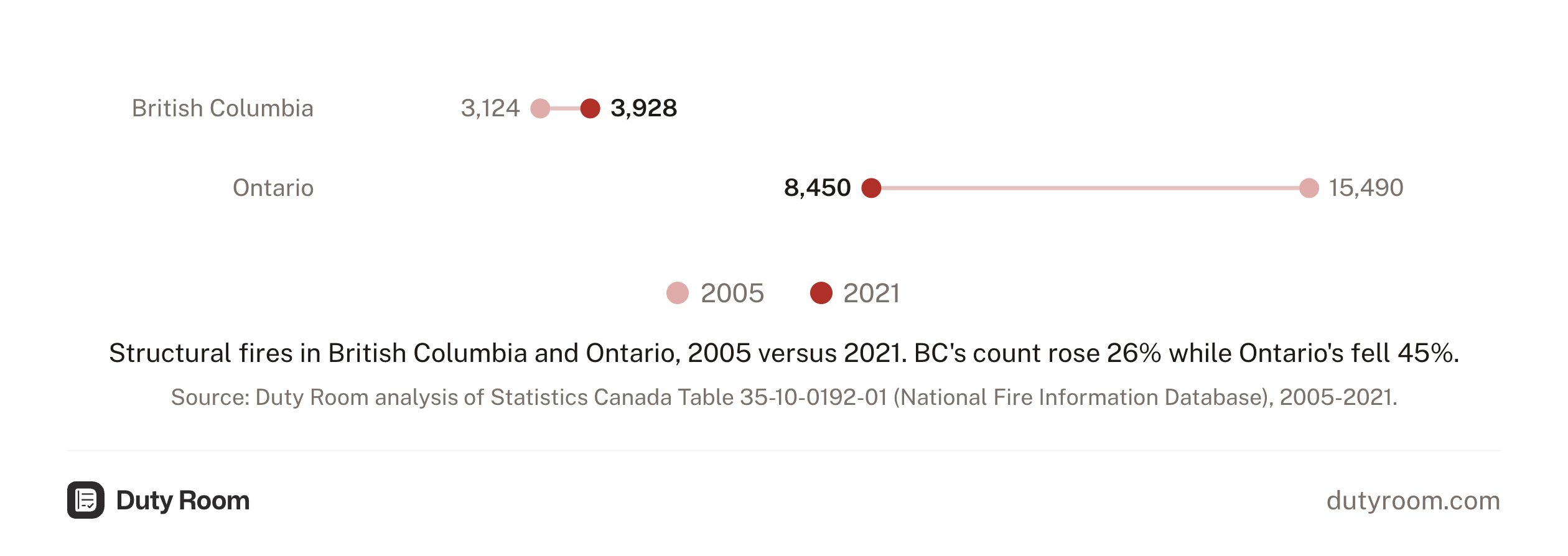
| Province | 2005 | 2021 |
|---|---|---|
| British Columbia | 3,124 | 3,928 |
| Ontario | 15,490 | 8,450 |
One likely explanation is enforcement intensity, and the new Fire Safety Act gives BC a tool to move in that direction.
The scale of the problem is real. In 2024, BC recorded 12,072 fires with total losses exceeding $663 million, and structure fires accounted for 4,063 of them. For residential structure fires, cooking equipment accounts for roughly 25% of ignition sources, and smokers' materials account for a similar share, both squarely within what a functioning fire safety plan addresses.
What fire inspectors actually write orders for
The penalty doesn't follow a fire. It follows non-compliance with an inspector's order or a failure to provide requested records. The first operators to receive an AMP probably won't be the ones who had a kitchen fire. They'll be the ones who got a routine inspection, received an order to fix something, and didn't move on it.
The things that trigger orders are ordinary: fire alarm test certificates not current, hood suppression systems with no maintenance record, exit routes partially blocked, a fire safety plan that doesn't match the current layout. None of these are expensive to fix. All of them are expensive to ignore under the new per-day penalty clock.
The fire safety plan question
Fire safety plans are consistently among the most out-of-date documents inspectors encounter. Evacuation routes that no longer match the floor layout, extinguisher service dates that have passed, and responsibility assignments naming former staff are all recurring findings.
Under the BC Fire Code, certain occupancies including assembly uses (restaurants and bars) are required to have a fire safety plan on site and kept current, available to the fire department on request. Hotels may have similar obligations as buildings required to have a fire alarm system. None of that is new. What's new is the consequence for having it out of date or missing entirely.
The fire plan sitting unreviewed in the back office and the expired extinguisher behind the bar were always violations. After an inspector writes an order to fix them, they become potential AMP violations carrying penalties of up to $50,000 for a corporation, with each day of continued non-compliance counted separately.
-
Duty Room analysis of Statistics Canada Table 35-10-0192-01 (National Fire Information Database), 2005-2021, using 2021 Census of Population denominators (BC 5,000,879; Ontario 14,223,942). Source data at statcan.gc.ca.
This briefing is based on sources available at publication and is for general information only. It doesn't constitute legal advice. For advice on your specific situation, consult a qualified professional.
Advice from your consultant, action from your sites.
BC corporations can face a $50,000 administrative penalty for each day specified fire-safety non-compliance continues. Keep your plan evidence current between visits.