A few big fires pull up the average
Florida Hospitality Fires: One Reported Every Ten Hours
From 2022 through 2024, Florida fire departments reported 2,718 fire incidents at the state's restaurants, bars, hotels, and motels to NFIRS.1 Spread across the three-year record, that's one reported fire every ten hours. Only 725, about one in four, have any direct property loss recorded. Among those, the typical loss was $5,000. A repair, not a ruin.
Those records contain $66.3M in reported direct property loss. The average among the 725 loss-positive records was $91,468, more than eighteen times the typical loss. Just 13 records with losses of at least $1 million account for 68.3% of the reported total.
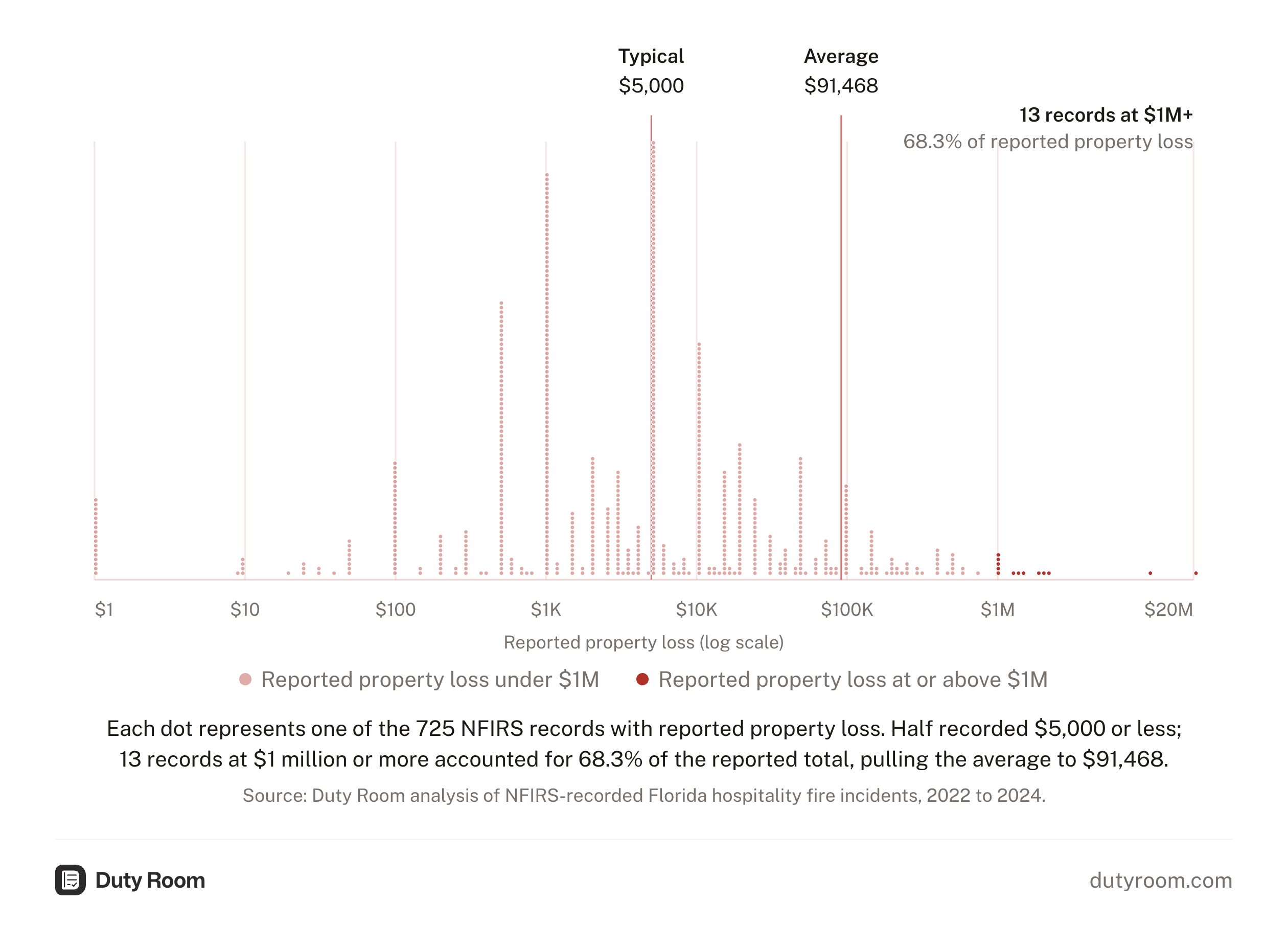
| Measure | Result |
|---|---|
| Typical loss (median) | $5,000 |
| Average loss (mean) | $91,468 |
| Losses of $1 million or more | 13 records (1.8%); 68.3% of reported property loss |
Restaurants and hotels have different fire risks
Restaurants make up six in ten of the NFIRS records and account for $56.8M of the $66.3M in reported direct property loss. That's 86 cents of every recorded dollar.
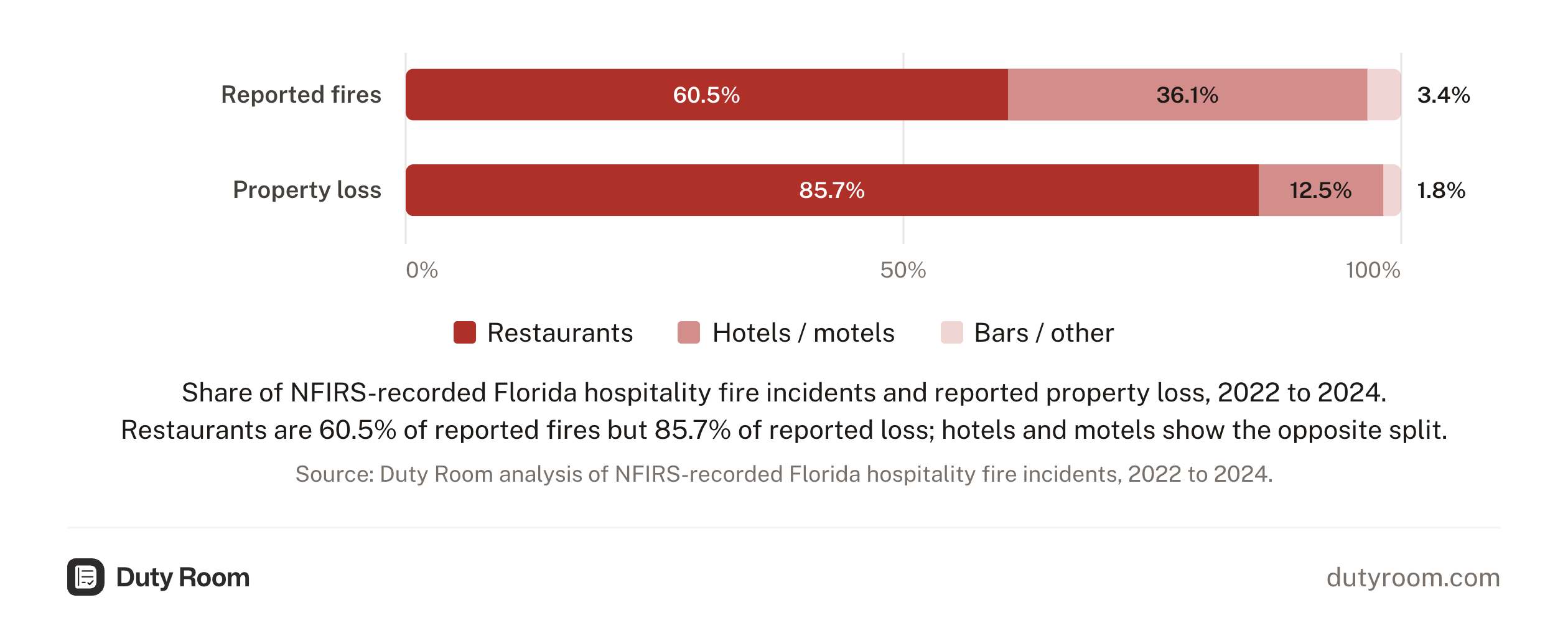
| Measure | Restaurants | Hotels / motels | Bars / other |
|---|---|---|---|
| Reported fires | 60.5% | 36.1% | 3.4% |
| Reported property loss | 85.7% | 12.5% | 1.8% |
Hotels and motels make up 36% of the reported incidents but 12.5% of the recorded property loss. Property loss is only one measure in a building full of sleeping guests. The Florida records contain two reported civilian deaths, too few to support a local pattern. National hotel data gives better guidance: nonconfined hotel fires most often start in bedrooms. Working alarms, sprinklers, and lit, unlocked exits buy people time.
The count is a floor, not a state total
NFIRS was voluntary, and USFA warns that its raw data isn't a census and shouldn't be used as Florida's official incident or loss total. The 2,718 records describe a reported floor. Reporting varied by department and year, so the rise from 839 to 920 to 959 records could reflect participation as much as fire incidence. The data can't separate the two.
Cooking dominates the national restaurant data
USFA's national restaurant data attributes 64% of restaurant building fires to cooking, and 68% stay confined to the object that caught first. The Florida extract doesn't carry complete enough cause data for a comparable state percentage, and public sources don't break grease out as its own share. Clean the hood and ducts on schedule either way, and keep the suppression system serviced before the line fires up.
The record trail runs through your vendors
After a fire, the questions are about the controls: when the hood was cleaned, whether the suppression system was serviced, where the latest alarm report is. The answers sit with vendors. Hood cleaners, suppression technicians, alarm companies, and sprinkler contractors all work on their own schedules, and at a multi-site business their reports land in different inboxes at different properties. When a fire marshal, insurance adjuster, or regional manager asks about one site, head office has to find them.
The Florida Fire Prevention Code, 8th Edition, and Chapter 69A of the state administrative code adopt national standards by reference. Local fire officials enforce them, and roughly 60 Florida jurisdictions have local amendments. The statewide baseline gives operators a short set of controls and records.
| Risk area | Florida-adopted control | Record to keep retrievable |
|---|---|---|
| Cooking and grease | Hood and duct cleaning at the NFPA 96 Table 11.4 frequency: monthly for solid-fuel cooking, quarterly for high-volume cooking, semi-annual for moderate-volume cooking, annual for low-volume cooking | Dated hood-cleaning certificates for each site |
| Kitchen suppression | Listed wet-chemical cooking suppression system inspected and serviced at least every six months under NFPA 96 and NFPA 17A | Suppression service tags and service reports |
| Equipment and electrical fire response | Class K extinguisher within 30 ft travel of cooking appliances that use combustible cooking media; monthly visual checks and annual professional service under NFPA 10 | Extinguisher tags and the monthly check log |
| Life safety and egress | Emergency lighting tested monthly for 30 seconds and annually for 90 minutes under NFPA 101; fire alarm inspection and testing on the NFPA 72 schedule | Emergency-lighting test log and alarm inspection reports |
| Sprinklers where present | Inspection, testing, and maintenance under NFPA 25 | NFPA 25 ITM reports, kept in the operator's own file |
Sprinkler reports are the awkward one. Under FAC 69A-46.041, the contractor must keep inspection reports for at least ten years and provide the owner with a copy. The statutory long-term file still sits with the sprinkler company. Keep your own copy where your team can find it.
In practice, one restaurant sends hood certificates to the GM, hotel alarm reports land in facilities, and sprinkler reports stay with the contractor. A bar may have current extinguisher tags but no monthly log. Pulling a single site's history together means searching email and calling vendors while the inspector waits.
Duty Room's Florida fire-safety area keeps these records by site and shows what's current. Your consultant and the fire marshal still decide whether the setup satisfies the code. When someone asks for the evidence, your team can open the file instead of calling the vendor.
Start with the restaurant kitchen set: hood-cleaning certificates, suppression service tags, extinguisher tags, and the monthly check log. Hotels add the life-safety set: alarm inspection reports, emergency-lighting tests, and sprinkler reports where a system exists. Keep them by site, and keep your own copies.
-
Duty Room analysis of the NFIRS Fire/HazMat Public Data Release, retrieved March 25, 2026, filtered to Florida, 2022-2024, Incident Types 100-199 and Property Use codes 161, 162, and 449. The extract contains 2,718 NFIRS-recorded fire incidents and $66.3M in reported direct property loss; these are reported records, not statewide totals. This product uses the Federal Emergency Management Agency's OpenFEMA API, but is not endorsed by FEMA. The Federal Government or FEMA cannot vouch for the data or analyses derived from these data after the data have been retrieved from the Agency's website(s).
This report is based on published enforcement data, sources available at publication, and original analysis. It is for general information only and doesn't constitute legal advice.
Advice from your consultant, action from your sites.
Keep Florida hood cleaning, suppression service, and alarm records current under the Fire Prevention Code and NFPA 96, ready between consultant visits.